
Aceto Balsamico Tradizionale di Reggio Emilia
Protected Italian vinegar made only from cooked grape must, fermented and aged in a battery of wooden barrels for at least 12 years: sweet, sharp and syrupy.
 FermenteaWhere food goes to change
Equipment · Barrels and casks
batteria · Balsamic vinegar barrel battery · Acetaia battery
A balsamic batteria is a graduated set of wooden casks for traditional vinegar in Modena and Reggio Emilia. Transfers, evaporation, seasonal conditions and wood contact make the battery work as one system.
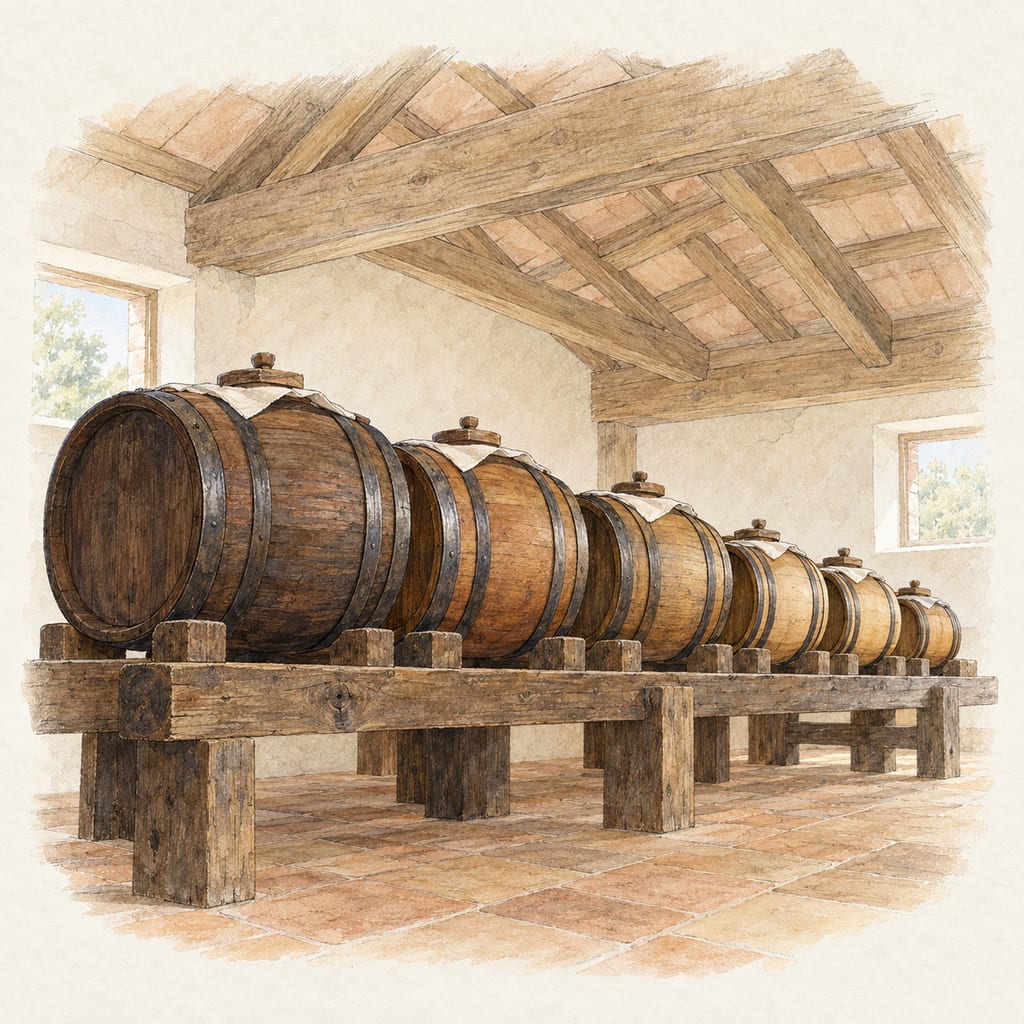
A batteria is an arranged series of wooden casks, graduated from larger to smaller. In the traditional balsamic-vinegar systems of Modena and Reggio Emilia, the casks are commonly of different woods as well as different sizes. The Modena product specification describes a series of numbered and marked vessels; the Reggio Emilia specification likewise describes successive transfers into casks of varying sizes and woods. The arrangement is not a standard kit: local examples differ in scale and composition.
The name matters because a battery is a working set. Its identity lies in the relationship among the casks and the movement of vinegar through them, rather than in any single barrel. The term should not be applied indiscriminately to all balsamic vinegar. Traditional balsamic vinegar is made from cooked grape must and aged in a series of casks; Modena balsamic vinegar with the PGI designation follows a distinct, faster production specification.
The casks hold a succession of ages of cooked grape must as it ferments, acetifies and matures. Each year, producers draw a portion from the smallest cask for bottling and replenish it from the next larger cask; the larger vessels are then replenished in turn, with younger material entering at the large end. The proportions and exact handling belong to the producer. The sequence continually blends material of different ages without making the smallest cask an isolated, self-contained process.
The casks are kept in an acetaia, a vinegar loft or production room. The Modena specification calls for suitable ventilation and exposure to natural temperature variation. Seasonal warming and cooling, partial transfers and evaporation shape the long maturation; the cask walls also bring the must into contact with wood. In a battery with several wood types, that contact varies across the sequence. Acetaia Malpighi identifies chestnut, cherry, juniper, mulberry, oak and acacia in its account of traditional Modena barrels and describes distinctive contributions from particular woods. These are producer descriptions of their practice, not a universal ranking or a fixed recipe for every battery.
A roof space is part of the familiar setting because the process uses natural seasonal variation rather than a constant, mechanically controlled room. The municipal acetaia in Modena occupies the loft of the Palazzo Comunale. Its three batteries include two sets of six small casks and one of ten; separate larger mother casks supply them. This is a documented public example, not a required number or configuration for private batteries.
The Modena designation is geographically restricted to its province. Reggio Emilia has its own protected traditional vinegar and production specification. Both traditions use graduated wood-cask systems, but their names, legal specifications and local practices should remain distinct. A battery image or description cannot identify a protected product by itself.
Traditional barrels are coopered objects that can be numbered and marked for their place in a battery. The wood selection may include several locally used species; the documented Modena specification does not make every cask the same size or wood. At Acetaia Malpighi, chestnut, cherry, juniper, mulberry, oak and acacia are listed, with the producer describing differences in tannin, aroma, durability and moisture resistance. Such details help explain why wood is treated as part of maturation, while avoiding the claim that a particular sequence is universal.
No general capacity, diameter, height, cask count or transfer volume is established for a batteria in the sources used here. The six- and ten-cask groups at Modena's municipal acetaia are one specific example. The producer's account of its own collection likewise describes its practice, not a minimum equipment specification. A reader assembling or identifying a battery therefore needs information about the particular acetaia rather than an invented standard size.
Batterie belong to the preparation and long maturation of traditional balsamic vinegar. The required work is a series of measured transfers and replenishments, carried out in the setting described by the product specification. The public Modena acetaia also keeps larger mother casks apart from its smaller batteries, showing that supply vessels and the graduated aging sequence can be distinct parts of one cellar arrangement.
The sources consulted do not set a general cleaning schedule, repair method, replacement interval or universal barrel capacity. Those decisions depend on the individual cask and its producer. The equipment should be understood as a maintained system used for a specific protected product, not as proof that an arbitrary wooden barrel or any bottle labelled balsamic follows the same method.
The battery is part of the traditional balsamic-vinegar system associated with Modena and Reggio Emilia. The exact date when this arrangement first appeared is not established here. The Modena municipal acetaia, created in 2003 in the Palazzo Comunale loft, documents contemporary use of several named batteries; the Reggio Emilia specification describes the current regulated method.
A single cask is not the graduated battery described for traditional balsamic vinegar; the sequence of casks and transfers is part of the method.
Source →The battery is specific to the traditional cooked-must method and should not be treated as a description of every product sold as balsamic vinegar.
Source →The Modena designation and municipal acetaia document this method in the province; the row does not claim the battery originated in one locality.
The Reggio Emilia specification documents a similar graduated-cask method for its distinct protected product; the row does not assert the Modena and Reggio specifications are identical.
Protected Italian vinegar made only from cooked grape must, fermented and aged in a battery of wooden barrels for at least 12 years: sweet, sharp and syrupy.
A vacuum tumbler is a powered rotating drum that massages meat under reduced pressure, distributing marinade or brine before later processing.
No community contributions have been published for this entry yet.
Sign in to contribute. Published comments and photos are free to read.
Consorzio Tutela Aceto Balsamico Tradizionale di Modena D.O.P.Method · Equipment · Geography
The Product SpecificationsThe traditional Modena method uses a series of numbered and marked vessels of different sizes and woods.
Production rooms require ventilation and exposure to natural temperature variations.
The protected method and production area are distinct from other balsamic vinegar products.
Cited in: A set of casks, not one special barrel; How the battery works; Attic setting and regional examples; Materials, scale and what is not standardized; Use and care
Consorzio Tutela Aceto Balsamico Tradizionale di Modena D.O.P.Identity · Method · Limits
Balsamic vinegar FAQsTraditional Modena balsamic vinegar is made only from cooked grape must and matured in a series of barrels of different woods.
The Modena DOP is distinct from Modena PGI.
Cited in: A set of casks, not one special barrel; Use and care
VisitModena, Official Modena Tourist Information SiteGeography · Equipment · Use
Acetaia comunale di ModenaThe municipal acetaia is in the town-hall loft and has two six-cask batteries, one ten-cask battery, and separate larger mother casks.
The municipal acetaia opened in 2003 and documents contemporary use.
Cited in: Attic setting and regional examples; Materials, scale and what is not standardized; Use and care
Acetaia MalpighiMaterials · Equipment
The barrelsTraditional Modena DOP batteries use casks in descending size and different woods.
The producer lists chestnut, cherry, juniper, mulberry, oak and acacia and describes their wood properties.
Cited in: How the battery works; Materials, scale and what is not standardized
Consorzio Tutela Aceto Balsamico Tradizionale di Reggio EmiliaMethod · Geography
Disciplinare di produzione: Aceto Balsamico Tradizionale di Reggio Emilia DOPReggio Emilia DOP rules specify a series of transfers into casks of different sizes and types of wood.
The acetaia environment must provide ventilation and natural temperature variation.
The designation's protected production area is the Province of Reggio Emilia.
Cited in: A set of casks, not one special barrel; How the battery works; Attic setting and regional examples