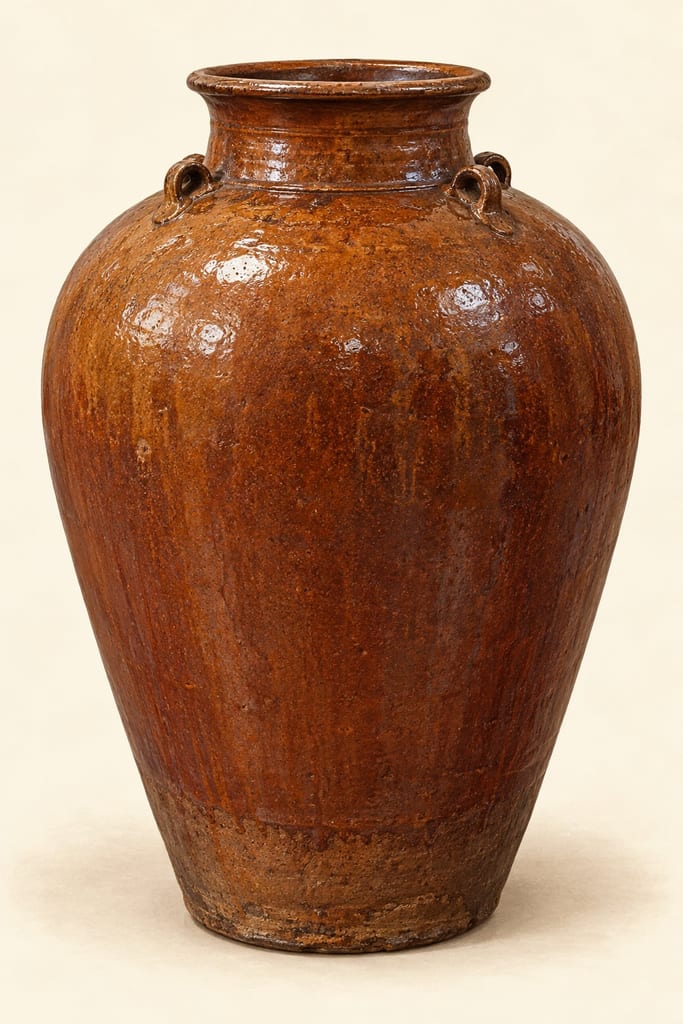
Tajau and tuak jar
A large glazed stoneware jar used in documented Sarawak contexts for storage and fermenting tuak, while also serving as a valued Iban heirloom.
 FermenteaWhere food goes to change
Equipment · Bamboo, leaf and wraps
A bamboo internode can serve as the cooking vessel itself: its natural node closes one end while the open end holds food, often with a leaf lining or plug. Regional preparations differ in filling, fire arrangement and handling.
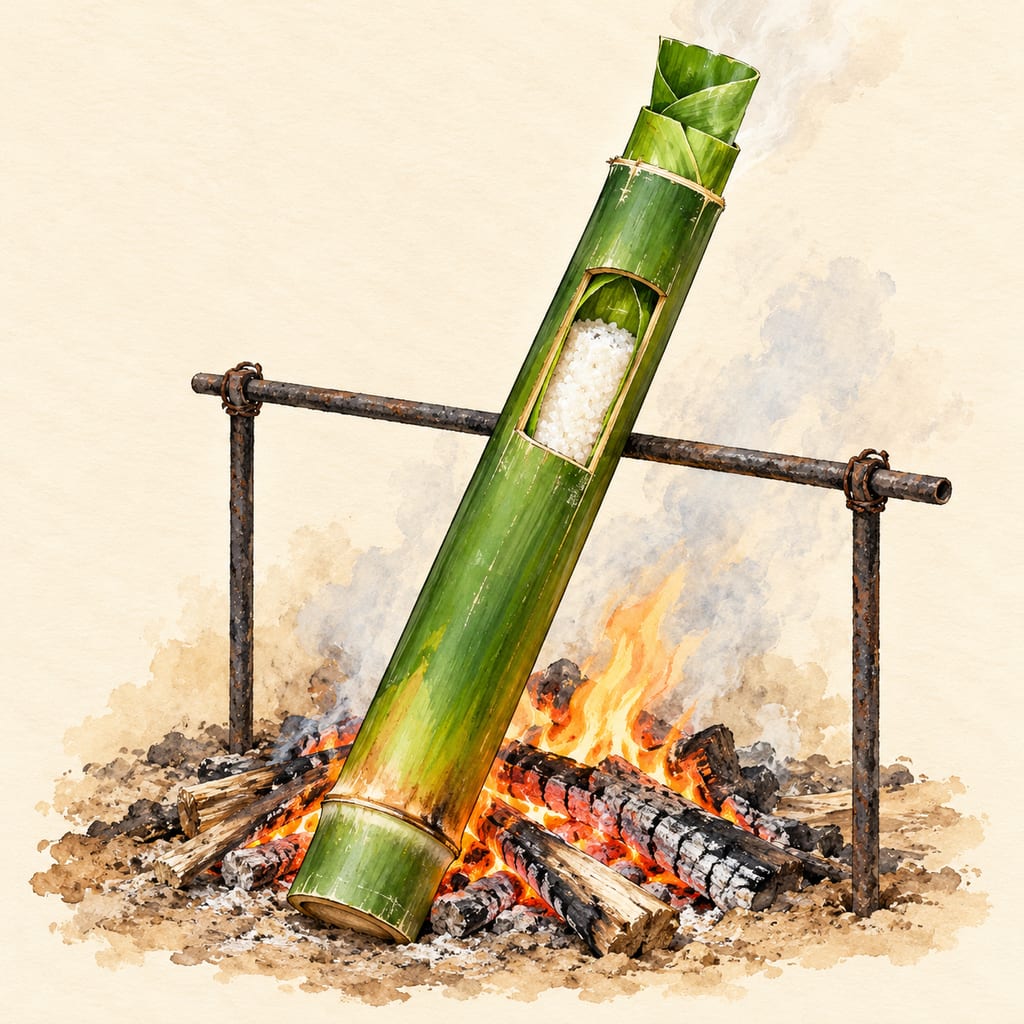
A bamboo cooking tube is a selected internode used directly as a food container over heat. The natural node closes one end; the other is filled and may be lined, covered with a leaf, or stopped with other plant material according to the dish. This makes the tube both vessel and portion. It is not one standardized utensil: wall thickness, length, filling and closure are chosen within local preparations.
In Malaysian lemang, glutinous rice, coconut milk and salt are packed inside banana-leaf-lined bamboo and cooked beside a fire. The heritage material describes thin-walled bamboo and a natural closed end, while leaving the mouth open enough for steam to escape. The leaf lining reduces sticking and is part of this form; it should not be assumed in every bamboo-cooked dish.
Bamboo tubes appear in several distinct Southeast Asian preparations. Thailand’s tourism directory records khao lam at Ban Tha Sila in Surin, combining sticky rice with local ingredients such as sugar and coconut. A Northern Thai account cleans and dries the cylinders, leaves space at the top, adds a plant-material stopper and turns the tubes over a charcoal stove. It recommends particular bamboo with a thin inner membrane; those details belong to that recipe rather than to every tube.
In Sarawak, the Iban preparation manok pansuh cooks chicken with aromatics and a little water inside bamboo, with tepus shoots and cassava leaves at the opening in the cultural-mapping recipe. In Toraja, a local account describes pa‘piong with banana-stem pith, coconut, chicken and seasonings. These are distinct culinary practices, not interchangeable fillings for a universal bamboo recipe.
Cơm lam in northwest Vietnam is reported among Thái communities and neighboring groups. Fresh young bamboo holds the soaked glutinous rice; banana leaf is wrapped at the opening, and the tube cooks over a controlled flame. The rice’s two-hour soak is one reported step, not a complete standardized formula or a measured endpoint.
Cambodian kralan shows another variation. Makers fill bamboo with sticky rice, coconut milk, beans, sugar and salt, stop the opening with plant material and roast the tubes. In the reported two-stage method, they shave the exterior thinner after the first roast and return it to the fire. The vessel is therefore worked during cooking, not simply discarded after a single undifferentiated firing.
The cited accounts support selecting bamboo for the named preparation rather than substituting a generic cylinder. Lemang’s thin-walled tube is lined with banana leaf; the Thai khao lam account specifies bamboo with a thin inner membrane; the Vietnam report names fresh young bamboo. The shape is an internode with a closed node at one end and an accessible mouth. Dimensions and capacity vary, and these records do not supply a common specification.
Cooking times and closures also belong to individual methods. One Bernama report gives a five-to-six-hour lemang routine for a practitioner’s batch, while Northern Thai khao lam is reported on a charcoal stove and turned for even cooking. The Malaysian heritage account says the open end must allow steam to escape. Do not tightly pressure-seal an improvised tube. The sources do not establish a universal reuse, storage or cleaning schedule.
Published heritage, tourism, cultural-mapping and practitioner accounts document different bamboo-tube preparations. They establish regional use but do not date the invention of the vessel or a single origin.
Lemang is documented as a Malay preparation using leaf-lined bamboo; this country-level association is not an origin claim for bamboo cooking generally.
Thailand's tourism directory records khao lam cooked in bamboo at this locality.
JKKN records manok pansuh within Iban food culture in Sarawak; it does not represent every bamboo-tube practice.
A local Toraja preparation using bamboo is reported from Desa Lea, Makale.
Vietnam News Agency documents cơm lam among Thái communities and neighboring groups in the region.
A firsthand report records makers preparing kralan in bamboo; this does not claim a single national formula.
A large glazed stoneware jar used in documented Sarawak contexts for storage and fermenting tuak, while also serving as a valued Iban heirloom.
No community contributions have been published for this entry yet.
Sign in to contribute. Published comments and photos are free to read.
Malaysia Department of National HeritageEquipment · Regional use · Method
Malay traditional food preservation volumeLemang uses glutinous rice, coconut milk and salt in banana-leaf-lined bamboo cooked beside a fire.
The heritage material describes suitable thin-walled bamboo and an open end that permits steam to escape.
Cited in: A plant segment becomes the vessel; Choosing and handling a documented form
BernamaPractitioner account · Method
Lemang practitioner reportA practitioner report describes turning the bamboo tube during cooking and gives a 5–6-hour routine for the reported batch, not a universal cooking time.
Cited in: A plant segment becomes the vessel; Choosing and handling a documented form
Thailand Tourism DirectoryRegional use · Method
Ban Tha Sila khao lamThe directory documents khao lam cooking in bamboo at Ban Tha Sila, Surin.
It associates the local preparation with sticky rice, sugar, coconut and bamboo without establishing a standardized formula or earliest date.
Cited in: Different foods, different tube practices
Northern Thai Information Center, Chiang Mai University LibraryEquipment · Method · Care
Khao LamThe preparation cleans and dries the bamboo cylinders, leaves headspace, closes the top with plant materials, roasts the tubes and turns them evenly.
It notes that only certain bamboo kinds with a thin inner membrane are suitable; this method is specific to the recorded Northern Thai recipe.
Cited in: Different foods, different tube practices; Choosing and handling a documented form
Malaysia Department of Culture and Arts (JKKN)Regional use · Method
Manok pansuhA recipe attributed to Iban cultural specialist Dr Noria Anak Tugang includes chicken, aromatics, tepus shoots and cassava leaves cooked in bamboo with a little water.
The bamboo exterior faces the fire while the contents cook in their juices.
Cited in: Different foods, different tube practices
KompasRegional use · Practitioner account
Banana stems become a Toraja dishA firsthand report describes Toraja pa‘piong with banana-stem pith, grated coconut, chicken and seasonings cooked in bamboo.
Other versions use different meats or greens; the report is local practitioner evidence.
Cited in: Different foods, different tube practices
Vietnam News Agency / VietnamPlusRegional use · Method
Unique rice in bamboo tube in Vietnam’s northwest regionThe report documents Thái communities and neighboring groups cooking glutinous rice in fresh young bamboo; its inner membrane holds and scents the rice.
The reported process soaks rice for two hours, fills the tube, adds banana leaf wrapping and cooks over a controlled flame.
Cited in: The tube changes with the method
The Phnom Penh PostRegional use · Practitioner account · Method
Hard work put into roadside snack favourite kralanA report interviews Cambodian kralan makers who roast sticky rice, coconut milk, beans, sugar and salt in bamboo.
The makers shave the outside thinner after an initial roast, then fire the tubes again; the article does not establish a preservation schedule.
Cited in: The tube changes with the method