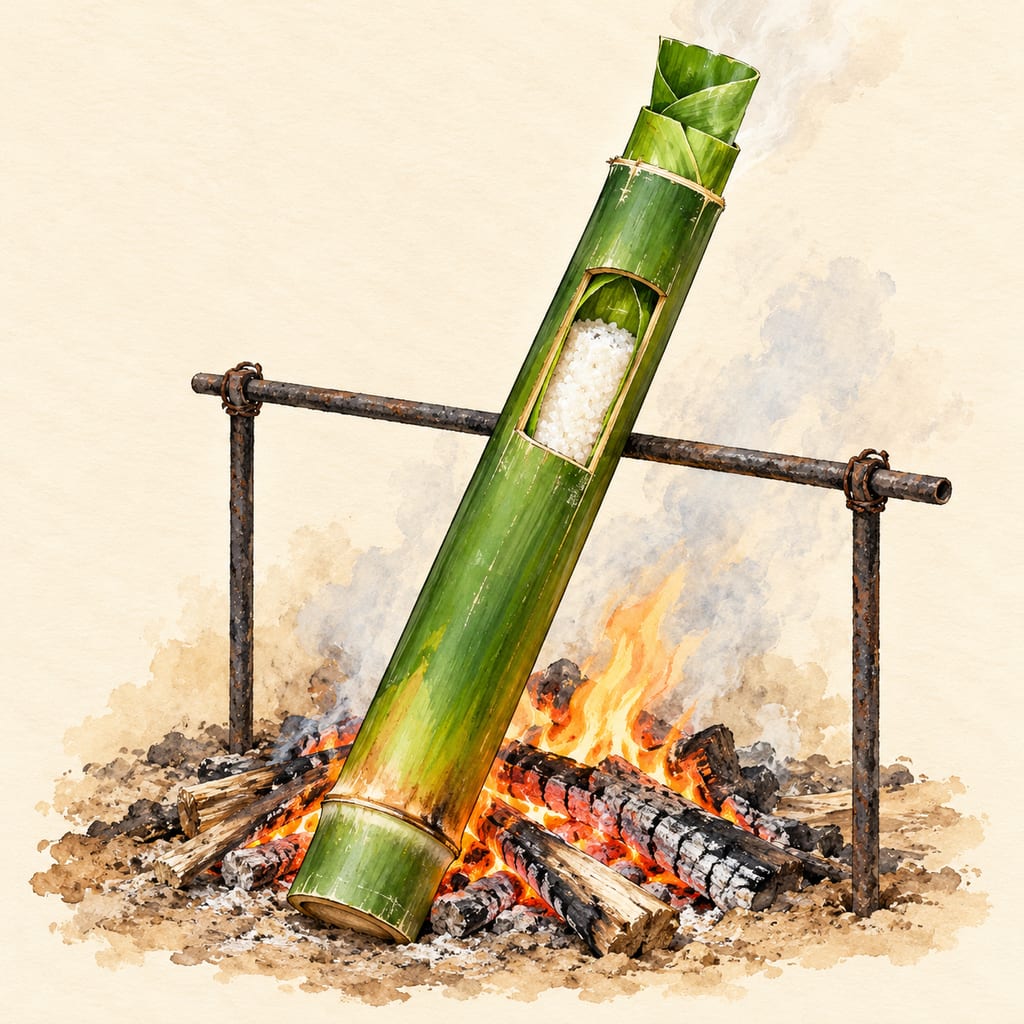
Bamboo cooking tube
A bamboo internode can serve as the cooking vessel itself: its natural node closes one end while the open end holds food, often with a leaf lining or plug. Regional preparations differ in filling, fire arrangement and handling.
 FermenteaWhere food goes to change
Equipment · Jars, pots and crocks
tajau · tuak jar
A large glazed stoneware jar used in documented Sarawak contexts for storage and fermenting tuak, while also serving as a valued Iban heirloom.
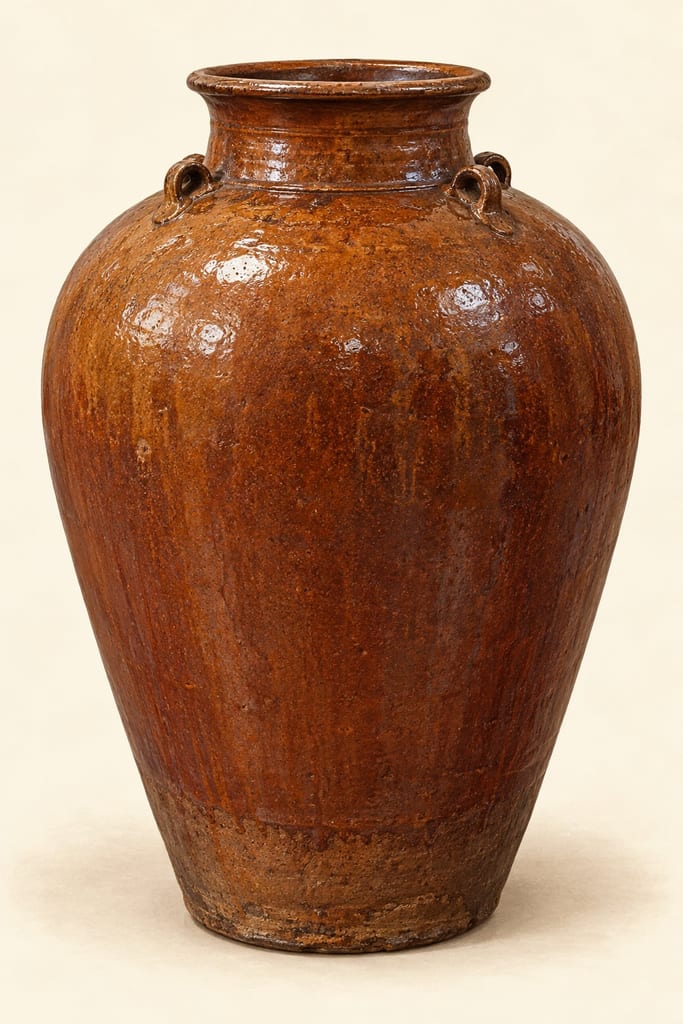
The tajau described in Sarawak sources is a large ceramic storage jar with overlapping practical, social and ceremonial roles. Lucas Chin's Penn Museum account records imported jars in Sarawak and describes an example collected there in 1897. The same account says large jars were displayed in longhouse family rooms as valued possessions, but also used for water and food storage; it specifically records rice wine, tuak, being fermented in them.
The jar’s place in the household was not reducible to brewing. The Penn account describes Iban classifications with distinct names and relative values, and notes that jars could be inherited, displayed, used in exchanges and reserved for funerary purposes. It even records an upside-down jar kept from wine-making for its owner’s funeral. Such examples warn against reading every heirloom vessel as a working fermenter.
In a 2026 report, Iban informants described tajau as continuing to mark kinship and customary life. A longhouse chief in Katibas said his community still ferments tuak in tajau, while acknowledging that lighter plastic containers are increasingly convenient. These accounts describe particular households and practices, not a single rule for all Iban communities.
Museum records and photographs show substantial jars with a broad rounded body, narrowing neck, and small shoulder handles or lugs. Some are brown-glazed and carry relief decoration. The University of Malaya Museum of Asian Art describes one Sarawak tajau as a stoneware jar with a running brown glaze and applied dragons and clouds; its record says potters from Guangdong who settled in Borneo copied this kind of jar in the early twentieth century. That is one documented example, not a pattern to expect on every vessel.
A photograph of Marcathy Gindau’s collection in Bawang Assan shows several inherited jars together, with varying necks, shoulders, glazes and decoration. The variety matters: tajau is not a single standardized model, and individual jars may have different social identities and uses. The sources give no shared capacity or standard dimensions for the class.
Available accounts give no comparative temperature measurements or establish one universal fermentation closure. A specific jar’s glaze condition and food-contact suitability cannot be inferred from age, appearance or cultural importance.
Chin’s account explicitly names tuak as a rice wine fermented in large jars. Contemporary reporting also shows how practice differs by maker: in 2025, a Bidayuh brewer from Bau said her sugarcane tuak fermented in a tajau or a glass bottle. That report concerns her sugarcane preparation and does not make it interchangeable with Iban rice tuak.
The jar’s size, ceramic body and ability to be moved make it different from a fermentation pit or room built in place. Yet this equipment page cannot supply a universal brewing method: the accounts do not establish one recipe, capacity, closure or cleaning routine for all tajau. The practical lesson is to treat a named jar as a particular vessel within a local practice, rather than assume every large decorated jar was used for food.
Penn Museum's 1988 account captions a large jar collected in Sarawak in 1897 and describes large jars used for water, food and rice wine. Later sources document Iban heirlooms and continuing tuak fermentation, while distinguishing individual jars and uses.
The evidence supports collection and use in Sarawak, not an origin claim.
A bamboo internode can serve as the cooking vessel itself: its natural node closes one end while the open end holds food, often with a leaf lining or plug. Regional preparations differ in filling, fire arrangement and handling.

A Cap-Pelé boucanière is an Acadian herring-smoking building. The documented Willie Niles example is a one-storey wood-frame structure with a ridge smoke vent and interior bays for hanging fish-bearing cannes.

Achcharu is a family of Sri Lankan vinegar pickles made with mixed vegetables or seasonal fruit and a piquant spice dressing. This version is a quick, refrigerated, non-fermented mixed-vegetable pickle.

The acocote is a long, hollowed and dried gourd used to draw aguamiel from a mature maguey. It is a harvesting tool: the sap is transferred to a separate vessel before it ferments into pulque.

Adrak murabba preserves young ginger in sugar syrup, a sweet South Asian preparation recorded in Indian cookery and food-processing sources.

Parkia biglobosa seeds are fermented into regional West African seasonings, including nététou, iru, dawadawa and soumbala. The yellow fruit pulp is a separate food, and names and methods vary by place.

Japanese reddish-brown vinegar from sake lees matured about three years, turned to vinegar by acetic bacteria; the vinegar of Handa and Edomae sushi rice.

A refined common-wheat flour blended for a broad range of baking; its protein and behavior vary with wheat, milling and market.

The almond mushroom, Agaricus subrufescens, was cultivated in eastern North America in the 1800s, lost its market, and returned as a cultivated mushroom from Brazil, where it is grown under several names.
No community contributions have been published for this entry yet.
Sign in to contribute. Published comments and photos are free to read.
Penn Museum, Expedition MagazineHistory · Materials · Morphology · Use · Geography
Trade Objects: Their Impact on the Cultures of the Indigenous Peoples of Sarawak, BorneoThe 1988 article describes traded ceramic jars in Sarawak, a large Chinese storage jar collected there in 1897, longhouse display, water and food storage, and rice wine tuak fermented in large jars.
The article describes overlapping heirloom, economic, ritual and practical roles and notes that not every jar was used for wine.
Cited in: A traded jar made part of longhouse life; Glazed stoneware, with forms that vary; Fermentation is one use among several
Museum of Asian Art, University of MalayaMaterials · Morphology · Manufacture
Vase, Jar & MartabanThe collection record identifies a Sarawak tajau example with brown running glaze and applied dragons/clouds; it describes Guangdong potters settling in Borneo in the early twentieth century and copying jars to replace broken examples.
Museum entries identify other named and regional variants, confirming that decoration and form vary.
Cited in: Glazed stoneware, with forms that vary
DayakDailyContemporary use · Cultural context · Morphology · Geography
Tajau: Heirloom jars that made its homeInformants describe heirloom jars and continuing customary roles; a Katibas longhouse chief reports still using tajau to ferment tuak and contrasts it with lighter plastic containers.
The article captions Marcathy Gindau’s tajau collection in Bawang Assan; it discusses differences in jar form and rank.
Cited in: A traded jar made part of longhouse life; Glazed stoneware, with forms that vary
The Borneo PostContemporary use · Geography
Coffee-infused and sugarcane tuak draw crowds at Bazaar Gawai Dayak 2025A Bidayuh brewer in Bau said her sugarcane tuak fermented in a tajau or glass bottle; the source distinguishes this maker’s sugarcane preparation from rice tuak.
Cited in: Fermentation is one use among several