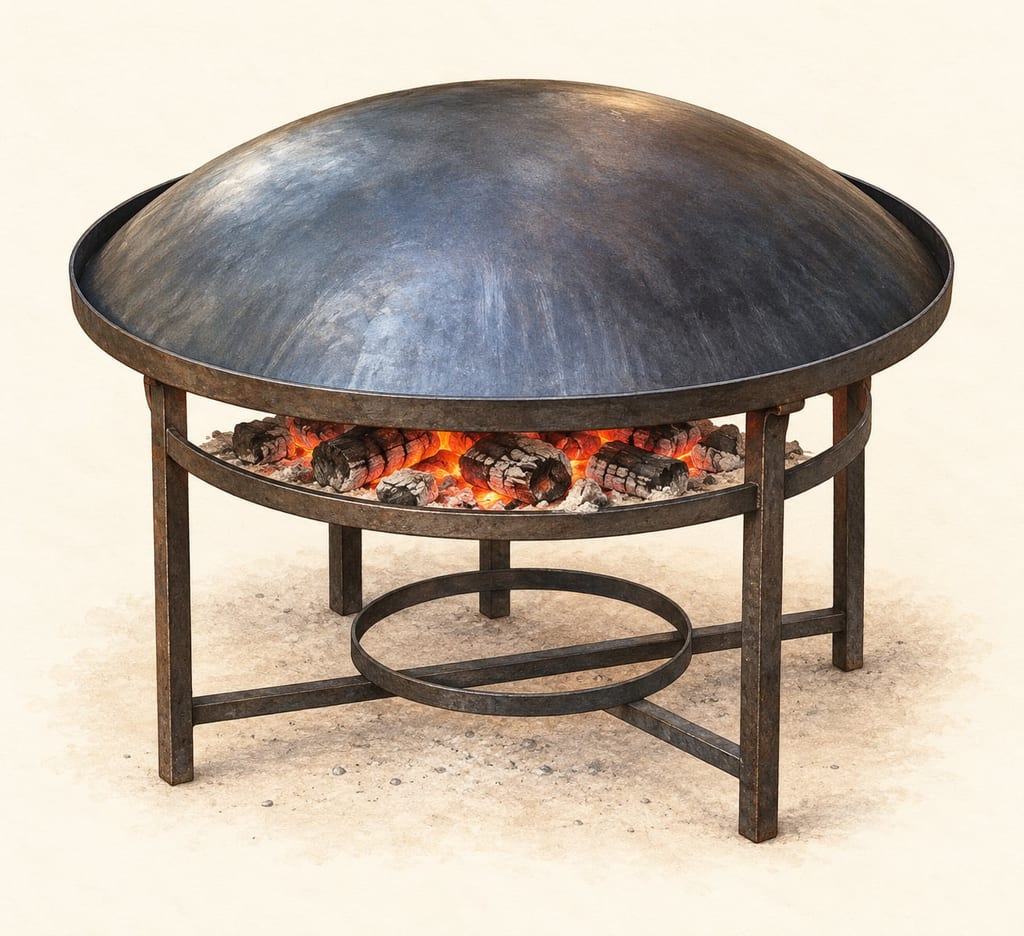
Saj
A portable convex metal griddle used for thin flatbreads. Surveyed forms are about 50 cm across and set over embers; regional names and modern heat sources vary.
 FermenteaWhere food goes to change
Equipment · Jars, pots and crocks
clay amphora · clay arak jar
Clay amphorae mature some Levantine arak. Muaddi in Palestine documents 12 months in clay; Château Ksara specifies two years for Ksarak in clay jars. Both are producer-specific storage practices.
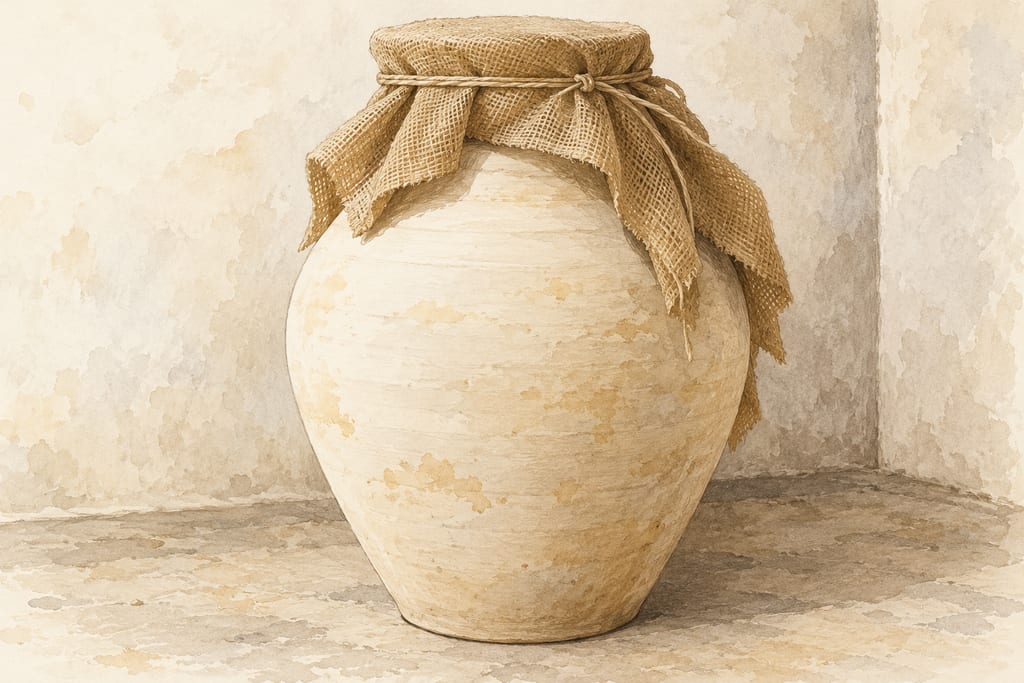
Clay amphorae remain part of some contemporary arak production in the Levant. Muaddi Craft Distillery, based in Palestine, describes maturing its arak in clay amphorae for 12 months. The company's public materials identify its handmade vessels as sourced from Hebron; a 2021 profile also names Jerusalem. These details concern one producer's supply and process, rather than a single design used by every distillery.
A separate Lebanese example appears in Château Ksara's Ksarak technical sheet: that product is aged for two years in clay jars. The varied names—amphorae and jars—point to a family of ceramic storage vessels, not proof of identical shape, capacity, or craft practice across Palestine and Lebanon.
In the documented examples, the clay vessel holds distilled, anise-flavoured spirit during maturation. Muaddi's stated sequence begins with Dabouki grape wine, followed by distillation and anise infusion; the amphora comes afterward. Ksarak's sheet likewise describes grape alcohol, anise, distillation and then clay-jar aging. The amphora is therefore not the fermentation vessel in these accounts.
The name arak covers products and practices that vary. The entry follows only the clay maturation vessel; it does not prescribe a recipe, distillation technique, or finishing period. In particular, Muaddi's 12 months and Ksarak's two years belong to separate producer examples and should not be merged into a generic timetable.
A photograph by Gabriel Helou, captioned by Wine Enthusiast as Muaddi's arak aging in clay amphorae, shows large pale vessels partly wrapped in burlap during sampling. The image makes the clay storage role tangible, but the wrapping conceals much of each vessel's outline. It does not establish a standard neck, handle arrangement, interior coating, volume, or wall thickness.
The sources identify handmade clay amphorae and clay jars, but do not provide a maker's technical drawing or a measured specification. For that reason, this record does not infer that the modern vessels share one ancient amphora silhouette or that all are made with the same clay, firing, finish or closure.
Muaddi's FAQ describes its 12-month period as a time for the distilled anise and spirit to settle together, while the Ksarak product sheet gives a two-year clay-storage period. Those descriptions establish how the named products are handled; they do not compare clay with other materials under controlled conditions or define the effect of a particular jar.
Clay can be discussed as a material, but these references do not report porosity measurements, evaporation rates, or sensory trials. The page therefore records the producer's material choice without claiming that every clay vessel creates the same change in arak.
No source consulted here supplies a standard capacity, dimensions, cleaning method, inspection schedule, glaze or lining specification for the vessels. The linked photograph and producer accounts identify clay use; they are not a food-contact test or a certification for any individual amphora. A current public list of potters or replacement suppliers is also not established.
The available record documents modern producer examples but does not date the first use of clay amphorae for arak or prove an unbroken line from ancient transport vessels. The item is linked to the arak recipe it serves, while the related regional article provides the wider source context.
Producer material documents modern maturation of arak in clay vessels in Palestine and Lebanon. The available evidence does not date the first such use or demonstrate an uninterrupted line from ancient transport amphorae to the photographed modern vessels.
The documented maturation periods differ by producer: Muaddi specifies 12 months in clay amphorae, while Château Ksara's Ksarak sheet specifies two years in clay jars. Neither is a universal schedule for arak or a specification for every clay amphora.
Source →The sources do not establish capacity, a standard morphology, glaze or liner, or food-contact testing for any particular vessel. The photograph documents use and appearance, not a manufacturing or compliance specification.
Source →Muaddi's producer site identifies handmade Hebron clay amphorae; a 2021 profile names Hebron and Jerusalem as sourcing locations. This does not establish that every arak amphora is made there.
Muaddi documents 12-month clay-amphora maturation; the Wine Enthusiast image caption identifies the pictured amphorae at Muaddi Craft Distillery.
Château Ksara's Ksarak technical sheet specifies two years in clay jars for that product, not a universal Lebanese duration.
A portable convex metal griddle used for thin flatbreads. Surveyed forms are about 50 cm across and set over embers; regional names and modern heat sources vary.
No community contributions have been published for this entry yet.
Sign in to contribute. Published comments and photos are free to read.
Muaddi Craft DistilleryEquipment · Method · History
Arak Muaddi | The Spirit of Palestine – FAQsMuaddi's FAQ describes its wine-and-anise arak process and says the resulting spirit is matured for 12 months in clay amphorae.
The producer distinguishes this resting/maturation period from wood aging and describes its own practice; the page does not provide a general vessel design, capacity, interior coating or care procedure.
Cited in: Clay amphorae for arak maturation; A storage vessel, not the fermenter; Maturation times and material claims; What is not specified
Muaddi Craft DistilleryEquipment · Geography
Arak Muaddi | The Spirit of PalestineThe producer identifies its clay amphorae as handmade in Hebron.
Cited in: Clay amphorae for arak maturation
Heinrich-Böll-Stiftung Palestine and JordanEquipment · Geography · History
Muaddi Craft DistilleryThe 2021 profile identifies clay amphorae for maturation as sourced from Hebron and Jerusalem, and describes Muaddi's 12-month aging period.
The page is licensed CC BY-SA 4.0; its photo credit is Muaddi Craft Distillery.
Cited in: Clay amphorae for arak maturation; The visible form and its limits
Wine EnthusiastEquipment · Geography · Method
Understanding Arak, an Ancient Spirit with Modern AppealThe caption identifies a photograph of Muaddi's arak aging in clay amphorae and credits photographer Gabriel Helou; the photo visibly shows large pale clay vessels partly wrapped in burlap.
The article describes Muaddi's Palestinian production and reports Lebanese arak rules and clay maturation practices; these are not used here as a substitute for an official legal text.
Cited in: The visible form and its limits; What is not specified
Château Ksara (technical sheet hosted by LAC Products)Equipment · Method · Geography
Arak KsarakThe Ksarak product sheet states that its grape spirit is combined with anise, distilled and aged for two years in clay jars.
This is a product specification, not a universal arak maturation duration or a full vessel specification.
Cited in: Clay amphorae for arak maturation; A storage vessel, not the fermenter; Maturation times and material claims; What is not specified