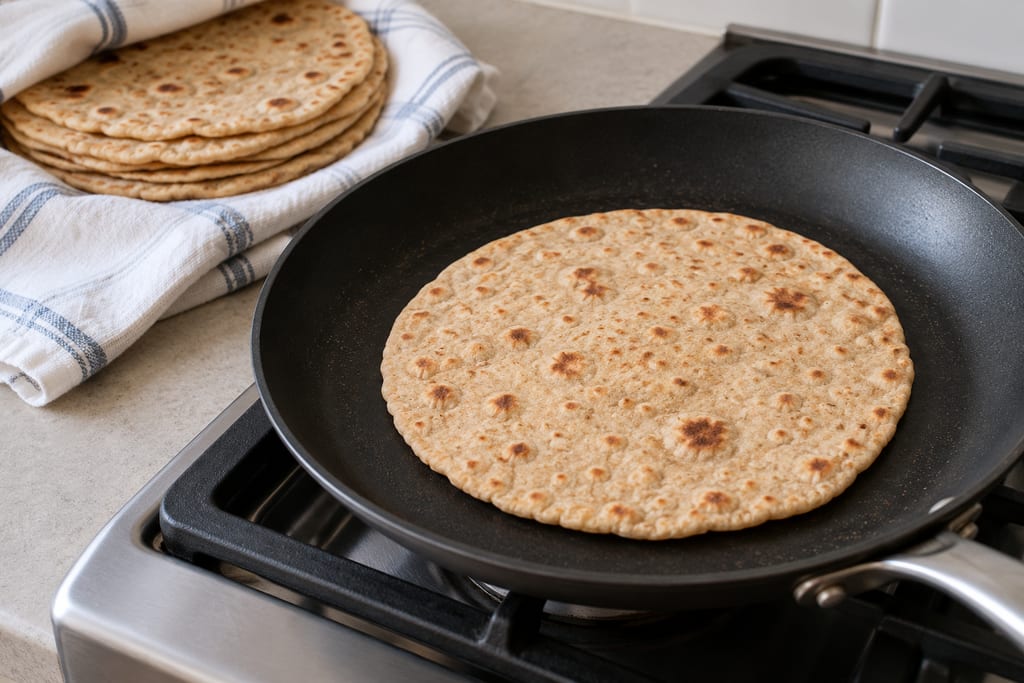
Markouk (small-pan home version)
A small home-pan adaptation of Levantine markouk: rested wheat dough rolled into small rounds and cooked quickly on a hot flat pan. It is thicker and smaller than the hand-stretched sheets made on a saj.
 FermenteaWhere food goes to change
Equipment · Baking surfaces and griddles
ṣāj · ṣāj · saaj · saj griddle
A portable convex metal griddle used for thin flatbreads. Surveyed forms are about 50 cm across and set over embers; regional names and modern heat sources vary.
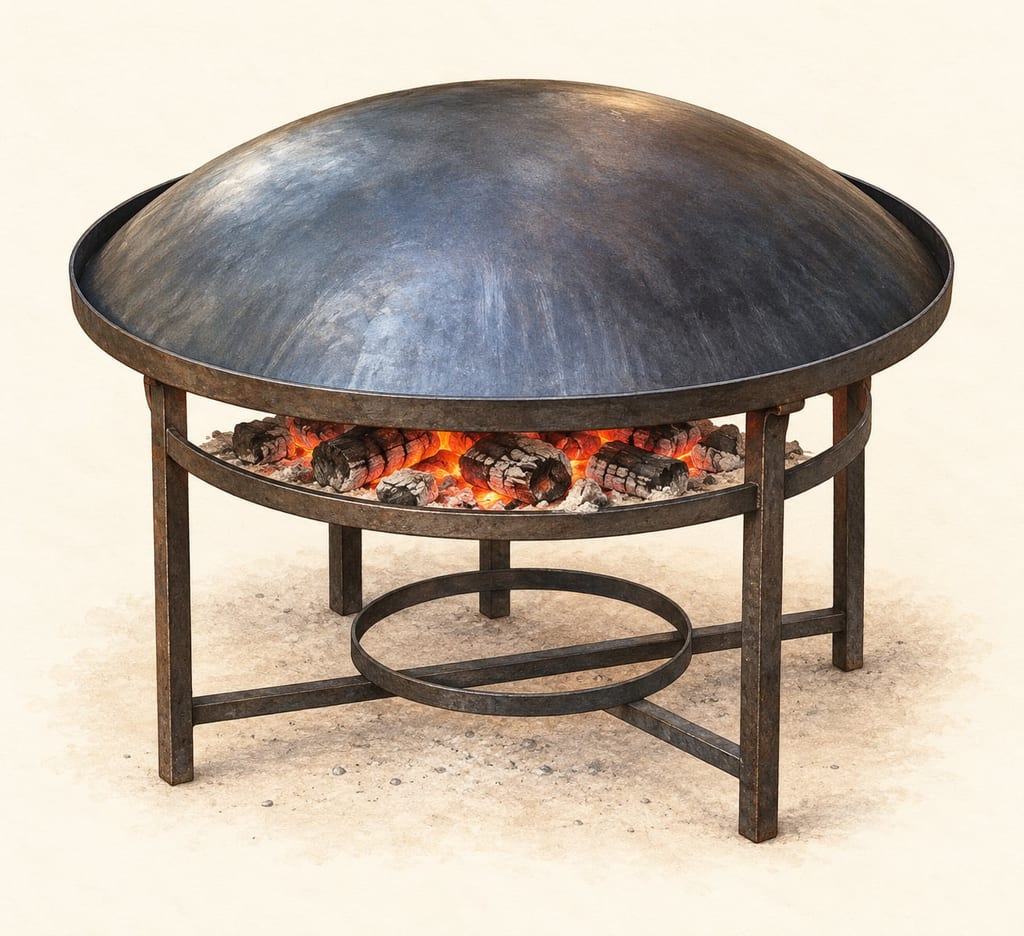
A saj is a large, circular, convex metal griddle: an open baking plate rather than a masonry oven. A comparative survey reports an approximate diameter of 50 cm for the surveyed form and describes placing it on embers. Thin dough is stretched and laid across its curved heated surface. The plate gives the baker a broad, direct-contact surface without the vertical chamber of a tannūr or tabūn.
The names travel with particular breads and places. The survey associates Jordanian shrak and mashrouh, Lebanese markouk, Egyptian farasheeh and Greek fylla perek with the saj-type plate; it records the name satsi for the Greek form. These associations show regional use, not a single birthplace or one uniform design. A Lebanese heritage account describes markouk as thin dough baked on a heated metal dome, traditionally over village wood fires.
The plate is the cooking surface: heat reaches the thin dough at its contact with the warmed metal. The survey distinguishes baking plates from vertical ovens, so a saj should not be used as another name for a tannūr or tabūn. It also contrasts the saj with flat metal pans and other baking systems. The approximate 50 cm diameter is the survey’s representative figure, not a guaranteed size for every domestic or bakery model.
Fuel and supports vary. The comparative account describes traditional use over embers, while the Lebanese heritage account records village saj fires fed with wood and notes that gas and electric models are also common today. Those newer heaters are adaptations of the cooking surface; they do not erase the traditional fire-heated form. The sources do not supply a universal temperature, heating time, care routine, or construction specification, so none should be inferred from the plate’s appearance.
The Mediterranean survey documents the griddle in Jordan, Lebanon, Egypt and Greece through the breads and baking systems it records. The Lebanese heritage entry places markouk and saj use throughout Lebanon and describes continuing village practice. This is evidence for a broad regional family and a specific Lebanese tradition, not proof that every community used the same fuel, support, dimensions or dough.
The sources establish traditional and present-day use but do not date the first appearance of the saj itself. The ancient history of flatbread, or archaeological evidence for a different baking plate, cannot be transferred to this particular convex metal griddle without direct evidence. A photograph of a domestic model documents one form; it is not an archaeological reconstruction or a universal pattern.
The comparative survey records saj as a traditional baking plate and a Lebanese heritage account says it remains in village use. Neither source dates the first use of the saj itself; general antiquity claims about flatbread or other baking plates do not establish its date.
The survey lists Jordanian breads baked on saj; this does not claim invention or origin.
Lebanon is a documented place of use, not a claimed birthplace.
The survey associates Egyptian flatbread Farasheeh with the saj-type griddle; no origin claim is made.
The survey records the related name Satsi for Greece and lists Fylla Perek; it does not claim all forms are identical.
A small home-pan adaptation of Levantine markouk: rested wheat dough rolled into small rounds and cooked quickly on a hot flat pan. It is thicker and smaller than the hand-stretched sheets made on a saj.
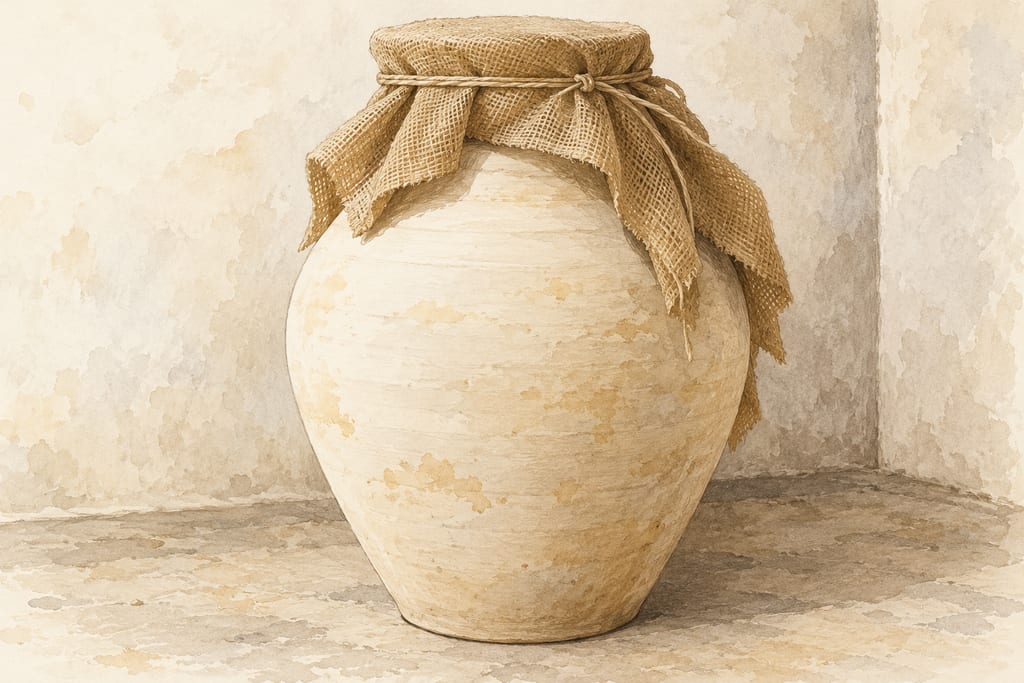
Clay amphorae mature some Levantine arak. Muaddi in Palestine documents 12 months in clay; Château Ksara specifies two years for Ksarak in clay jars. Both are producer-specific storage practices.
No community contributions have been published for this entry yet.
Sign in to contribute. Published comments and photos are free to read.
Foods (MDPI); open-access copy hosted by the University of MaltaEquipment form · Dimensions · Regional use · Comparison
The Large and Diverse Family of Mediterranean Flat Breads: A DatabaseThe paper describes a circular convex metal griddle named saj in the Middle East and Egypt and satsi in Greece, used on embers, with an approximate diameter of 50 cm.
Its table records Jordanian Mashrouh and Saaj, Lebanese Saj, Egyptian Farasheeh, and Greek Fylla Perek with the saj-type system.
The article distinguishes traditional baking plates from vertical tannūr and tabūn ovens and captions Figure 7 as a domestic saj.
The article is open access under Creative Commons Attribution (CC BY 4.0).
Cited in: A broad plate for thin breads; Heat source and the shape of the work; Regional evidence and historical limits
iHERITAGE: ICT Mediterranean platform for UNESCO Cultural HeritageGeography · Traditional use · Regional name
Markouk or Saj breadThe heritage entry locates markouk or saj bread throughout Lebanon and describes a heated metal dome used for traditional bread.
It records village wood-fired use alongside contemporary electric or gas models.
Cited in: A broad plate for thin breads; Heat source and the shape of the work; Regional evidence and historical limits