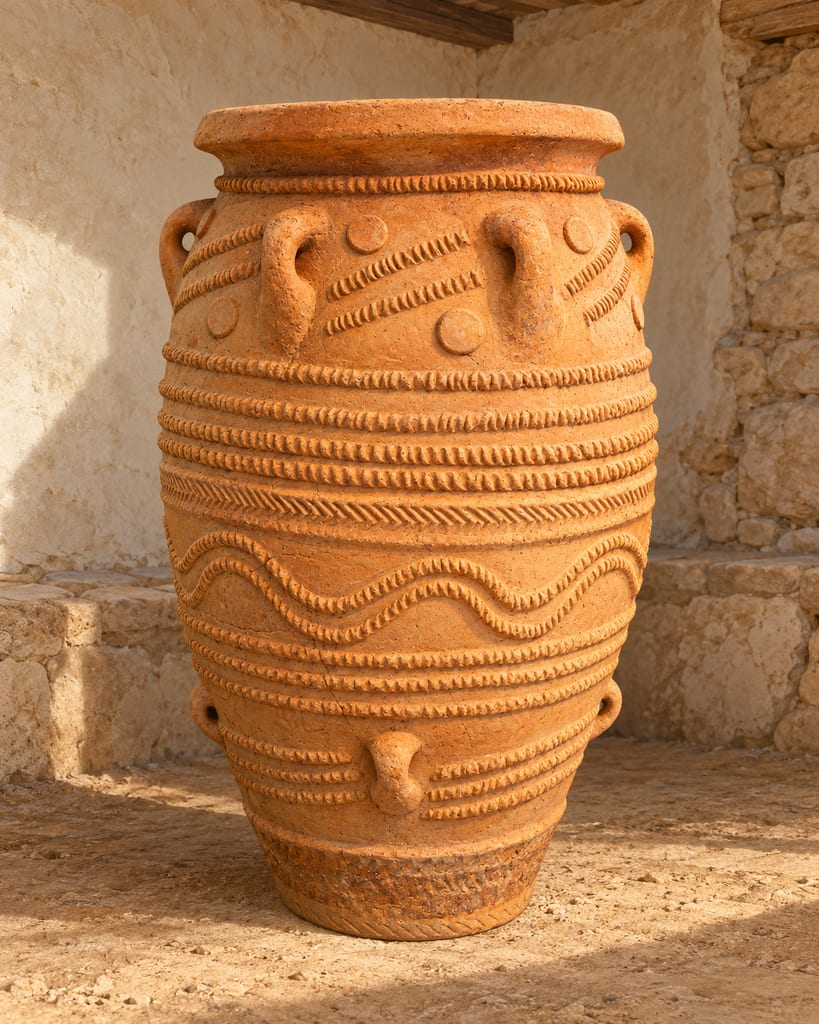
Pithos
A pithos is a large ceramic storage jar documented in Minoan palatial storerooms and later Aegean settings. Its clay body, broad shoulder and high capacity suited bulk storage, while individual forms and uses varied by place and period.
 FermenteaWhere food goes to change
Equipment · Barrels and casks
Two portable vessels documented for feta maturation: a coopered wooden barrel used with salted cheese and brine, and a rectangular metal tin used with cheese in brine. They differ in construction and packing.
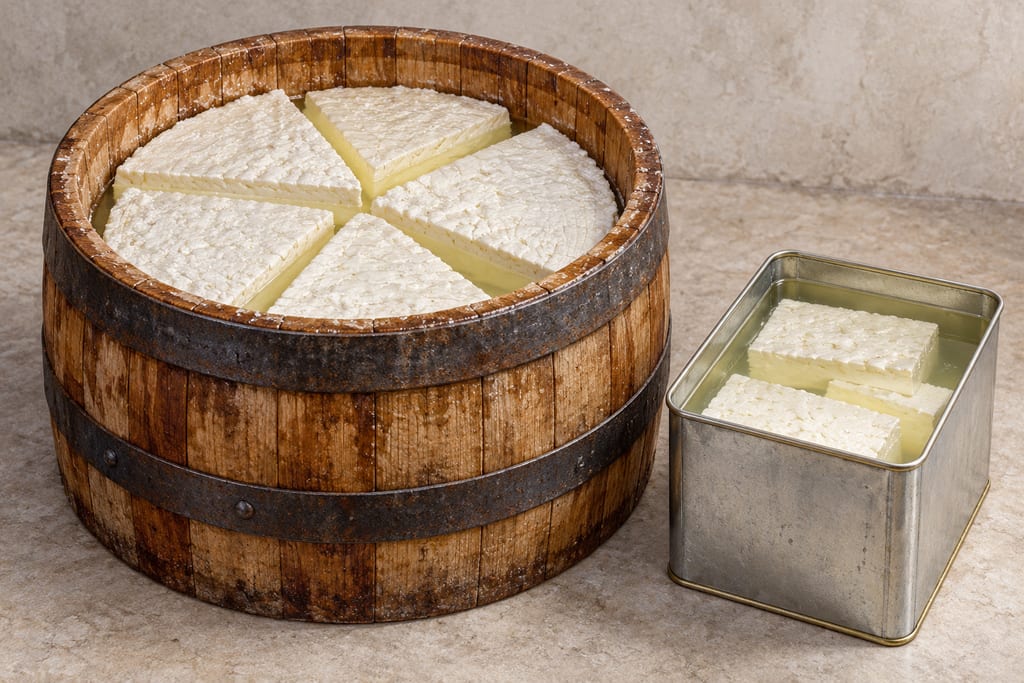
Feta may mature in more than one kind of portable container. The paired forms described here are a coopered wooden barrel and a rectangular metal tin. They can hold the same broad category of cheese, but their construction, geometry and packing medium differ. A barrel is assembled from staves and hoops around a broad circular body; a tin is a straight-sided manufactured can with folded seams. The Kalavryta cooperative says moulds give curd a wedge shape for a barrel and a rectangular shape for a tin.
These are food-contact vessels rather than fixed rooms or pits. They travel from the dairy to the maturation chamber, where surrounding temperature and humidity are managed separately. A container's walls shape the contact environment, but the room, recipe and producer's process also matter.
The cooperative describes removing drained cheese from its moulds, placing it in a wooden barrel, adding salt, sealing the vessel and moving it to maturation. In the barrel, feta portions are packed as wedges rather than as one uniform wheel. A 2019 report from the cooperative's facilities photographs dry-salting in open wooden barrels and describes barrel-ripened product for domestic sale.
A 2023 peer-reviewed study identifies beech or oak barrels and dry salting as traditional Feta technology. It discusses wood as porous, allowing a different exchange with the surrounding environment than a closed metal container. This describes a material property and production contrast; it does not prove every wooden barrel creates a particular taste or that wood alone explains sensory differences. The experimental barrels were 50 kg containers, a detail of that comparison rather than a standard size.
The visible equipment should retain its coopered form: curved staves, hoops, a circular opening and wedge-packed cheese. The Kalavryta photograph shows cheese during dry-salting. It is a useful view of packing and material, not a complete record of every barrel's dimensions, species or construction.
The cooperative's second option is a tin container. It says curd is moulded into rectangular pieces, then placed in the tin with brine; the container is sealed before ripening. The study calls the contemporary industrial format a tinned-steel can filled with brine. This is a straight-sided manufactured container, not a barrel with a metal lining and not a stainless-steel bulk tank.
A 2019 visit report photographs tins at Dodoni and describes tin-packed feta as a producer's export format, while the Kalavryta cooperative documents tins as one option in its process. These accounts support the format but not the claim that all exported feta, all Greek dairies or every producer uses tins. Printed labels belong to commercial packaging; they are not part of the vessel's underlying geometry.
The study's tinned cans held 17 kg in its experiment. That measurement describes only those specimens. Container sizes and industrial systems vary, and no universal capacity or dimension follows from the article.
In the cooperative's process, salt is added to barrel-packed cheese and brine to cheese in tins. Both are sealed and moved to ripening chambers. The cooperative describes a first phase at 18°C with relatively high chamber humidity until the cheese's pH falls, followed by refrigeration; it says both phases are completed within two months. These are details from its current process description, not general settings for every producer or every vessel.
The 2019 report records different times and decisions at particular dairies, including producers that ripened cheese longer and assessed readiness during maturation. These observations demonstrate producer variation, but should not be used to override or universalize the cooperative's published process. An equipment entry is not a recipe or a safe home-process specification.
The 2023 study compares wooden barrels and tinned cans and also evaluates a newer bulk container. Its discussion of stainless steel must remain separate from the tin format. Material, size, brine, cheese geometry, chamber conditions and protocol interact; one study design cannot establish a universal sensory ranking.
The Agricultural Dairy Cooperative of Kalavryta places its production in the Kalavryta area of Achaea in the Peloponnese. Its process page documents both wooden barrels and tins. The 2019 report describes a visit to A.S. Kalavryton and separately photographs tin-packed feta at Dodoni. These are named producer observations, not a map of every Greek dairy.
The barrel is described in research as a traditional ripening vessel, while tinned-steel cans are framed as a modern industrial format. The available sources do not date the first barrel or the adoption of tins, so no invention date or precise origin is assigned. A modern producer can continue a traditional vessel form, and a traditional product can also be made in industrially standardized containers.
For readers comparing feta, the useful distinction is practical and source-backed: barrel-packed cheese is salted and held in a coopered wooden container; tin-packed cheese is formed in rectangular pieces and held in brine in a sealed can. The surrounding maturation regime remains part of the process, and neither vessel alone identifies the finished cheese's quality or flavour.
Sources describe coopered wooden barrels as traditional and tinned-steel cans as a modern industrial ripening format, but do not establish when either form began or identify a single origin. A 2019 visit records both in use at separate Greek producers.
Barrel and tin packing differ: the cooperative describes salted cheese in wood and cheese with brine in tins; they are not interchangeable descriptions.
Source →The study also evaluates stainless steel bulk containers. These are not tin cans and should not be depicted as such.
Source →The cooperative's two-month process description and the reporter's producer-specific longer maturation observations differ in scope; neither duration is universal.
Source →Cooperative practice in the Kalavryta area, not the origin or a universal Greek pattern.
Country-level context, not a claim that every Greek producer uses both forms.
A pithos is a large ceramic storage jar documented in Minoan palatial storerooms and later Aegean settings. Its clay body, broad shoulder and high capacity suited bulk storage, while individual forms and uses varied by place and period.
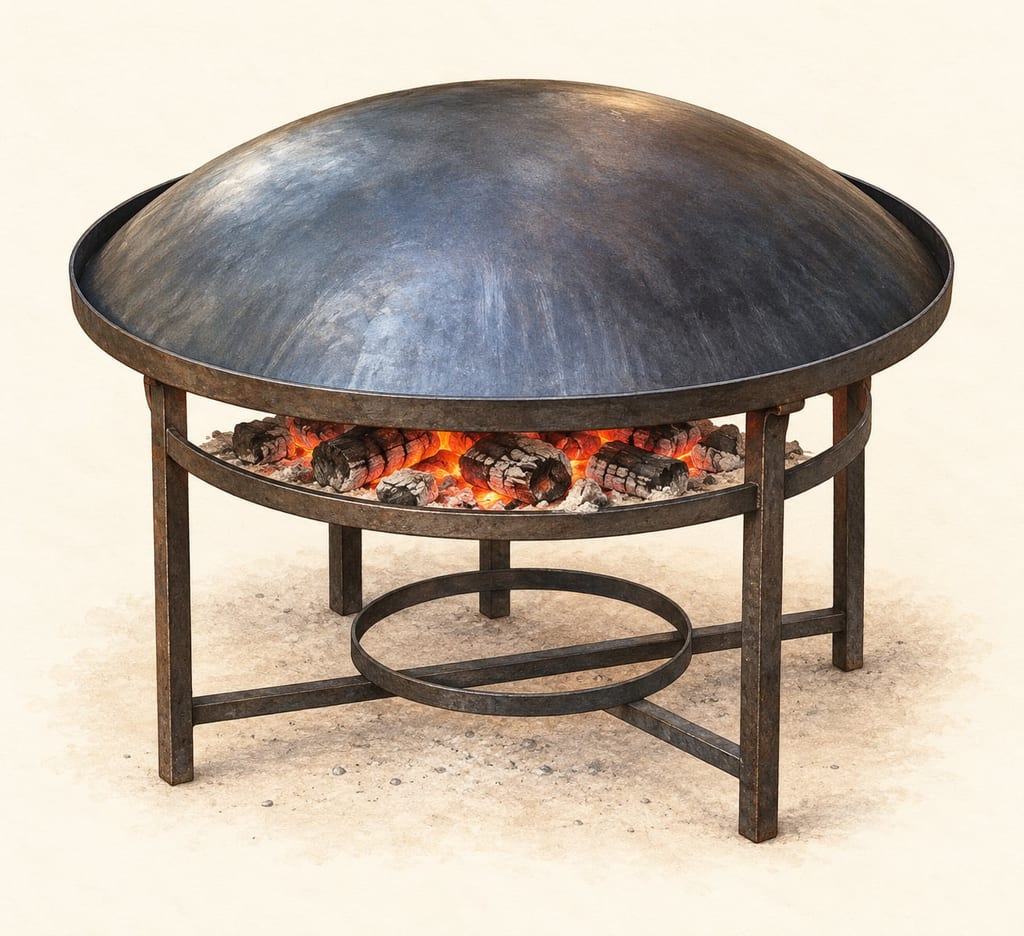
A portable convex metal griddle used for thin flatbreads. Surveyed forms are about 50 cm across and set over embers; regional names and modern heat sources vary.
No community contributions have been published for this entry yet.
Sign in to contribute. Published comments and photos are free to read.
Agricultural Dairy Cooperative of KalavrytaProcess · Equipment · Geography
Feta PDO Production ProcessThe cooperative says curd moulds produce wedges for wooden barrels and rectangles for tin cans.
After straining, cheese enters a wooden barrel or tin; salt goes in barrels and brine in tins before sealing and ripening.
Its process page describes a two-phase maturation completed within two months; this is a current cooperative process, not a universal duration.
Cited in: Two ways to hold feta as it ripens; The wooden barrel; The metal tin; Maturation is a system, not a vessel alone; Where the forms are documented
FoodsMaterials · Process · Mechanism
Evaluation of a New Bulk Packaging Container for the Ripening of Feta CheeseThe paper describes beech or oak barrels and dry salting as traditional technology, and tinned-steel cans with brine as modern industrial practice.
It discusses wood as porous and metal cans as a different barrier surface; it does not establish a universal sensory advantage.
Its 50 kg wooden barrels and 17 kg tinned cans are experimental specimens, not standard capacities.
Cited in: Two ways to hold feta as it ripens; The wooden barrel; The metal tin; Maturation is a system, not a vessel alone; Where the forms are documented
TablehopperVisual reference · Documented use · Geography
PDO Feta Trip to GreeceThe 2019 report photographs dry-salting in barrels at A.S. Kalavryton and feta in brine in tins at Dodoni.
Its producer-specific observations do not establish a universal Greek packing rule.
Photographs are credited © tablehopper.com and are shown only as linked images.
Cited in: The wooden barrel; The metal tin; Maturation is a system, not a vessel alone; Where the forms are documented