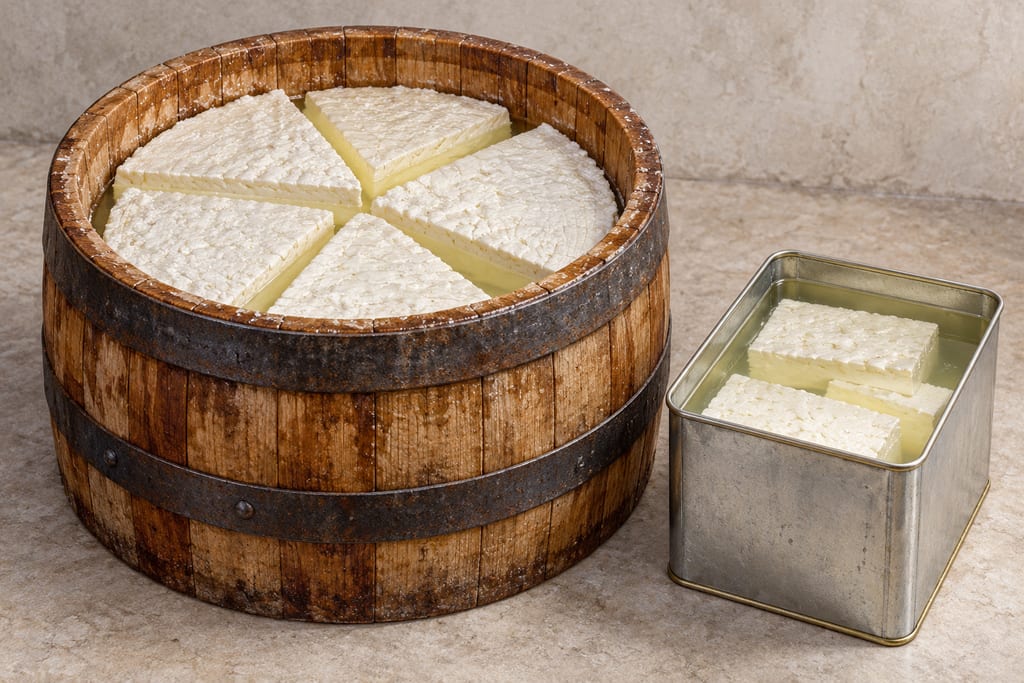
Feta ripening barrel and metal tin
Two portable vessels documented for feta maturation: a coopered wooden barrel used with salted cheese and brine, and a rectangular metal tin used with cheese in brine. They differ in construction and packing.
 FermenteaWhere food goes to change
Equipment · Jars, pots and crocks
A pithos is a large ceramic storage jar documented in Minoan palatial storerooms and later Aegean settings. Its clay body, broad shoulder and high capacity suited bulk storage, while individual forms and uses varied by place and period.
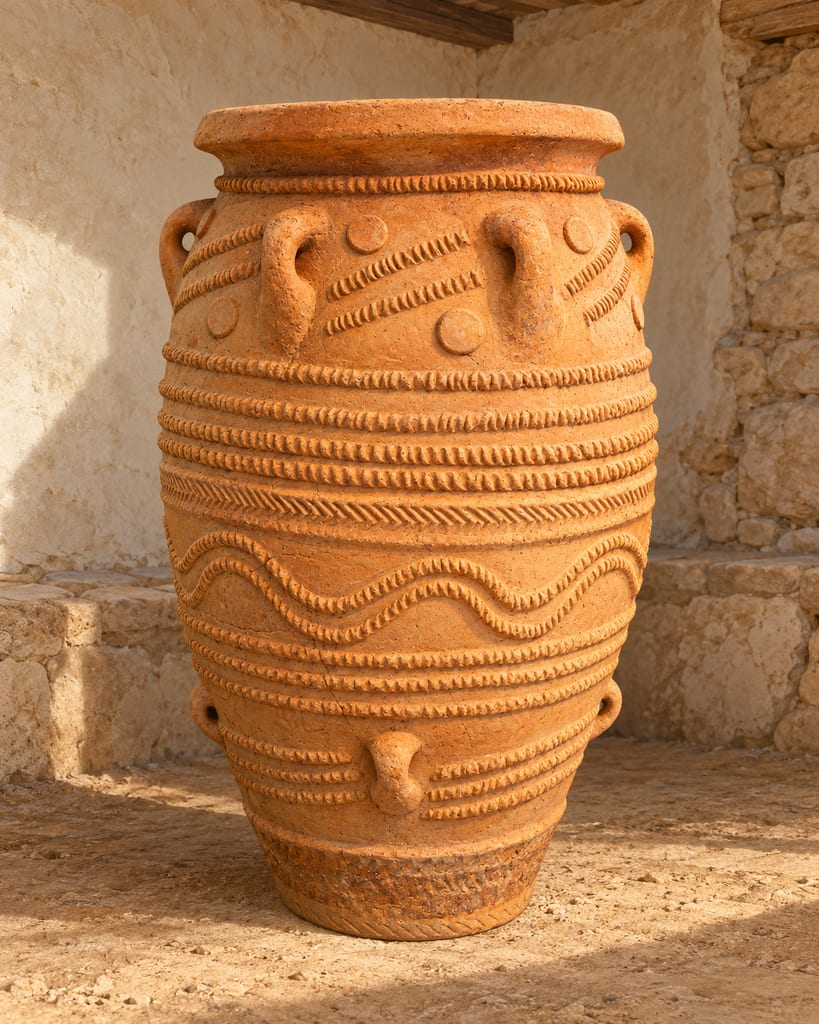
Pithos is the singular Greek term, with pithoi as the plural. It refers to a large ceramic storage jar rather than one standardized potter’s pattern. The broad form is upright, with a wide shoulder, a narrower mouth, a substantial rim and a smaller base. Large Minoan examples could approach human scale. Their clay bodies and heavy proportions suit stationary bulk storage more readily than frequent carrying, although handles could help people move or secure individual jars.
Handles and ornament vary. The Heraklion Archaeological Museum describes handles below the rim and above the base as features that helped with transport and with attaching lids. Raised bands, relief knobs and incised decoration appear on some examples, not all. One museum vessel carries an incised Linear A inscription made before firing; its reading may indicate a connection to Sybrita, but the inscription does not define every pithos.
On Bronze Age Crete, large pithoi were central to the storage of agricultural produce in palatial communities. The Heraklion museum’s example comes from the Royal Villa at Hagia Triada and is dated 1600–1500 BCE. At Knossos, the British Museum records a terracotta pithos found in a magazine, or storeroom, in the west wing of the Palace of Minos. That particular jar measures 114.30 centimetres high and 69.85 centimetres across; those figures describe one object, not a standard size.
The vessels’ capacity made them useful for keeping bulk produce in palace and villa stores. A pithos could hold an agricultural product, but its shape alone cannot identify the contents. Some broad descriptions connect the vessel family with wine, yet a museum object catalogued as an agricultural storage jar is not evidence that the specific specimen held wine or fermented food.
The name covers vessels from more than one period and place. A study of relief pithoi discusses examples made in Late Geometric and Orientalizing contexts across Aegean islands, especially the northern Cyclades, Crete and Rhodes. Their conspicuous decoration is considered alongside the economic and social importance of food storage. These later decorated vessels should not be collapsed into a single Minoan template: body shape, handles, relief and inscription vary among individual jars.
The surviving records show how useful a large storage jar could be in different communities, while also setting limits on what can be inferred. No single origin, universal shape or continuous history for every pithos is established here.
A pithos provides a high-capacity ceramic enclosure for storage. Its heavy body suits bulk holdings, while the rim and handles on documented examples support a lid and some handling. The sources do not establish a standard volume, insulation performance, permeability, cleaning routine or fermentation protocol for the type. Nor do they support assigning every pithos a wine or fermentation use.
These sources describe historical artifacts and food-storage contexts rather than a current purchasing guide or a specific fermentation method. They do not give a present-day maker, care instructions or a standard size.
Museum records document large Minoan agricultural-storage pithoi at Hagia Triada and Knossos; later relief pithoi are also attested across Aegean islands. These examples do not establish the type's first appearance or a single continuous design.
Museum records document agricultural-storage pithoi in Minoan palace and villa contexts; this is not a single origin for all vessels called pithoi.
The cited study discusses relief pithoi made in the northern Cyclades and other Aegean islands in later periods.
The cited study names Rhodes among the Aegean production areas for relief pithoi in later periods.
Two portable vessels documented for feta maturation: a coopered wooden barrel used with salted cheese and brine, and a rectangular metal tin used with cheese in brine. They differ in construction and packing.
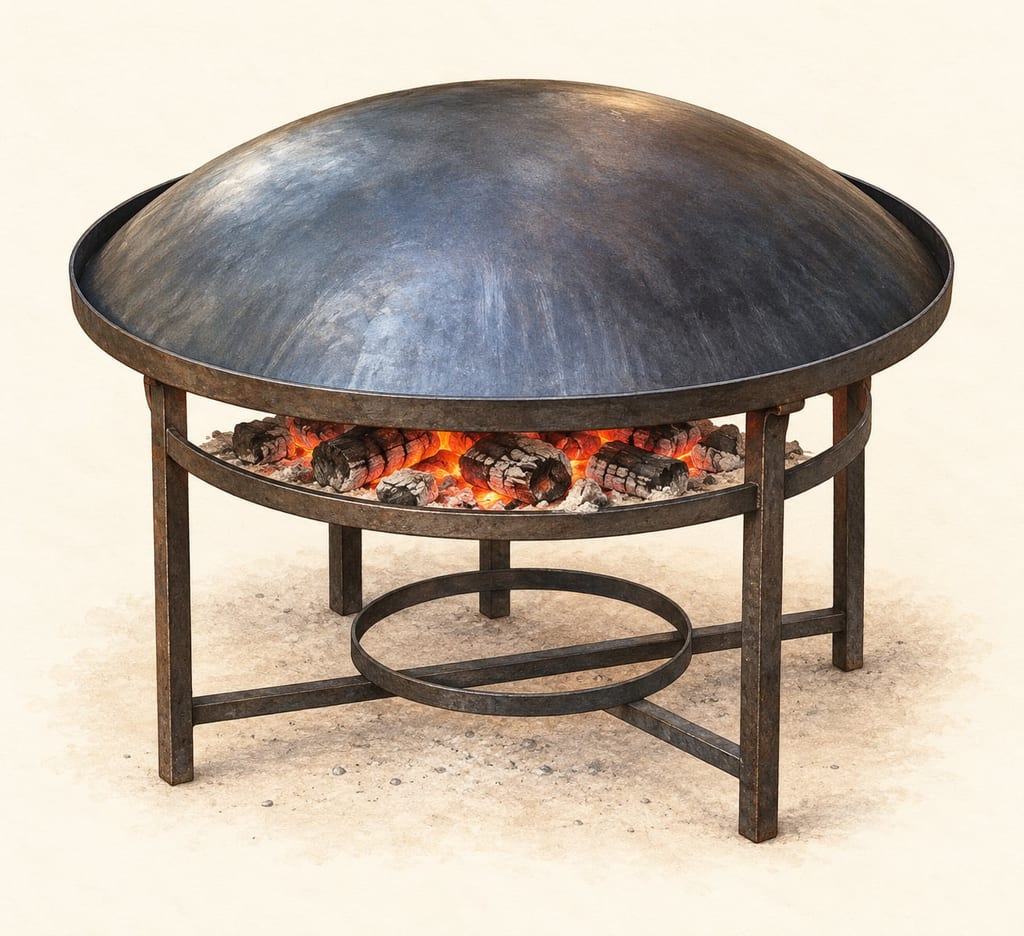
A portable convex metal griddle used for thin flatbreads. Surveyed forms are about 50 cm across and set over embers; regional names and modern heat sources vary.

At North Abydos in Egypt, a fixed early Dynastic brewery comprised parallel semi-subterranean installations with rows of ceramic mash vats; excavation reports revise their number, scale and estimated batch capacity.

Ají amarillo is the orange-yellow Peruvian chilli cultivar group of Capsicum baccatum, used to colour and season huancaína sauce and ají de gallina. Published heat estimates do not establish one range for the named cultivar.

Toasted almonds are whole sweet almond kernels dry-roasted until golden to brown. Heat replaces their marzipan note with a roasted, nutty one; they thicken and flavour romesco.

Kodiak salmon, halibut and cod cut as seg'aq and hung on an initaq rack to become tamuuq, with kac'amaasaq and kupcuunaq named as different results.

Aniseed is the dried ripe fruit of Pimpinella anisum, an aromatic Apiaceae spice commonly called a seed. It adds a sweet, warm aroma to breads such as Moroccan krachel and South African mosbolletjies, and is distinct from star anise.

A fixed Late Chalcolithic installation in Areni-1 cave combined a shallow clay pressing basin with a large jar set into the cave floor and storage vessels nearby.

Ripe avocado flesh is the soft, buttery, fat-rich pulp of Persea americana, eaten raw. It is low in acid, so it is a fresh ingredient that needs care in chilled dishes.

A portable dome and pan used over a hearth, with embers on the lid and heat from below. Regional peka and saç forms share this principle while differing in materials, pan shape and how the food is cooked.
No community contributions have been published for this entry yet.
Sign in to contribute. Published comments and photos are free to read.
Heraklion Archaeological MuseumHistory · Form · Use · Geography
Large pithos with incised Linear A inscriptionThe museum dates a pithos from the Royal Villa at Hagia Triada to 1600–1500 BCE.
Large pithoi were the main agricultural-storage jars used by Minoan palatial communities.
Handles under the rim and above the base supported carrying and lids; this specimen's inscriptions were incised before firing.
Cited in: A large jar, not one fixed design; Minoan palace and villa stores; Forms across the Aegean; What the jar does—and what remains unknown
The British MuseumHistory · Form · Use · Geography
pithosObject 1884,0807.1 is a terracotta pithos from the third magazine in the west wing of the Palace of Minos at Knossos.
The museum dates it to 1450–1375 BCE and records its height as 114.30 cm and diameter as 69.85 cm.
The record describes four bands of incised wavy lines; those details belong to this particular object.
Cited in: A large jar, not one fixed design; Minoan palace and villa stores; What the jar does—and what remains unknown
The Journal of Hellenic Studies, Cambridge University PressHistory · Form · Geography · Use
Protector of the city, or the art of storage in early GreeceThe study discusses relief pithoi produced in Late Geometric and Orientalizing periods across Aegean islands, especially the northern Cyclades, Crete and Rhodes.
Its interpretation places conspicuously decorated pithoi in the social and economic importance of food storage.
Cited in: Forms across the Aegean; What the jar does—and what remains unknown