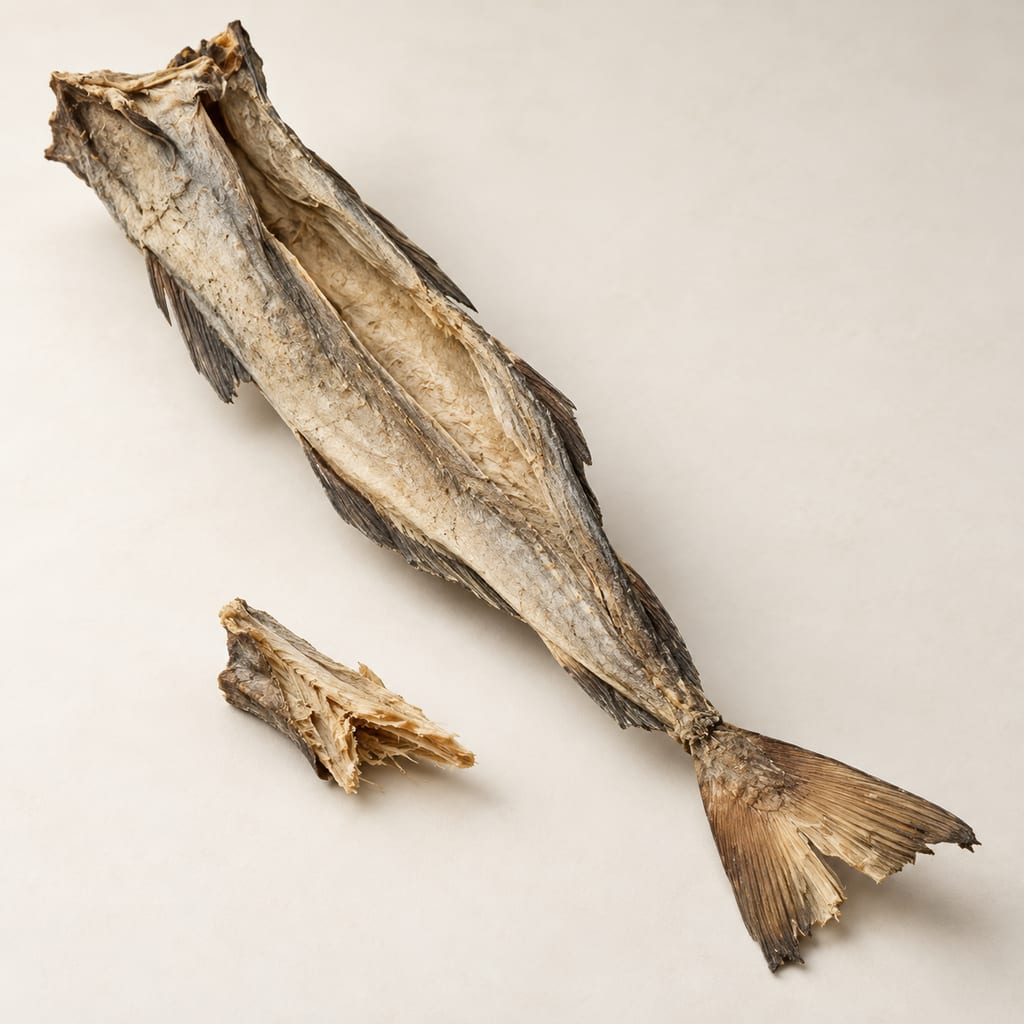
Stockfish
Cod hung on open racks in cold northern air until most of its water has gone, leaving a hard, light, unsalted fish that keeps and travels and must be soaked for days before cooking.
 FermenteaWhere food goes to change
Built structures · Terraces, platforms and stands
hjell · hjeller · fiskehjell · stockfish drying rack
A Lofoten hjell is a large outdoor wooden rack for drying stockfish in the region’s moving coastal air. Flat racks and piles are recorded in the product specification; the archive also describes horizontal and tall triangular arrangements.
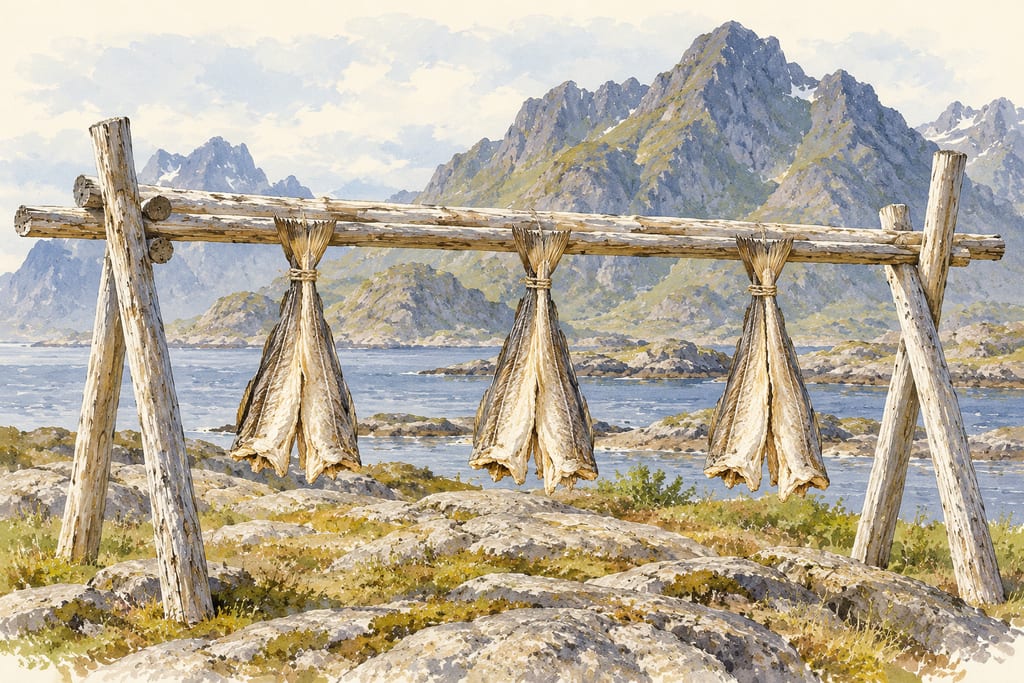
In Lofoten, the large outdoor wooden racks used for stockfish are called hjell or fiskehjell. They raise fish into the open air above the ground. A photograph of the racks at Å shows long timber rows in a coastal landscape; it documents one site and arrangement, not a standard blueprint.
The archive describes flat horizontal rack forms as well as taller triangular frames. The product specification for Tørrfisk fra Lofoten refers to flat racks or piles. Together these sources establish a family of outdoor support structures, without requiring every rack to share one geometry.
Lofoten’s stockfish racks stand in open, breezy locations. Regional descriptions connect the fishery with the coast’s moving air and changing weather. Visit Lofoten describes one locally used orientation relative to southwest rain and northern wind; that account is specific to the region and does not supply a universal placement plan.
The protected product area separates where the cod is caught from where the rack work occurs: fish are caught around Lofoten and Vesterålen, then delivered to Lofoten to be dried, sorted and packed. The specification lists Værøy among Lofoten’s municipalities.
The hjell is the fixed support structure; stockfish is the product hung on it. The linked recipe records the stockfish associated with the rack, while a separate Lofoten preparation record is linked for the named protected product. Neither link turns the rack description into a household process guide.
The sources do not give a standard height, span, foundation, timber species or construction sequence for a hjell. This page keeps those details open instead of filling them with measurements from a single photograph.
The protected product specification documents naturally dried cod produced in Lofoten. Visit Lofoten describes wooden hjell racks as part of the continuing regional fishery; a Commons photograph records a rack array at Å in 2009.
A build is made where it stands: moving it means building it again.
The product specification places drying, sorting and packing in Lofoten and lists Værøy among its municipalities; cod is caught around Lofoten and Vesterålen.
Cod hung on open racks in cold northern air until most of its water has gone, leaving a hard, light, unsalted fish that keeps and travels and must be soaked for days before cooking.
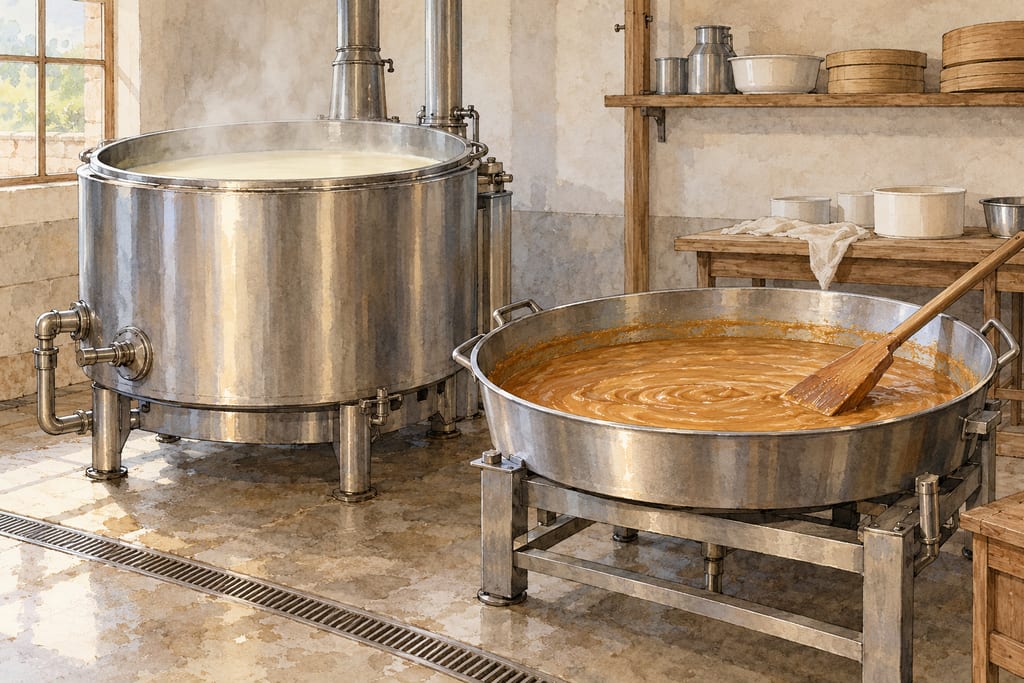
The kettle heats and reduces a large volume of thin liquid such as whey; before it nears the brewer's minimum fill the batch moves to a wide pan for the thick, stirred finish.
No community contributions have been published for this entry yet.
Sign in to contribute. Published comments and photos are free to read.
Department for Environment, Food & Rural Affairs, United KingdomForm · Geography · Use
Product Specification for Tørrfisk fra LofotenThe protected product is naturally dried cod from Lofoten; fish are caught around Lofoten and Vesterålen, then delivered to Lofoten for drying, sorting and packing.
The specification refers to drying on flat racks or piles and says paired fish must hang without contacting one another or the rack.
The listed Lofoten municipalities include Værøy.
Cited in: The outdoor rack called hjell; A structure shaped by the Lofoten setting; Rack and product are separate subjects
Visit LofotenSite · Climate · Use · Geography
Skrei and StockfishThe page describes open-air stockfish racks in Lofoten and says local microclimate, wind and weather shape their placement and use.
It describes fish backs oriented toward southwest rain and open bellies toward the northern wind; this is a regional account, not a universal construction specification.
Cited in: A structure shaped by the Lofoten setting
Visit LofotenTerminology · Materials · History
Food culture and culinary heritage in LofotenThe source calls the large outdoor wooden stockfish racks hjell or fiskehjell and describes the tradition as continuing in Lofoten.
Cited in: The outdoor rack called hjell; Rack and product are separate subjects
Wikimedia CommonsVisual reference · Rights · Geography
File:Drying Stockfish Lofoten 2009 3.JPGThe file page identifies a photograph of stockfish drying racks in Å, Lofoten, Norway, taken in 2009.
The license is Creative Commons Attribution-ShareAlike 3.0 Unported (CC BY-SA 3.0); the author requests credit as Petr Šmerkl, Wikipedia.
Cited in: The outdoor rack called hjell; Rack and product are separate subjects