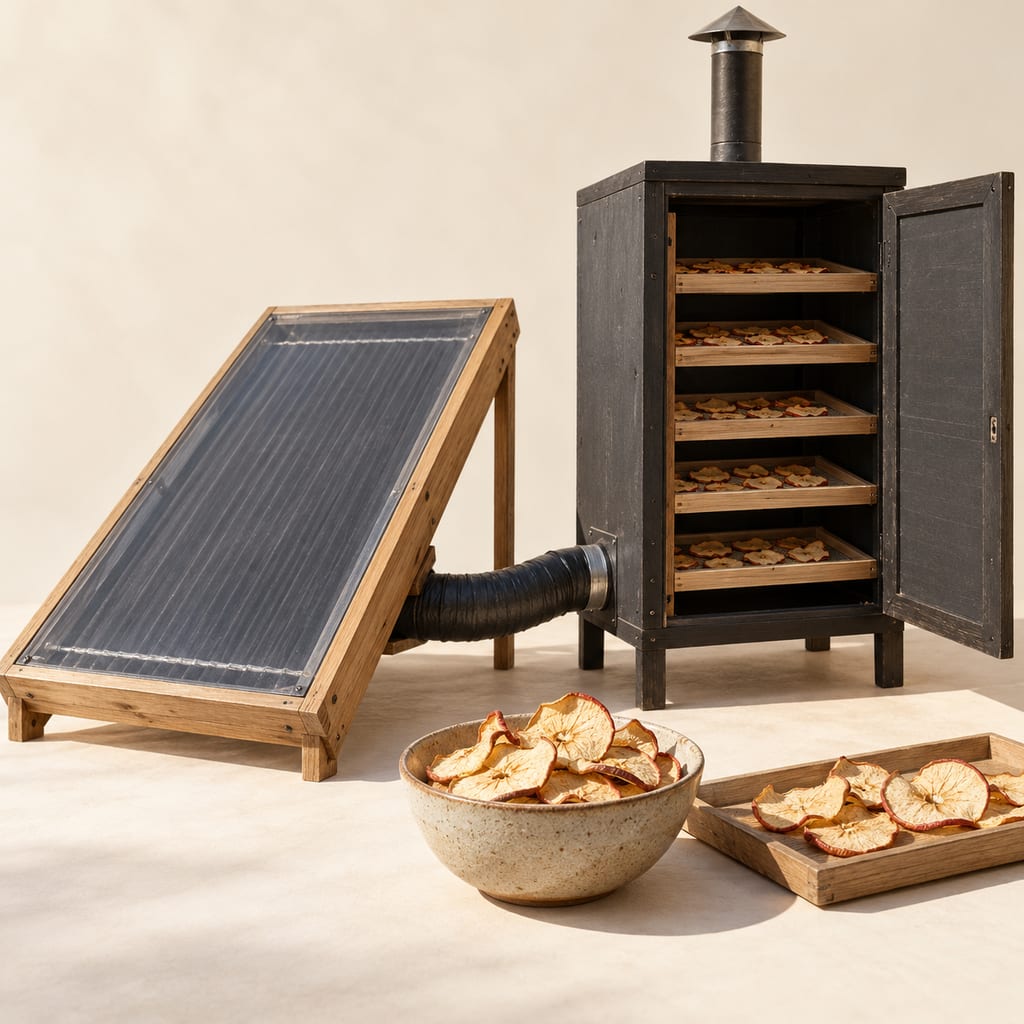
Indirect solar collector and drying cupboard
A solar air collector that heats air separately, then passes it through a shaded tray cupboard and out of a chimney. The product never sits in direct sunlight.
 FermenteaWhere food goes to change
Equipment · Drying kilns and dryers
indirect solar cabinet dryer
An indirect solar dryer heats air in a separate collector, then moves it through a covered food chamber. Designs vary in size, materials and airflow.
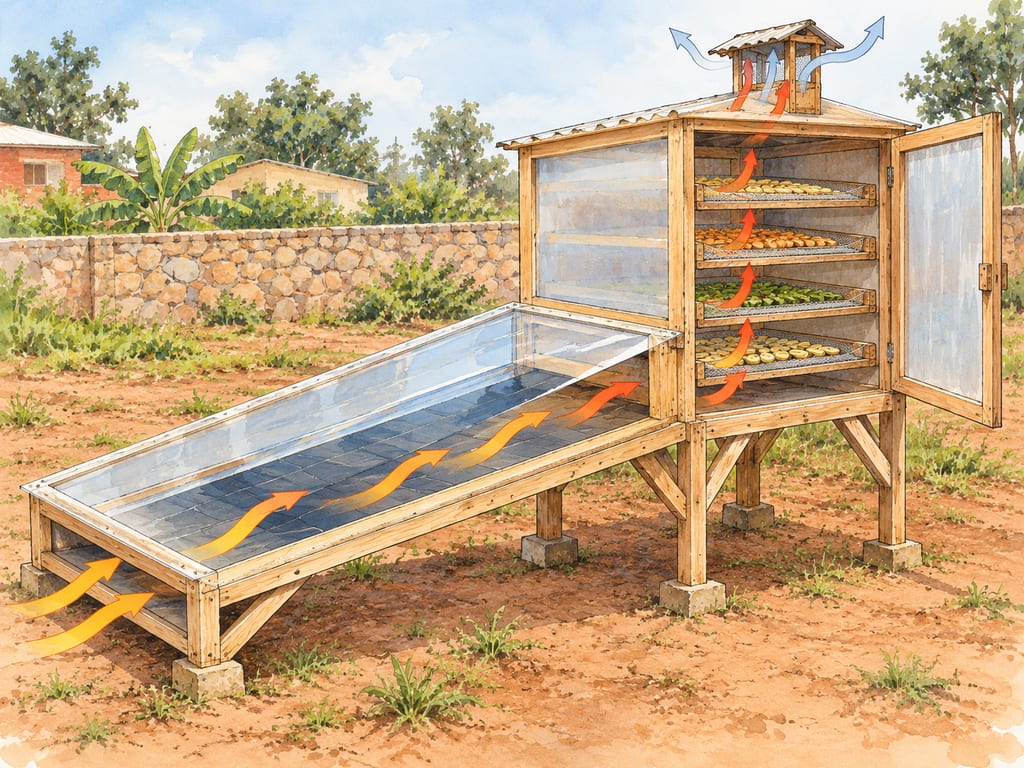
The indirect collector-and-chamber layout is presented in contemporary agricultural training as a way to heat air separately from the food chamber. The material used here does not trace an origin, name an inventor or date the first use. This page describes a technical category rather than one maker's model or a tradition with a claimed birthplace.
The invention date and earliest attestation have not been established. The historical period therefore remains unknown; the following account focuses on the documented form and its operating limits.
An indirect solar dryer has two main working spaces: a solar collector that warms air and a covered chamber that holds food on trays. Sunlight heats a dark absorber plate inside the collector; the warmed air then travels into the chamber and across the food. The product is protected from direct solar exposure, unlike a direct dryer whose transparent cover lets sunlight reach the food itself.
The term describes an airflow arrangement, not one fixed shape. A small cabinet may sit beside its collector, while larger installations use different chambers and tray systems. In passive models, heated air can rise through the trays; active designs add a fan or blower. Mixed-mode dryers are a separate category because the food receives direct solar radiation as well as heat from incoming air.
The collector does not dry food by itself. It raises the temperature of the incoming air, and the moving air carries water vapour away from the product. Natural-convection versions depend on the temperature difference and open air path; forced-convection versions use a fan. How quickly a load dries therefore depends on the collector, tray arrangement, airflow, ambient humidity, solar radiation and what is being dried.
The separate chamber can protect the food from direct sunlight; whether it also excludes dust, insects or rain depends on its cover and screened openings. Direct and indirect solar dryers are not interchangeable just because both sit outdoors.
The technical manual's basic indirect diagram uses a flat-plate collector with a black absorber. Its separate, much larger hybrid solar-biomass greenhouse dryer uses galvanized framing, plastic glazing, metal trolleys, mesh trays and auxiliary heating; those specifications belong to that hybrid installation, not to every indirect dryer.
A linked photograph by Shafiq Kayondo shows a raised timber-framed solar food dryer enclosed with translucent sheeting in Uganda. It gives a real material and regional reference, but does not show the inside or prove that its airflow follows the indirect-cabinet diagram. The generated illustration presents the collector-and-chamber principle as a representative explanatory drawing, rather than copying this photographed unit.
EBAFOSA hosts a Uganda-tagged page titled for the safety and use of an indirect solar dryer. A linked Commons photograph, dated 24 November 2018, shows a raised timber-framed solar food dryer in Uganda. It does not show the inside, so the image does not prove that this particular unit follows the indirect collector-and-cabinet layout described above.
A Kenya-focused training manual includes indirect solar drying among its design categories. These are documented contexts rather than claims that the equipment originated in either country, that one cabinet design is standard there, or that the photographed Ugandan dryer has the same internal airflow.
Solar drying depends on weather as well as equipment. Extension guidance notes that drying time changes with the food, cut thickness, starting moisture and drying method; humidity, temperature and air circulation also affect results. Solar drying can take several days, and damp product may mold before it is fully dry.
Choose a tested, food-specific method and endpoint rather than inferring a safe cycle from the presence of a collector, fan, mesh tray or enclosure. Clean, food-compatible contact surfaces matter too. The equipment descriptions here explain how air is heated and routed; they do not validate drying meat, vegetables or fruit under any particular local conditions.
The indirect collector-and-chamber layout is a contemporary engineering category in this account. Neither an origin nor an invention date is established, so this is not a claim about which place invented the design.
Airflow through the chamber and the weather conditions are part of drying performance; do not treat a collector or tray layout as a food-specific validated process.
The basic indirect solar category in this record has no documented fuel or combustion path. The cited manual's biomass hybrid is a separate design requiring its own fire, exhaust and structural assessment.
Sunlight and ambient conditions are variable; the training manual identifies solar radiation, ambient temperature, humidity and natural airflow as performance factors.
Source →No inspected source gives a standard capacity, size, drying temperature or cycle time for the indirect cabinet type as a whole; values from one model cannot be generalized.
Source →A dryer design does not by itself establish a safe endpoint for every food. The University of Minnesota guidance says solar drying depends on weather and food-specific variables, and warns that slow drying can allow mold before the product is fully dry.
Source →The photograph documents a solar food dryer in Uganda, while the EBAFOSA page is specifically about an indirect dryer; the photo does not prove the pictured unit's internal airflow design.
The training manual distinguishes indirect solar dryers among designs discussed in its Kenya project context; it does not claim that one cabinet design is standard across Kenya.
A solar air collector that heats air separately, then passes it through a shaded tray cupboard and out of a chimney. The product never sits in direct sunlight.

A temporary leaf-and-stalk support inside a cooking pot keeps leaf-wrapped food above boiling water.
No community contributions have been published for this entry yet.
Sign in to contribute. Published comments and photos are free to read.
African Centre for Technology Studies, Kenya Industrial Research and Development Institute, UNEP and Institute of Food TechnologistsForm · Operation · Classification · Limits
Training Manual for Design and Fabrication of Hybrid Solar Biomass Greenhouse DryerThe manual distinguishes direct, indirect and mixed-mode solar dryers; for an indirect type, a flat-plate collector with a black absorber heats air that then passes to a separate drying chamber.
Solar dryers can use natural convection from a thermal gradient or forced airflow from a fan or blower; climate and airflow affect performance.
The manual is part of a Kenya-focused training project and separately documents more complex hybrid solar-biomass greenhouse equipment, which is not the simple indirect cabinet model described here.
The manual identifies sanitary material selection and airflow as design considerations; the separate biomass hybrid must keep flue gas from drying air through a heat exchanger.
For its hybrid greenhouse dryer, the manual says tray surfaces that contact food should be accessible for cleaning and inspection; this is model-specific.
Cited in: An undated engineering category; A collector separate from the food; Airflow is the working mechanism; Materials and examples differ by design; Documented contexts in Uganda and Kenya
Ecosystem Based Adaptation for Food Security Assembly (EBAFOSA)Documented use · Geography · Operation
Manual on safety and usage of an indirect solar dryerThe Uganda-tagged EBAFOSA page identifies a manual specifically about the safety and use of an indirect solar dryer.
The page describes solar dryers as heating air with solar radiation and using that air to remove moisture from material inside an enclosure. The attached PDF could not be retrieved in this session, so no further operating instructions are attributed to it.
Cited in: An undated engineering category; A collector separate from the food; Airflow is the working mechanism; Documented contexts in Uganda and Kenya
University of Minnesota ExtensionLimits · Safety · Operation
Preserving food at home: DryingDrying time varies with food, cut thickness, moisture content and method; low humidity, low heat and air circulation affect results.
The guidance warns that solar drying conditions vary and can allow food to mold before it is completely dry; food-specific preparation, endpoint and storage guidance remains necessary.
Cited in: Drying equipment is not a food-safety schedule
Wikimedia CommonsImage reference · Documented use · Geography
A solar food drier that is used to dry fruits and vegetablesThe 24 November 2018 photograph is tagged as a solar food dryer in Uganda and shows a raised timber frame enclosed with translucent sheeting.
The file page identifies the photo as the photographer's own work under CC BY-SA 4.0; the picture does not establish that the photographed dryer has the same airflow layout as an indirect cabinet dryer.
Cited in: Materials and examples differ by design; Documented contexts in Uganda and Kenya