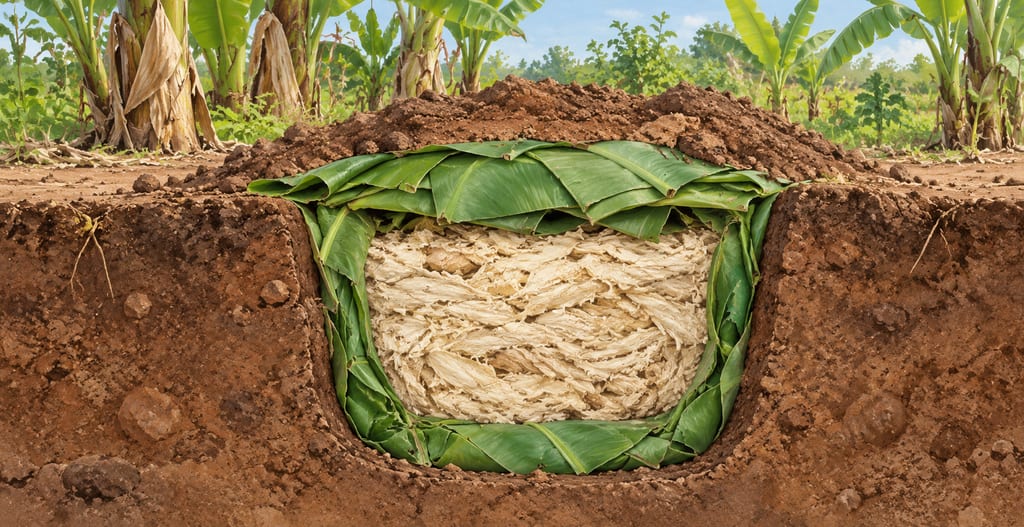
Kocho leaf-lined pit
A fixed earthen pit used to ferment and store kocho, lined and covered with broad leaves of enset. Published accounts document the form in Ethiopia but do not establish one universal shape or size.
 FermenteaWhere food goes to change
Built structures · Cabinets and chamber conversions
An enclosed, warm cabinet for fermenting teff batter for injera, started with saved ersho from the previous batch.
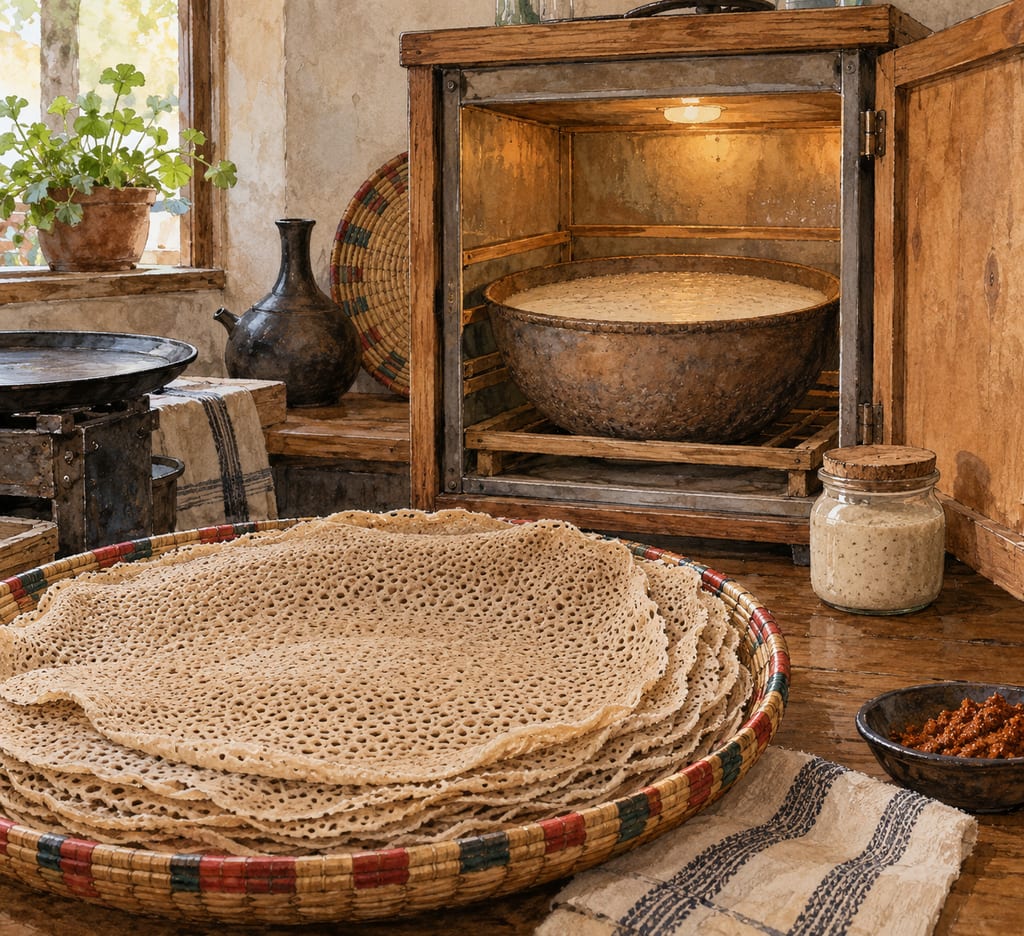
Injera is a fermented flatbread made from teff batter. The fermentation is started by backslopping: a portion of the previous batch, called ersho, seeds the next batter. The cabinet holds that batter at a steady temperature while the lactic acid bacteria and yeasts work.
The cabinet is a modern way of keeping the batter where the traditional method keeps it, in a covered, warm place.
One study of ersho samples found the pH consistently around 3.5. An Addis Ababa University thesis from 2024 collected 91 ersho samples from nine towns and isolated lactic acid bacteria, yeasts and moulds to develop a starter culture.
A household study followed thirty households that regularly make injera and analysed ersho and dough fermented for one to three days.
The traditional method ferments the batter at room temperature for 24 to 72 hours. A Jimma University thesis tested primary fermentation from 25 to 38 C and found 25 C best, with 64 hours of fermentation and four hours of secondary fermentation.
The optimum is not settled. The room-temperature range and the 37 C result come from different setups, and the 37 C figure comes from an informal blog that reports the primary fermentation finishing in under six hours.
The sources reviewed do not validate a cabinet temperature for injera. The thesis data come from one setup, and the blog figures are anecdotal.
The next question is the full texts of the Jimma and Addis Ababa studies, with a measured batter temperature in a cabinet compared with the room-temperature method.
A build is made where it stands: moving it means building it again.
A food safety review of traditional fermented foods made by small-scale producers addresses injera fermentation. The review gives no single temperature limit in the summary read.
Hazard sourceKeep the batter covered and check its acidity before cooking
Control sourceThe 37 C result comes from an informal blog and is not a validated process. Measure the batter, not the cabinet air.
Country-level. Injera is an Ethiopian staple; the sources reviewed give no locality.
A fixed earthen pit used to ferment and store kocho, lined and covered with broad leaves of enset. Published accounts document the form in Ethiopia but do not establish one universal shape or size.
No community contributions have been published for this entry yet.
Sign in to contribute. Published comments and photos are free to read.
Journal of Food Protection (archive article listing)Safety · Method
Food safety recommendation for traditional fermented food by small-scale producers: injeraTeff batter with starter ersho fermented 24 to 72 hours at room temperature (backslopping). Read via search summary.
Cited in: Overview
Jimma UniversityMethod
Jimma University institutional repository: injera fermentation thesisPrimary fermentation 25 to 38 C, best at 25 C for 64 hours plus four hours secondary. Thesis record read via search summary; full text not opened.
Cited in: Temperature and time; Limits and open questions
Addis Ababa UniversityMethod · History
Evaluation of microbes from teff (Eragrostis tef) ersho for injera starter culture development91 ersho samples from nine towns; LAB, yeast and mould isolation; ersho pH around 3.5. Thesis record read via search summary; full text not opened.
Cited in: Overview; Ersho and the starter; Limits and open questions
The Fresh Loaf (informal baker blog)Method
The Fresh Loaf: docdough injera postAnecdotal report of a 37 C fermentation finishing in under six hours. Informal blog, not peer-reviewed.
Cited in: Temperature and time