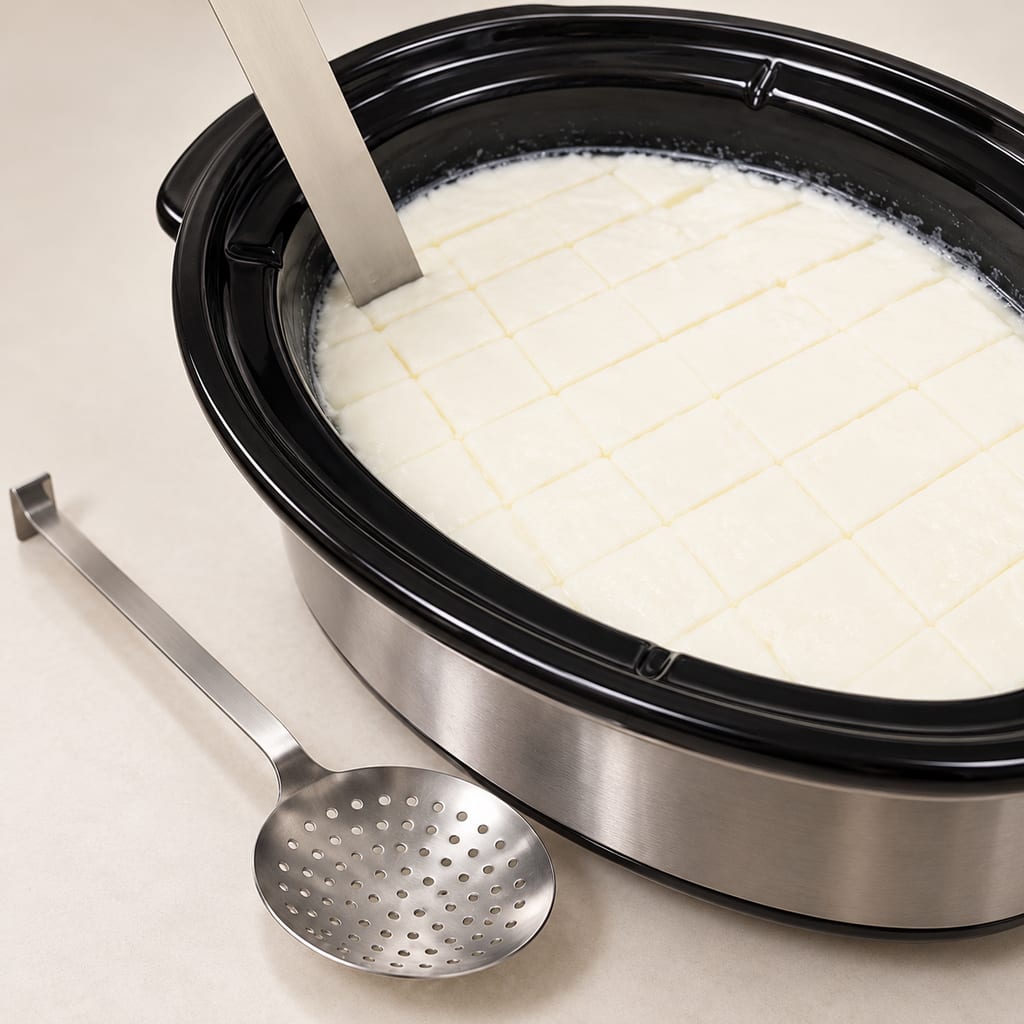
Curd knife and slotted ladle
A curd knife cuts set milk into recipe-sized pieces; a perforated ladle lifts and moves curd while whey drains. The hand tools work at different moments in an open cheesemaking vessel.
 FermenteaWhere food goes to change
Equipment · Baskets, trays and beds
A shallow woven basket or tray can hold cooked, dehulled seeds while they ferment into alkaline condiments. Beninese and Nigerian sources document different basket, tray and cover arrangements rather than one regional standard.
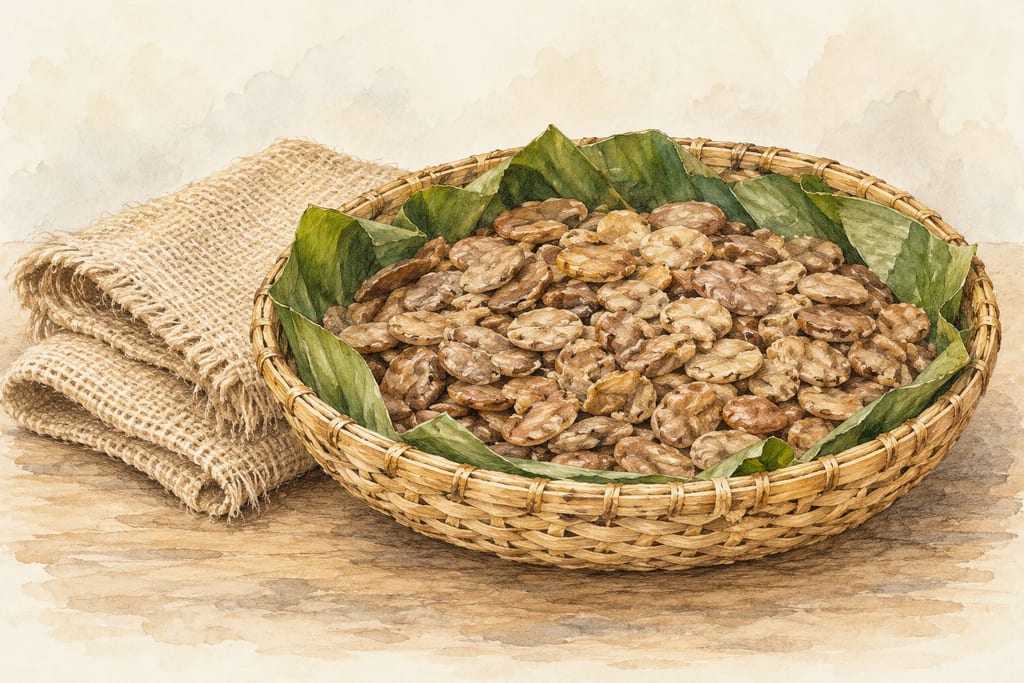
A leaf-lined basket is part of a family of shallow baskets and trays used to hold cooked, dehulled seeds while they ferment. The vessel keeps a moist solid mass together, allows it to drain, and gives the producer access to a broad surface. A liner keeps the seeds from sitting directly against the weave in methods that call for leaves; cloth or sack covers can be added to retain warmth. These are related forms, not one standard model: documented equipment includes woven basket trays, deeper containers, leaf liners, jute and cloth covers, and wooden trays or boxes.
The equipment is used for alkaline seed condiments made from African locust bean, Parkia biglobosa. Its job is to support a prepared solid substrate during fermentation, not to hold a liquid brine. The basket does not by itself define the product. Seed preparation, local starter practice, how the batch is arranged, and the cover all differ among named condiments and places.
A study of afitin, iru and sonru in Benin distinguishes three products and their local methods. In its afitin account, cooked, dehulled cotyledons are spread on basket trays so water can drain. The trays are then wrapped in layers of jute sacks or cloth; after fermentation the cover is removed and the product is left to cool in air. The same paper describes different additives and practices for iru and sonru, so the names should not be treated as interchangeable labels for one identical process.
Later Benin studies document wooden alternatives. A sonru experiment used wooden trays and deliberately varied the depth of the cotyledon layer alongside time and the proportion of yanyanku. Its laboratory tray measured 40 by 25 centimetres, with sides between 4 and 17 centimetres high. Those dimensions describe that experimental apparatus only. A separate afitin study compared a wooden box with the traditional basket-and-jute arrangement. These studies show experimentation around familiar production equipment; they do not establish that a wooden box replaces every local basket.
One Sokoto study describes a large flat basket covered with leaves during the first part of daddawa fermentation from African locust bean. In that account, the mass is later moved to a deep bowl, then spread out again in the basket. This is one reported Nigerian procedure, and the sequence is a reminder that the basket may be only one part of a production set rather than the sole vessel used from start to finish.
The names and methods across West Africa need careful handling. Beninese afitin, iru and sonru have documented differences; Nigerian iru and daddawa also have regional variants. Leaves may line a basket, cover its contents, or be absent from an alternative tray-and-cloth method. The exact local practice, not a generic picture of a basket, determines which arrangement belongs with a particular condiment.
The container's shallow area and the depth of the seed layer affect drainage and the conditions within a warm, moist solid batch. The Benin sonru experiment treated layer thickness as a variable because heat develops within the fermenting mass and the dominant Bacillus population responds to process conditions. This does not mean the basket is a temperature-control device: the study varied several factors at once, and its findings describe its own sonru trial rather than a universal basket formula.
A weave, leaf liner and cover also make different physical interfaces. The weave provides a supporting surface; the liner separates the food from it in methods that use leaves; and a cover can reduce heat loss. The sources do not isolate each material's effect in a controlled comparison, so it would be too strong to assign a particular flavour, microbial community or guaranteed result to the leaf or basket alone. The main documented contrast is between local equipment arrangements and their handling.
There is no measured capacity or standard dimension for the traditional woven baskets in the sources used here. The only recorded measurements belong to a wooden tray made for a particular sonru study. Basket depth, weave, liner and cover should therefore be understood as local choices, not as specifications that can be copied from one study to every producer.
The research describes how baskets and trays are used, but does not set a general cleaning method, replacement interval or storage routine. It also does not identify a universal plant species for the basket weave or the leaf liner. Those details belong to the particular producer and place. When a source describes a different arrangement—such as a wooden box, a leaf-covered basket, or a basket with jute and cloth—the equipment page preserves that difference instead of turning it into a single recommended design.
Studies describe basket and tray equipment in Beninese afitin, iru and sonru preparation, and a large flat basket in one Nigerian daddawa account. They document present practice but do not establish when the form first appeared.
The studies describe Beninese afitin, iru and sonru methods; the basket, jute-covered tray and wooden tray are distinct arrangements, not one standard vessel.
A Sokoto study describes one traditional daddawa procedure using a large flat basket and leaves; it does not claim that the method is uniform across Nigeria.
A curd knife cuts set milk into recipe-sized pieces; a perforated ladle lifts and moves curd while whey drains. The hand tools work at different moments in an open cheesemaking vessel.
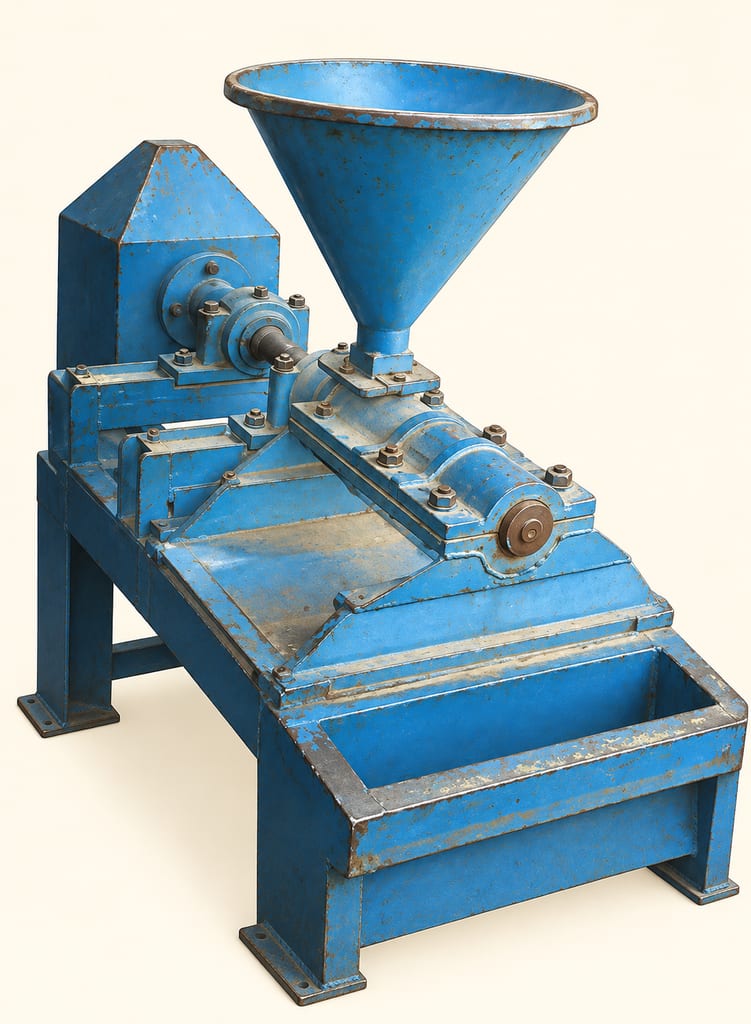
A continuous screw press compresses prepared palm-kernel meal in a perforated cage, draining oil while cake exits separately. FAO documents several preparation routes and machine examples from Benin and Cameroon.
No community contributions have been published for this entry yet.
Sign in to contribute. Published comments and photos are free to read.
International Journal of Food MicrobiologyMethod · Equipment · Geography
Microbiological and chemical changes during the fermentation of African locust bean (Parkia biglobosa) to produce afitin, iru and sonru, three traditional condiments produced in BeninThe study distinguishes Beninese afitin, iru and sonru and describes the basket-tray method for draining cooked, dehulled cotyledons before covering them with jute sacks or cloth.
The products use different local methods and inoculum practices; the paper reports Bacillus spp. as the main organisms involved.
Cited in: A shallow working container for a solid ferment; Benin: baskets, covers and wooden trays; Nigeria: a different daddawa arrangement; What the geometry changes; Choosing and caring for one
Journal of Food Science and TechnologyMethod · Equipment · Geography
Optimal fermentation parameters for processing high quality African locust bean condimentsA Benin study used wooden trays for sonru fermentation and reports a laboratory tray measuring 40 by 25 cm with sides from 4 to 17 cm; this is a study apparatus, not a universal dimension.
The experiment varied fermentation duration, cotyledon layer thickness and yanyanku proportion, showing why vessel geometry and batch depth should be treated as process variables.
Cited in: A shallow working container for a solid ferment; Benin: baskets, covers and wooden trays; What the geometry changes; Choosing and caring for one
International Journal of Agronomy and Agricultural ResearchEquipment · Method · Limits
Performance of a wooden box for production of Afitin, fermented food condiment from BeninThe study compares a wooden box with the traditional basket-and-jute method for afitin; it evaluates one alternative, not a required replacement or universal standard.
Traditional basket, jute bags and cleaned cloths are reported as materials used for fermentation; the study notes variability in the older materials.
Cited in: A shallow working container for a solid ferment; Benin: baskets, covers and wooden trays; What the geometry changes; Choosing and caring for one
Caliphate Journal of Science & TechnologyEquipment · Method · Geography
Effect of fermentation process on nutritional composition of condiments from seeds of P. biglobosa, G. max and H. sabdariffaA Sokoto study's account of traditional daddawa from African locust bean describes spreading the seeds in a large flat basket covered with leaves, then transferring the fermenting mass to a deep bowl.
The article presents this as one Nigerian method, not a single West African standard.
Cited in: Nigeria: a different daddawa arrangement; What the geometry changes; Choosing and caring for one