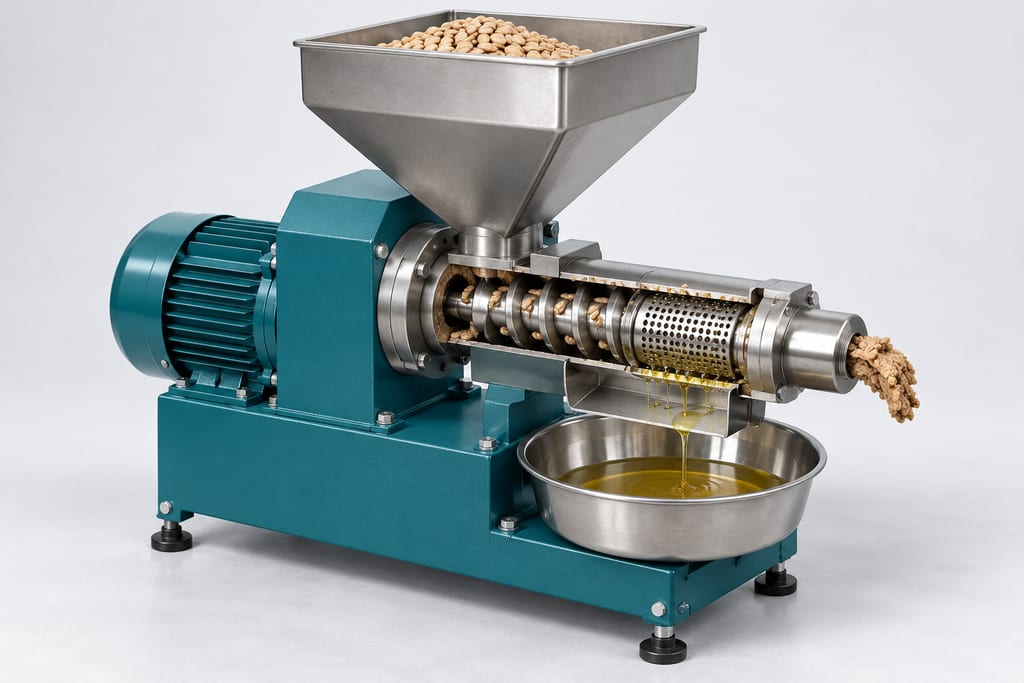
Screw press
A screw press advances prepared material through a cage, squeezing out oil while solid press cake leaves separately.
 FermenteaWhere food goes to change
Equipment · Presses and weights
A continuous screw press compresses prepared palm-kernel meal in a perforated cage, draining oil while cake exits separately. FAO documents several preparation routes and machine examples from Benin and Cameroon.
An expeller press moves prepared kernel meal through a stationary perforated barrel with a rotating, interrupted helical screw called a worm. In FAO’s description, the screw’s working volume narrows from the feed end toward the outlet, progressively compressing material as it advances. This is a continuous mechanical press rather than a traditional hand-operated oil recovery tool.
Oil drains through openings between the cage’s lining bars while the de-oiled solid leaves through an annular outlet. The same machine therefore separates an oil stream from a press cake. The chapter describes this mechanism for palm-kernel meal; it does not provide the dimensions or alloy of any one machine.
FAO groups mechanical palm-kernel extraction into direct screw-pressing, partial pretreatment, and complete pretreatment followed by pressing. Direct pressing can feed kernels without pretreatment; some mills first grind the kernels, and other lines continue through flaking and steam conditioning. The specific route depends on the mill and feed preparation, so the press is not evidence for one universal treatment sequence.
The chapter contrasts these mechanized presses with a described traditional palm-kernel method: frying or simply heating dried kernels, pounding or grinding them to paste, adding a small quantity of water, heating to release oil, and skimming the oil. The expeller belongs to the mechanized route and should not be presented as the traditional process.
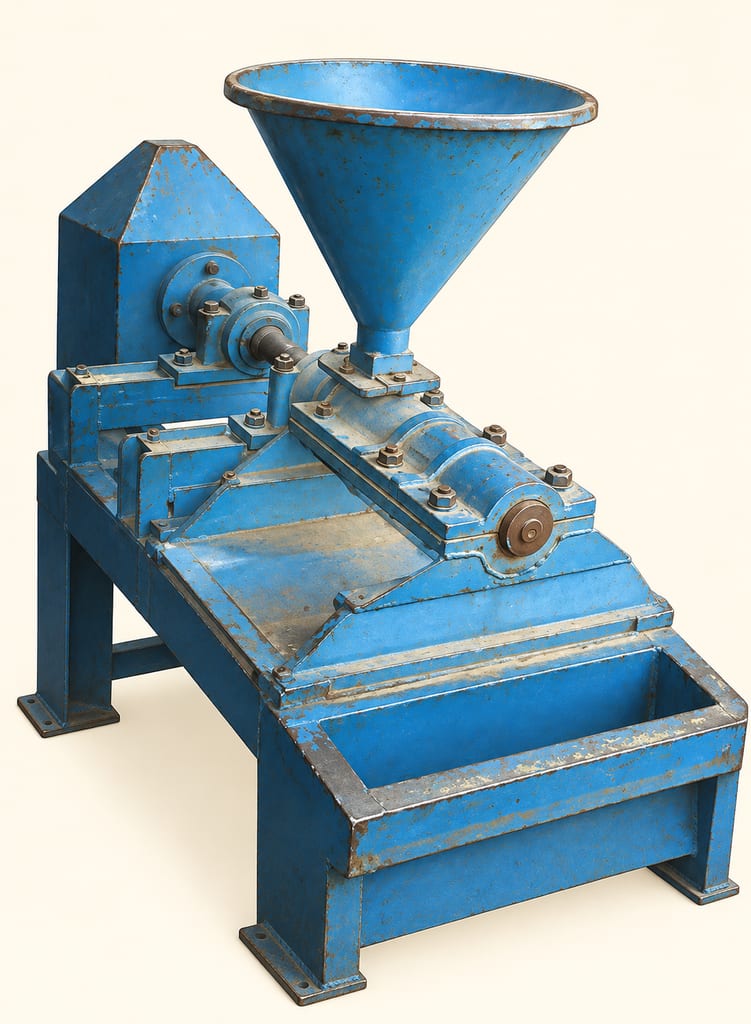
FAO’s chapter shows a whole palm-kernel expeller captioned as CAMEMEC, Benin (Figure 20), and another expeller captioned as O.P.C., Cameroon (Figure 21). Its text also describes village stations accepting well-dried kernels for mechanized, motorized expelling. These are documented examples of use and machine form, not a claim that the expeller originated in either country.
FAO reports that direct screw presses are normally below ten tonnes per unit per day, but gives no capacity for the pictured machines. The chapter also says the expeller output contains fines that must be removed during oil clarification. Dimensions, motor arrangement, local maker availability, cleaning, and maintenance instructions are not established for the generic equipment record.
Palm-kernel oil is extracted from the kernel; the equipment and process should not be conflated with presses for oil from the palm fruit's fleshy mesocarp.
Source →Direct, partial-preparation and full-preparation routes differ; no single pretreatment path or machine setting applies to every palm-kernel expeller.
Source →FAO caption identifies Figure 20 as a whole palm-kernel expeller from CAMEMEC, Benin. This is a documented example, not the type's origin or exclusive range.
FAO caption identifies Figure 21 as a palm-kernel expeller from O.P.C., Cameroon. This is a documented example, not the type's origin or exclusive range.
A screw press advances prepared material through a cage, squeezing out oil while solid press cake leaves separately.
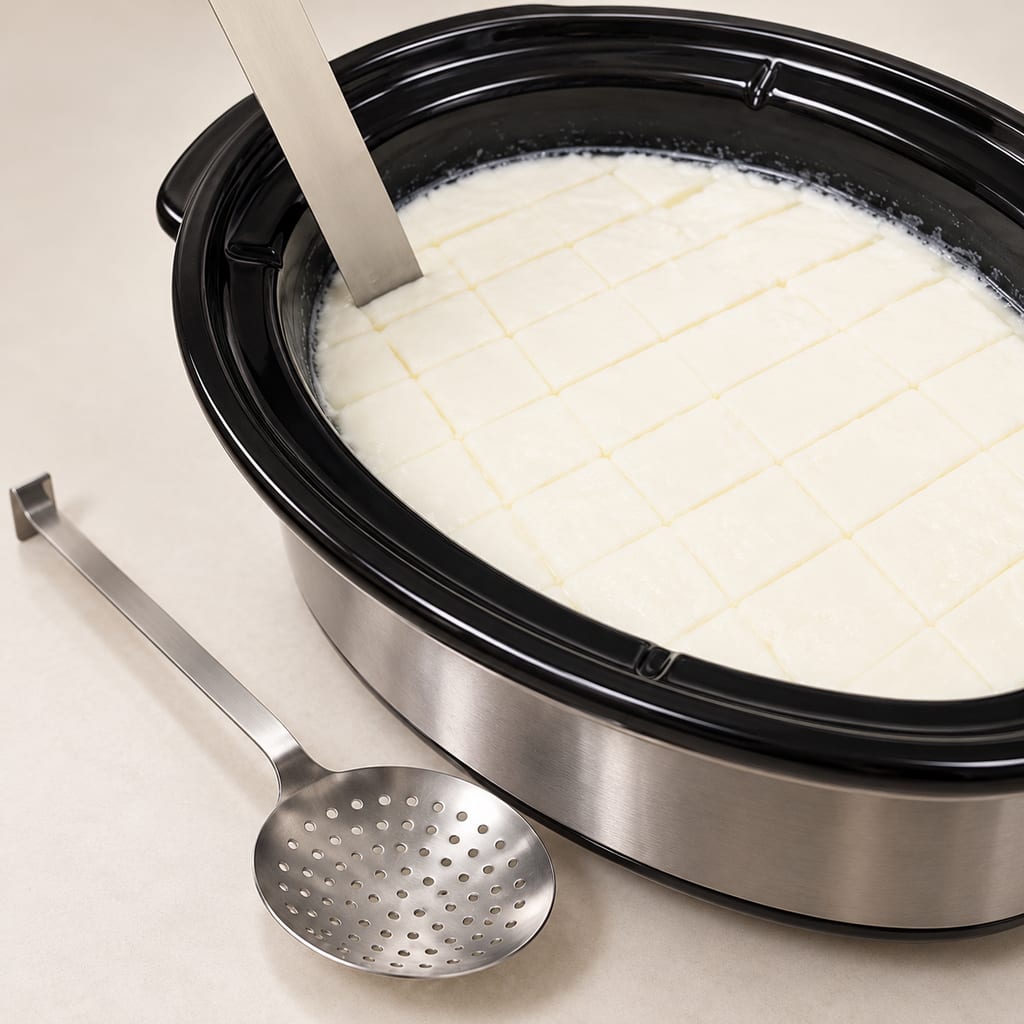
A curd knife cuts set milk into recipe-sized pieces; a perforated ladle lifts and moves curd while whey drains. The hand tools work at different moments in an open cheesemaking vessel.
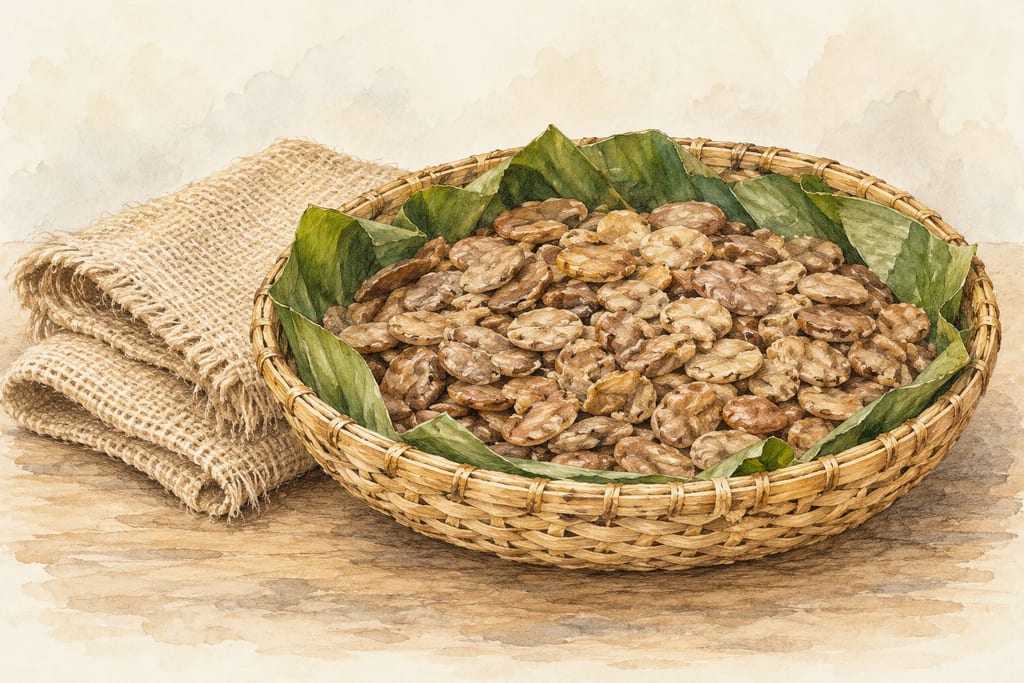
A shallow woven basket or tray can hold cooked, dehulled seeds while they ferment into alkaline condiments. Beninese and Nigerian sources document different basket, tray and cover arrangements rather than one regional standard.
No community contributions have been published for this entry yet.
Sign in to contribute. Published comments and photos are free to read.
Food and Agriculture Organization of the United Nations (FAO)Expeller structure and operation · Palm kernel extraction routes · Documented machine examples
Small-Scale Palm Oil Processing in Africa, Chapter 5: Palm Kernel Oil ExtractionFAO describes a screw press with an interrupted helical worm rotating inside a stationary perforated cage or barrel; the worm compresses meal as its displaced volume decreases toward the discharge.
Oil drains through the cage perforations while de-oiled cake leaves through an annular outlet; FAO states that palm-kernel extraction may use direct screw-pressing, partial pretreatment, or complete pretreatment.
The chapter says village stations accept well-dried kernels for mechanized, motorized expellers. Figure 20 identifies a whole palm-kernel expeller from CAMEMEC, Benin; Figure 21 identifies a palm-kernel expeller from O.P.C., Cameroon.
FAO distinguishes traditional palm-kernel oil recovery by frying or heating and grinding kernels to paste, then adding a little water and heating to release oil, from mechanized expeller extraction.
Cited in: A screw inside a perforated cage; Different routes to the press; Documented palm-kernel examples