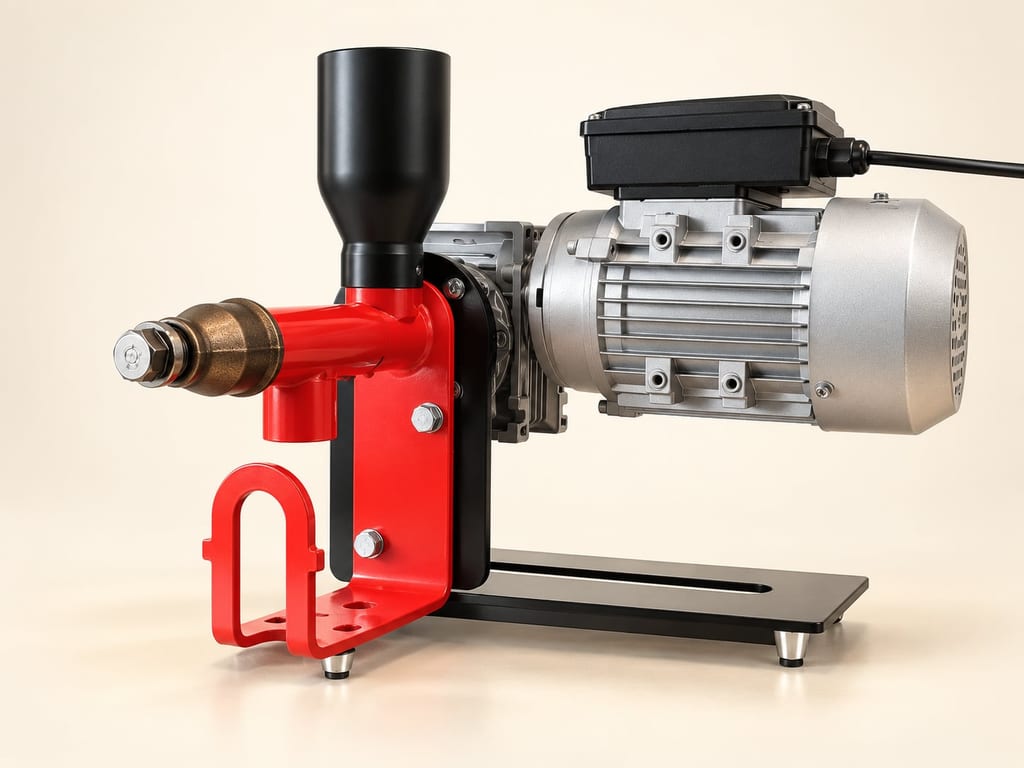
Small oil expeller
Small oil expellers use a screw to compress prepared oilseeds and nuts, separating oil from press cake. Piteba documents manual and motorized small-scale examples; their settings and feed requirements do not define every press.
 FermenteaWhere food goes to change
Equipment · Presses and weights
Oilseed screw press
A screw press advances prepared material through a cage, squeezing out oil while solid press cake leaves separately.
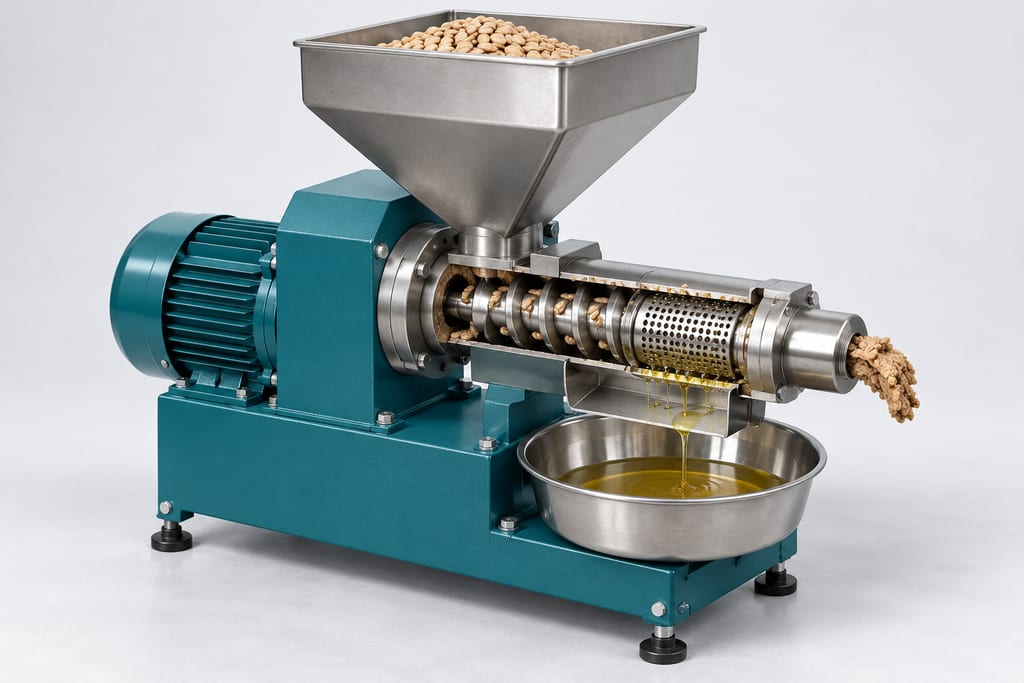
A screw press is a mechanical extractor in which a rotating screw advances material through a press barrel or cage. The available space narrows toward the outlet, compressing the feed as it moves. FAO describes the screw as an interrupted helical worm inside a stationary perforated cage: oil escapes through the cage openings while the more solid cake leaves at the outlet. This is a continuous screw-driven mechanism, but individual machines differ in their drive, cage, screw, pressure settings and feed route. The related palm-kernel expeller page covers one crop-specific group of machines; this entry uses a Moroccan press studied with prickly-pear seeds as a separate documented model example, not a competing invention.
A 2026 study of Opuntia ficus-indica seed oil from eastern Morocco identifies its machine as a P55/AFYACH screw press made in Morocco in 2019. Its published study identifies a 220/380 V supply and includes the equipment in Figure 3. The current manufacturer listing describes a single-head oilseed press with a variable-speed 1.5 kW motor and a claimed input rate of 2–5 kg per hour, depending on seed density and extraction speed. That current specification is distinct from the study's particular machine, and neither is a type-wide standard. The visible example has a hopper above a compact painted housing, a metal press head and a collection pan. It is one contemporary design, not the universal form of screw presses.
In the Moroccan study, the feed was dried Opuntia ficus-indica seed. The researchers describe cold mechanical pressing without chemical extraction during the pressing step, followed by decanting and several rounds of paper filtration to remove seed debris. They report 67.10 g of oil from 500 g of dried seeds, or 13.42 percent for that batch. This figure is the study's yield under its conditions; it is not a capacity rating or an expected result for other seed species, moisture levels, press settings or machines. The paper identifies the seed collection area as Guerbouz in Berkane Province, eastern Morocco, but does not give the operating location of the press.
The screw press mechanism is shared by unlike machines. FAO describes motorized palm-kernel expellers in Benin and Cameroon and distinguishes direct pressing from routes that include grinding, flaking or steam conditioning. The Piteba oil press is another named electric model for oil-rich seeds and nuts; its own page gives model-specific setup instructions. These records are linked for comparison because they share screw-driven extraction, not because their capacity or preparation steps are interchangeable. The sources consulted here do not provide a universal seed setting, cleaning schedule or safety manual for the P55. Use the instructions and guards for the exact machine, and do not transfer a yield or setting from one crop and model to another.
Kadda et al. document a Moroccan-made P55/AFYACH press manufactured in 2019; FAO documents mechanized palm-kernel expellers, but neither source dates the origin of screw pressing.
The mechanism advances and compresses material while the press runs.
Hazard sourceThe studied P55/AFYACH is reported as a 220/380 V machine; the current maker listing describes a variable-speed electric motor.
Hazard sourceUse the exact model's guarding, electrical and stop instructions; the research sources describe extraction but do not provide an operating safety manual.
Control sourceThe 13.42% yield is a result for one 500 g dried Opuntia ficus-indica batch, not a universal press yield.
Source →The current Ateliers Afyach P55 throughput and dimensions are manufacturer specifications for that model; they do not define all screw presses or necessarily the press used in the 2019 study.
Source →FAO's mechanism description is in the context of palm-kernel expellers, while the 2026 study documents a P55 for Opuntia seeds; the feed and operating route differ.
Source →The article identifies the press as made in Morocco; it does not give the workshop locality.
The article gives this area as the seed collection source; it does not locate the press's operating site there.
Small oil expellers use a screw to compress prepared oilseeds and nuts, separating oil from press cake. Piteba documents manual and motorized small-scale examples; their settings and feed requirements do not define every press.
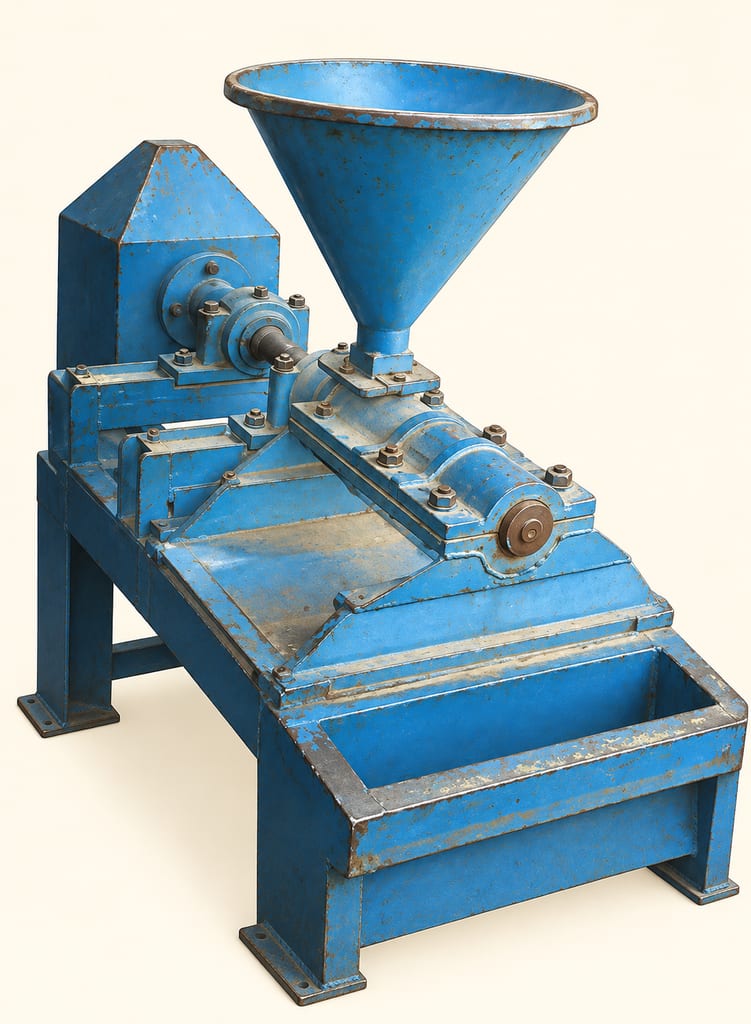
A continuous screw press compresses prepared palm-kernel meal in a perforated cage, draining oil while cake exits separately. FAO documents several preparation routes and machine examples from Benin and Cameroon.
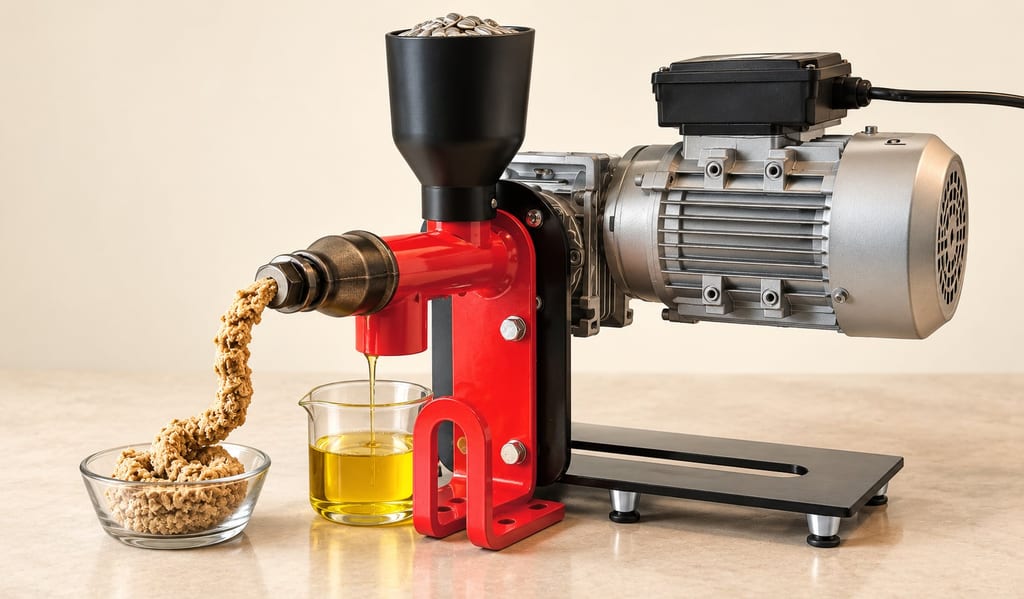
The Piteba electric oil press uses a motor-driven screw to separate oil from prepared oil-rich seeds and nuts. Oil drains through a slit; pressed cake exits the cap.
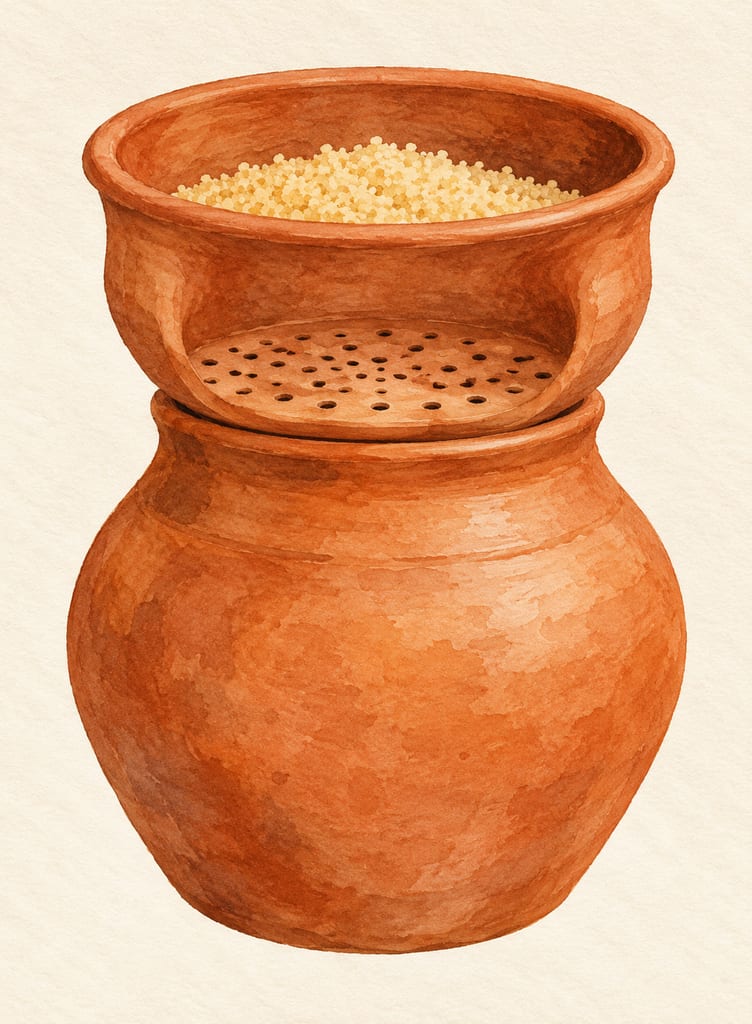
A two-part steamer for couscous: a perforated upper chamber sits over a lower pot that produces steam. Clay, basketry and metal forms are documented in different places and periods.
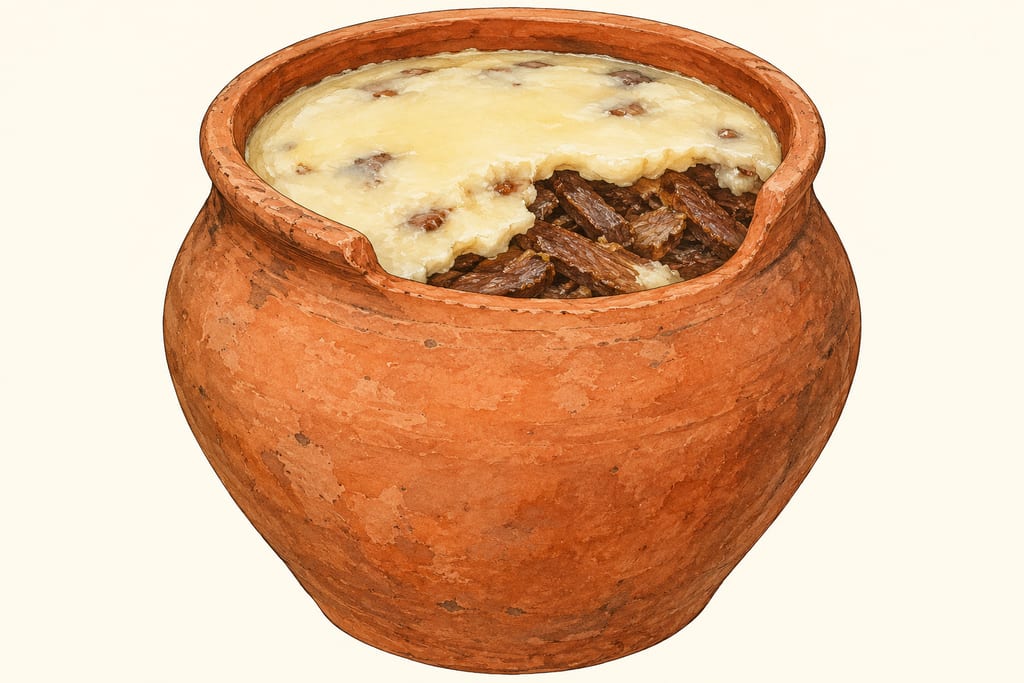
Khlii storage vessels hold prepared meat beneath rendered fat or oil. Traditional terracotta jars and present-day plastic tubs are both recorded forms in Morocco.
A ceramic Ezzir jar holds salted butter during smen maturation in Algeria; a goatskin Chekoua is documented for churning the sour milk beforehand. Sources also report animal-skin containers, but do not establish a single shared form.
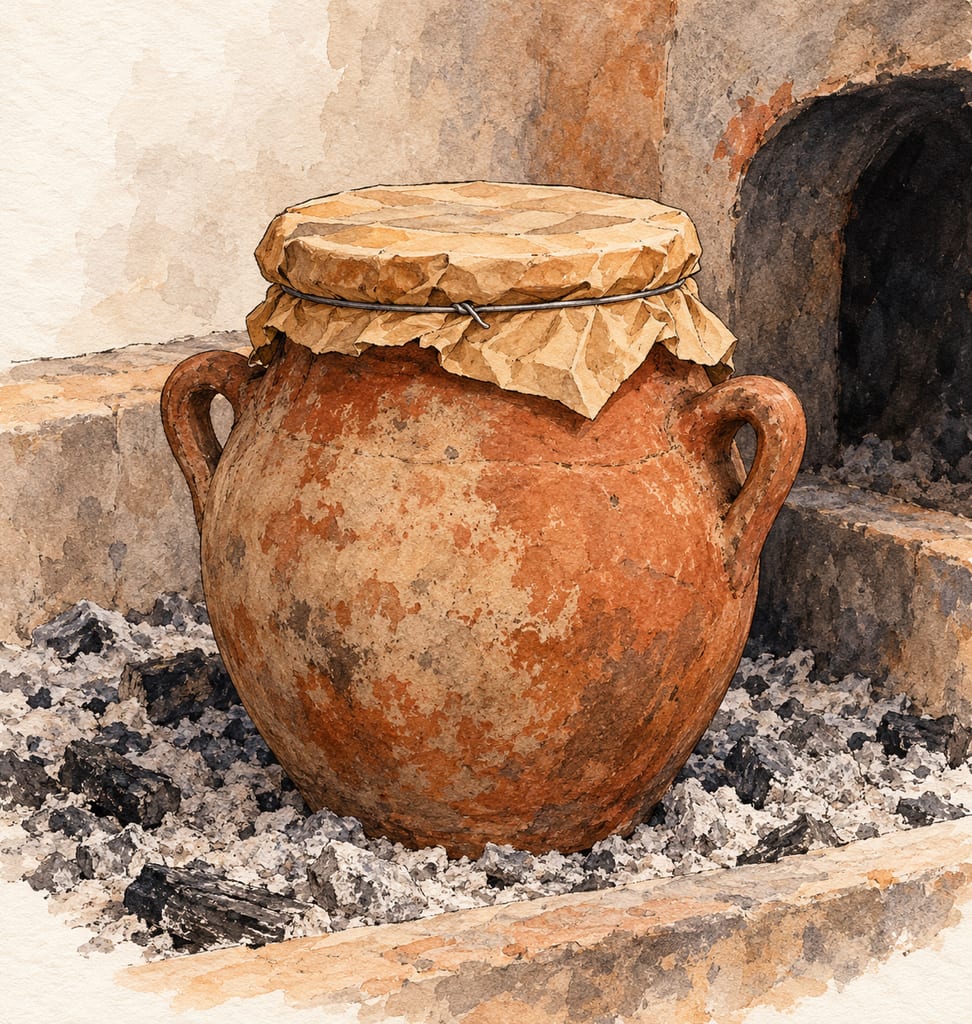
A purpose-made terracotta vessel, also called tangia or kallouch, for Marrakech’s slow-cooked tanjia. Potters make it mainly in Marrakech; a fernatchi cooks the closed jar among managed furnace embers.
No community contributions have been published for this entry yet.
Sign in to contribute. Published comments and photos are free to read.
Scientific ReportsModel and geography · Seed pressing · Process outcome · Image reference
Applications of Opuntia ficus-indica (L.) mill seed oil from eastern Morocco including chemical profiling, antibacterial activity, and dockingThe paper identifies an Ateliers Afyach P55/AFYACH oil press made in Morocco, with 220/380 V supply and a 2019 manufacture year.
The studied extraction passed Opuntia ficus-indica seeds through a screw press, then decanted and filtered the oil.
The authors say seeds were collected in Guerbouz, Berkane Province, Eastern Morocco; the press's actual operating site is not stated.
The paper reports 500 g of dried seeds yielding 67.10 g oil (13.42%) in its study; this is a study result, not general press capacity or guaranteed yield.
Figure 3 captions the pictured press as an oil press for Opuntia ficus-indica seeds from Eastern Morocco.
Cited in: How the screw press separates oil; A documented P55/AFYACH example; Feed preparation and the studied seed oil; Different presses, different settings
Food and Agriculture Organization of the United NationsScrew press mechanism · Comparison
Small-Scale Palm Oil Processing in Africa, Chapter 5: Palm Kernel Oil ExtractionFAO describes a rotating interrupted helical worm moving material through a stationary perforated cage, with the working volume narrowing toward the outlet.
Oil drains through the cage openings while press cake exits at an annular outlet.
FAO describes direct screw pressing and partially or fully pretreated palm-kernel routes; the feed and treatment vary by mill.
FAO captions two whole palm-kernel expeller examples from Benin and Cameroon; these are examples and not the origin of screw pressing.
Cited in: How the screw press separates oil; Different presses, different settings
Les Ateliers AfyachCurrent model specifications
Presse d’extraction d’huile P55The manufacturer’s product listing states that the P55 is for oilseed extraction and lists a single press head.
The current P55 listing gives 1.5 kW variable-speed electrical power, 220/380 V supply, food-grade stainless construction with painted steel chassis, dimensions 1080 × 600 × 400 mm, approximate weight 165 kg, and claimed throughput 2–5 kg/h depending on fruit density and extraction speed.
These are current manufacturer specifications and not all are established for the 2019 study machine.
Cited in: A documented P55/AFYACH example; Different presses, different settings