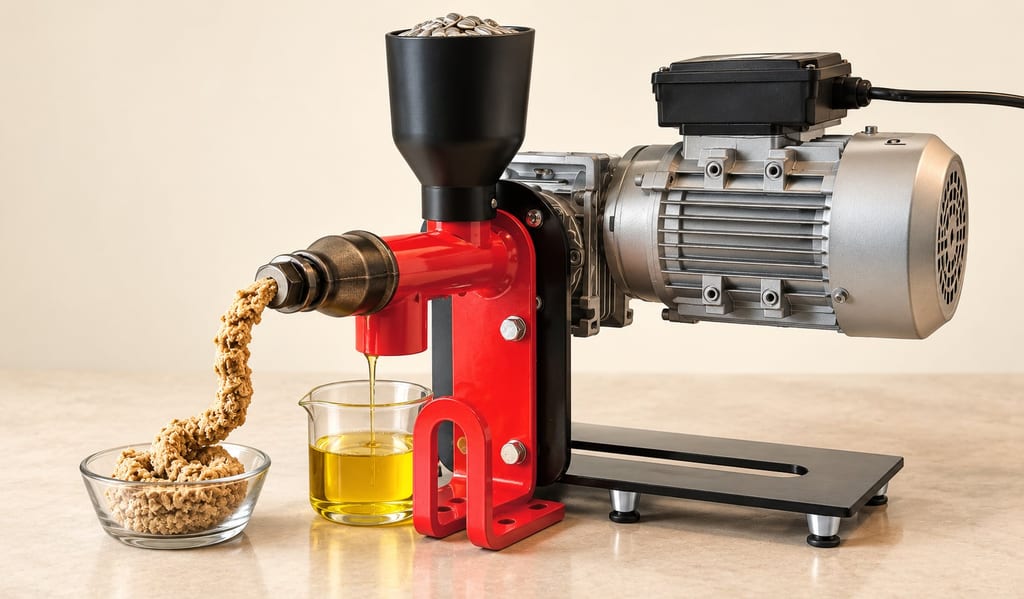
Piteba oil press
The Piteba electric oil press uses a motor-driven screw to separate oil from prepared oil-rich seeds and nuts. Oil drains through a slit; pressed cake exits the cap.
 FermenteaWhere food goes to change
Equipment · Presses and weights
Small oil expellers use a screw to compress prepared oilseeds and nuts, separating oil from press cake. Piteba documents manual and motorized small-scale examples; their settings and feed requirements do not define every press.
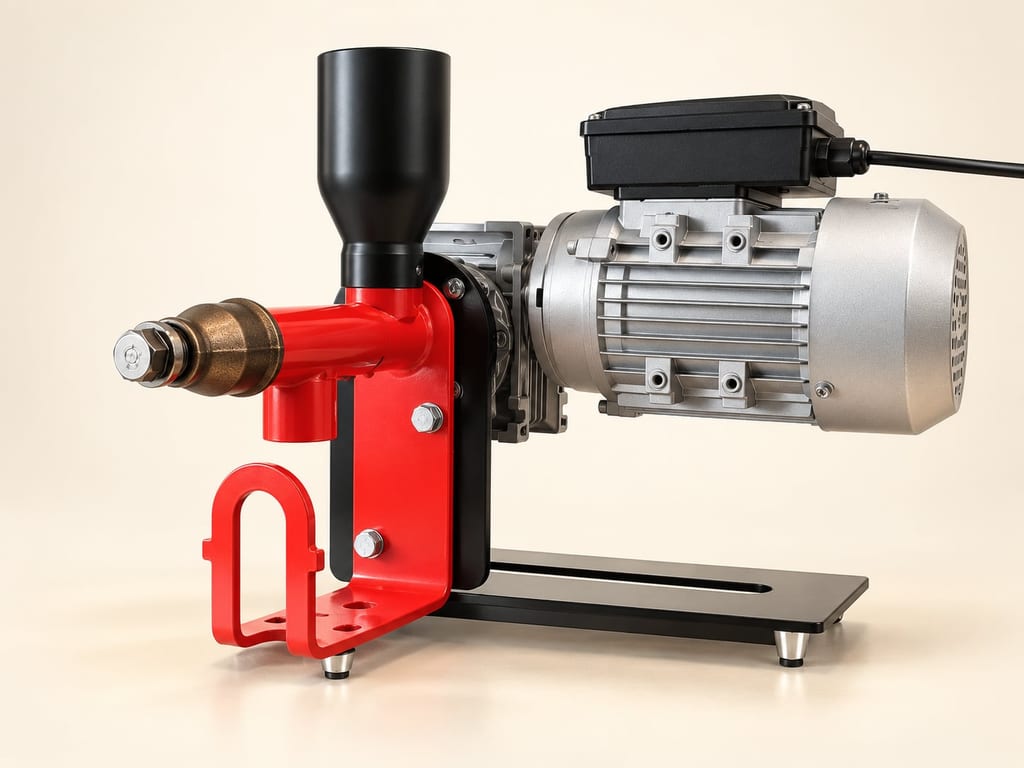
A small oil expeller is a compact press that uses a screw to compress prepared oilseeds or nuts. The general mechanism separates liquid oil from the compressed solid press cake, but the exact chamber, outlet, power source and controls vary by machine. The title names a functional equipment class rather than one brand or standard model. Piteba's manual press and its motorized version are documented small-scale examples; the manufacturer says the electric model uses the same basic press mechanism as its hand-driven version.
This entry is narrower than the general screw-press page: it focuses on small oilseed and nut presses rather than every screw-driven press or industrial scale. A press designed for oil-bearing seeds is also different from a ghani. K. T. Achaya's FAO account describes the traditional Indian ghani as a circular mortar holding seed beneath an upright pestle, turned around by an animal through a load beam. Its crushing action does not use a screw.
In Piteba's documented press, seed or nut material is fed through a hopper into a screw-driven press assembly. The screw continuously compresses it; oil runs out while the remaining press cake is discharged through the end cap. An adjustment bolt changes pressure in that Piteba design. These details illustrate one small press and should not be mistaken for a universal layout or setting across all expellers.
Feed preparation matters. Piteba lists sunflower, walnut, sesame and peanut among suitable oil-rich seeds and nuts, and says its press needs seed with about 10 percent moisture. The maker warns that material that is too dry can stop oil flow and the motor. Its adjustment guide also gives seed-specific advice. These are instructions for Piteba's equipment, not a shared moisture recipe for every crop or machine.
Piteba describes a throughput of up to about 3.5 kg of seed per hour for one electric press, with results depending on seed type. Treat this as the manufacturer's figure for its current model, not a rating for the wider small-expeller class. Other presses can differ in screw size, drive, throughput and the condition of their feed.
The manufacturer says its expressed oil may come out cloudy and can settle at room temperature over several days; the cake can be discharged separately. This page does not treat that statement as a universal clarification or storage instruction, nor does it infer oil quality or shelf life. Recipes and ingredient records linked from this equipment entry identify documented outputs, not guaranteed yields.
For the Piteba model, the manufacturer instructs users to keep the filling funnel in place so fingers cannot reach the screw, use the on/off switch rather than unplugging the motor as a stop control, and stay nearby if seed bridges at the hopper. Follow the manual supplied with the actual press; neither those controls nor the motor arrangement are universal across all small expellers.
Piteba describes its current oil press as a Dutch product made in its own workshop. Separately, a 2010 Wikimedia Commons photograph shows a hand-operated Piteba press in use in Ghana; its caption and image show one documented use, not the geographic origin or prevalence of this equipment class. The FAO ghani source concerns traditional oil pressing in India and should not be used to assign Indian origin to screw expellers.
The sources document current small Piteba models and compare screw presses with the distinct Indian ghani, but do not date the origin of small oil expellers.
This is a functional class entry, not a model specification. Piteba is a documented small-scale example; its electric output, voltage, moisture target and adjustment instructions must not be applied to every expeller.
Source →Seed and nut preparation, moisture and pressure are feedstock- and model-specific. Piteba says its press needs about 10 percent moisture; this is a Piteba-specific instruction, not a universal oilseed target.
Source →The manufacturer tells users to stay near the Piteba press because seed can bridge at the hopper; it also instructs users to use the funnel and on/off switch.
Source →The FAO ghani comparison concerns a different mortar-and-pestle mechanism; it does not make the animal-powered ghani a screw expeller.
Source →Piteba says the discharged oil can be cloudy and settle; the consulted sources do not establish a general refining or shelf-life rule for oils from all expellers.
Source →Piteba describes its press as a Dutch product made in its own workshop; this records one model manufacturer, not the origin or manufacture of every small expeller.
The 2010 photograph documents one hand-operated Piteba press in use in Ghana; it does not establish wider distribution or a local tradition.
The Piteba electric oil press uses a motor-driven screw to separate oil from prepared oil-rich seeds and nuts. Oil drains through a slit; pressed cake exits the cap.
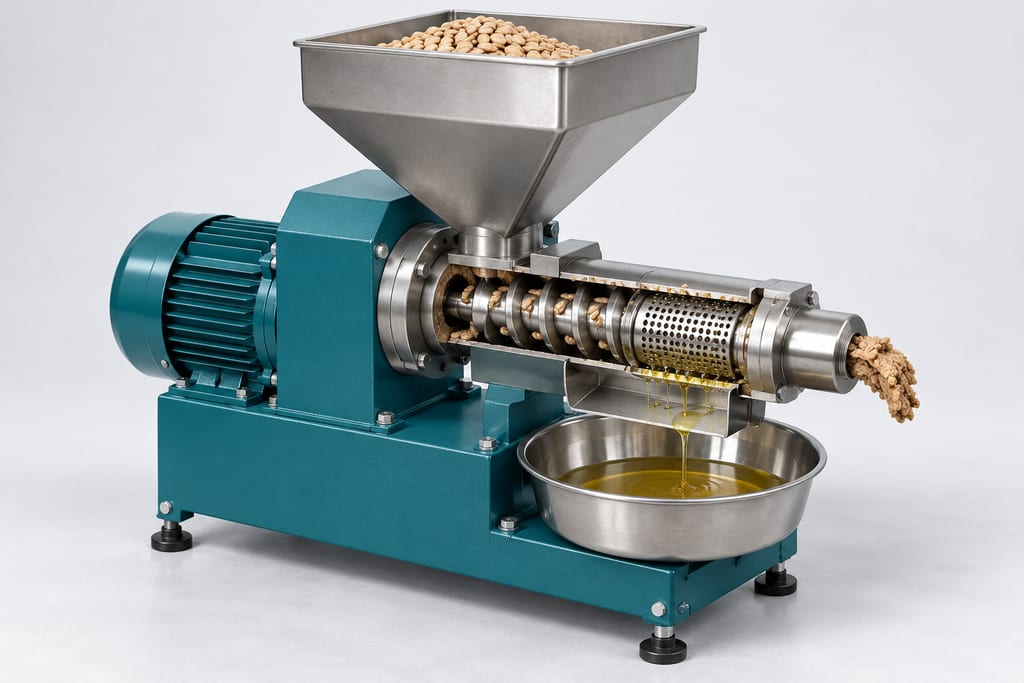
A screw press advances prepared material through a cage, squeezing out oil while solid press cake leaves separately.
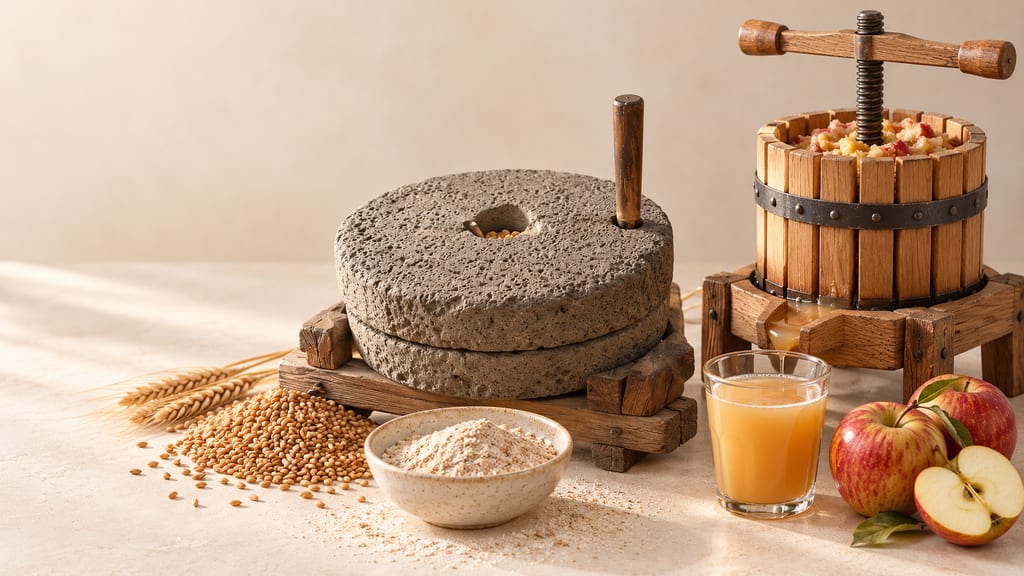
A blender, a stone refiner and a small screw press each replace hours of pounding or squeezing, but grinding, pressing oil and extracting a milk are different jobs with different limits.
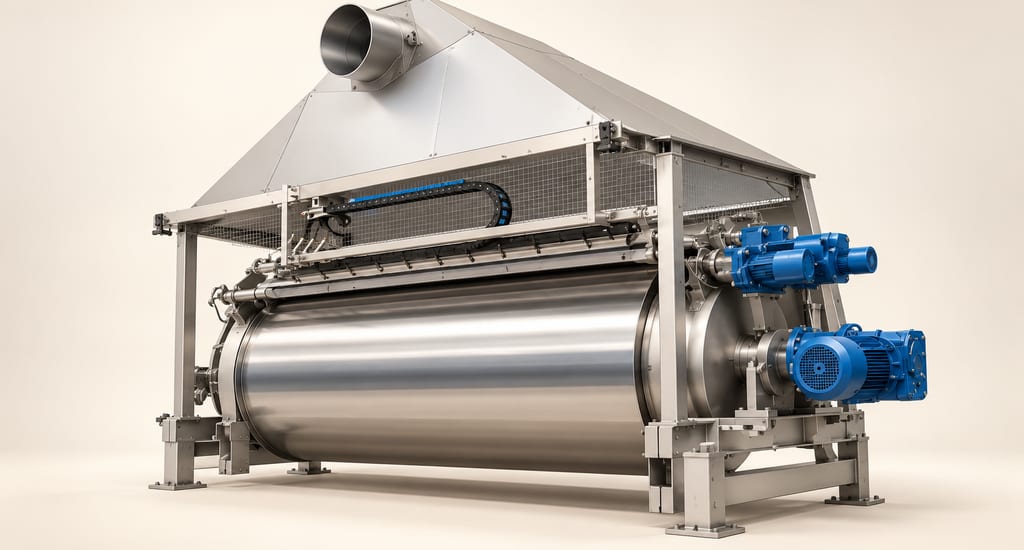
A drum dryer spreads pumpable wet food as a thin film over one or more internally heated rotating metal drums. A blade scrapes the dried layer off for flaking, milling or further blending.
No community contributions have been published for this entry yet.
Sign in to contribute. Published comments and photos are free to read.
PitebaCurrent model example · Operation · Safety · Care · Manufacture
Electric oil press: how to press oil from seeds and nutsPiteba says its electric model uses the same screw press mechanism as its manual version, powered by a motor.
For the Piteba model, the manufacturer describes screw compression, oil flow and automatic press-cake discharge through the cap, with pressure adjusted by a bolt.
Piteba gives a manufacturer throughput of up to about 3.5 kg of seed per hour, depending on seed type; this is model-specific, not a class-wide rating.
Piteba says its press accepts oil-rich seeds and nuts such as sunflower, walnuts, sesame and peanuts; it reports a target of about 10 percent seed moisture for its model.
Piteba warns users to stay near the press if seed bridges at the hopper and to use the filling funnel and on/off switch.
Piteba says its product is Dutch and made in its own workshop.
Cited in: A small screw press for oil-bearing feed; How the press works; Model limits and output; Safety, examples and geography
PitebaModel specific adjustment
Improve press results: correct setting of adjustment boltPiteba explains that its adjustment bolt changes pressure and that the suitable setting depends on the seed.
Piteba gives ingredient-specific handling instructions, illustrating that preparation and adjustment do not transfer unchanged across feedstocks.
Cited in: How the press works
Food and Agriculture Organization of the United Nations; K. T. AchayaComparison · Indian traditional press context
Ghani: A traditional method of oil processing in IndiaAchaya describes the ghani as a mortar with an upright pestle driven around by animal traction; it is mechanically distinct from a screw expeller.
The FAO account compares ghani pressure with small screw-press and large expeller pressure, framing the values as a comparison in that technical account rather than model specifications.
The FAO account places the historical discussion in Indian oil processing.
Cited in: A small screw press for oil-bearing feed; Safety, examples and geography
Wikimedia Commons; photograph by Gerard van de GardeImage reference
Piteba oliepers - Help Ghana op gang.JPGThe image page identifies a Piteba oil press used in Ghana and states CC BY-SA 3.0; the photograph depicts the hand-operated form, not the electric version.
Cited in: Safety, examples and geography