
Home equipment crafts
Mills, presses and extractors at home
A blender, a stone refiner and a small screw press each replace hours of pounding or squeezing, but grinding, pressing oil and extracting a milk are different jobs with different limits.
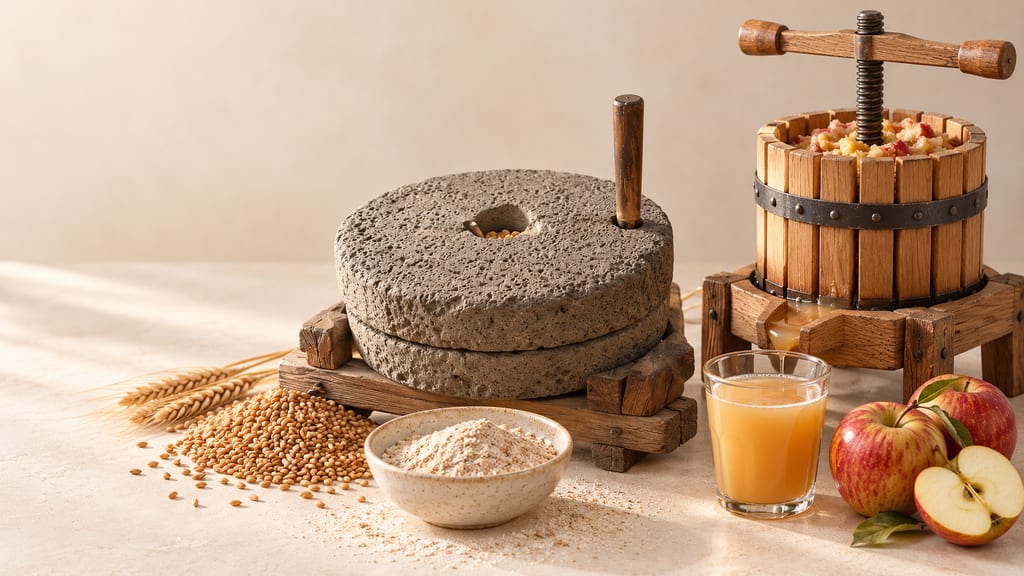
A stone hand mill, grain and fresh juice: the oldest kitchen tools are the ones that break food open.
Three jobs a motor can take over
Many traditional foods begin with hard physical work that has nothing to do with heat or microbes. Seeds are ground to a paste. Oilseeds are crushed until oil runs. Grated coconut, soaked tigernuts or wet maize are squeezed through cloth to carry their soluble and suspended parts into water. That work was done with stones, pestles, animals and hands, and the kitchen motor has taken over much of it, though not all.
Three different jobs hide under the word grinding. The first is particle reduction: breaking a seed, a nib or a grain into ever smaller pieces until the paste feels smooth on the tongue. The second is pressing: squeezing a seed hard enough that its oil flows away from the solids. The third is extraction followed by separation: grinding a food with water so that fat, protein, starch and flavour pass into a milky liquid, then straining the solids out and, sometimes, splitting the liquid itself into cream and water. Each job has its own physics, and a machine built for one can do another badly.
Friction runs through all three. In the Indian ghani, the friction of the pestle on dry sesame produces the heat that cooks the ground seed. A chocolate refiner works better when its drum is warm, but its maker warns against letting it get hot. Village coconut oil is made by boiling the milk for hours. The heat in each case is either a tool or a side effect, and knowing which matters as much as knowing the speed of the blade.
Ogi, poi and gari also ferment after milling, and that biology runs on its own clock whatever machine did the grinding.
Blender minutes, refiner days
The contrast is easiest to see with sesame. Vitamix's tahini recipe puts 5 cups (705 g) of toasted sesame seeds in the blender, starts it at the lowest speed and quickly raises it to the highest, and blends for two to three minutes, using the tamper to push the seeds down into the blades. Toasting is optional, but the recipe notes that toasted seeds give a more uniform and smooth texture rather than a thicker paste, and a more intense flavour; it toasts them at 180 °C for ten minutes. A stone chocolate refiner takes about three hours over the same job.
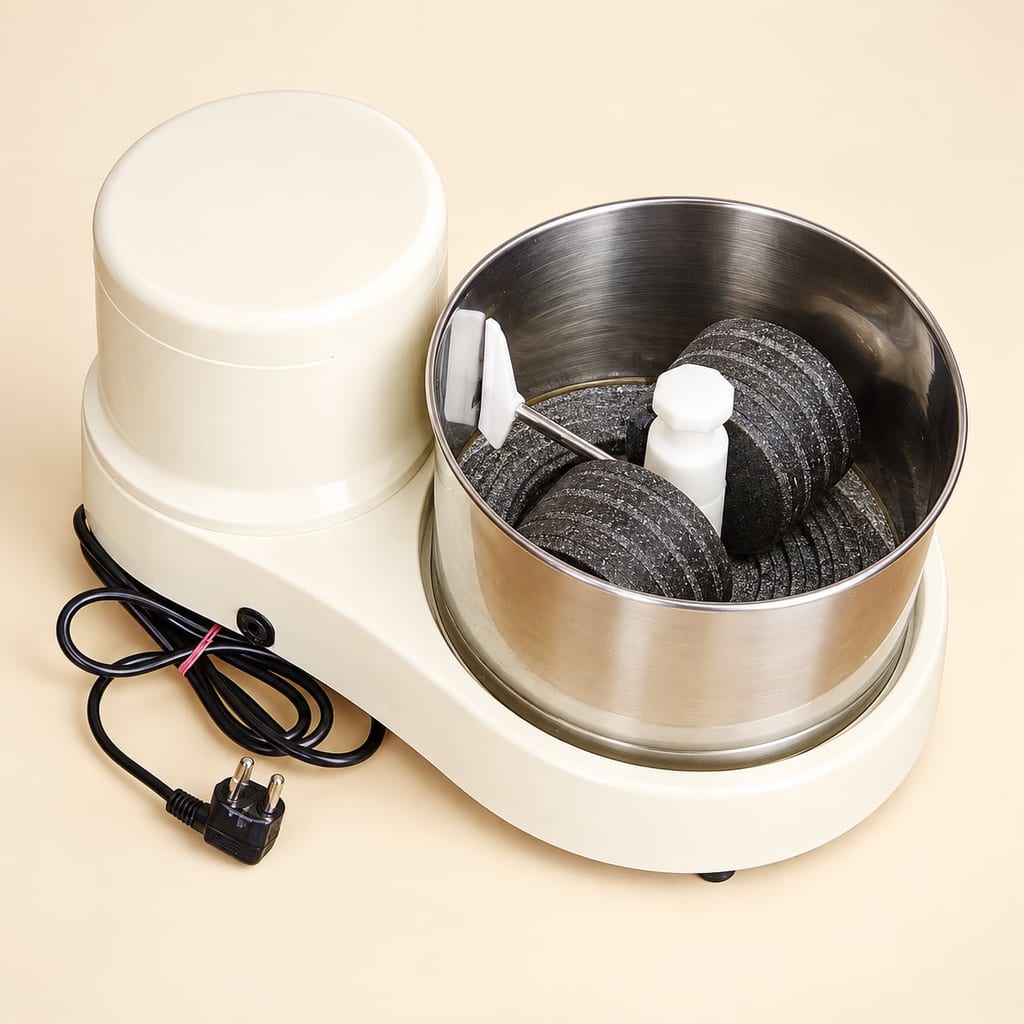
A chocolate refiner, also called a melanger, works differently from a blender. In the Premier, sold by Diamond Custom Machines (DCM), a 200 W motor turns a stainless-steel drum under granite roller stones, whose pressure on the mass is set with a knob; DCM compares its electricity use to a 200-watt light bulb. The machine is built in Chennai, India, by Sivanesan Company. The maker puts the main difference between its refiner and an ordinary wet grinder in the motor and safety features: wet grinders are designed to run for short periods, while the refiner has been tested to run safely for 72 hours continuously. It has a heat-triggered cut-off in case the motor overheats. The refiner also makes nut butters and spreads and can grind rice or lentils into a paste for dosa, the South Indian batter whose fermentation is covered in the article Rice, koji and malt in a warm hold.
Running for days is the point. The stones refine cocoa particles to below 20 microns, the size at which the tongue perceives only smoothness. The maker gives between 24 and 72 hours to get there, depending on conditions. Refining for more than 48 hours with the pressure knob fully engaged can over-refine the chocolate into a sticky mass like peanut butter. Once the chocolate is smooth enough, the knob can be loosened or removed and the machine run in a conching mode for up to 72 hours, aerating the chocolate so that harsh, acidic notes disperse without further grinding. These times are the maker's guidance for its own machine, not a rule for every refiner.
A blender's blades chop and fling the seeds for a few minutes; a refiner's stones roll over the mass, a little at a time, for hours or days. That difference explains why one finishes tahini in minutes and the other spends days on chocolate, and it explains the maker's warnings. The stones must never run dry for more than a few seconds, which can damage them for good. Whole nuts must be pre-ground to a wet, sand-like powder first, and the machine should be filled to at least 30 per cent of capacity. A room below 18 °C can let chocolate set in the drum. The motor and parts set a heat limit as well: product warmed with a heat gun or hair dryer should stay below 65 °C, never reaching 75 °C, and the maker's recipes say never above 60 °C. Warmth helps because it frees cocoa butter faster: the warmer the room, the shorter the refining. Water does the opposite: honey, syrups, liquid milk and vanilla extract make chocolate seize and can damage the machine.
Sesame, nuts and the order of ingredients
In a refiner, nut and seed butters are a short job compared with chocolate. The maker's freshly ground tahini starts with 50 g of sesame oil in the drum, then adds 950 g of roasted whole or hulled sesame seeds about 100 g at a time, and processes for three hours. The added oil is a formulation choice; the Vitamix recipe uses seeds alone. Both rest on the same rule for all such pastes: the mass starts thick and becomes fluid only as oils and fats are released.
With more than one ingredient, start with those that contain oils and fats, such as nibs, seeds and nuts, and add dry ingredients like sugar and milk powder only once the paste is fluid. A hazelnut chocolate spread made this way roasts 550 g of hazelnuts until light caramel in the middle, removes the skins, pulse-grinds them to a fine flour in a mixer-grinder for about a minute, and lets the refiner turn the flour into a thick paste before adding 350 g of sugar in 100 g portions. After five hours, 100 g of cocoa powder goes in, 50 g at a time, and the machine runs for another half hour. A gianduja bar adds roasted hazelnut flour and sugar to cacao that has already refined for about eight hours, then runs for at least ten to fifteen hours more.
Roasting, pre-grinding and sweetening are separate choices made before and during the grind. The refiner supplies patience. It does not decide the roast, and the maker leaves best-before dates to each chocolate maker; its storage times are recommendations only.
Chocolate for drinking: grinding and frothing are separate jobs
Grinding cacao and preparing the drink call for different tools. The molinillo, a carved wooden whisk held in the Smithsonian's collections, is a whisk for a pot of melted chocolate and milk heated together. Its handle is turned between the palms, and it beats the liquid until it froths. In Mexican tradition the foam holds the spiritual essence of the chocolate.
A modern kitchen can split the same two stages between two machines. A refiner's 70 per cent dark chocolate, 700 g of cocoa nibs refined for about eight hours before 300 g of sugar is added and the whole runs for ten to fifteen hours more, makes a base for bars, confections and hot chocolate. The milk cannot go into the refiner, because liquid milk makes chocolate seize, so it belongs in the pot, where a molinillo or a milk frother does the frothing. A regional drinking chocolate follows that region's own recipe rather than a refined modern bar.
Pressing oil: the seed has to be ready
The ghani is the classic Indian oil mill: a large mortar in which a pestle is turned by an animal walking in a circle. Vegetable juices were extracted with mortar and pestle as early as 1500 BC, a Sanskrit text of about 500 BC refers to an oil-press, and ghani work is depicted in a thirteenth-century temple in South India. As the animal circles, the pestle rotates and presses sideways against the upper wall of the pit. The pressure comes mainly from a weight placed on the load-beam, usually 115 to 160 kg, and reaches about 10 kg/cm² at the point of greatest contact.
Water is the ghani operator's control. For 10 kg of sesame, and water goes in at set points in small, measured amounts: 180 ml sprinkled around the upper wall of the pit and 120 ml poured into it, then 300 ml round the pithead. After about 45 minutes a sudden flood of frothy oil covers the surface; 100 ml more goes over the oil, and finally about 20 ml is brushed over the cake. The additions total about 7.5 per cent, and each has a purpose. The first gives the pestle a grip on dry seed, and the friction produces heat. The second, with that heat present, cooks the ground seed. After the oil appears, the third hydrates and coagulates gums and phospholipids, and the last clears oil from the surface of the cake. The operator tests the cake by balling it in the palm, and if it crumbles too easily, more water is needed. A ghani yields about 5 per cent less oil from sesame or groundnut than a modern expeller and leaves about 15 per cent fat in its cake, roughly twice as much as screw-press cake. A traditional ghani handles at most about 50 kg a day. Flavour was best in oils from mild ghani crushing, but that urban households today want bland, refined oil.
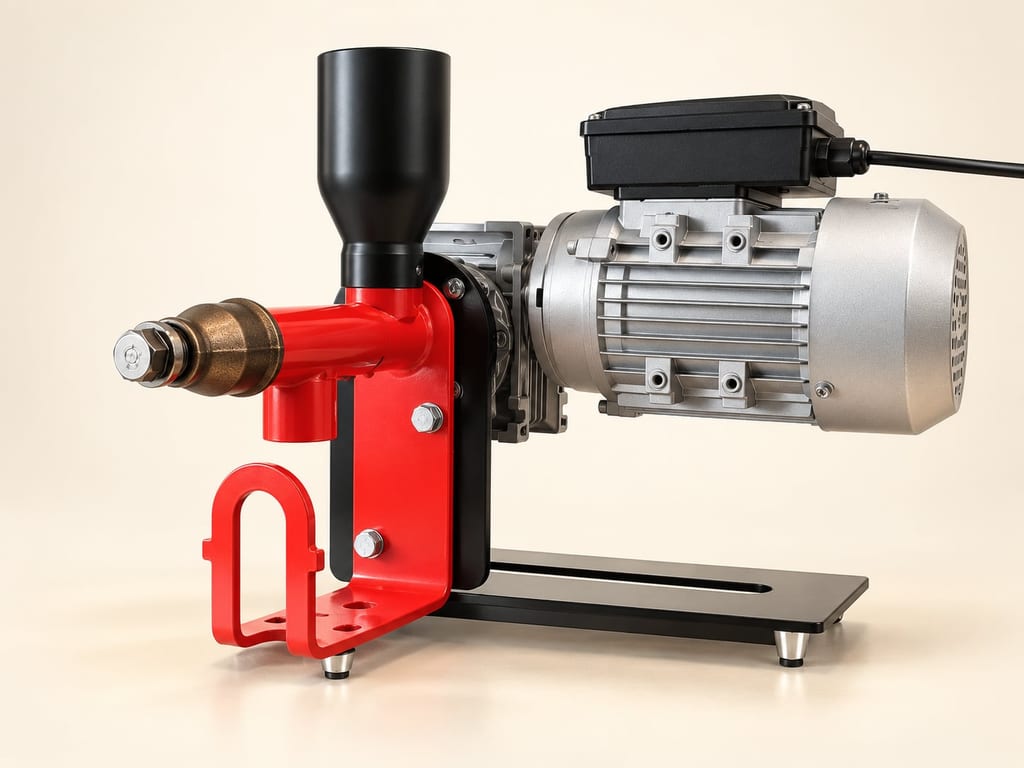
A small screw press, such as the Piteba, replaces the pestle with a screw that continuously compresses seed inside a press cage, so that oil runs out and a cake emerges. The electric version uses the same press as the hand-driven one, turned by a slow electric motor, and the maker says it presses up to 3.5 kg of seed an hour, depending on the seed. Piteba's rule for seed condition is strict: the seed must always contain about 10 per cent moisture. If it is too dry, no oil comes out and the motor stops. That holds for every seed, while the preparation varies: walnuts should be shelled and crushed first, sunflower seed can be pressed untreated, and coconut has to be dried into copra until no white remains, then grated or cut small. Piteba says the press works at room temperature without heating, although a small burner is supplied to warm the press cage first when the room is below about 20 °C. The maker states that the oil stays below 40 °C. Pressed oil comes out cloudy and clears if left to stand for a day or two somewhere warm. The adjustment bolt sets the pressure, and the yields differ widely by seed: Piteba lists an extraction efficiency of 50 per cent for sesame against 86 per cent for sunflower.
The cake is food as well as waste. In West Java, black oncom is fermented from the presscake left after pressing peanut oil, as described in the article Soy milk, tofu and yuba, and Piteba suggests grinding its own cake into flour.
Coconut: squeezing makes milk, not oil
Coconut milk is an extraction. Vitamix's recipe blends 2 cups (150 g) of unsweetened shredded coconut with 4 cups (960 ml) of water for 60 seconds. It notes that the unstrained milk can be used in cooking and baking, but that smooth sauces and drinks need strained milk. With fresh grated coconut, 500 g is mixed with 1 litre of water at 70 °C, kneaded by hand for five minutes and squeezed out through a strainer, and the extraction is repeated three times. Either way, what comes out is an emulsion of fat droplets in water.
Getting oil from that emulsion is a separate job, and squeezing alone does not do it. Left to stand for two hours, the milk separates into a cream layer on top and a watery layer below, and the cream still holds its oil as an emulsion that has to be broken. The traditional village wet process, still practised in Malaysia, Indonesia, Thailand and other coconut-growing countries, grates the coconut and separates the oil from the milk by cooking it. That cooking takes three to four hours and recovers only 30 to 40 per cent of the oil. The oil also keeps poorly because of its high moisture content, although it has a pleasant aroma and few free fatty acids. Faster ways to break the cream have been tested in the laboratory. Treating it with acetic acid or baker's yeast for 10 to 14 hours split it into an oil-rich upper layer and water. The oil phase was then boiled for 20 minutes at 102 °C to drive off the remaining moisture, and up to 60 per cent of the oil was recovered. A mixture of enzymes reached 73 per cent.
The dry route works the other way round. A screw press like Piteba's takes copra, coconut flesh dried until it is no longer white, and presses oil from it directly. That is pressing, not extraction. A third, intermediate-moisture route, developed in FAO- and DFID-supported small-scale projects, presses grated coconut dried to a set moisture; whichever route is used, controlled heat can help one stage but never replaces drying or moisture control. Making coconut milk at home is an easy blender job with published recipes. Turning that milk into oil is a separate, slow process with a moisture problem at the end.
Horchata de chufa: an extraction kept cold
Horchata de chufa is a sweet, milky drink made from tigernuts, the small tubers the Valencians call chufas. The Consejo Regulador, the council that oversees the Chufa de Valencia designation of origin, describes the industrial process and publishes a home recipe. The council's own origin story, which it presents as a legend, has a young woman offering King Jaime I of Aragon a white, sweet drink.
The council's home recipe uses 250 g of tigernuts, 1 litre of water and 110 g of sugar. The tubers are washed and soaked in water to cover for six to eight hours, with the water changed every three or four hours. They are then disinfected by adding sodium hypochlorite to the wash water for a few minutes with occasional stirring, and rinsed several times to remove it completely. The soaked tubers are crushed with half a litre of very cold water, and the paste is pressed and sieved through a cloth. The residue is mixed with the remaining water and pressed again for a second extract, and the sugar is dissolved in the combined liquid. The finished horchata is cooled quickly to around 0 °C and stored at 2 °C or below.
The industrial version scales the same extraction. Tubers are rehydrated, disinfected, and ground in a mill with about 3 litres of water per kilogram of dry tigernuts. A continuous press separates the liquid, and a second extraction with about 2 litres of water per kilogram follows. Sugar is added at 100 to 150 g per litre, and the drink is cooled to near 0 °C. The council's standard for natural horchata requires at least 12 per cent soluble solids, 2.2 per cent starch, 2.5 per cent fat and a pH of no less than 6.3. A pasteurised class is heat-treated below 72 °C without additives. The home recipe names no machine for the crushing, so a blender followed by a cloth bag or a small press is a reasonable adaptation. The temperature rules come from the council and stay as they are: chill the drink at once and keep it at 2 °C or below.
Wet milling of maize, sorghum, taro and cassava
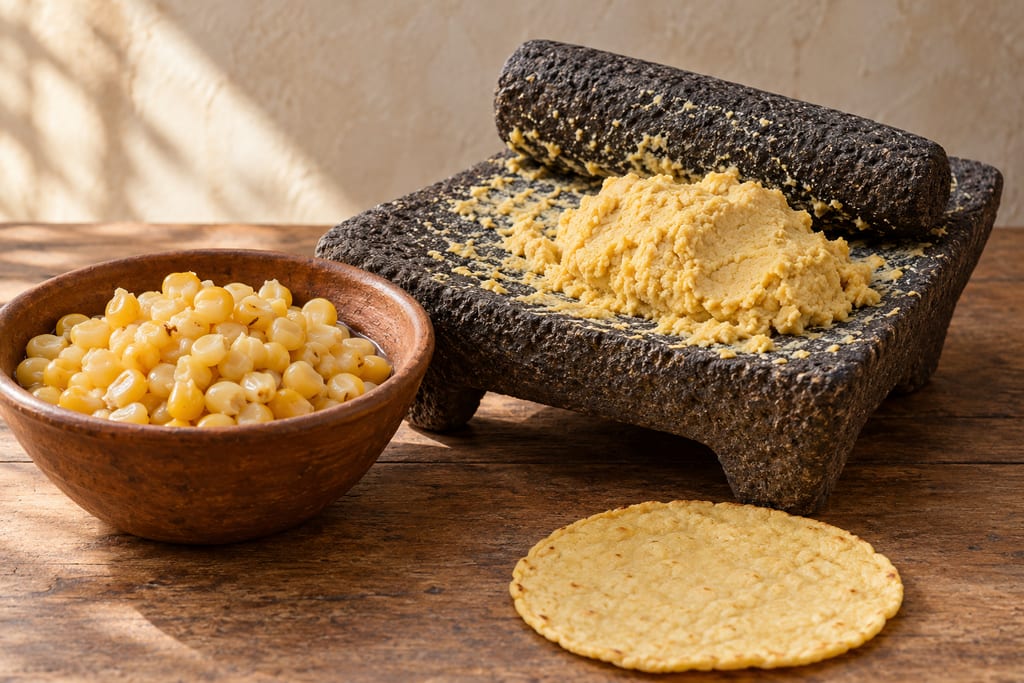
Nixtamal is maize cooked in lime and then ground. UNESCO's listing of traditional Mexican cuisine, inscribed in 2010, names nixtamalisation (lime-hulling maize, which, it says, increases its nutritional value) together with grinding stones and stone mortars among the defining practices. Rural lime-cooking adds one part of whole maize to two parts of an approximately 1 per cent lime solution. The mixture is heated to 80 °C for 20 to 45 minutes and left to stand overnight. The next day the cooking liquor is poured off and the nixtamal is washed two or three times to remove the seed coats, tip caps and excess lime. The maize was originally ground several times on a flat stone. Today the first grinding is done with a meat grinder or a disc mill and the dough is refined on the stone, and about 50 g of it is patted flat and cooked on a hot iron or clay plate. The whole process takes 14 to 15 hours and loses about 15 per cent of the dry matter. The lime has costs as well as benefits. Calcium becomes bound to the starch, and that more than 25 per cent of the tryptophan was lost with 1 per cent lime against 8 per cent with 0.2 per cent. A mill takes over the grinding, but the cook still decides the lime, the cooking endpoint and the texture.
Ogi, a West African porridge base, shows wet milling as the first step of a fermentation. Maize, sorghum or millet is soaked for one to three days, wet-milled and sieved to remove the bran, hulls and germ, which go to animal feed. The filtrate then ferments for two or three days into a sour, white starchy sediment. The ogi is diluted to 8 to 10 per cent solids and boiled into a pap, or cooked into a stiff gel called agidi or eko. A wet grinder or blender can replace the stone and the sieve. It cannot replace the fermentation, which is driven by a mixed community in which Lactobacillus plantarum predominates, alongside yeasts and moulds. Much of the grain's protein sits in the germ and seed coat that sieving removes.
Poi is the Hawaiian staple made from taro corms. Steamed or boiled corms are pounded with a little water into a smooth paste, using a pestle called pōhaku kuʻi ʻai, carved from basalt, coral or wood. The paste is eaten as one-, two- or three-finger poi depending on its thickness. Left for three or four days it ferments, as wild lactic acid bacteria and yeasts drop the pH from about 6.3 to 4.5 within the first day and sour it; it is usually thrown out on the fourth or fifth day as it becomes less pleasant. Poi one or two days old is called fresh poi, and three or four days old, sour poi. The cooking step is not optional. Raw taro is acrid and irritating because of needle-like calcium oxalate crystals, and cooking, often for a long time, is one of the steps that reduces them. The taro has to be properly identified edible taro, steamed or pressure-cooked. Modern commercial poi already relies on steam pressure and mechanical grinding, so a home pressure cooker and food processor follow an established direction. Hand-pounded paʻi ʻai keeps its own cultural and textural identity and is not what a processor makes.
Gari, the toasted cassava granule of West Africa, is the case where mechanisation meets a real hazard. Cassava roots contain cyanide, which is poisonous, and bitter roots should not be eaten raw. Grating the roots into a mash is part of removing it, and de-watering and fermenting the mash complete the process. The mash is bagged and left to drain and ferment for a few days, pressed repeatedly until no more water comes out, broken into grits through a 1.5–2.0 mm sieve, and roasted in a lightly oiled tray until it turns into dry, creamy granules. If the fire is too cool the gari stays white, and if too hot it burns. Leaving too much water makes lumps, while too little makes it floury. Fermentation longer than a day or two makes a very sour product, and the length is left to local taste. Comparing laboratory-scale and conventional processing shows that grating and roasting set the particle size, which ranged from 0.44 to 0.89 mm between the two scales, while fermentation and pressing set the lactic acid content. A food processor, a cloth press and a frying pan could do each operation, but there is no measurable endpoint for cyanide removal that a home cook could check, so a home gari should follow the published smallholder method and the limits set out in the article What an appliance cannot reproduce.
Wholegrain mustard: a short blend on purpose
Not every grind should be fine. Vitamix's wholegrain mustard mixes ½ cup (90 g) of yellow mustard seeds and ¼ cup (40 g) of brown seeds with ½ cup (120 ml) each of apple cider vinegar and ale, a tablespoon of date syrup and an optional teaspoon of salt. The mixture is covered and refrigerated overnight so that the seeds soak. Then ⅓ cup (80 ml) of honey is added and the mixture is blended with an immersion blender, moved up and down, for about 60 seconds or until it has the texture wanted. It is one continuous blend, not a series of pulses. The mustard is spicy at first and mellows; blending less, or thinning with water, adjusts both consistency and heat. It keeps in a sealed jar.
A stand mixer as a sausage workshop
A stand mixer's motor can power several traditional tasks through its attachments. KitchenAid sells a food-grinder attachment and a sausage stuffer for its mixers, and the same machine churns cream to butter with its whisk, as covered in the article Cream four ways. For fresh sausage the motor drives a chilled grinder, the mixer combines the ground meat, and a suitable stuffer forms the sausages. The maker shows what the attachments can do, but that is not a validated meat recipe: each sausage needs its own formula, handling and cooking method.
Cooked fresh sausage and fermented dry sausage are different projects. A grinder and stuffer make the first practical at home; the second depends on controlled fermentation, drying and meat-safety endpoints that no kitchen motor supplies, and belongs to the article What an appliance cannot reproduce.
What a motor cannot supply
A motor changes the labour, not the chemistry. It will not condition a seed: Piteba's press stops if the seed is too dry. It will not break a coconut emulsion into oil, which takes hours of cooking or an acid, yeast or enzyme treatment. It will not shorten a fermentation such as ogi, poi or gari, or remove cyanide by itself. It will not cook taro, whose irritating crystals need heat. And a machine built for a few minutes of work should not be run for days. The difference between a refiner tested for 72 hours and a wet grinder designed for short runs is a warning against treating similar-looking machines as interchangeable.
Related
Discussed in this article
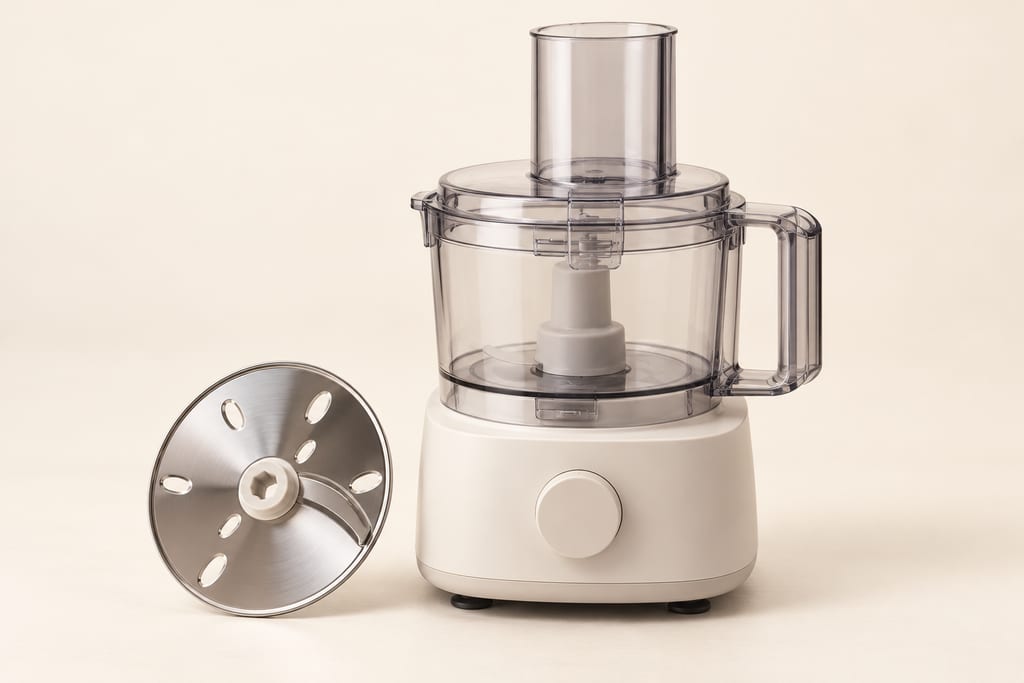
Blender or food processor
A fast blade in a jug that grinds toasted sesame to tahini, blends cooked or soaked material with water into milky extracts and chops material for pressing. It does not strain.
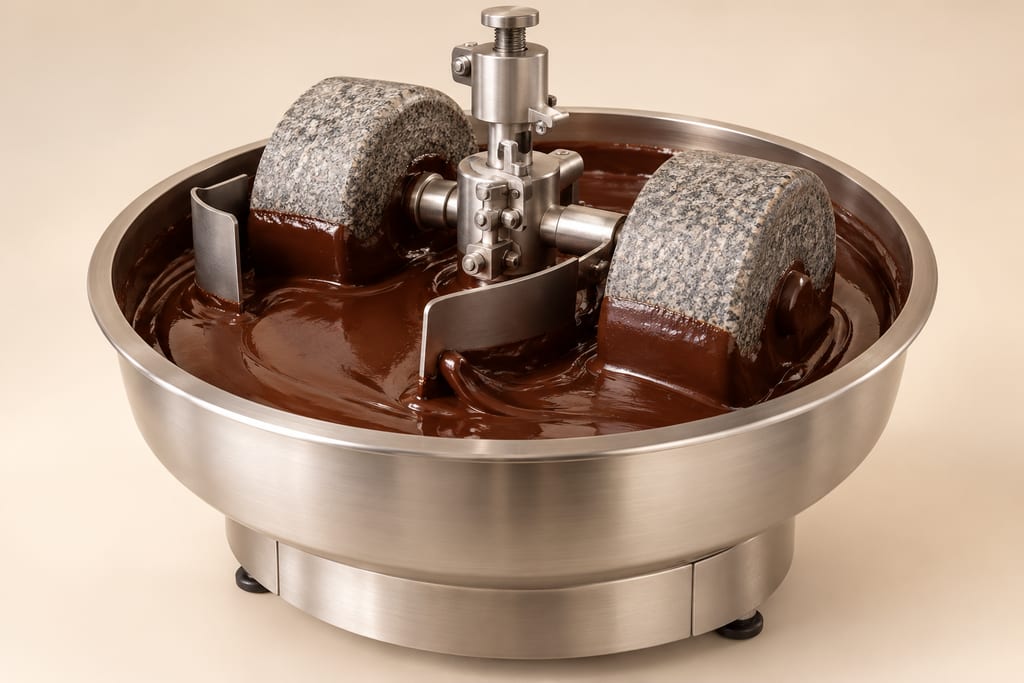
Chocolate refiner (melanger)
A chocolate refiner or melanger uses powered rotation and stone rollers to refine cocoa mass. Some models also process nut and seed pastes; design, material and operating limits vary.
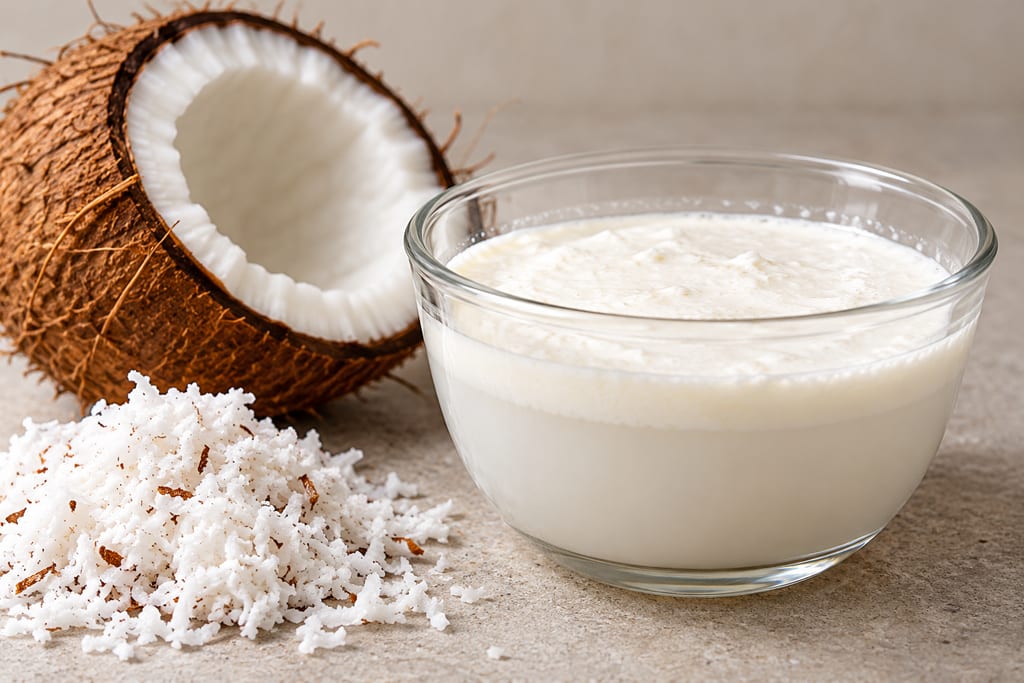
Coconut milk and cream
Grated or shredded coconut extracted with water and squeezed or strained into a milky emulsion; left to stand, it separates into cream and a watery layer.
Nixtamal and masa
Whole maize cooked and steeped overnight in lime water, washed of its skins and excess lime, then ground into the moist dough used for tortillas.
Small oil expeller
Small oil expellers use a screw to compress prepared oilseeds and nuts, separating oil from press cake. Piteba documents manual and motorized small-scale examples; their settings and feed requirements do not define every press.
Wet grinder
A powered mill that uses stones to grind soaked grains or pulses with water into batter or slurry. Domestic forms include conventional, tabletop and tilting models; capacities, construction and run limits vary by machine.
Community
No community contributions have been published for this entry yet.
Share what you made
Sign in to contribute. Published comments and photos are free to read.
Sources
Diamond Custom Machines (DCM)
FAQ | www.melangers.comCited in: Blender minutes, refiner days; What a motor cannot supply
Diamond Custom Machines (DCM); manufactured by Sivanesan Company (Ind.), Chennai, India
Premier Chocolate Refiner with Stainless Steel Stone Holder: User ManualCited in: Three jobs a motor can take over; Blender minutes, refiner days; Sesame, nuts and the order of ingredients; Chocolate for drinking: grinding and frothing are separate jobs
CORD 9(01), International Coconut Community, 1993
Three improved methods for coconut oil extractionCited in: Three jobs a motor can take over; Coconut: squeezing makes milk, not oil; What a motor cannot supply
Smithsonian Magazine
A Historic Kitchen Utensil Captures What it Takes to Make Hot Chocolate From ScratchCited in: Chocolate for drinking: grinding and frothing are separate jobs
PITEBA
Electric oil press. how to press oil from seeds and nutsCited in: Pressing oil: the seed has to be ready; What a motor cannot supply
PITEBA
Improve press results: correct setting of adjustment boltCited in: Pressing oil: the seed has to be ready; Coconut: squeezing makes milk, not oil
FAO
Ghani: A traditional method of oil processing in IndiaCited in: Three jobs a motor can take over; Pressing oil: the seed has to be ready
Nature Microbiology 9:2666–2683, 2024
Neurospora intermedia from a traditional fermented food enables waste-to-food conversionCited in: Pressing oil: the seed has to be ready
Consejo Regulador de la Denominación de Origen Chufa de Valencia
La Horchata - DO Chufa de ValenciaCited in: Horchata de chufa: an extraction kept cold
Consejo Regulador de la Denominación de Origen Chufa de Valencia
Receta horchata de chufa de ValenciaCited in: Horchata de chufa: an extraction kept cold
FAO
Maize in human nutrition - Processing of whole maize: lime-cookingCited in: Wet milling of maize, sorghum, taro and cassava
UNESCO
Traditional Mexican cuisine - ancestral, ongoing community culture, the Michoacán paradigm - UNESCO Intangible Cultural HeritageCited in: Wet milling of maize, sorghum, taro and cassava
FAO (Agricultural Services Bulletin No. 138, 1999)
Fermented cereals a global perspective. Chapter 2.Cited in: Three jobs a motor can take over; Wet milling of maize, sorghum, taro and cassava
Metabolites 15(11):748 (MDPI), 2025
Impact of Natural Fermentation on Mineral Composition, Resistant and Non-Resistant Starches, Microbial Diversity, and Global Metabolite Profiles in Commercial Poi from Hawai‘iCited in: Wet milling of maize, sorghum, taro and cassava
Nutrients 15(15):3337 (MDPI), 2023
Taro Roots: An Underexploited Root CropCited in: Wet milling of maize, sorghum, taro and cassava; What a motor cannot supply
Alternative Therapies in Health and Medicine 11(1):58–64, 2005
A non-dairy probiotic's (poi) influence on changing the gastrointestinal tract's microflora environmentCited in: Wet milling of maize, sorghum, taro and cassava
International Institute of Tropical Agriculture (IITA), Ibadan, 2012
Producing Gari from Cassava: An illustrated guide for smallholder cassava processorsCited in: Wet milling of maize, sorghum, taro and cassava; What a motor cannot supply
International Journal of Food Science & Technology 56(3):1311–1321
Identification of critical versus robust processing unit operations determining the physical and biochemical properties of cassava-based semolina (gari)Cited in: Wet milling of maize, sorghum, taro and cassava
FAO Technologies and Practices for Small Agricultural Producers (TECA); DFID
Coconut oil extraction: intermediate moisture content method (FAO TECA / DFID)Cited in: Coconut: squeezing makes milk, not oil
University of Hawaiʻi at Mānoa, College of Tropical Agriculture and Human Resources
Poi brochure (University of Hawaiʻi CTAHR)Cited in: Wet milling of maize, sorghum, taro and cassava
KitchenAid UK
Food grinder applications; sausage-stuffer product (KitchenAid UK)Cited in: A stand mixer as a sausage workshop
KitchenAid US
How to make butter in a KitchenAid® stand mixerCited in: A stand mixer as a sausage workshop

Gaps
- The maker’s FAQ gives 48–72 hours to reach 20 microns, and its manual gives 24–48 hours.
- The moisture target and pressing conditions of the intermediate-moisture coconut-oil route are not established for home use.
- Which pot or mill materials suit the alkaline nixtamal mixture has not been established.
- The acid, yeast and enzyme coconut-oil methods are laboratory results; the moisture and keeping quality of such oil made in a kitchen are unmeasured.
- No home method exists for wet-route coconut oil, gari with a checkable cyanide endpoint, or refiner-made drinking chocolate with a milk ratio.
- The horchata home recipe includes a sodium hypochlorite wash without a concentration.
- No fresh-sausage formula or cooking endpoint is given for the stand-mixer grinder and stuffer.
Updated 2026-10-27