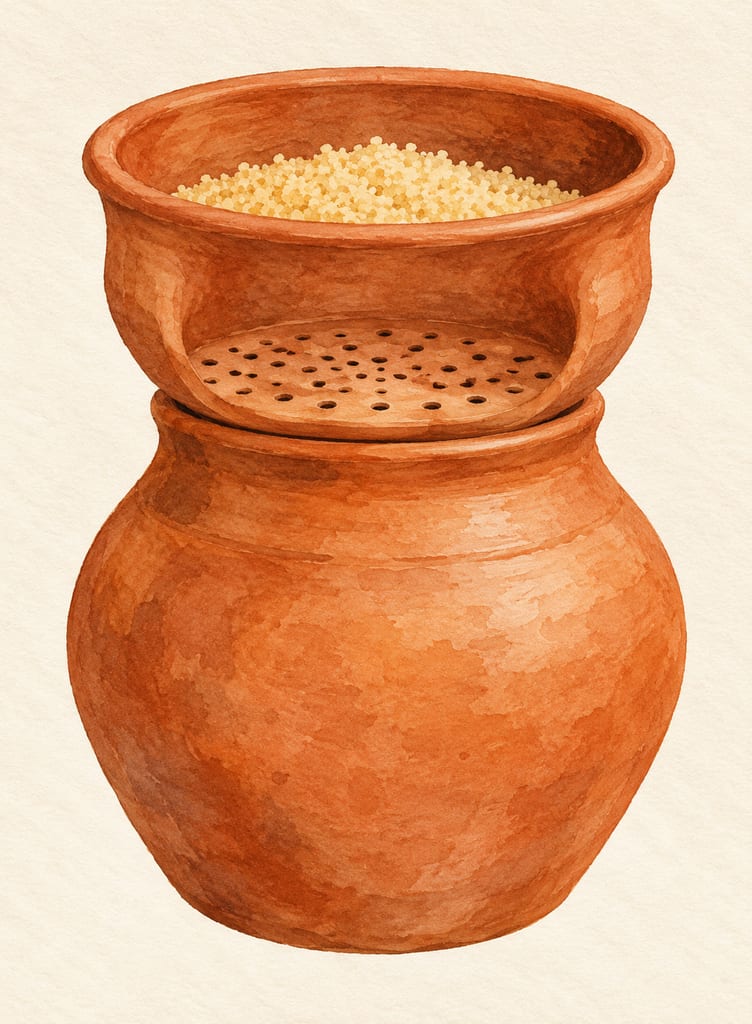
Couscous steamer
A two-part steamer for couscous: a perforated upper chamber sits over a lower pot that produces steam. Clay, basketry and metal forms are documented in different places and periods.
 FermenteaWhere food goes to change
Equipment · Jars, pots and crocks
A purpose-made terracotta vessel, also called tangia or kallouch, for Marrakech’s slow-cooked tanjia. Potters make it mainly in Marrakech; a fernatchi cooks the closed jar among managed furnace embers.
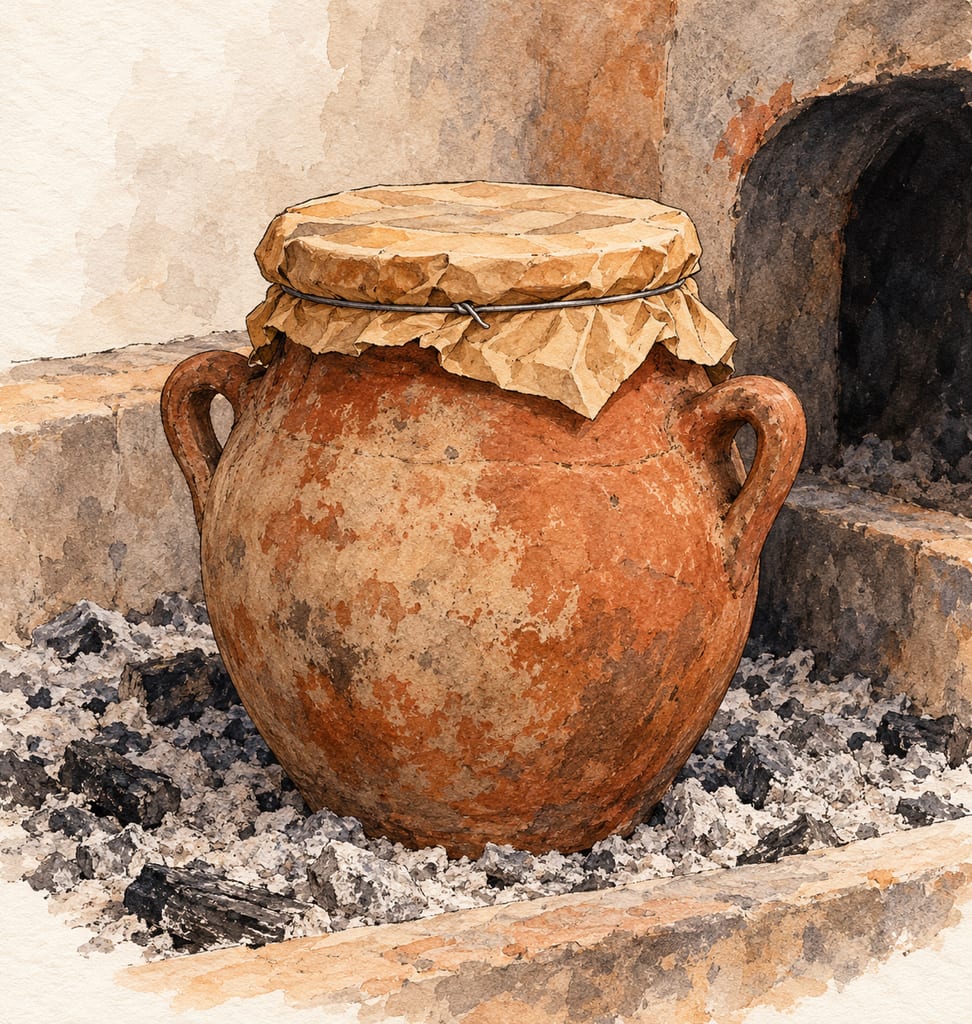
Tangia names both the meal and the vessel used to cook it. A 2021 World Intellectual Property Organization study calls the jar tangia or kallouch and describes it as a terracotta amphora specially designed for the dish. It says the jar is mainly produced in Marrakech and uses the same terracotta as tagines. In a recent account of the city’s practice, a visitor buys an unglazed clay urn from a potter. The jar’s exact capacity and dimensions are not supplied in these sources.
The WIPO study suggests that the familiar cooking vessel may have developed from an amphora used for carrying and storing liquids. It presents this as an apparent evolution, not a securely dated sequence. The documented vessel is best understood through its current form and use rather than an asserted antiquity. It is distinct from the shallow dish and conical lid called a tagine: the tangia is a jar that can be closed and placed among embers.
The jar connects craft production with shared city infrastructure. In Marrakech, the WIPO study records terracotta tangias made mainly in the city. For cooking, meat and seasonings are placed inside, the mouth is covered with paper secured by wire, and the vessel is set in wood-fire embers under the supervision of the fernatchi, the furnace attendant. A recent Smithsonian account describes the urn placed in residual embers beneath the wood-fired furnace that heats a hammam. The attendant manages the heat; the jar does not generate it.
That arrangement lets a household use heat already maintained for the bathhouse rather than fire a separate oven. The vessel contains the food while surrounding embers provide slow heat. The documented Marrakech recipe places the jar in managed ashes beside the furnace rather than directly in the fire, with the attendant redistributing and replenishing ash. This is a cooking vessel for braising, not evidence of pressure cooking or room-temperature preservation.
The strongest documented association is with Marrakech, Morocco: the WIPO study links both production and the named dish to the city, and the official tourism council presents tanjia as a signature local specialty. These accounts support local manufacture and traditional use; they do not establish that every jar is made there or supply a first date for the practice.
Terracotta is the jar’s defining material and a practical limit: the WIPO study explicitly calls the utensil fragile. It supplies no standard capacity, measurements, cleaning method or seasoning instructions, so these details should come from the maker of an individual vessel rather than be assumed from another pot. Its relation to the recipe is recorded in the linked Tanjia marrakchia page.
A 2021 WIPO study identifies a purpose-made terracotta tangia, also called kallouch, mainly produced in Marrakech. It cautiously suggests that the cooking jar developed from an amphora used to transport and store liquids, but gives no date for the change. Contemporary use is reported in 2026. This supports continued use, not an invention date.
The terracotta jar is described as fragile.
Source →Tangia jars are mainly produced in Marrakech; this does not claim every jar is made there.
The sources identify the jar and dish with Marrakech and describe current use. No wider distribution is inferred.
A two-part steamer for couscous: a perforated upper chamber sits over a lower pot that produces steam. Clay, basketry and metal forms are documented in different places and periods.
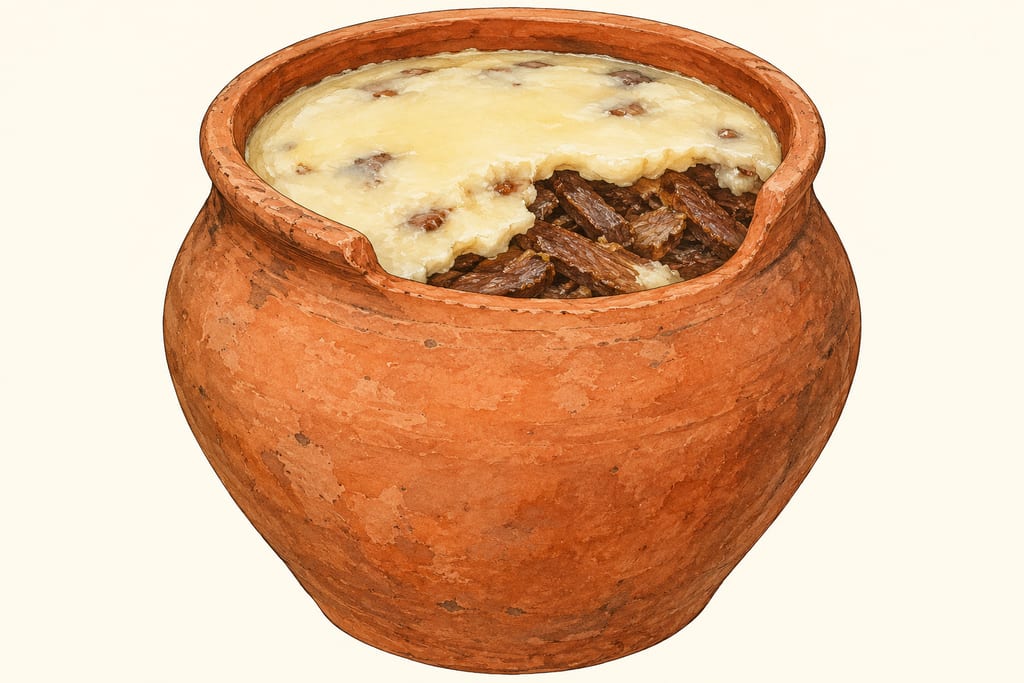
Khlii storage vessels hold prepared meat beneath rendered fat or oil. Traditional terracotta jars and present-day plastic tubs are both recorded forms in Morocco.
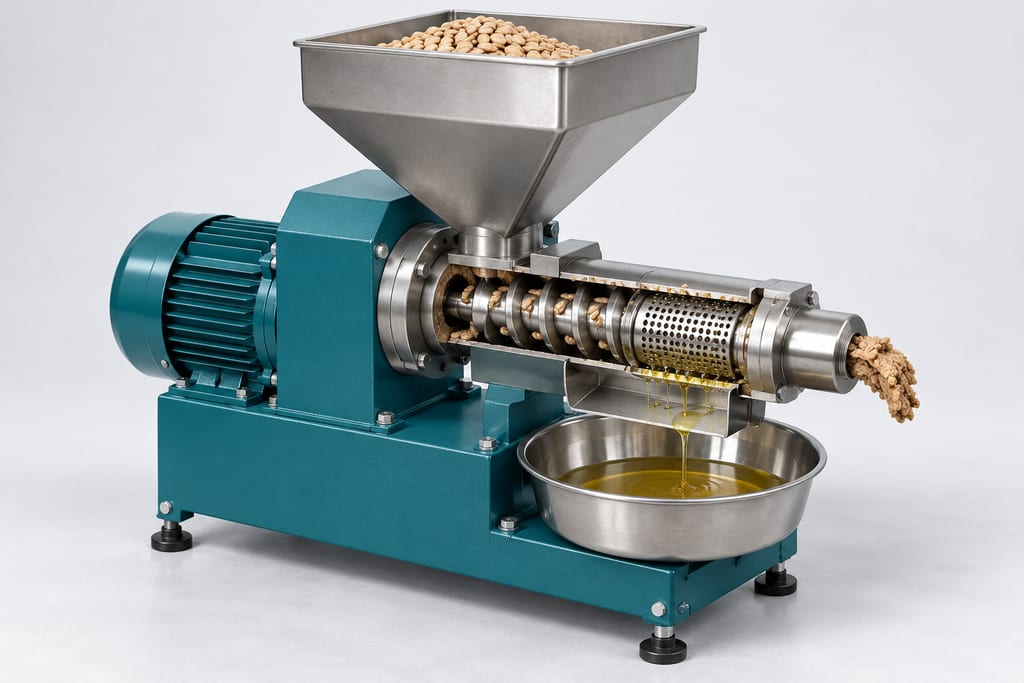
A screw press advances prepared material through a cage, squeezing out oil while solid press cake leaves separately.
A ceramic Ezzir jar holds salted butter during smen maturation in Algeria; a goatskin Chekoua is documented for churning the sour milk beforehand. Sources also report animal-skin containers, but do not establish a single shared form.
No community contributions have been published for this entry yet.
Sign in to contribute. Published comments and photos are free to read.
World Intellectual Property OrganizationHistory · Materials · Manufacture · Use
Scoping study on the gastronomic tourism sector in MoroccoThe tangia or kallouch jar is purpose-made from terracotta, mainly produced in Marrakech, using terracotta also used for tagines.
The study cautiously suggests evolution from a liquid-transport and storage amphora, without dating it.
The study describes the jar as fragile and documents paper closure and cooking in embers supervised by the fernatchi.
Cited in: A jar with the dish’s name; From the potter to the hammam furnace; A place-bound, fragile form
Marrakech-Safi Regional Tourism Council (Visit Marrakech)Traditional use · Geography
The “Tanjia”, a typical culinary specialty of Marrakech which is the pride of the MarrakchisThe tourism council presents tanjia as a signature dish and long culinary tradition of Marrakech; the name refers to both dish and vessel.
Cited in: A place-bound, fragile form
Smithsonian MagazineMaterials · Acquisition · Use
How Tanjia, a Meat Stew Slow-Cooked in Bathhouses, Shaped Marrakesh’s Social LifeA contemporary account describes buying an unglazed clay tangia urn at a potter’s shop and placing it in residual embers beneath a hammam furnace.
Cited in: A jar with the dish’s name; From the potter to the hammam furnace
Marrakech RiadUse
Tanjia (Tangia) from MarrakechThe traditional jar is placed in managed hot ashes beside the hammam furnace, where the attendant renews and redistributes ashes.
Cited in: From the potter to the hammam furnace