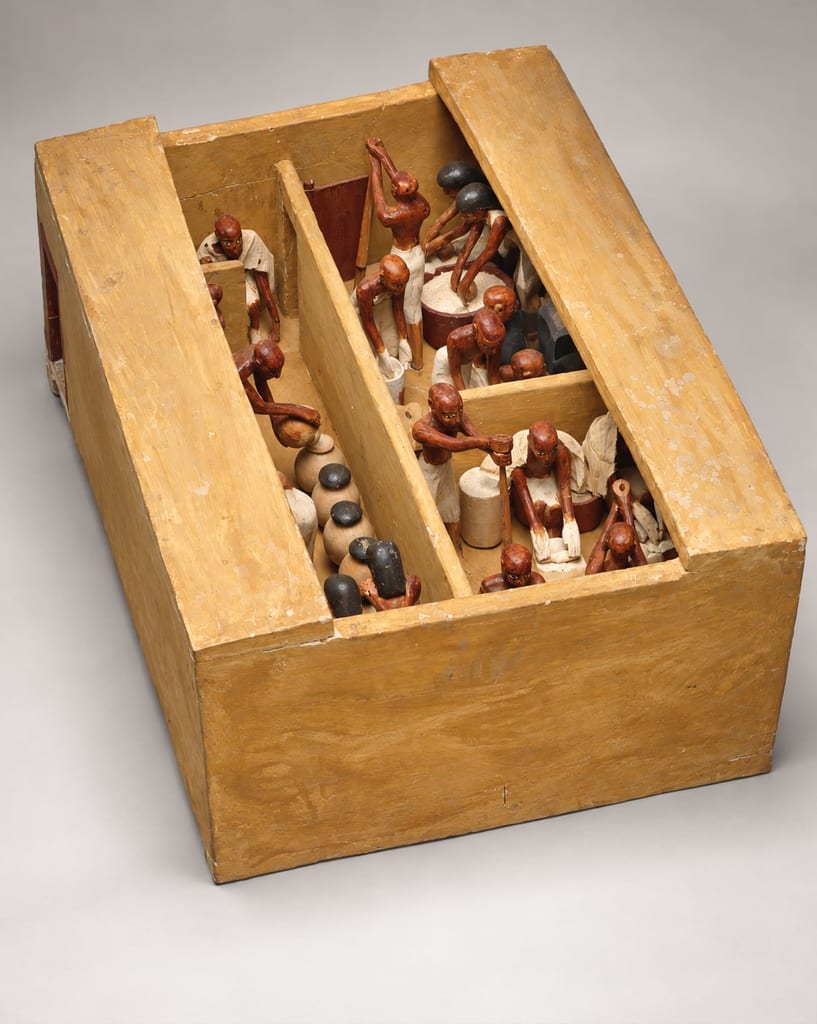
Egyptian brewery basins and beer jars (Meketre model)
The Meketre tomb model depicts brewing at Thebes: a mixing vat, fermenting crocks and round jugs for the finished beer.
 FermenteaWhere food goes to change
Equipment · Jars, pots and crocks
ballas · zallaa · zalaa
Mish is ripened in capacious earthenware jars called ballas or zallaa. Sources describe layered cheese, seasoned salty liquid and a sealed mouth, but give no standard capacity or universal jar geometry.
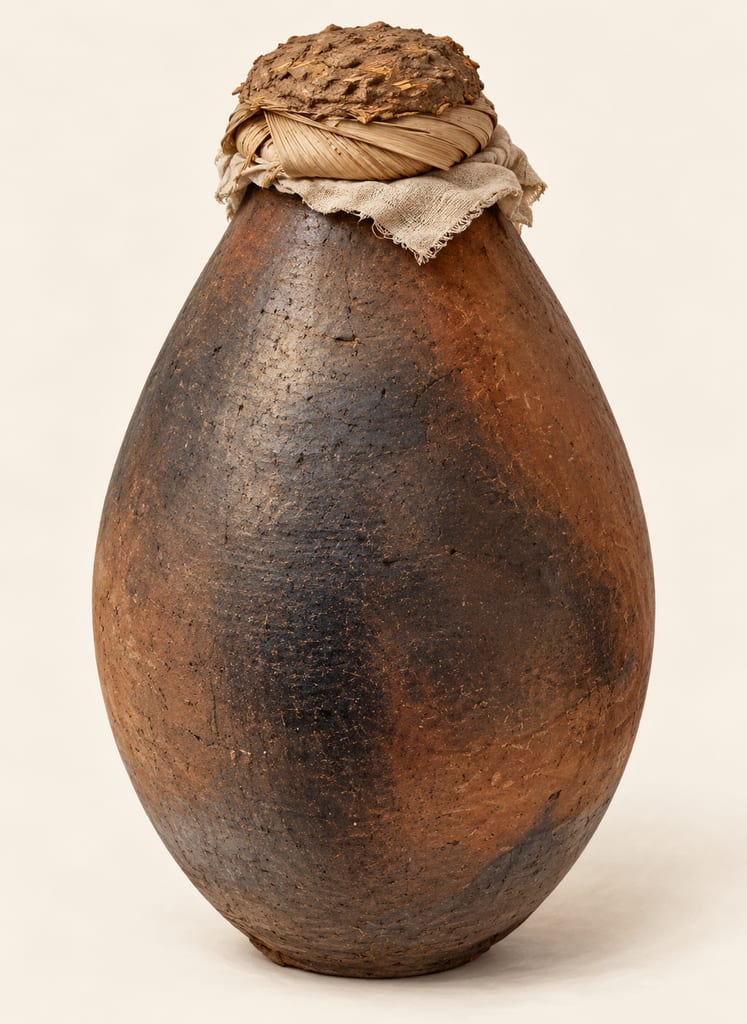
Mish is an Egyptian ripened cheese made by preserving pieces of karish in a salty, seasoned liquid. The vessel is not an incidental storage container: the cheese and liquid are layered inside a capacious earthenware jar, and the jar is closed while the contents mature. The names recorded for the vessel are ballas and zallaa (also written zalaa). These are names for the traditional pot in the mish process, not evidence that every vessel called a Ballas jar was made for cheese.
The Food and Agriculture Organization account describes rinsed and drained cheese placed in layers with pickling liquid. The liquid may include buttermilk, sour skim milk, whey or morta, a cooked dairy residue; red or green pepper and old mish may also be included. Previous mish jars are preferred in that account. Once closed, the pot stands at ambient temperature for at least a year. Slow Food describes the mouth being filled to the neck, covered with palm sheath and cloth, and sealed using mud mixed with chaff. The two accounts describe related practice, not one mandatory recipe or universal closure specification.
Earthenware is the documented material; the sources do not specify whether every jar is glazed, how thick its walls are, how it is fired, or how porous it should be. Nor do they provide a standard capacity. Slow Food calls the vessel large and describes filling it to the neck, but that is not a measured size. A particular pot must be judged by its actual condition and intended food use; the historical descriptions alone do not establish that any old or decorative jar is food-safe.
A Mucem record documents a Ballas jar collected in Qena in 1979. It describes a white-clay, amphora-like object used to carry water and goods, with a rounded base, handles and dimensions for that specimen. This gives a concrete record of a Ballas pottery form, but the object is not identified as a mish jar; its proportions must not be generalized to the cheese vessel. The image of an ancient jar from Ballas is older still, but it is likewise not labelled as a mish jar.
The FAO account reports that a similar cheese was said to have been found in the tomb of Hor-Aha at Saqqara. That statement concerns a claimed cheese resemblance; it does not identify the modern ballas or zallaa, describe a ripening jar from that tomb, or demonstrate an unbroken practice across millennia. The available sources support a traditional Egyptian cheese vessel and its role in ripening, but not an origin date for the jar.
The practical specifications remain local to the pot and the batch: the source descriptions do not settle a single shape, volume, glaze, seal recipe or care routine. The jar’s documented job is to hold cheese under its seasoned pickling liquid through long ambient maturation, with the mouth covered and sealed in the described practice. The links on this page point to mish itself and to the specific museum records that clarify what can—and cannot—be inferred from another Ballas pot.
No standard capacity, wall thickness, clay composition, glaze or closure design is established for all mish jars.
Source →The Mucem Ballas jar described in this record is for water and transport; it is not evidence that the specimen was used for mish.
Source →The ancient Ballas jar in the linked photograph is not identified as a mish vessel; resemblance or shared place-name does not prove continuity.
Source →FAO and Slow Food describe Egyptian mish ripened in earthenware pots; this does not imply that every vessel called a Ballas jar was used for mish.
The Meketre tomb model depicts brewing at Thebes: a mixing vat, fermenting crocks and round jugs for the finished beer.
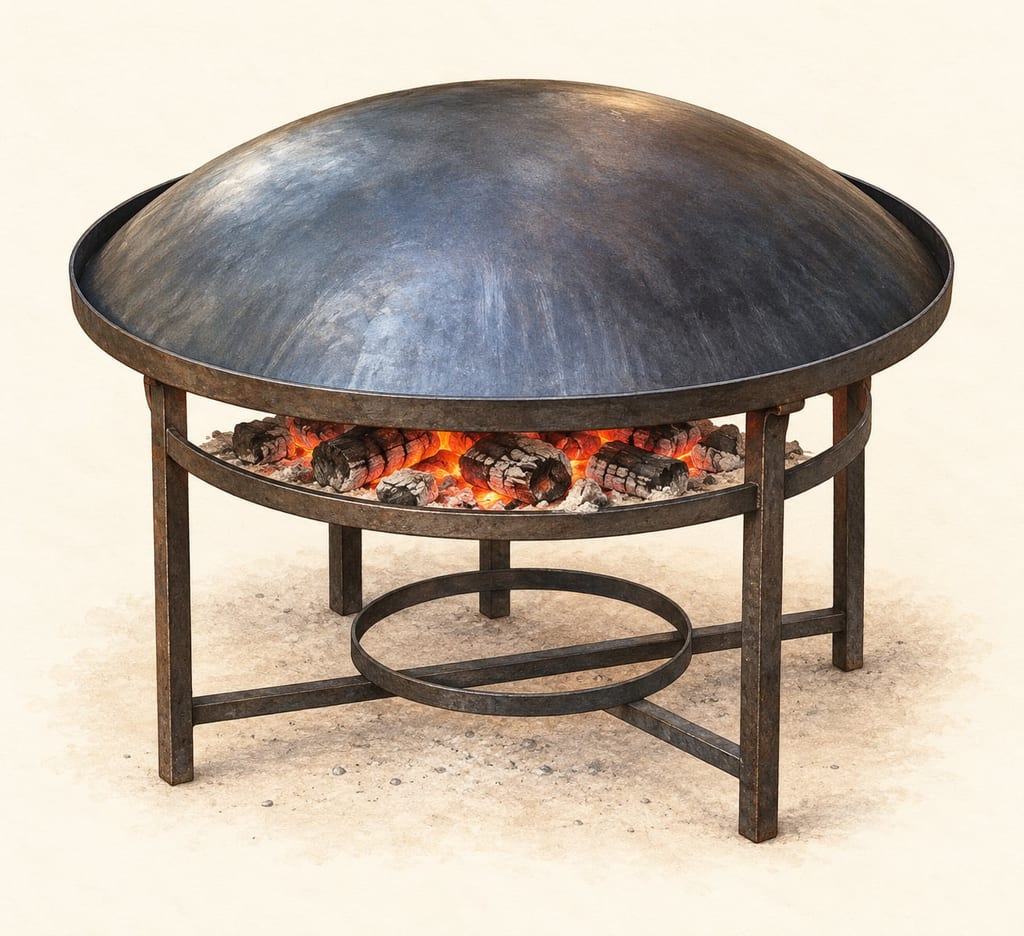
A portable convex metal griddle used for thin flatbreads. Surveyed forms are about 50 cm across and set over embers; regional names and modern heat sources vary.
No community contributions have been published for this entry yet.
Sign in to contribute. Published comments and photos are free to read.
Food and Agriculture Organization of the United NationsVessel name and use · Process · Geography · Historical qualification
The technology of traditional milk products in developing countries, section 4.20: Mish cheeseIdentifies mish as Egyptian cheese made by ripening karish in pickling liquid in earthenware jars called zalaa or ballas.
Describes layering cheese and pickling solution, adding old mish as starter, sealing and ambient ripening for at least a year.
Mentions a similar cheese reported from Hor-Aha's tomb but does not establish continuity of the modern product or jar.
Cited in: A jar for a cheese that keeps ripening; Keeping the history in proportion
Slow Food Foundation for BiodiversityVessel and closure · Traditional preparation · Geography
Mish CheeseDescribes a large clean earthenware pot called ballas or zallaa.
Says the pot is filled to the neck and its mouth covered with palm sheath and cloth, then sealed with mud mixed with chaff.
Places mish cheese in Egypt and describes warm storage and long ripening.
Cited in: A jar for a cheese that keeps ripening; Keeping the history in proportion
MucemComparative vessel record
Jarre, ballas, inventory 2017.24.40Records a white-clay Ballas jar collected in Qena in 1979 and described as used for water and transport, not mish.
Describes an amphora-like jar with rounded base, low maximum diameter and two handles; its dimensions are specific to this specimen and are not a mish-jar standard.
Cited in: What the pottery tells us—and what it cannot
Wikimedia CommonsVisual reference · Historical qualification
Misfired ancient Egyptian jar, Ballas Egypt, c3650–3200 BCThe file page identifies a museum artifact from Ballas dated c. 3650–3200 BCE and states that the photographer dedicated the photograph to the public domain.
This ancient artifact is not identified as a mish jar and does not establish continuity with the modern vessel.
Cited in: What the pottery tells us—and what it cannot