
Baking bell (coal-covered pot)
A portable dome and pan used over a hearth, with embers on the lid and heat from below. Regional peka and saç forms share this principle while differing in materials, pan shape and how the food is cooked.
 FermenteaWhere food goes to change
Equipment · Skins and bladders
mišina · mješina · sir iz mišine sack
A whole lambskin, prepared as a flexible sack, holds densely packed cheese for ripening as sir iz mišine. The Croatian record locates the tradition in Dalmatia, Velebit and Lika, while its beginnings remain uncertain.
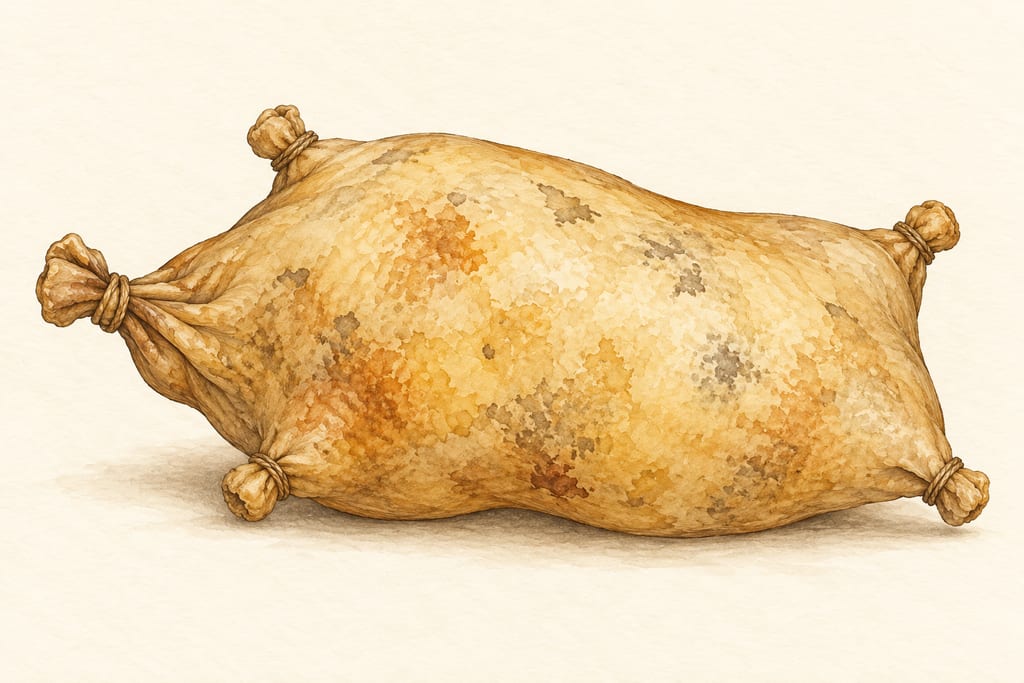
Mišina, also written mješina, is the lambskin sack associated with Croatian sir iz mišine. The heritage account describes cheese curd drained in cloth, pressed, salted and placed in the sack in pieces, with each layer packed firmly. The maker compacts the filling and expels air before the sack is tied for ripening. This describes a flexible hide vessel enclosing dense cheese, not a rectangular leather bag or an ordinary cloth cheesecloth.
The heritage account outlines preparation of a lambskin: it is turned so the side that touched the animal lies inward, washed, its openings tied, then inflated, shaved, salted and dried before conditioning for use. These details come from a 2007 designation text and should be presented as that source's documented process, not as instructions for preparing a food-contact hide today.
The sack is a ripening enclosure rather than a serving bag. The heritage account describes curd being loaded progressively or in one filling, tightly packed, and matured under controlled conditions. It reports a two-to-three-month period in its traditional process description. A 2014 dairy study followed Croatian cheese in a lambskin sack over 60 days and found ripening time affected compositional, biochemical and sensory measures. Its abstract reports lower consumer acceptance after 45 days in that study; this is a study result, not a universal rule for every producer or batch.
Research on other animal-skin cheeses shows that similar-looking sacks occur in multiple traditions. Their names, skin materials and methods differ. Mišina should stay specific to the Croatian cheese documented here rather than being treated as a generic name for every hide-ripened cheese.
The Dalmatian hinterland, Velebit and part of Lika are named, and the tradition is also known in western Herzegovina. These are regional associations, not evidence that every village uses an identical sack or process. Reliable information about the beginning is unavailable. Proposed connections to Illyrian and Thracian herding remain hypotheses, not established history.
The heritage page credits the Ministry of Culture for the text and the small cheesemakers' association Mišinac for its photographs. Its stated permission allows article distribution with attribution except for commercial purposes, so those photographs are useful as subject references but are not reused here as public gallery images.
The Croatian heritage text dated 20 December 2007 says the tradition has no reliable beginning date and labels an ancient origin as a hypothesis. A 2014 study examined compositional, biochemical and sensory changes over 60 days of ripening.
The heritage designation explicitly says reliable information about the beginning is lacking; proposed Illyrian or Thracian origins remain hypotheses.
Source →Mišina is the Croatian form documented here. Similar skin-sack cheeses elsewhere have their own regional names and procedures.
Source →The 2014 study's findings describe its studied cheese and ripening period; they are not a universal production standard.
Source →The designation describes the tradition in this named area; not an ancient-origin claim.
The designation names the Velebit area; no locality or universal form is asserted.
The designation names part of Lika; no village-specific claim is made.
The text says the tradition is also known there; it does not claim identical products or origin.
A portable dome and pan used over a hearth, with embers on the lid and heat from below. Regional peka and saç forms share this principle while differing in materials, pan shape and how the food is cooked.
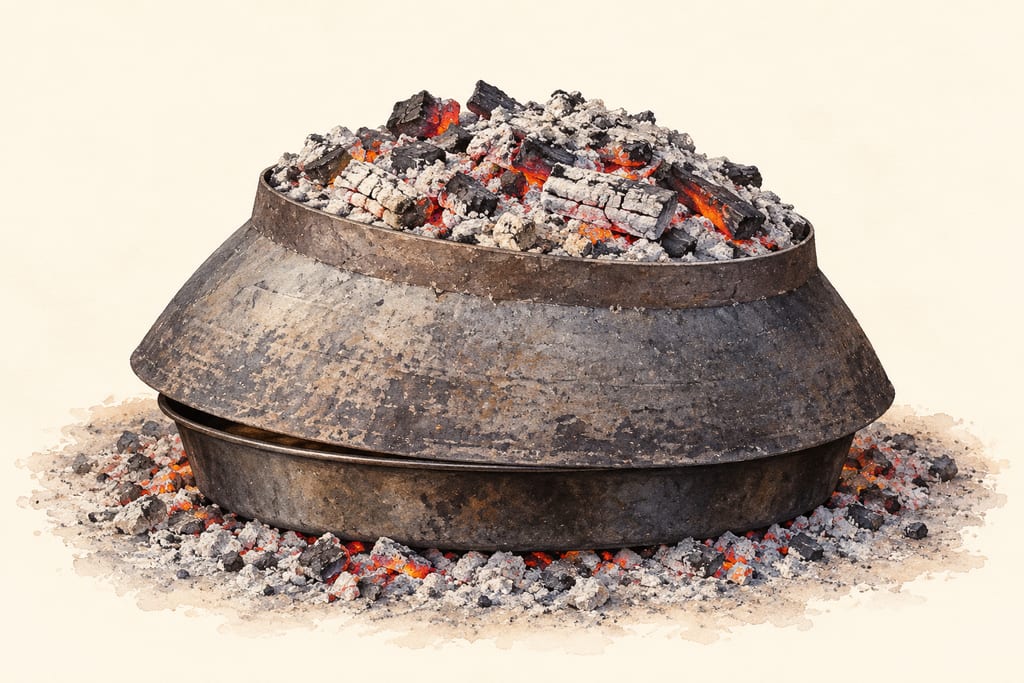
Peka names a family of hearth-baking lids: a domed clay or metal bell carries embers above food. In the later Dinaric assembly, a shallow pan sits beneath the lid, sometimes with a ring to hold coals in place.
No community contributions have been published for this entry yet.
Sign in to contribute. Published comments and photos are free to read.
Croatian Food Agency; heritage designation text supplied by the Ministry of Culture, 20 December 2007; photos supplied by small cheesemakers' association MišinacEquipment · Method · Geography · History · Image reference
Priprema sira iz mješine s područja Dalmatinske zagore, Velebita i LikeNames Dalmatian hinterland, Velebit and part of Lika; also notes the tradition in western Herzegovina.
States there is no reliable information on when the tradition began and presents ancient origin as a hypothesis.
Describes a whole lambskin prepared by turning it, washing, tying openings, shaving, salting, drying and conditioning before use; this is the source's account, not a universal current protocol.
Describes curd being drained, pressed, salted and packed in pieces layer by layer; cheese is tightly compacted and air expelled before ripening in the sack.
The page credits the Ministry for its heritage text and Mišinac for its photographs; distribution of articles is allowed with attribution except for commercial purposes, so its images are reference-only here.
Cited in: A whole-skin sack for ripening; Ripening changes the cheese; Place and historical uncertainty
Milna Tudor Kalit, Samir Kalit and Jasmina Havranek; Mljekarstvo 60(3), 2010Equipment · Regional comparison
An overview of researches on cheeses ripening in animal skinReviews cheese ripening in whole lamb or goat body-skin sacks across several traditions and countries; distinguishes local names and procedures, so mišina is not treated as a universal term.
Cited in: Ripening changes the cheese
Tudor Kalit et al.; International Journal of Dairy Technology 67(2), 2014Equipment · Ripening research
Changes in the composition and sensory properties of Croatian cheese in a lamb skin sack (Sir iz mišine) during ripeningReports a study of Croatian cheese in lambskin over 60 days; ripening time significantly affected chemical, biochemical and sensory measures. The abstract reports lower consumer acceptability after 45 days in the study and does not establish a universal optimum for all makers.
Cited in: Ripening changes the cheese