
Baking bell (coal-covered pot)
A portable dome and pan used over a hearth, with embers on the lid and heat from below. Regional peka and saç forms share this principle while differing in materials, pan shape and how the food is cooked.
 FermenteaWhere food goes to change
Equipment · Covered pot ovens
Peka names a family of hearth-baking lids: a domed clay or metal bell carries embers above food. In the later Dinaric assembly, a shallow pan sits beneath the lid, sometimes with a ring to hold coals in place.
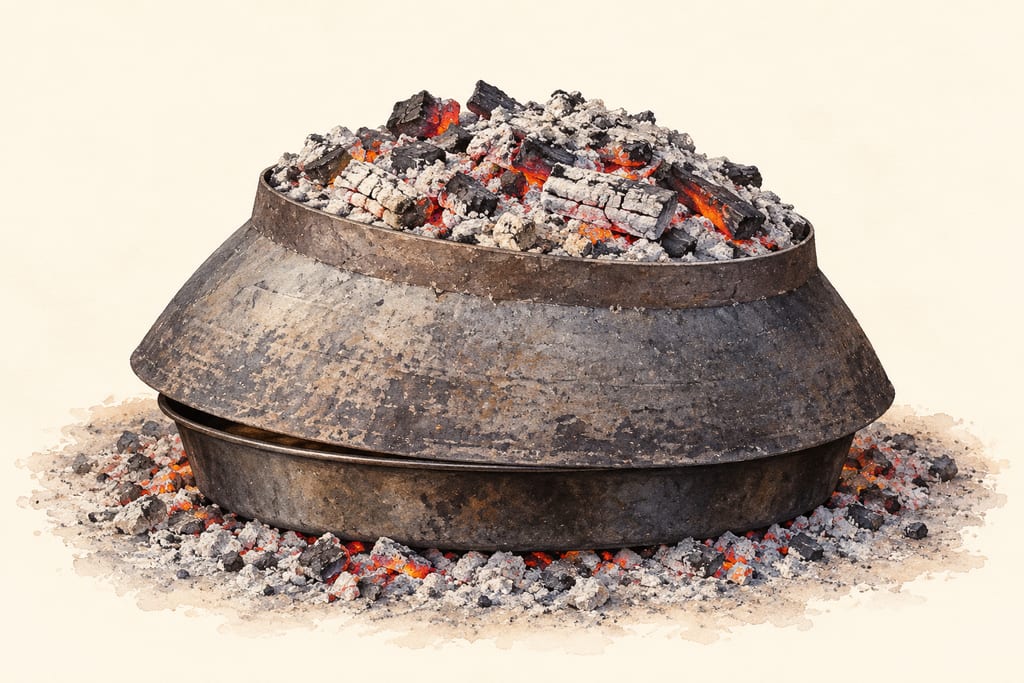
Peka is the name of a hearth-baking method and its distinctive domed lid. Food sits on the hearth beneath the bell; live embers are heaped over the top, so the cover supplies heat from above while the hearth and pan warm the food below. The regional tourist account for Dalmatia describes the method as a traditional way to bake meat, fish and seafood. It is equipment for a particular kind of hearth cooking, not the name of one finished dish.
In its later Dinaric assembly, the bell fits over a shallow pan and a ring helps keep coals on the dome. Krka National Park describes an earlier arrangement with the lid alone and food baked directly on the hearth; the pan-and-ring assembly developed later in the region. These are different layouts. A panless hearth lid should not be quietly redrawn as a modern pan set, or vice versa.
Peka works by combining heat from the ember-covered lid with heat at the base. The lid and pan make a covered cooking space in which steam and juices stay close to the food. Regional accounts describe slow cooking in the food's own juices and careful management of the coals. No standard temperature or universal cooking duration follows from that description: the heat depends on the fire, the lid, the hearth and the dish.
The clay and metal bell are not the same object with a different finish. The Zadar regional account describes clay lids formed in moulds or on a potter's wheel, and a metal variant; it reports metal lids as more common today in its area because they heat more quickly, while ceramic lids warm more slowly and were kept ready beside continuously used rural hearths. Those are regional observations, not a rule for every household or material.
The island of Iž is a documented centre for clay peka/črpnja craft. A Croatian Island Product catalogue records local pottery forms made by Predrag Petrović on a traditional wheel, while the Zadar board says the island workshop continues to make clay čripnje. That evidence supports a living craft source for a clay form; it does not promise a standard size or that every peka sold elsewhere is made on Iž.
The peka family has no single capacity, diameter or universal pan material in the sources reviewed here. Nor does every clay lid share one profile: local potters and regional naming traditions shape the object. The image gallery shows one contemporary metal bell in use; it is an example, not a template for ceramic peka.
Peka, pekva, čripnja and related spellings appear across Adriatic and Balkan accounts, alongside names such as sač. A 2020 archaeological review brings these terms together because they refer to dome-shaped lids used for baking on open hearths, but it also describes different materials, shapes and regions. The names are useful for finding related objects, not proof that every locality uses an identical lid or assembly.
A clear neighboring example is Kosovar and Albanian flia. Slow Food describes the layered batter as cooked beneath a bell-shaped iron dome called a saç, and identifies Rugova Valley as a production area. Flija is a related iron-bell method. Slow Food identifies its equipment as the iron saç, distinct from the Iž clay čripnja; this comparison does not make the two objects interchangeable or all bell-cooked foods one recipe.
The historical record needs the same restraint. The archaeological review discusses earlier dome-shaped lids and notes that such hearth tools are found across long periods, but that does not date today's named peka or prove an unchanged line from prehistory. The currently assembled pan-and-ring peka is separately described in regional accounts. The sources here establish variation and continuing practice, not one origin date.
A regional method described by Krka National Park begins with a wood fire that is allowed to burn down to coals. Food is placed in the shallow pan on a flat hearth, covered by the bell and heated from above with a measured layer of coals. Grapevine, beech and hornbeam are examples of wood named by that account, not mandatory fuels everywhere. Its roughly 90-minute ember period is local guidance for that description, not a fixed schedule for every peka meal.
The fit between cover and pan matters. The Krka page says the lid should sit well so air does not enter, and notes that ash can be spread around the edge. That is a described hearth practice, not an engineered pressure seal. A ceramic peka, a metal bell and a clay roasting pot may respond differently; the sources do not give a shared temperature curve, standard capacity or maintenance schedule.
Peka equipment appears in different dishes. The Octopus and Potatoes under a Peka recipe documents the covered roasting arrangement. Flija, by comparison, uses the neighboring iron saç to bake successive layers. Those links preserve the distinction between slow covered roasting and repeated lifting of a lid to build a layered bread.
The strongest place-specific evidence in this record is Dalmatia, Croatia, where regional tourism sources describe peka as a familiar hearth method. A separate craft record places clay peka/črpnja production on the island of Iž. Related dome-lid cooking is also documented in Bosnia and Herzegovina, Montenegro and southern Serbia; in Kosovo, Slow Food identifies the iron saç used for Rugova Valley flia. These place rows describe forms and uses actually named by the sources, not one exclusive origin or uniform equipment set.
A reader looking for a clay lid can consult a local potter, including the documented Iž craft tradition. The sources do not state a universal sales route, current price, standard size or supply of metal bells. Before choosing a set, the practical question is whether the dome and pan are made to fit one another and suit the hearth; the sources provide no universal cross-fit dimensions.
The 2020 review documents dome-shaped hearth lids archaeologically and distinguishes a wide set of regional terms, but does not establish a single continuous design. Current regional sources describe clay and metal peka forms, while the Krka account differentiates an early lid-only hearth method from a later Dinaric shallow-pan and ember-ring assembly. No invention date is assigned.
The lid must fit its particular pan or hearth arrangement; ash may be used around the edge to limit air entry. Do not assume a bell from one set fits another.
Source →The clay peka, metal peka and early panless hearth form are distinct variants; a description or picture of one does not establish the material or layout of another.
Source →The Dalmatian Tourist Board describes dishes baked under peka as a traditional and popular regional preparation. This is a place of documented use, not a claim of sole origin.
The Croatian Island Product catalogue documents Iž traditional ceramics including peka/črpnja and identifies a local potter. Zadar's tourist account says the island workshop continues to make clay čripnje; this describes the clay craft, not every metal or panless variant.
A 2020 archaeological review says related hearth-lid cooking remains in traditional cuisine here. Local names and forms vary; this row does not claim every version is called peka.
A 2020 archaeological review says related hearth-lid cooking remains in traditional cuisine here. Local names and forms vary; this row does not claim every version is called peka.
A 2020 archaeological review says related hearth-lid cooking remains in traditional cuisine in southern Serbia. Local names and forms vary; this row does not claim every version is called peka.
Slow Food documents Albanian and Kosovar flia baked under an iron bell called saç and gives Rugova Valley as its production area. This is a related iron-lid variant, not a claim that the Croatian peka name is used there.
A portable dome and pan used over a hearth, with embers on the lid and heat from below. Regional peka and saç forms share this principle while differing in materials, pan shape and how the food is cooked.
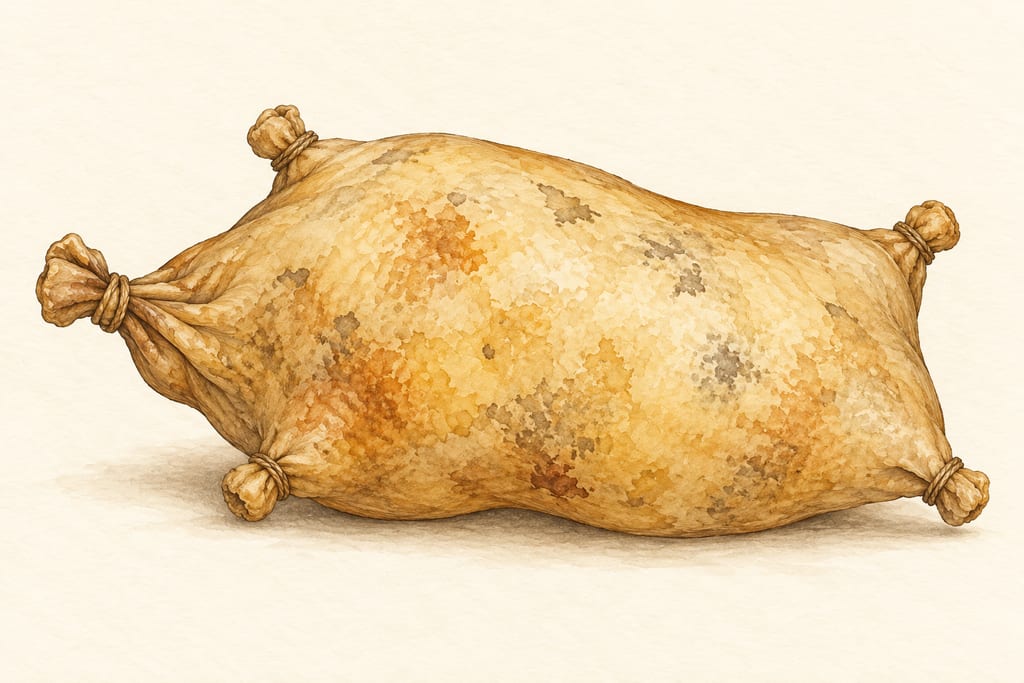
A whole lambskin, prepared as a flexible sack, holds densely packed cheese for ripening as sir iz mišine. The Croatian record locates the tradition in Dalmatia, Velebit and Lika, while its beginnings remain uncertain.
No community contributions have been published for this entry yet.
Sign in to contribute. Published comments and photos are free to read.
Krka National ParkVariant distinction · Hearth process · Fit and ember handling
PekaThe park distinguishes an earlier lid-only hearth arrangement from a later Dinaric assembly of a shallow pan, clay or iron lid and ring that holds coals.
It describes burning wood to coals, placing food in the pan, covering with the peka and spreading embers over it; the source gives about 90 minutes as an example and says the lid should fit well.
Cited in: A lid that becomes the oven; Firing, fitting and cooking
Zadar Tourist BoardDalmatian use · Clay and metal variants · Iž pottery · Image gallery
Peka, the Baking Lid, and the First Oven That Has Survived on Today's HearthsThe board describes the peka/čripnja as a bell-shaped lid over a shallow tray, heated first and covered with embers and ash; it describes clay and metal as separate variants.
The board says Iž potters continue to produce clay čripnje, and that metal lids are more commonly used in its account; these are regional observations, not universal rates.
Cited in: A lid that becomes the oven; Clay and metal are separate forms
The official site of the Tourist Board Split-Dalmatia CountyDalmatian traditional use · Equipment context
PekaThe regional tourist board describes baking dishes under the peka lid as a traditional and popular Dalmatian cooking method, used for meat, octopus, fish and squid.
Cited in: A lid that becomes the oven; Places and practical access
Vjesnik Arheološkog muzeja u Zagrebu, vol. 53 no. 1Regional terminology · Archaeological context · Historical limits
Sub testu: preparation of Roman food under a clay domeThe 2020 review discusses dome-shaped lids used on open hearths and lists regional names including peka, pekva, sač and čripnja.
It describes contemporary use of related lid-baking methods in Dalmatia, Bosnia and Herzegovina, Montenegro and South Serbia, and distinguishes clay and iron forms; it does not prove an uninterrupted identical design from prehistory.
Cited in: Names travel with their own histories; Places and practical access
Croatian Ministry of the Sea, Transport and Infrastructure, Croatian Island Product catalogue 2011Iž clay craft · Local terminology · Maker context
Traditional Ceramics from the Island of Iž / Škarpini FootwearThe catalogue records Iž traditional ceramics by Predrag Petrović, including peka/črpnja and related local forms, and describes the craft as manually produced on a traditional wheel.
Its account identifies local terms and a pottery tradition; it does not establish a standard form or dimensions for all peka lids.
Cited in: Clay and metal are separate forms; Names travel with their own histories; Places and practical access
Slow Food Foundation for Biodiversity, Ark of TasteKosovo and Albanian related iron bell use · Cross link context
FliaThe record describes Albanian and Kosovar flia cooked beneath a bell-shaped iron dome called saç and identifies Rugova Valley as a production area.
This is evidence for a related regional iron-lid form, not proof that every local name is interchangeable with Croatian peka.
Cited in: Names travel with their own histories; Firing, fitting and cooking; Places and practical access