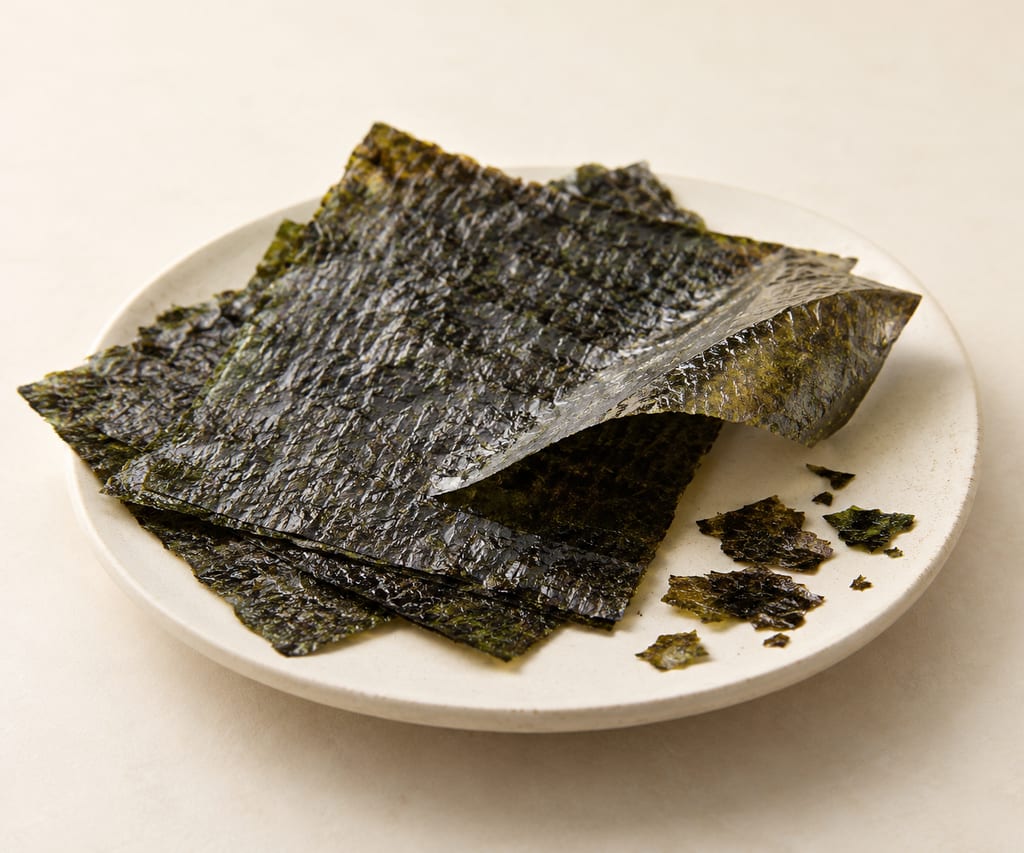
Nori
Nori is a red seaweed farmed in East Asia and dried into thin sheets, prized for its savoury flavour and crisp texture when roasted and used with rice, in soups and as a seasoning.
 FermenteaWhere food goes to change
Equipment · Bags, sacks and casings
Sachets can remove oxygen or absorb water vapour in a sealed package. They help manage suitable dry foods, but cannot replace adequate drying, a sound seal or a validated preservation method.
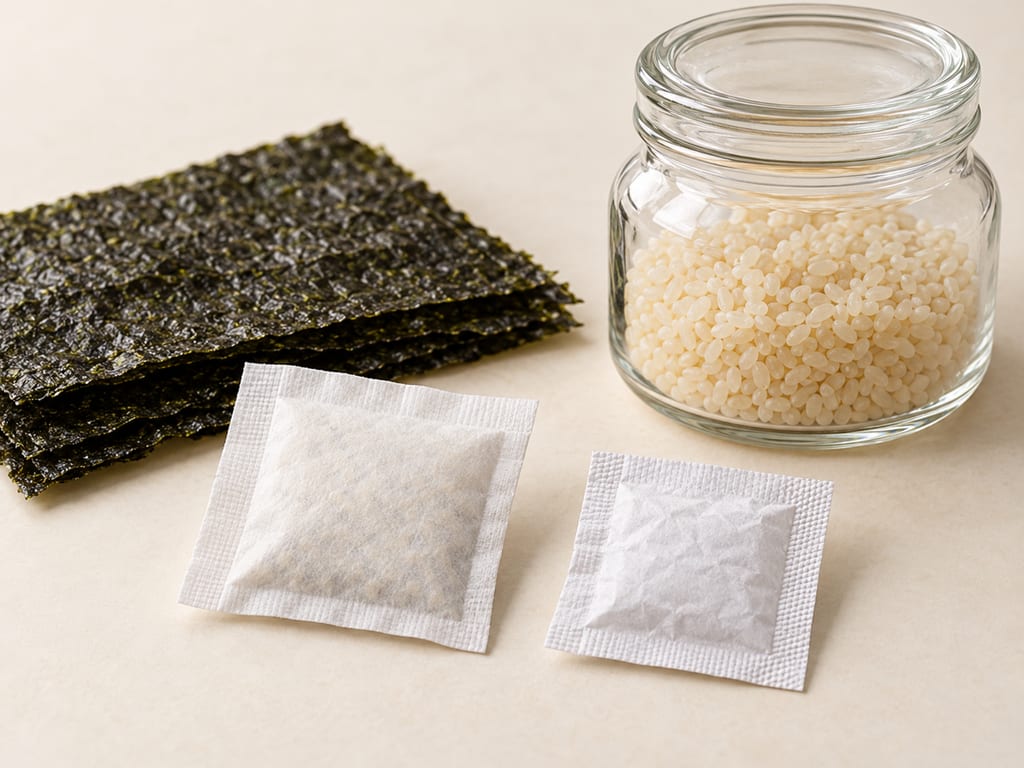
An oxygen absorber and a desiccant are small active-packaging inserts, often enclosed in a permeable sachet and placed inside a sealed food package. They are related by format, not interchangeable by function. An absorber is intended to reduce residual oxygen in the package atmosphere. A desiccant takes up water vapour and helps manage humidity. Neither is a jar, bag or preserving method by itself: each works only as a component of a compatible package.
Some common oxygen-absorber sachets use iron-based chemistry. An Extension expert describes iron powder reacting with oxygen and moisture, while packaging reviews describe a wider range of oxygen-scavenging materials and formats, including packet, film and integrated packaging systems. The active substance, activation conditions and capacity therefore depend on the product. A packet labelled “oxygen absorber” should not be assumed to contain one universal recipe or to suit every food.
Oxygen left in a sealed pack can contribute to oxidation and off-flavours in susceptible foods. Utah State University Extension describes oxygen absorbers used with suitable dry foods in tightly closed containers; it notes that lowering oxygen can help preserve quality and protect stored dry goods from insect infestation. A study of dried laver (nori) provides a more specific example: during six months of storage, the researchers found that a free-oxygen absorber inhibited lipid oxidation when the laver was kept in a gas-barrier bag. That finding belongs to the study's dried-laver and package conditions; it is not a universal shelf-life guarantee.
A desiccant addresses a different variable. Dried foods can pick up water again from the surrounding air, and the National Center for Home Food Preservation stresses cooling food fully before packing, using clean dry containers, and checking stored foods for moisture changes. A packet may help manage humidity within a package, but it cannot undo incomplete drying, compensate for a poor seal, or rescue food that has become damp. Moisture control and oxygen control need to match the food and the package together.
The packet must be specified for its intended application. Oxygen absorbers come in different capacities; the Extension expert advises checking the maker's indication of how much food each packet is designed to accompany. A sound seal matters because oxygen entering through a leaky package can defeat a finite absorber. Utah State's guidance discusses tightly sealed PETE bottles and other barrier packaging for appropriate low-moisture products; its directions are not a blanket recommendation for every food or every container.
Desiccants also differ in absorbent material, packet construction and suitability. The photographed silica-gel sachet is one recognizable form, not a standard for every desiccant. Buy only a product explicitly suitable for the intended food package and follow its label, especially when the packet may sit in direct proximity to food. A packet that was already exposed to air may have used some capacity before it reaches the package; keep it sealed until use and respect the maker's storage instructions.
An oxygen absorber does not make a moist food safe at room temperature. USU warns that removing oxygen can increase the ability of botulism bacteria to grow in food that otherwise requires refrigeration or freezing; the required cold storage still applies after vacuum sealing or oxygen reduction. This equipment is for the package conditions and dry-food uses established by the source, not a shortcut around canning, drying or another validated preservation process.
Use the absorber's instructions for product type, package volume and seal; use a desiccant only where the food-packaging instructions allow it. Keep both packets out of the edible portion and never eat them. Dried foods should be cool before packing, enclosed in clean dry containers, and checked during storage. If a dried food shows moisture pickup, follow established drying guidance; discard moldy food. The packets are consumable packaging components, not reusable vessels, and no general capacity, size or service life applies across product types.
The inspected sources describe current food-packaging use but do not establish a first invention date or a single place of origin. This page groups two distinct modern packet functions; it does not treat them as one technology.
Removing oxygen can increase the ability of botulism bacteria to grow when the food otherwise requires refrigeration; an absorber is not a means of making moist food shelf-stable.
Hazard sourcePackets are packaging components, not food; keep them out of the food and follow the packet's printed warning and disposal directions.
Hazard sourceUse oxygen absorbers only for appropriately dry foods in a tightly sealed package and retain any refrigeration or freezing required by the food.
Control sourceCool dried food fully and package it in clean, dry, insect-proof containers; check stored dried food for moisture changes.
Control sourceDo not use an oxygen absorber to make moist food shelf-stable.
Never eat a packet; choose only a desiccant or absorber explicitly intended for the food-package application.
Oxygen absorbers are not a stand-alone preservation process. Food that requires refrigeration or freezing still requires it after oxygen removal.
Source →Use oxygen-absorber packets only with appropriately dry foods in suitable sealed packages; reduced-oxygen storage does not make moist food shelf-stable.
Source →A desiccant cannot correct inadequate drying or a leaking package. Dried foods can reabsorb moisture and spoil during storage.
Source →Documented for international use, with no single place of origin assigned.
Nori is a red seaweed farmed in East Asia and dried into thin sheets, prized for its savoury flavour and crisp texture when roasted and used with rice, in soups and as a seasoning.
Every preserved food is a stack of barriers against microbes, enzymes, air and time. This is how they work, what a recipe's numbers measure, and how cooks worldwide build them.
No community contributions have been published for this entry yet.
Sign in to contribute. Published comments and photos are free to read.
Utah State University ExtensionUse · Safety · Packaging
Packaging FoodsOxygen absorbers can remove residual oxygen in tightly sealed packages of suitable dry foods.
A vacuum or oxygen-reduced package is not itself a preservation method for foods that require refrigeration or freezing.
USU advises low-moisture dry products and an airtight package for the described absorber use.
Cited in: Why package atmosphere matters; Choose the packet for the food and package; Limits and safe use
National Center for Home Food Preservation, University of GeorgiaHandling · Storage
Packaging and Storing Dried FoodsDried foods can reabsorb moisture and should be cooled completely before packing.
Warm food can sweat inside its package; containers should be clean, dry and insect-proof.
Reopening a package exposes dried foods to air and moisture; check stored foods for moisture changes.
Cited in: Why package atmosphere matters; Limits and safe use
Ask ExtensionMechanism · Use
Food safe oxygen absorbersAn oxygen absorber can lengthen shelf life of dry food in a sealed container by reducing oxygen.
The expert describes iron powder reacting with moisture and oxygen; the answer is about the product class discussed and does not establish every chemistry.
Packet capacity varies and should be checked against the product packaging; the packet should remain airtight before use.
Cited in: Two packets, two jobs; Choose the packet for the food and package; Limits and safe use
Nippon Suisan GakkaishiFood specific use · Science
Changes in the Lipids of Dried Laver “Nori” at Different Water ActivitiesThe study stored dried laver at 19 ± 1 °C for six months across water activities.
It reports free-oxygen absorber use inhibited lipid oxidation in dried laver kept in a gas-barrier bag.
The study also reports that both very low and intermediate water activities affected oxidation, so oxygen removal is not a substitute for moisture control.
Cited in: Why package atmosphere matters
Trends in Food Science & TechnologyMechanism · Geography · Variation
Oxygen scavengers for food packaging applications: A reviewOxygen-scavenging packaging is used to increase shelf life of packaged foods.
The review describes different scavenging chemistries rather than a single universal absorber material.
The contemporary literature examines food-packaging use across multiple product and market contexts.
Cited in: Two packets, two jobs
Sustainable Food Technology, Royal Society of ChemistryForms · Geography
Recent advances in polymeric food packaging materials: application of biodegradable materials in active and intelligent packaging systemsOxygen scavengers may be used as sachets, stickers, coatings or within packaging material.
The review names use in Japan, the United States and Australia, with comparatively less use in Europe under its regulatory conditions.
It lists commercial systems associated with manufacturers in Japan, the United States, Australia, Italy and Finland.
Cited in: Two packets, two jobs
Wikimedia CommonsVisual reference · Form
Silica gel - bag.jpgThe image documents a labelled silica-gel sachet and shows its approximate packet form.
The image warns not to eat the sachet; it is a visual reference, not food-safety research.
Cited in: Choose the packet for the food and package