Palm sap
Sugar-rich liquid tapped from different palms, gathered fresh or transformed into local drinks and sweeteners; species and collection stage shape its composition.
 FermenteaWhere food goes to change
Equipment · Gourds, calabashes and carved bowls
bandji calabash · bulle · buli
A hollowed gourd tied below a palm opening to collect sap. Sierra Leone records a Limba bulle/buli; Nso sources describe a calabash steadied by stick and plant material. These are related local forms, not one standard design.
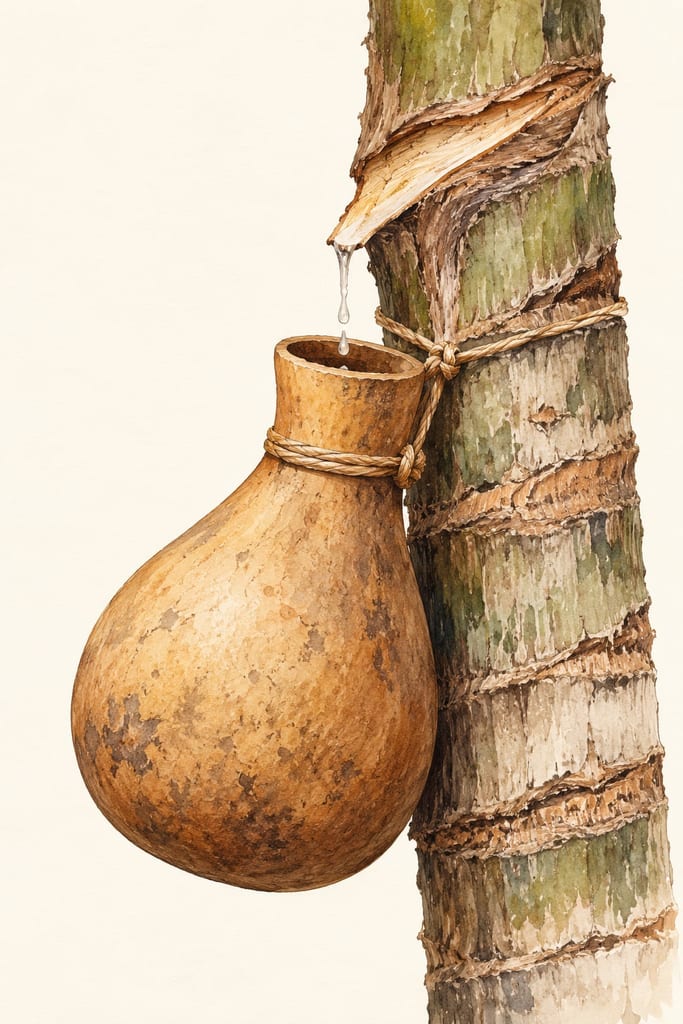
A palm-wine tapping calabash is a hollowed gourd placed under a palm opening to catch sap. Sierra Leone’s National Museum records a Limba gourd container called a bulle or buli: after a hole is made in the palm, the vessel is tied below it. The museum page associates the specimen with poyo, or palm wine, and records vegetable or organic-fibre material. It is a collector at the tree, not the small half-gourd cup used later to drink the finished wine.
The shape and fittings are not standardized in the evidence. The museum gives no dimensions, capacity or detailed profile. A 1942 photograph from the Belgian Congo shows calabashes used to carry palm wine and offers a visual comparison for gourd containers, but its caption describes transport rather than tapping.
Among the Nso’ of Cameroon, a study describes a traditional calabash used to collect palm wine. Its account says a stick is pinned beside the gourd to keep it from falling. Dry plantain leaves or clean grass are wrapped around its mouth both to keep dirt out and to help hold the vessel against the tree. The paper’s Figure 4 is identified as a 2022 photograph from Buhlami Edward’s private collection. These details document one local setup; they should not be added to every bulle or palm-wine gourd.
The two records share the basic job of catching sap with a gourd, but describe the attachment differently: the Sierra Leone museum says its example is tied below the tapping hole, while the Nso account adds a supporting stick and plant material. Neither source describes a universal shape, closure or capacity.
The calabash catches sugary sap as it leaves the palm. The Food and Agriculture Organization’s account describes a gourd tied around the tapping point, with collection after a day or two and daily collection in its process diagram. Fermentation may already be under way in the collecting vessel: the account notes that residual yeasts in a gourd can start fermentation quickly, while also explaining that microorganisms may come from the gourd, the palm, tapping tools or the air. The container can therefore be part of the early fermentation environment without being a purpose-built vat for a later controlled batch.
The FAO discussion covers palm wine across West Africa, including emu and ogogoro in Nigeria and nsafufuo in Ghana, but it does not claim that each community uses the same type of gourd. Its discussion of sanitation is process context, not a recommendation to copy a historical cleaning practice; the cited equipment records supply no cleaning or maintenance protocol for this vessel.
The Sierra Leone National Museum dates one bulle/buli specimen only as pre-1965. It identifies the culture group as Limba and says the example was acquired at Mile 47, on the outskirts of Freetown, but lists associated places as unknown. Acquisition does not prove that the calabash was made or used there. The museum record is evidence for that object, not a date for the invention of the form.
The Nso study documents a collection scene photographed in 2022 and published in a 2024 journal issue. Together, these sources establish documented use in Sierra Leone and the Cameroon Grassfields, with different local descriptions. They do not support assigning a single place of origin to a broader palm-wine tapping calabash family.
The cited records name a gourd or calabash but do not identify the plant species, how the shell is dried or opened, the maker, the cost of obtaining one today, or a standard size. The Sierra Leone specimen’s dimensions are explicitly unknown. No measured capacity, thickness, shelf life or specific replacement interval belongs in the record.
The Nso description explains the local use of leaves or grass around the mouth and a stick for support; it is not a complete care guide. The available evidence does not describe washing, drying or storage after collection. Those details are left open rather than inferred from the word “traditional.”
The Sierra Leone National Museum records a gourd used to catch palm wine under a tapped tree, identifies the object as Limba, and dates this specimen only as pre-1965. It says the example was acquired at Mile 47 outside Freetown, while associated places are otherwise unknown. A 2024 study of Nso’ economic roles in Cameroon describes a traditional calabash used to collect palm wine and illustrates the process with a 2022 photograph. Neither source dates the invention of the form.
The documented Sierra Leone specimen has no recorded dimensions or capacity; the sources do not establish a standard size.
Source →Support and mouth-cover details vary by source: the Nso account mentions a stick and plant material, while the Sierra Leone museum record simply describes a gourd tied below the tapping hole.
Source →This is the recorded acquisition place, not a documented place of manufacture or use.
The article documents the Nso’ of Cameroon and includes a 2022 photograph; the association does not establish an exclusive origin.
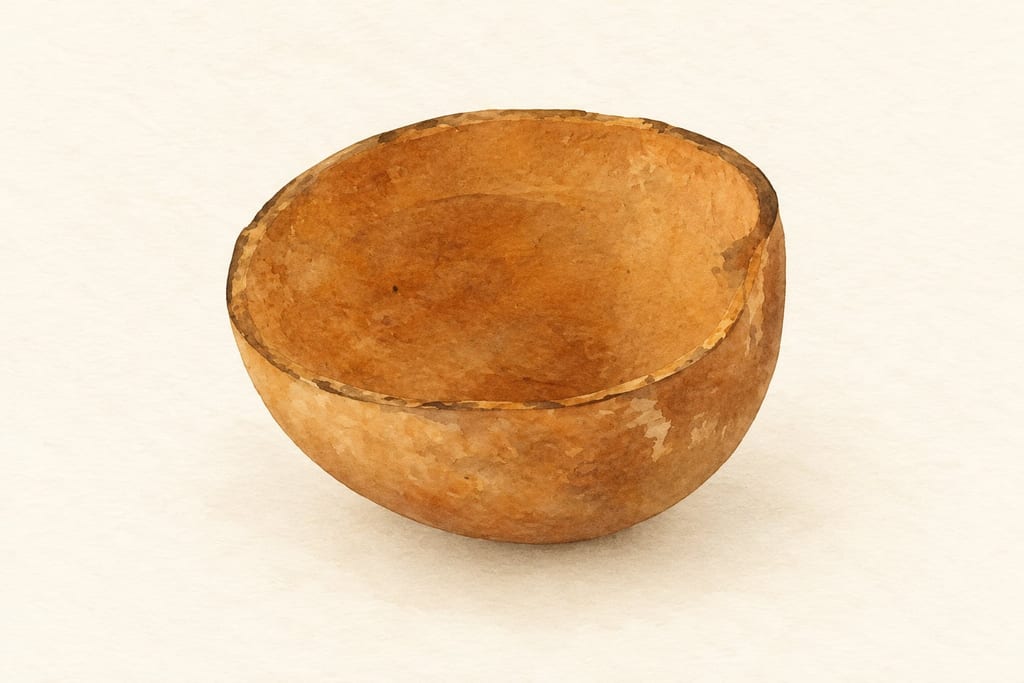
A plain drinking cup made from a dried gourd cut in half, catalogued by Sierra Leone’s National Museum as a Kono poyo cup associated with Yengema.
No community contributions have been published for this entry yet.
Sign in to contribute. Published comments and photos are free to read.
Sierra Leone National Museum collection, presented by Sierra Leone HeritageEquipment · Form · Material · Use · Dating · Geography
BulleThe object is called bulle or buli and is a gourd container used to tap poyo/palm wine; after a hole is tapped into the palm tree, it is tied below the hole to catch liquid.
The specimen is Limba, made of vegetable/organic fibre, has unknown dimensions, is dated pre-1965, and was acquired at Mile 47 outside Freetown; the source does not state that this was its place of manufacture or use.
Cited in: A gourd at the tapping point; How local collection setups differ; What the dates and places establish; Material, care and limits of the record
AFO-A-KOM: Journal of Culture, Performing and Visual Arts; University of BamendaEquipment · Form · Material · Use · Geography · History
Pictures (images) and construction of gender economic roles among the Nso’ of CameroonThe study’s Figure 4 is described as a 2022 palm-wine-production image from Buhlami Edward’s private collection.
The text says a traditional calabash collects palm wine; a stick pinned beside it keeps it from falling, while dry plantain leaves or clean grass wrap its mouth to keep out dirt and support it against the tree.
The study concerns the Nso’ of Cameroon and says calabashes were also used to transfer collected wine; its evidence is a local account, not a continent-wide specification.
Cited in: How local collection setups differ; What the dates and places establish; Material, care and limits of the record
Food and Agriculture Organization of the United Nations, Agricultural Services Bulletin 134Equipment · Use · Fermentation · Care · Limits
Fermented fruits and vegetables: a global perspective, Chapter 4: Products of yeast fermentationThe account describes tying a gourd under an incision in the palm and collecting sap after a day or two; its flow diagram shows a gourd fixed below the cut and daily collection.
It says residual yeasts in an often-unwashed collection gourd can start fermentation quickly, but also discusses hygienic collection and notes that yeasts may originate from the gourd, palm, tools or air; this does not establish one universal sanitation practice.
The account describes palm wine across West Africa and names emu and ogogoro in Nigeria and nsafufuo in Ghana; it does not establish a common gourd design.
Cited in: Collection and the first fermentation
Wikimedia Commons; source credit: Belgian Congo at War (New York, 1942)Image reference · Form · Use
Calabashes used for transporting palm wine, Belgian CongoThe public-domain 1942 photograph shows calabashes used to carry palm wine; it illustrates gourd containers in the beverage context, not a gourd attached to a palm during tapping.
Cited in: A gourd at the tapping point