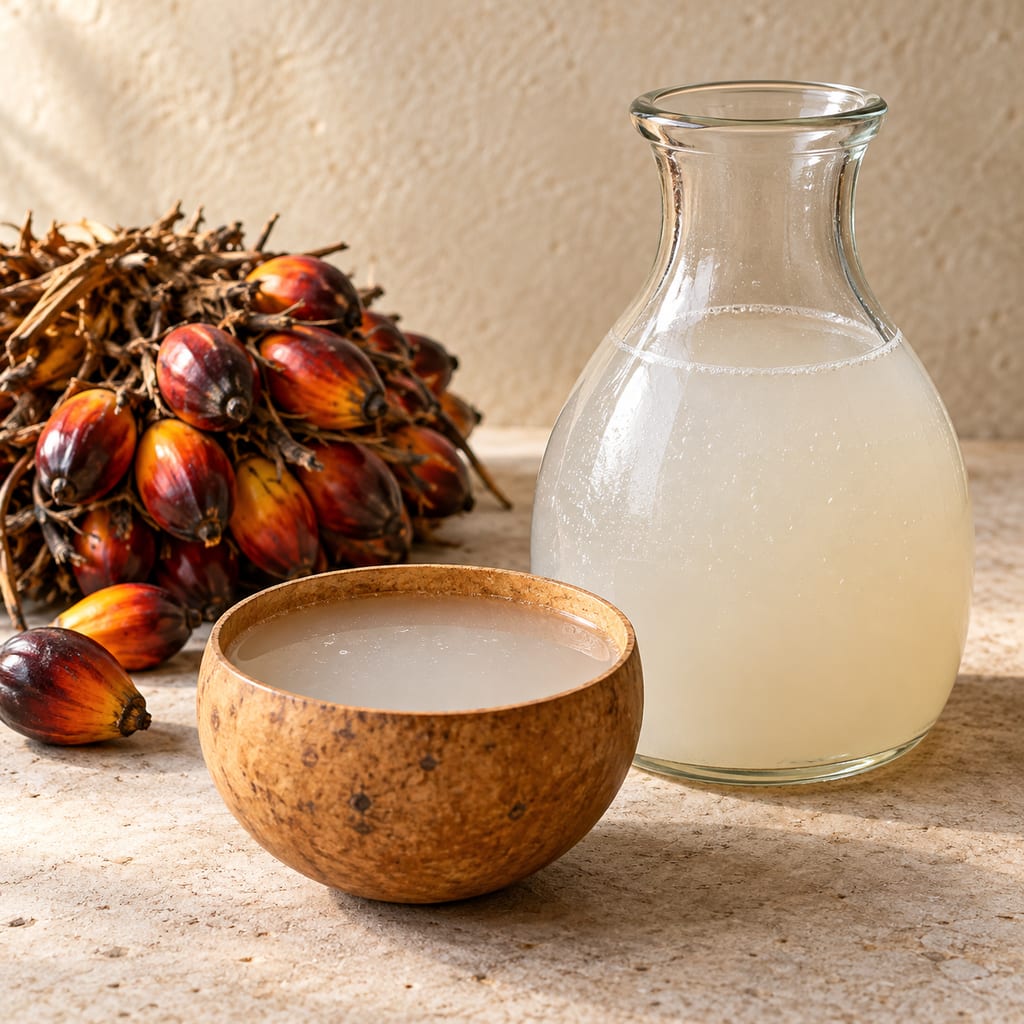
Palm wine
Palm wine is fermented sap from several palm species. West and Central African traditions differ in palm, tapping, vessel and serving stage; this page records shared principles without claiming one universal home-scale process.
 FermenteaWhere food goes to change
Equipment · Gourds, calabashes and carved bowls
A plain drinking cup made from a dried gourd cut in half, catalogued by Sierra Leone’s National Museum as a Kono poyo cup associated with Yengema.
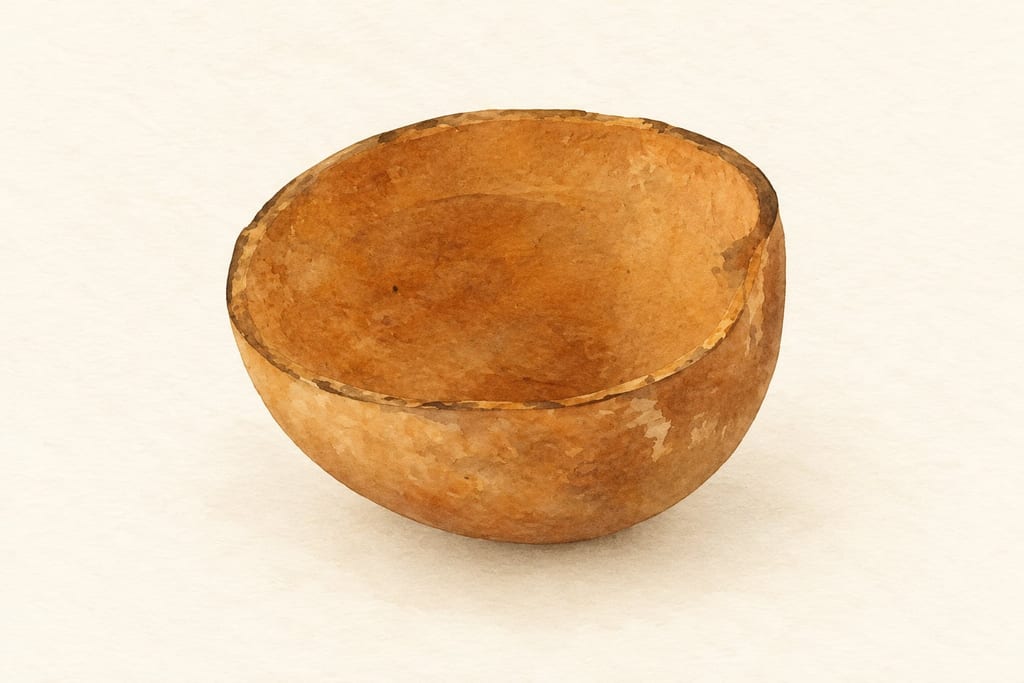
The Poyo Cup is a simple vessel formed from a dried gourd, or calabash, cut in half. The surviving half makes a shallow open bowl: its cut edge is the rim and the hollowed interior holds a serving. The collection record does not describe extra fittings, a handle, decoration or a lid. Its plain form is the defining feature of this specimen, rather than a standardized set of dimensions or a named construction technique.
The cup is associated with poyo, Sierra Leonean palm wine. Poyo is fermented sap gathered from palms, but this small half-gourd belongs at the drinking end of that chain. It is not the receptacle tied under a palm during tapping, and the evidence does not identify it as a fermentation or bulk-storage vessel. That distinction matters because other gourds used around palm wine can be larger, closed or fitted for collection and carrying.
A different Sierra Leone National Museum object, catalogued as a bulle or buli, is described as a gourd tied below a cut in a palm tree to catch the liquid. Its role is collection at the tree, not drinking. Another calabash vessel in the Glasgow Museums collection has a wooden funnel-like mouthpiece tied on with twine and an etched design; its use for holding poyo is recorded as probable. These forms should not be treated as variants of the half-gourd cup simply because all are made from calabash and appear in the same beverage culture.
The wider context is a drink that changes after tapping: poyo ferments from palm sap. That process does not make every gourd in the sequence a fermenter. The cup's documented purpose is to drink the beverage; the available record says nothing about fermentation within this vessel, its volume, or how long a serving was held in it.
The National Museum identifies the object as Kono and associates it with Yengema, Nimi Koro Chiefdom and Kono District in Sierra Leone. It records Town Chief Foday Yengema as donor and assigns accession number SLNM.1965.34.01. The production date is given only as “pre-1965.” This bounds the museum's date for the specimen but does not identify a year, an origin for the cup form, or the age of poyo drinking.
Dimensions are listed as unknown. The gourd species, maker, route by which the cup was obtained, and cleaning or storage practice are also unrecorded in the sources consulted. The specimen therefore documents a recognizable serving form and a specific Kono museum object, while leaving its exact size, manufacture and broader distribution open.
The Sierra Leone National Museum records this specimen as pre-1965 and as belonging to the Kono cultural group. That catalogue date applies to this object; it does not date the first use of half-gourd drinking cups or poyo itself. The record associates the cup with Yengema, Nimi Koro Chiefdom and Kono District, without specifying whether any of these is its place of manufacture, use or collection. The donor is recorded as Town Chief Foday Yengema.
This is a drinking cup, not the gourd used to catch sap during tapping. A separate Sierra Leone National Museum object, the bulle or buli, is tied below a tapped palm to collect liquid.
Source →No dimensions or capacity are recorded for this specimen; the sources do not support a standard size.
Source →The collection record associates the specimen with Yengema, Nimi Koro Chiefdom and Kono District, but does not say whether those places indicate manufacture, use, collection or origin.
Palm wine is fermented sap from several palm species. West and Central African traditions differ in palm, tapping, vessel and serving stage; this page records shared principles without claiming one universal home-scale process.

From sour breads and milk to savoury seeds, cassava staples and living beers, African fermentation follows the crop, the community and the work of transformation.
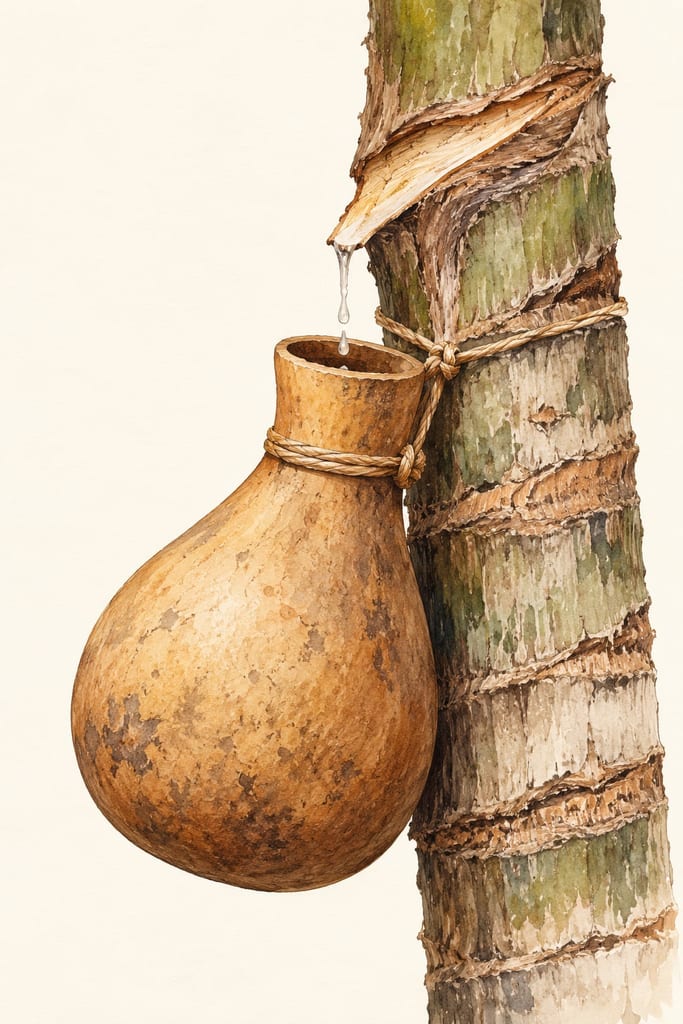
A hollowed gourd tied below a palm opening to collect sap. Sierra Leone records a Limba bulle/buli; Nso sources describe a calabash steadied by stick and plant material. These are related local forms, not one standard design.
No community contributions have been published for this entry yet.
Sign in to contribute. Published comments and photos are free to read.
Sierra Leone National Museum collection, presented by Sierra Leone HeritageEquipment · Form · Material · Use · Dating · Geography
Poyo CupThe object is a cup made from a dried gourd or calabash cut in half; cups like it are sometimes used to drink poyo, or palm wine.
The museum records vegetable/organic-fibre material, Kono culture group, unknown dimensions, and production date pre-1965.
Associated places are Yengema, Nimi Koro Chiefdom and Kono District; Town Chief Foday Yengema is recorded as donor; accession SLNM.1965.34.01.
Cited in: A drinking bowl cut from a dried gourd; Not the sap-collecting or storage gourd; A Kono specimen with an incomplete date
Sierra Leone National Museum collection, presented by Sierra Leone HeritageComparison · Use
BulleA separate gourd container called bulle or buli is tied below a tapped palm to catch poyo; the museum records it as a Limba object and identifies its acquisition near Mile 47 outside Freetown.
Cited in: Not the sap-collecting or storage gourd
Glasgow Museums collection, presented by Sierra Leone HeritageComparison · Equipment
Calabash VesselA separate Mende calabash vessel has a wooden funnel-like mouthpiece attached with twine and a surface design; its use for holding palm wine is described as probable, not certain.
Cited in: Not the sap-collecting or storage gourd
Slow Food Foundation for BiodiversityUse context
Palm WinePoyo is a fermented palm-sap drink in Sierra Leone; the page describes it as made from sap of various palm species.
Cited in: A drinking bowl cut from a dried gourd; Not the sap-collecting or storage gourd