
Shuwa
Omani celebration dish of spiced meat wrapped in leaves, sewn into palm-fibre bags and cooked in a sealed pit of embers for up to a day.
 FermenteaWhere food goes to change
Built structures · Pits and cavities
Omani Shuwa uses a ground-built Tannur: a stone-lined pit heated with wood, where palm-fiber parcels are lowered for long cooking. Sources do not establish one measured design.
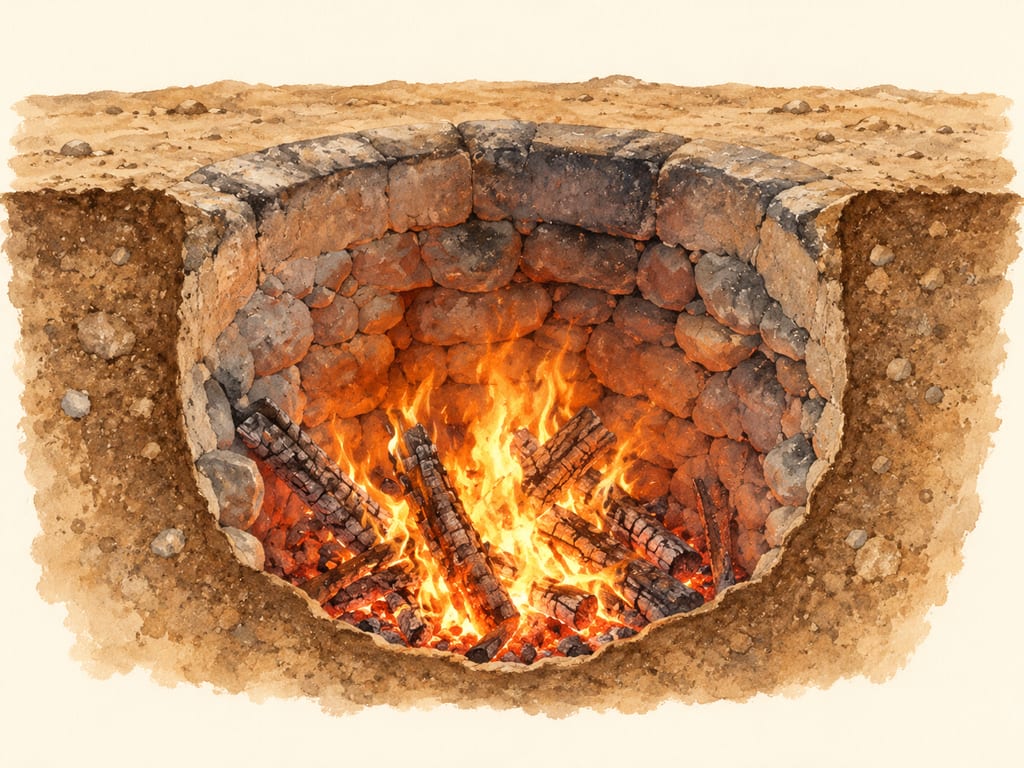
The Tannur used for Omani Shuwa is a fixed oven dug into the ground. Al Shabiba describes a stone-lined pit used for meat and bread, with stones sometimes secured using sarooj or cement. A photograph accompanying that report shows a round opening and irregular stone lining during firing. Neither the photograph nor the text establishes a single standard plan, and the source’s reproduced depth unit is unclear, so this page does not give a measured profile.
Shuwa is a celebratory meat preparation associated with Eid and shared work. The local account describes wood burned in the pit before meat wrapped in leaves and carried in a woven palm-frond container is lowered inside. Smithsonian Folklife records an Omani practitioner’s account of family participation and both household and shared community pits. These sources support the Tannur as the structure that supplies retained ground heat; they do not prove one origin date or identical construction across Oman.
The build is described in practical stages: prepare the pit, line it with stones, burn wood to heat the chamber, and lower the wrapped meat in its palm-fiber carrier. Al Shabiba says the firewood may include samr, ghaf or mango and reports a several-hour firing; the exact species and schedule are not a universal recipe. The woven carrier, called khassaf in the report, keeps the meat bundle together for loading and retrieval. A hooked pole is used to bring the container back out after the long cooking interval.
Other reporting describes a drum or metal container placed inside a pit, with a lid and mud seal. That is a documented variant in contemporary accounts, not a reason to redraw every Omani Tannur as a metal insert. This page centres the stone-lined earthen pit pictured in Al Shabiba and keeps construction variants distinct. The sources do not provide dimensions, fire-clearance specifications, or a tested temperature curve.
Oman is the supported geographic scope. Oman Observer specifically identifies Nizwa as a place where Eid barbecue and opening the stone oven remain part of local celebrations. Smithsonian Folklife describes the communal character through an Omani practitioner’s memory: families prepare together, and neighbours may share a larger pit. Those accounts explain why the oven is often part of a collective event rather than a small domestic appliance.
The available reporting supports a ground pit, stone lining, wood firing and palm-frond carriers, but not a single engineering drawing. One article reproduces a depth number without a clear unit; it is deliberately omitted. The cutaway image is editorial illustration of the below-ground relation, not archaeological evidence or a measured plan. The Tannur is linked to the Shuwa preparation and to the broader pit-oven family; the particular recipe page remains a separate record.
Omani media accounts describe the Tannur as a traditional ground oven used for meat and bread, particularly for celebrations. Al Shabiba's 2017 account attributes construction details to the Omani Encyclopedia. Smithsonian Folklife documents Shuwa as a family and community preparation remembered by an Omani practitioner. These accounts establish living and remembered use, not the oven's date of origin.
A build is made where it stands: moving it means building it again.
This is a descriptive record, not a construction, fire-safety or food-safety plan. The sources do not establish ground-stability requirements, clearances, operating temperatures or validated doneness controls.
Country-level association with Omani Tannur/Shuwa; sources do not establish an exclusive origin or a single construction form.
The Oman Observer identifies Nizwa as a place where Eid barbecue and opening the stone oven are traditions; this does not locate every Tannur or the linked photograph.
Omani celebration dish of spiced meat wrapped in leaves, sewn into palm-fibre bags and cooked in a sealed pit of embers for up to a day.
No community contributions have been published for this entry yet.
Sign in to contribute. Published comments and photos are free to read.
Al ShabibaConstruction · Materials · Method · History
What is the Tannur and how is it made in the Sultanate?Defines the Tannur as a pit dug into the ground for meat or bread.
Describes a stone lining, which may be secured with sarooj or cement, and reports wood firing before palm-frond containers are lowered.
Describes a hooked pole used to lift the containers and says the oven is commonly associated with Eid and celebrations.
Attributes construction information to the Omani Encyclopedia; the reproduced text's depth unit is ambiguous, so no depth is repeated here.
Cited in: A ground oven for Omani Shuwa; Stone lining, fire and the palm carrier; Place, communal use and evidence limits
Times of OmanMethod · Materials · Local variation
How to make Shuwa for EidReports meat wrapped in leaves and carried in palm-leaf bags before placement in an ember-filled Tanoor.
Describes a metal cover and mud seal in this reported form; this is presented as a local construction account rather than a universal specification.
Identifies Shuwa as an Omani Eid dish and notes local naming variation.
Cited in: Stone lining, fire and the palm carrier
Smithsonian Folklife FestivalHistory · Social context · Method
Omani Recipe: Slow-Cooked Lamb ShuwaAn Omani practitioner describes Shuwa as a communal and family preparation.
The account describes meat wrapped in leaves and placed in a sack for pit cooking; some families have individual pits while shared community pits are also reported.
A modern festival adaptation uses a smoker instead of digging an earth pit, which is distinguished from the traditional structure.
Cited in: A ground oven for Omani Shuwa; Place, communal use and evidence limits
Oman Observer / Ministry of Information, Sultanate of OmanGeography · Social context
Keeping Eid traditions aliveNames Nizwa in particular when describing Eid celebrations that include Omani barbecue and opening the Tannur stone oven.
Cited in: Place, communal use and evidence limits