Form and function
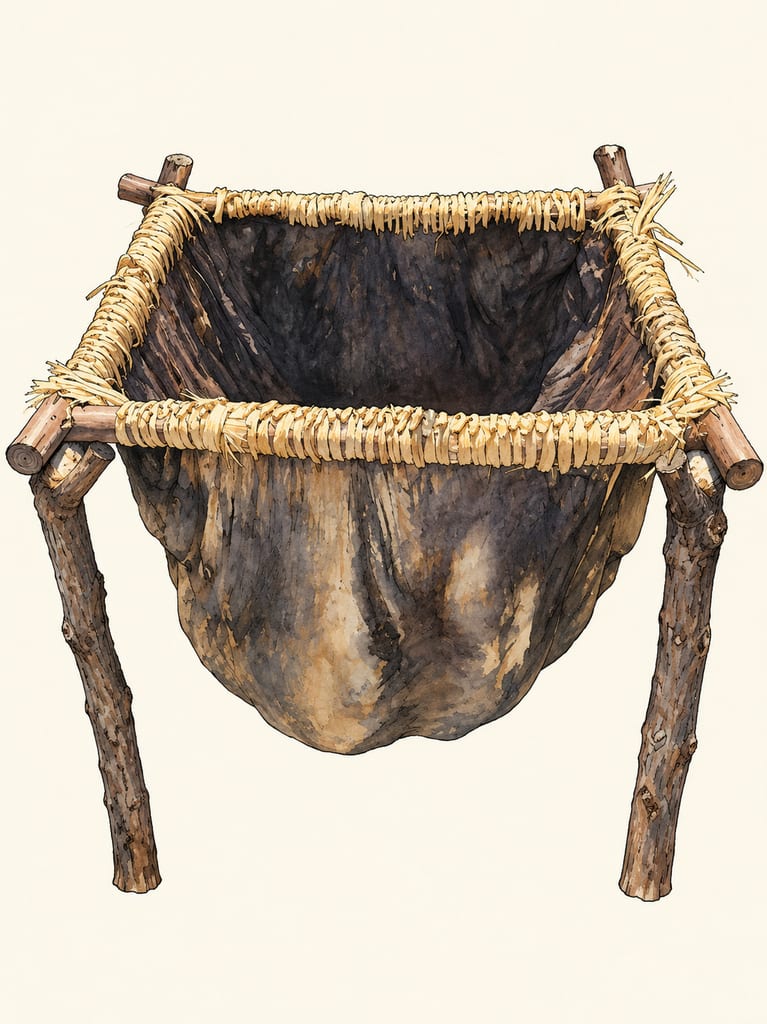
Finca 18 lists cowhides among vessels used to ferment agave spirits. Its photograph captioned “Mezcal Cowhide Fermentation, Puebla” shows a hide held over a timber frame. The centre sags below the frame to make an open basin, with an irregular rim around it. This is the configuration visible in that contemporary example, not a template for every hide vat: the source does not establish a universal hair-side orientation, hide treatment, lashing material, frame dimensions or capacity.
The vessel holds agave material during fermentation before distillation. Maguey Melate's listing for David Rivera's Papalometl batch in Santa María Ixcatlán, Oaxaca, specifies a cowhide vat and six days of vat fermentation. It separately reports 80 litres produced; that is batch output, not a measurement of the vat.
Sources for this section
Geography and chronology
The two records document contemporary cowhide-vat use in Puebla and in Santa María Ixcatlán, Oaxaca. They establish examples rather than a uniform practice across either state or all of Mexico. Finca 18 identifies the pictured fermentation as Puebla; the Maguey Melate listing names the batch and producer's town.
The Maguey Melate page calls the method pre-Hispanic, but a present-day product description does not independently date the vessel or demonstrate continuous use. Neither source supplies an archaeological or historical attestation for this particular suspended-hide form, so its period remains unknown here.
Sources for this section
What the sources leave open
No inspected source gives construction instructions, hide preparation, frame joinery, dimensions, capacity, cleaning practice or fermentation temperature. These details should not be inferred from a photograph or from a batch's six-day duration. The illustration for this record is editorial, based on an observed contemporary form; it is not evidence of an archaeological object or an older origin.
Sources for this section
History
Current producer accounts document cowhide fermentation in Puebla and Oaxaca. Neither source independently dates the suspended-hide form.
Equipment details
PowerNot established Sources do not state a power source; the vat is passive.
How you get oneNot established Sources do not explain how the hide vat or frame is made or acquired.
CareThe sources do not document cleaning, maintenance or storage; no procedure is supplied.
Made of
- cattle hide — vessel
Finca 18's Puebla photograph shows a hide suspended over a timber frame; orientation and preparation are not established. - timber — support frame
The photograph shows a timber support; species and dimensions are not stated.
Limits
Capacity and dimensions are not reported.
Source →The contemporary examples do not establish the origin or pre-contact date of this form.
Source →The photographed configuration is one example; hide orientation, fastening and frame details should not be generalized.
Source →Places
Puebla
Documented use · Region evidenceFinca 18 caption identifies a pictured contemporary example; it does not establish state-wide prevalence.
Santa María Ixcatlán
Documented use · Locality evidenceThe producer listing locates a current Papalometl batch here; it is not a claim of exclusive or general local use.