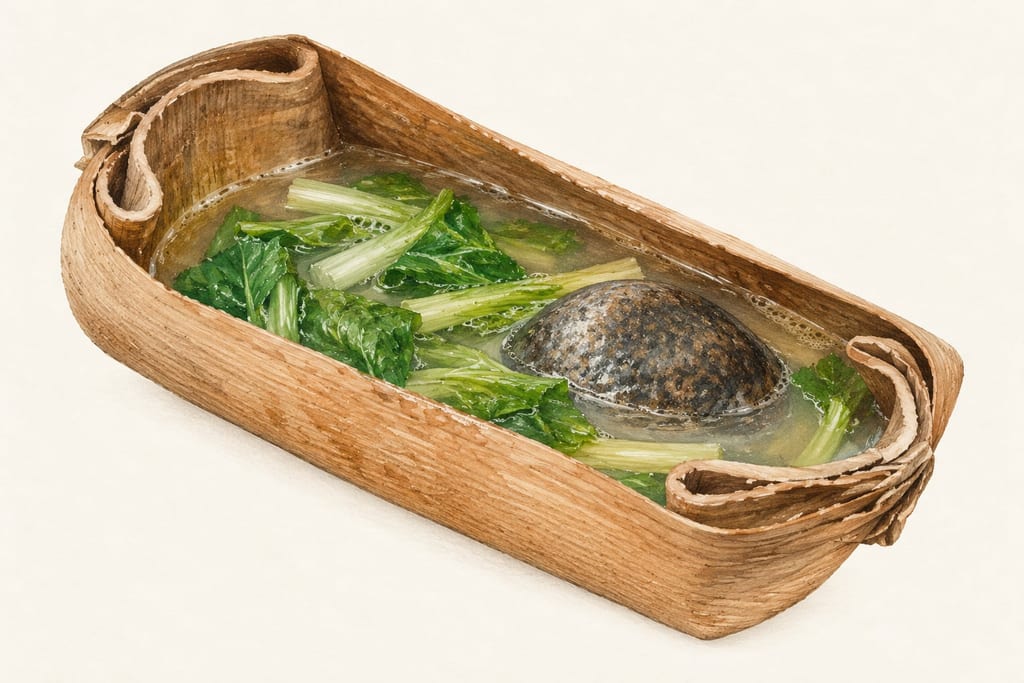
Stone-boiling vessel
Stone boiling heats food in a vessel with stones warmed separately in a fire. Amis leaf sheaths, Chinantec jícaras and Northwest Coast cooking baskets are distinct regional forms, not one universal pot.
 FermenteaWhere food goes to change
Equipment · Jars, pots and crocks
A fired-clay vessel assembly used to distil fermented agave must in several Mexican mezcal traditions. Its arrangement varies by region and producer; the sources document both clay or wooden vapour passages and particular cooling vessels.
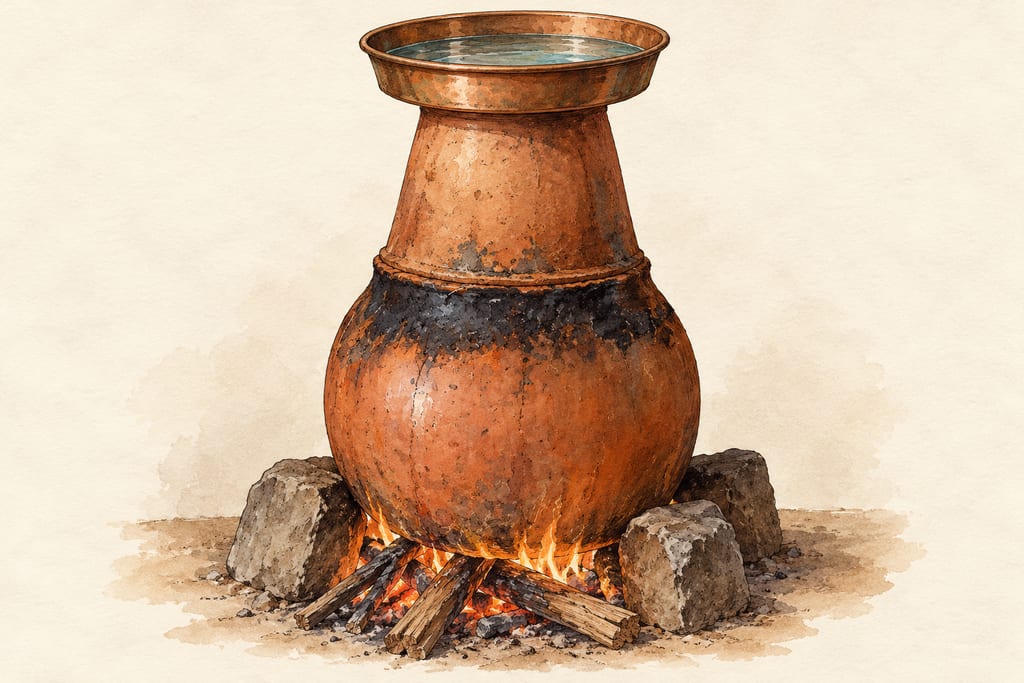
Olla de barro means a clay pot. In mezcal production the name refers to fired-clay vessels used in the distillation assembly, not to a single standardized still sold in one fixed design. A Mexican glossary defines the vessel as clay with openings in its base and upper part, and records its use in Oaxaca and some regions of Puebla and Guerrero in place of metal or wooden alembics. The national mezcal standard describes one legally defined ancestral arrangement: fermented agave must is heated by direct flame in a clay pot, with a clay or wooden coil. These descriptions overlap, but they do not make every local apparatus identical.
One Oaxaca state diagnostic explains a particular two-pot form. The lower olla holds the fermented material; an upper clay pot without a bottom receives the rising vapour, and a water-filled copper pan cools it. The report says this arrangement separates alcohol from the fermented liquid, while local mezcal makers manage the heat through their own practical knowledge. The exact vessel dimensions and capacity are not reported as a general specification, so this page gives none. A still of this kind is assembled from made objects and set above a fire; it is equipment rather than a fixed structure.
Heat supplied directly to the lower pot brings volatile components of the fermented agave must into the vapour stream. The still’s upper chamber and cooling surface then provide a route for vapour to lose heat and return to liquid form. In the Oaxaca example, a copper pan containing water sits over the upper clay chamber; the national standard also recognizes clay or wood coils in the ancestral configuration. The sources document more than one construction, so the two-pot and coil descriptions should be read as configurations, not combined into a fabricated universal blueprint.
Clay is the defining material of the lower vessel in this item. The available descriptions establish its role and broad arrangement, but do not supply a standard clay recipe, wall thickness, firing schedule, repair method, or cleaning procedure. Nor do they establish a common batch volume. Those details depend on a particular producer’s apparatus and should not be inferred from the words “ancestral mezcal.”
The term is documented for Oaxaca and for some regions of Puebla and Guerrero. That geographic wording matters: the source does not name every community using the still, and it does not support assigning the same design to each state. The Mexican norm distinguishes ancestral mezcal by its overall production configuration, including cooking, milling, fermentation and distillation stages; a clay pot alone does not establish that a drink satisfies the full category.
The still remains part of current mezcal production. In 2016, an Oaxaca state value-chain diagnostic described clay pots as one artisanal distillation method and contrasted it with other stills. The national norm published in 2017 defines direct-flame distillation in clay as an ancestral-mezcal option. Neither establishes when the clay still was invented or proves an unbroken ancient lineage for this specific apparatus.
The specific history of the clay-pot apparatus is not dated by the inspected sources. The 2016 Oaxaca state diagnostic records a clay-pot method, while Mexico’s 2016 norm later classifies direct-flame clay-pot distillation as part of ancestral mezcal production.
The glossary documents ollas de barro in Oaxaca, and the state diagnostic describes a two-pot arrangement; neither source makes it the only local design.
The glossary says the method is used in some regions of Puebla; it does not identify a locality.
The glossary says the method is used in some regions of Guerrero; it does not identify a locality.
The national standard defines direct-flame clay-pot distillation as an ancestral-mezcal configuration; this does not assert that the still originated throughout Mexico.
Stone boiling heats food in a vessel with stones warmed separately in a fire. Amis leaf sheaths, Chinantec jícaras and Northwest Coast cooking baskets are distinct regional forms, not one universal pot.
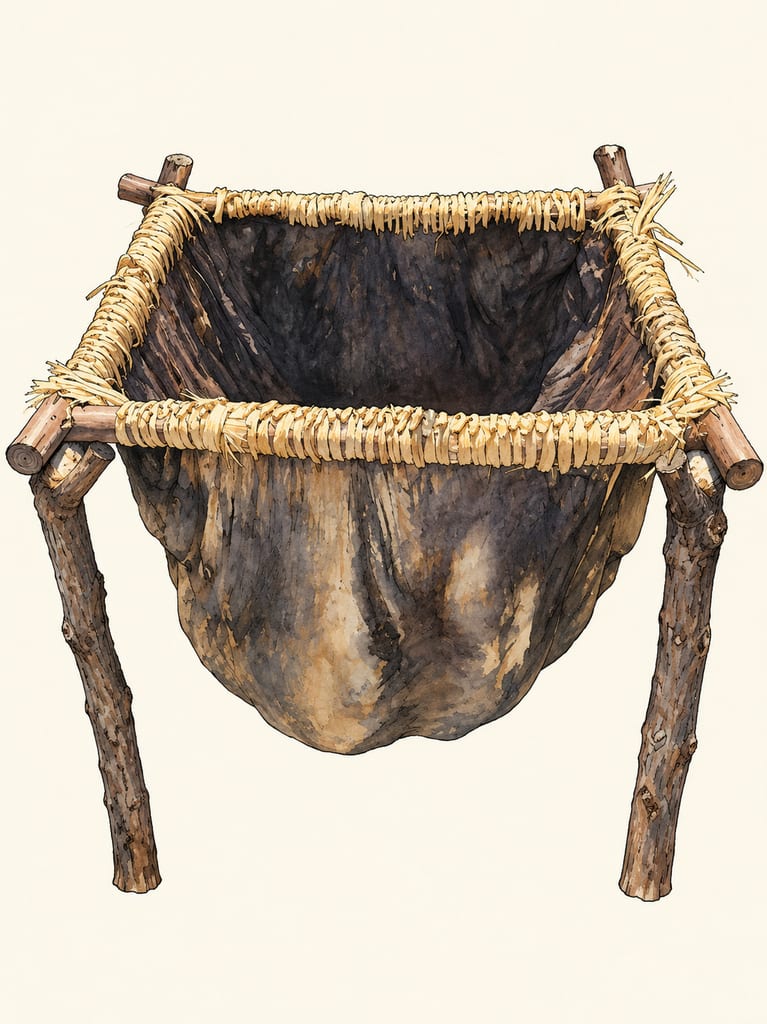
A hide stretched over a timber support forms an open, hanging basin for agave fermentation. Contemporary accounts document examples in Puebla and Oaxaca; the sources do not establish the form's pre-contact chronology.

Soft, spreadable Calabrian pork sausage made with a great deal of red chilli and fatty pork, stuffed into natural casings, sometimes smoked and matured while staying soft.

A way to add independent temperature logging to an existing food dehydrator without changing its built-in controls or protections. It is a monitoring method, not a rewiring plan.

Pleurotus cystidiosus is the abalone mushroom, a cultivated oyster-type fungus with dark brown caps that grows more slowly and is more demanding than other Pleurotus species.

A dark, balanced vinegar from Emilia-Romagna made by combining cooked or concentrated grape must with wine vinegar, then acetifying and refining it in wood under a protected specification.

A living dairy inoculum that starts controlled cream fermentation, developing acidity and aroma before sour cream or cultured butter is finished.

A small electric incubator holds jars at a selected temperature for yogurt and other documented warm food preparations. Controls, capacity and vessel arrangement vary by model.

Adygean salt is a seasoned table salt associated with Adygea and the wider North Caucasian culinary tradition. Salt is blended with garlic and a variable selection of herbs and spices; the exact mix depends on the named style and maker.

The African Caesar-group mushroom, Amanita masasiensis, is a wild ectomycorrhizal species of central and southern African woodlands, eaten locally. The genus contains deadly poisonous species, so identification needs care.
No community contributions have been published for this entry yet.
Sign in to contribute. Published comments and photos are free to read.
Mexico, Secretariat of Economy; English translation hosted by PAMFARegulatory specification · Equipment configuration
Official Mexican Norm NOM-070-SCFI-2016, Alcoholic Beverages—Mezcal—Specifications (English translation)Defines ancestral mezcal distillation as direct flame in a clay pot with clay or wooden coils; the English document states that the Spanish original prevails.
Cited in: A pot still made from local materials; How the assembly condenses vapour; A regional tool, not a universal form
Centro de Investigación y Asistencia en Tecnología y Diseño del Estado de Jalisco A.C. and Red Temática Mexicana Aprovechamiento Integral Sustentable y Biotecnología de los AgavesRegional terminology · Equipment · Geography
Regionalismos y términos comunes, antiguos y contemporáneos del proceso de elaboración del mezcalDefines olla de barro as a clay vessel with openings at base and top used for distillation; records use in Oaxaca and some regions of Puebla and Guerrero.
Cited in: A pot still made from local materials; A regional tool, not a universal form
Government of the State of OaxacaEquipment configuration · Regional use · History
Diagnóstico de la Cadena de Valor Mezcal en las Regiones de OaxacaThe 2016 report describes a method using two clay pots, with the lower pot holding fermented product, the upper receiving vapour, and a water-filled copper vessel acting as condenser.
Cited in: A pot still made from local materials; How the assembly condenses vapour; A regional tool, not a universal form
NVI NoticiasImage reference
Impulsan mezcal ancestral en Santa Catarina MinasThe article’s photograph shows a producer handling a large clay distillation vessel in Santa Catarina Minas; used as a visual reference only.