Sago starch
Sago starch is edible starch recovered from the pith of sago palms. It is pressed into thin cakes for Indonesian sagu lempeng, cooked as porridge and formed into other foods; in some regions, wet starch also ferments during storage.
 FermenteaWhere food goes to change
Equipment · Bamboo, leaf and wraps
In Papua New Guinea, moist sago starch may be packed tightly inside leaves for storage. Greenhill’s field study records this as a preferred Western Province method and contrasts it with water-covered vessels in East Sepik.
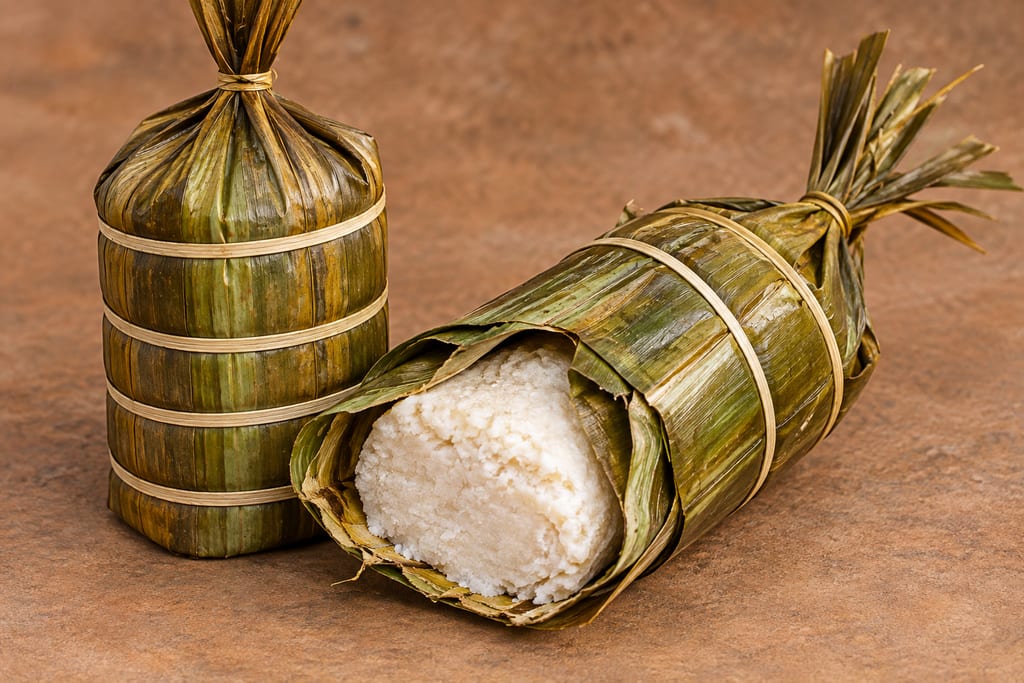
A sago leaf bundle is a flexible package for starch extracted from the pith of the sago palm, Metroxylon sagu. Greenhill's 2006 thesis calls the form a “sago bundle” and captions its Figure 2.07 as densely packed moist starch wrapped in sago leaves. The wrapping is in direct contact with the starch; unlike an earthenware pot, it has no rigid wall, stable mouth or separate lid. The figure documents a real form, but it does not define one required silhouette.
The leaf wrap holds a mass of damp starch together after extraction and while it is stored. It can also be carried as a package. A source photo in this record shows a different, dried sago product wrapped in palm leaves for transport and storage. Dry market bundles and the moist bundle in Greenhill's study are related uses of leaf packaging, but they are not the same stage or product.
Greenhill's survey found a clear difference between East Sepik and Western Province storage preferences. In the thesis table, 82% of 22 Western Province respondents preferred wrapping starch in leaves; the reported 95% confidence interval is 60–95%. In East Sepik, 15% of 27 respondents preferred leaf wrapping, while most respondents identified watertight vessels such as clay pots, saucepans or buckets. Those figures describe a modest field sample, not a census or a rule for every community.
The equipment record therefore places the bundle in Western Province and keeps East Sepik as a documented comparison. The evidence does not identify one village as the origin of leaf-wrapped sago, nor does it date when people began using leaves for storage. The subject is Papua New Guinean, but the regional preference and local construction should remain visible in how it is described.
Greenhill lists sago leaves, banana leaves and, occasionally, pandanus leaves among storage wraps used in Papua New Guinea. Those are alternatives reported by the source, not interchangeable materials in every local practice. Figure 2.07 specifically depicts sago leaves. A 1995 account by Keith Briggs, describing processing in the lower Fly delta and Aramia River, says women pinned sago leaves together with short pieces of leaf rib, then packed the heavy, putty-like residual starch into tubes or bags. Excess water could seep from the container.
The magazine's photograph shows a tube filled with freshly made sago, while Greenhill's thesis illustrates a tightly wrapped moist bundle. Together, these sources support a hand-formed leaf container and show that tube-like packages were used. They do not establish one standard cross-section, closure, tie spacing, capacity or leaf count. A generated illustration can clarify the package idea, but it cannot stand in for the full range of local forms.
Moist sago starch may ferment during storage, but the leaf bundle is not a controlled fermenter in the sense of a sealed jar with measured conditions. Greenhill compared sago wrapped in leaves with smoked sago and sago held under water in earthenware pots. The work tracked microbial populations under study conditions; the different containers did not guarantee a uniform outcome in households. The wrapper itself does not inoculate the starch or set a fermentation endpoint.
A separate study reports spontaneous fermentation in freshly prepared sago starch under laboratory conditions and describes chemical changes during storage. Its sealed laboratory containers are not the same apparatus as a traditional leaf bundle. It is useful evidence that sago starch can ferment, not proof that every wrapped parcel acidifies in the same way or over the same period.
The sources give no standard bundle weight or dimensions. The 1995 article reports that a family might consume a tube over several days, but that observation belongs to its description of one local production context and should not be used as a universal capacity. The JCU study reports that partial use exposes a bundle to more air and handling; its safety discussion warns that long-term leaf storage carries risks and is not a blanket preservation recommendation.
The inspected accounts do not provide a universal cleaning routine, a safe storage duration or a preparation protocol that can be applied across communities. The useful equipment questions are narrower: which local leaves were used, how the bundle was closed, whether the starch was moist or dried, and whether it was intended for storage, transport or another stage. If a source does not answer one of these questions, leave it open rather than filling it with an invented standard.
Greenhill's 2006 thesis depicts densely packed moist sago wrapped in sago leaves and records regional storage preferences. The thesis dates its field documentation, not the origin of the practice.
Greenhill's thesis reports contamination and variable microbiological results in sago samples; a leaf wrapper is not a validated safety barrier.
Hazard sourceDo not infer that leaf wrapping or spontaneous fermentation makes a particular batch safe. The cited research does not validate an all-purpose storage procedure.
No inspected source establishes a standard bundle size, mass, leaf species, number of layers or number of leaf-rib fasteners. The 1995 account describes one local tube method.
Source →The survey documents regional preferences, not a uniform practice for all of Papua New Guinea or a dated origin for the bundle.
Source →Laboratory microbial comparisons and reports of fermentation do not make leaf wrapping a food-safety guarantee. The thesis notes increased exposure risk for partly used bundles and discourages long-term leaf storage in its safety discussion.
Source →Dried palm-leaf transport bundles shown in the linked image are not the moist leaf-wrapped storage form documented by Greenhill's Figure 2.07.
Source →The survey reports leaf wrapping as the preferred sago storage method among its Western Province respondents; it does not describe every community.
The study documents sago storage here and reports a greater preference for water-tight vessels than leaf bundles; this is a sample comparison, not an exhaustive account.
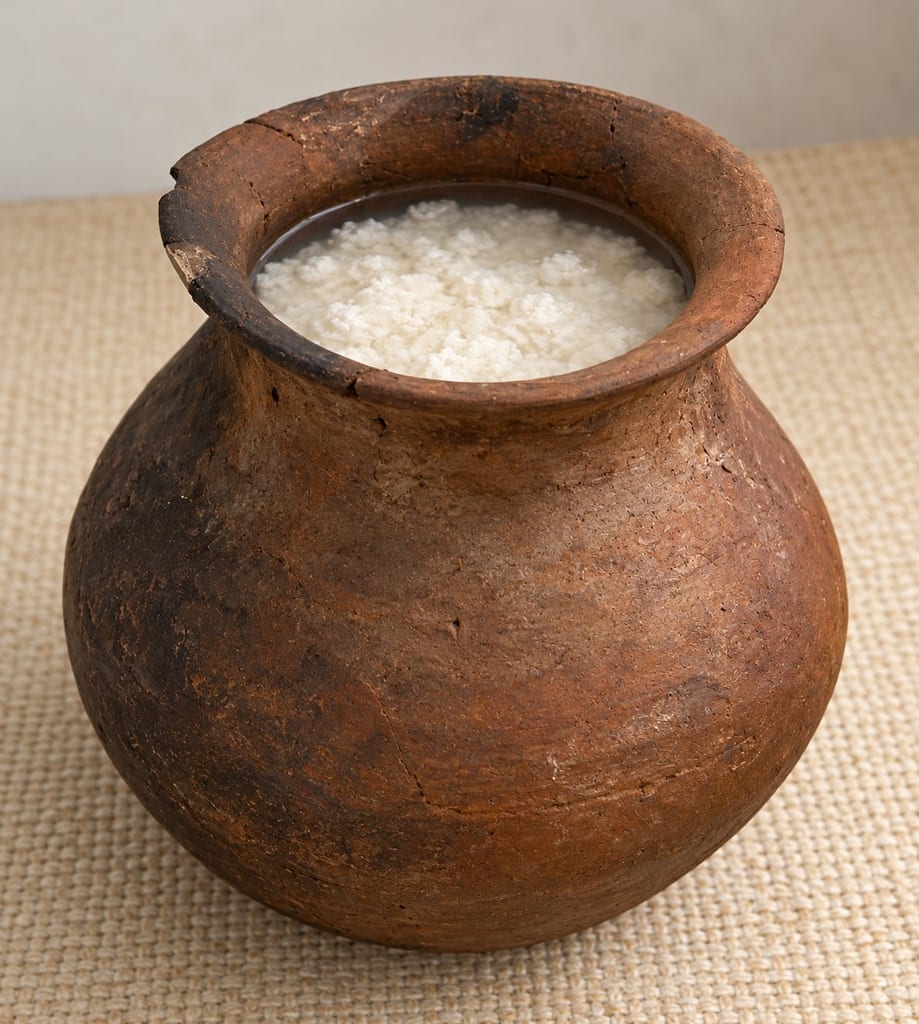
In lowland Papua New Guinea, sago starch may be kept beneath water in a pot, saucepan or bucket. The method is documented in East Sepik; moist storage can support spontaneous fermentation but does not guarantee it or safety.
No community contributions have been published for this entry yet.
Sign in to contribute. Published comments and photos are free to read.
James Cook University ResearchOnlineForm · Materials · Geography · Variation · Limits · Microbiology
Food safety and security of sago starch in rural Papua New GuineaFigure 2.07 caption identifies densely packed moist sago starch wrapped in sago leaves as a sago bundle.
In the study's storage survey, 82% (95% confidence interval 60–95%) of 22 Western Province respondents preferred leaf wrapping; in East Sepik, 15% (4–34%) preferred leaves while watertight vessels were preferred overall.
The study compares leaves, smoked sago and water-covered earthenware storage in a laboratory; its findings do not make the bundle a guaranteed safety control.
The thesis warns that partially used bundles may have greater exposure and reports no universal bundle dimensions or capacity.
Cited in: The bundle is the container; A documented regional contrast; Leaves, ribs and a local tube form; Storage is not a single fermentation recipe; Limits and care
Paradise magazine, Air Niugini, issue 112 (September–October 1995), pp. 29–31Form · Materials · Geography · Handling
Forest FlourThe story describes sago processing in the lower Fly delta and Aramia River.
It reports that women pinned sago leaves together with short leaf-rib pieces, packed heavy putty-like residual starch into tubes or bags, and let excess water seep from them.
The photographs and captions show a sago-leaf tube filled with freshly made sago; this documents a regional example rather than a standard shape or recipe.
Cited in: Leaves, ribs and a local tube form; Limits and care
Food Microbiology 26(2), 136–141Microbiology · Limits
Spontaneous fermentation of traditional sago starch in Papua New GuineaThe study reports spontaneous fermentation of freshly prepared sago starch under laboratory conditions and analyzes stored village samples; those results do not prescribe a universal leaf-bundle process or certify safety.
Cited in: Storage is not a single fermentation recipe
Bushguide 101 / Food Plant SolutionsVariant · Image reference · Limits
Sago – staple food in parts of Papua New GuineaThe linked photograph is captioned as dried sago wrapped in palm leaves for transportation and storage, a dry variant distinct from Greenhill's moist bundle.
The page also describes tightly wrapped leaf-and-bark storage and burial, but its long-duration claim is not adopted as validated storage guidance.
Cited in: The bundle is the container; Limits and care