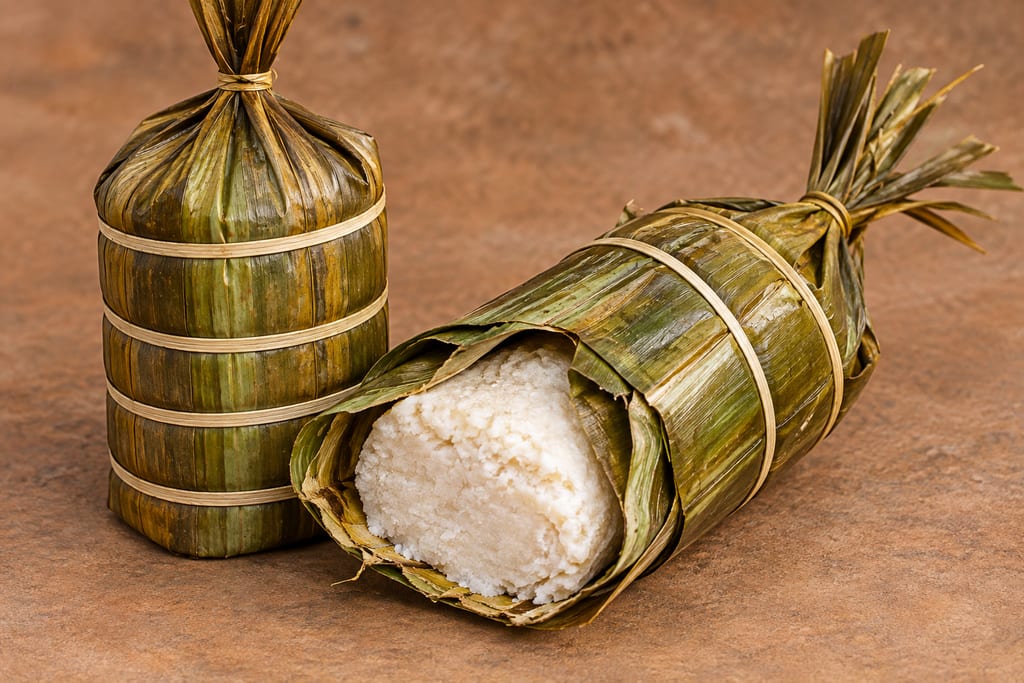
Wrapped sago leaf bundle
In Papua New Guinea, moist sago starch may be packed tightly inside leaves for storage. Greenhill’s field study records this as a preferred Western Province method and contrasts it with water-covered vessels in East Sepik.
 FermenteaWhere food goes to change
Equipment · Jars, pots and crocks
In lowland Papua New Guinea, sago starch may be kept beneath water in a pot, saucepan or bucket. The method is documented in East Sepik; moist storage can support spontaneous fermentation but does not guarantee it or safety.
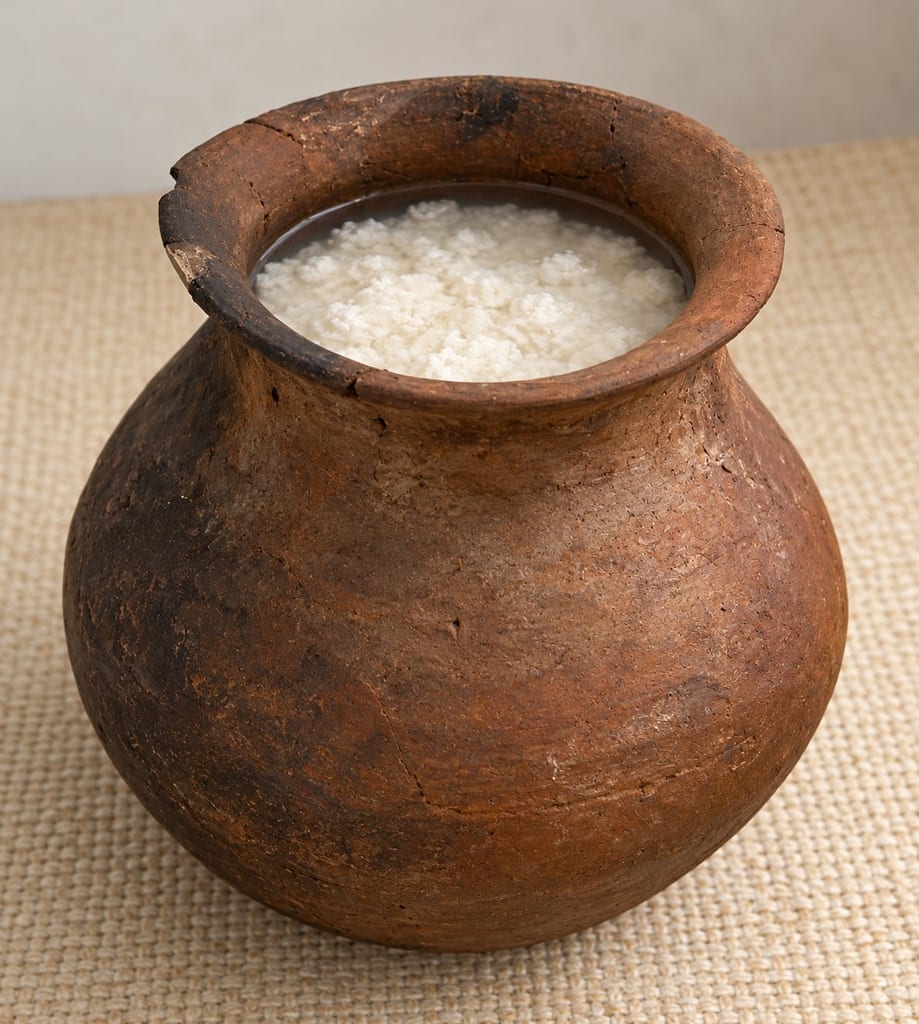
Sago starch in lowland Papua New Guinea is a moist food that can be kept in more than one kind of container. A field study in East Sepik recorded a preference for storing it in a pot, metal saucepan or plastic bucket with extra water. The researchers reported this preference among most survey respondents, not as a rule followed by every household. In the same study, the water-covered method was not observed in Western Province, where respondents preferred wrapping starch in leaves. The contrast matters: a water-covered pot is one regional storage choice, not a universal Papua New Guinean vessel.
The pottery form has a separate, visible history in the Sepik. A museum-held Iatmul earthenware jar is catalogued specifically as a sago-storage jar. It is a useful reference for the broad rounded body and open mouth of one traditional storage vessel, but it should not be mistaken for a photograph of the East Sepik survey method in use or evidence that every water-covered batch used an ornate jar.
A later 2018 chapter describes wet sago storage among Sepik River communities in East Sepik, including water-filled containers and dugout canoes, and reports regular water changes there without giving a single schedule. It distinguishes this wet practice from dry storage and leaf wrapping elsewhere. These accounts show both continuity in the regional tradition and variation in the objects and routines; the record here remains focused on the pot, saucepan and bucket forms reported in the earlier survey.
The vessel's job is to hold dense white or cream sago starch beneath water while it is stored. Keeping freshly prepared starch moist or under water can maintain the high water activity that fermentative bacteria favour. If fermentation proceeds, acid-forming bacteria and yeasts produce acids and the starch becomes more acidic. The pot does not itself inoculate the food or control the rate: starting conditions, water, handling and storage duration also matter.
Laboratory work helps explain the process but is not a household timetable. Researchers observed acid production and a falling pH in freshly prepared starch kept in sealed containers under controlled conditions. Their separate village samples showed a range of pH values. Those results establish that spontaneous fermentation occurs in sago starch; they do not show that each pot, saucepan or bucket reaches the same endpoint.
A water-covered storage vessel can be pottery, a saucepan or a bucket. The source does not give standard dimensions, capacities, clay recipes, metal alloys, plastic types, lids or household procurement routes, so none can be assigned to this entry. Each is a container alternative named in the survey, not proof that the materials behave identically or are used in every village.
Moist storage and fermentation are not sterilisation. The microbiological research found that some organisms declined during fermentation while Escherichia coli remained detectable in a challenged laboratory sample after three weeks. The authors also discuss contamination risks during extraction and storage. A souring process or the presence of water cannot certify a particular batch as safe, and the available studies do not support a single cleaning or water-changing routine for every vessel.
The vessel holds wet starch; the presence of added water does not establish that fermentation occurred, that every batch acidified, or that the result is safe.
Source →Fermentation findings from sealed laboratory containers cannot be treated as a measured outcome for every household pot, saucepan or bucket.
Source →The study concerns traditional sago processing and storage in lowland Papua New Guinea; its regional findings should not be generalized to all communities.
Most respondents in the study preferred storing starch in pots, saucepans or buckets with additional water; this is a respondent preference in that survey, not a universal practice.
In Papua New Guinea, moist sago starch may be packed tightly inside leaves for storage. Greenhill’s field study records this as a preferred Western Province method and contrasts it with water-covered vessels in East Sepik.

Soft, spreadable Calabrian pork sausage made with a great deal of red chilli and fatty pork, stuffed into natural casings, sometimes smoked and matured while staying soft.

A way to add independent temperature logging to an existing food dehydrator without changing its built-in controls or protections. It is a monitoring method, not a rewiring plan.

Pleurotus cystidiosus is the abalone mushroom, a cultivated oyster-type fungus with dark brown caps that grows more slowly and is more demanding than other Pleurotus species.

A dark, balanced vinegar from Emilia-Romagna made by combining cooked or concentrated grape must with wine vinegar, then acetifying and refining it in wood under a protected specification.

A living dairy inoculum that starts controlled cream fermentation, developing acidity and aroma before sour cream or cultured butter is finished.

A small electric incubator holds jars at a selected temperature for yogurt and other documented warm food preparations. Controls, capacity and vessel arrangement vary by model.

Adygean salt is a seasoned table salt associated with Adygea and the wider North Caucasian culinary tradition. Salt is blended with garlic and a variable selection of herbs and spices; the exact mix depends on the named style and maker.

The African Caesar-group mushroom, Amanita masasiensis, is a wild ectomycorrhizal species of central and southern African woodlands, eaten locally. The genus contains deadly poisonous species, so identification needs care.
No community contributions have been published for this entry yet.
Sign in to contribute. Published comments and photos are free to read.
James Cook University ResearchOnline; Proceedings of the International Sago SymposiumGeography · Traditional use · Storage method
Traditional sago starch processing and storage and their influence on food safety in Papua New GuineaStudy of traditional sago processing and storage in Western Province and East Sepik Province.
Most East Sepik respondents (85%) preferred pots, saucepans or buckets with additional water; the authors say this may promote fermentation.
The water-covered method was not observed in Western Province, where leaf-wrapped storage was preferred.
Selected storage methods and duration influenced bacteria, lactic acid bacteria, yeasts and moulds.
Cited in: A regional storage form; Materials and limits
James Cook University ResearchOnline; Food ControlStorage method · Safety · Regional variation
Hazards and critical control points for traditional sago starch production in Papua New Guinea: implications for food safety educationThe paper evaluates traditional sago starch production and consumption in Papua New Guinea.
Storage methods that promoted spontaneous fermentation were described as an important risk-reduction process, within the studied practices and local context.
The paper identifies hazards at multiple stages, including storage and cooking.
Cited in: What the water changes
Queensland Department of Primary Industries eResearch Archive; Food MicrobiologyFermentation · Microbiology · Safety limits
Spontaneous fermentation of traditional sago starch in Papua New GuineaTwelve stored village samples had lactic acid bacteria and measured pH values spanning 6.8 to 4.2; these data do not isolate one vessel form.
In a separate sealed-container laboratory observation at 30°C over four weeks, acids increased and pH fell from 4.9 to 3.1.
Some challenged pathogen counts fell, but Escherichia coli remained detectable after three weeks; laboratory findings do not certify safety for every household batch.
Cited in: What the water changes; Materials and limits
James Cook University ResearchOnlineSafety · Regional scope
Food safety and security of sago starch in rural Papua New GuineaThe thesis reports field sampling and sociological research in East Sepik Province and Western Province.
It documents food-safety hazards in sampled sago starch and explains that active fermentation can inhibit some pathogens without making all samples interchangeable or sterile.
Cited in: Materials and limits
Wikimedia Commons; Otago Museum display photographVisual reference
Sago storage jar, Iatmul, Sepik, earthenware - Otago Museum - Dunedin, NZ - DSC04417The file identifies an Iatmul Sepik earthenware sago-storage jar; its image shows an open rounded clay vessel as a distinct documented storage form.
The Commons file metadata identifies the photograph as public domain.
Cited in: A regional storage form
Springer Nature, in Sago PalmRegional variation · Modern attestation · Storage method
Addressing Food Insecurity in Papua New Guinea Through Food Safety and Sago CroppingA 2018 chapter describes wet storage of sago in water among Sepik River communities of East Sepik, including storage in dugout canoes or containers.
The chapter describes the water in such containers as changed regularly, without specifying one universal schedule.
The same chapter distinguishes wet storage in the Sepik River area from dry or leaf-wrapped storage in other places; this is not evidence that every East Sepik household uses the same container.
Cited in: A regional storage form