Brewer’s yeast
Brewer’s yeast is a working name for living cultures selected for brewing, not one strain or always one species. Ale and lager cultures differ, and older household books may use the term for foam or sediment from brewery beer.
 FermenteaWhere food goes to change
Cultures
Ale yeast is a broad group of Saccharomyces cerevisiae brewing cultures, not one strain. Style labels such as English, American, Belgian or wheat beer do not identify an interchangeable culture.
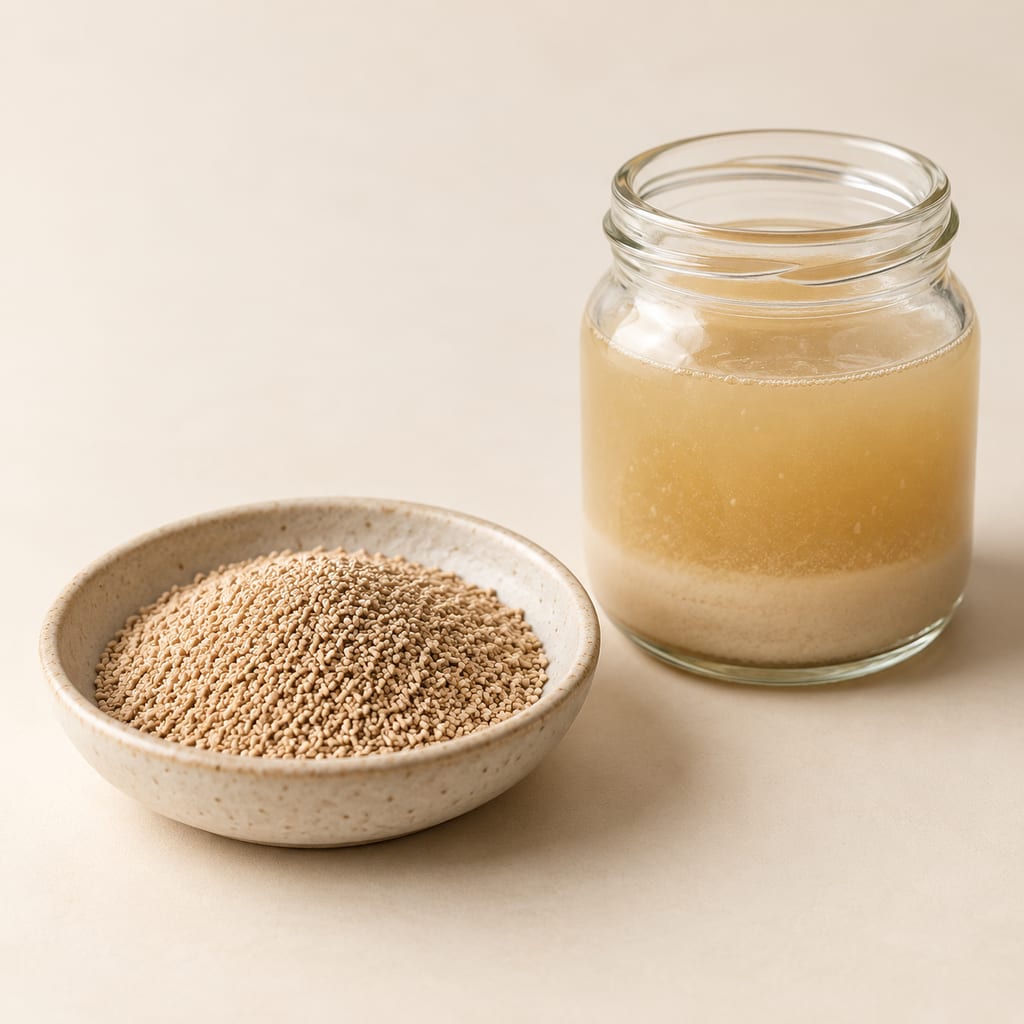
Ale yeast is the working name for the top-fermenting Saccharomyces cerevisiae cultures brewers use, and it covers many distinct cultures. A study of industrial beer yeasts found separate beer-yeast lineages and wide strain-level diversity within the species. Product names and beer-style labels do not identify a particular culture, and two yeasts sold for the same style can differ.
Ale yeast sits beside the broader page on brewer's yeast, which also covers lager cultures and older household uses of the term.
In the lineage study, one beer lineage held sampled groups from Belgium and Germany, Britain and the United States, while another lineage did not follow the same geographic pattern. The authors also describe three German Hefeweizen strains with mosaic ancestry. These findings concern the strains studied. They do not fix a single origin for every yeast sold as English, American, Belgian or wheat-beer style.
The authors estimate a date for an ancestral split from population data. That estimate is not a historical record of any modern commercial product, and the reviewed sources give no seasonal calendar for ale yeast.
Lallemand describes its LalBrew Nottingham as an English-style ale yeast and LalBrew Munich Classic as a Bavarian wheat-beer strain, each with its own technical data sheet. Those descriptions apply to the named products. They do not show that all strains associated with the same styles are alike or interchangeable.
The American Homebrewers Association's extract Weizen guide lists named German-style wheat-beer cultures with separate American-style alternatives, and its 2026 Monk's Ration Trappist-style single uses a packet of Lallemand Abbaye. Each ties a culture to one recipe. They are not a substitution chart for ale yeast as a whole.
Lallemand gives advice for harvesting and repitching homebrew slurry, while White Labs describes a separate conical-fermenter and yeast-brink routine for breweries. The equipment and storage advice suits different settings, and neither guide sets one care schedule for all ale cultures or makes unidentified slurry safe to reuse. A complete propagation or storage method for one named household culture, and general contamination-recovery or finished-beer safety limits, are not established by these sources.
Unknown: lineage groups carry regional names but the study does not establish a fixed place of origin for ale yeast.
Brewer’s yeast is a working name for living cultures selected for brewing, not one strain or always one species. Ale and lager cultures differ, and older household books may use the term for foam or sediment from brewery beer.
No community contributions have been published for this entry yet.
Sign in to contribute. Published comments and photos are free to read.
CellIdentity · History
Domestication and Divergence of Saccharomyces cerevisiae Beer YeastsDistinct beer-yeast lineages and strain-level diversity; regional patterns within sampled lineages; three German Hefeweizen strains with mosaic ancestry; an estimated ancestral split date.
Cited in: A category, not a strain; Regional style names and real ancestry
Lallemand BrewingProduct
LalBrew NottinghamNottingham is described as an English-style ale yeast.
Cited in: Supplier names describe particular products
Lallemand BrewingProduct
Nottingham High Performance Ale Yeast: Technical Data SheetProduct-specific technical data for Nottingham.
Cited in: Supplier names describe particular products
Lallemand BrewingProduct
LalBrew Munich ClassicMunich Classic is described as a Bavarian wheat-beer strain.
Cited in: Supplier names describe particular products
Lallemand BrewingProduct
Munich Classic Wheat Beer Yeast: Technical Data SheetProduct-specific technical data for Munich Classic.
Cited in: Supplier names describe particular products
American Homebrewers AssociationUse
Brewing with ExtractExtract Weizen guide lists named German-style wheat-beer cultures and separate American-style alternatives.
Cited in: Homebrew examples
American Homebrewers AssociationUse
2026 Official Big Brew Recipes: Monk’s Ration Trappist-Style SingleThe Monk's Ration Trappist-style single uses a packet of Lallemand Abbaye.
Cited in: Homebrew examples
Lallemand BrewingHandling
5 Tips For Repitching Yeast at HomeRecommendations for harvesting and reusing homebrew slurry.
Cited in: Reusing yeast
White LabsHandling
Yeast Harvesting & Repitching GuideConical-fermenter and yeast-brink workflow for breweries.
Cited in: Reusing yeast