Pineapple
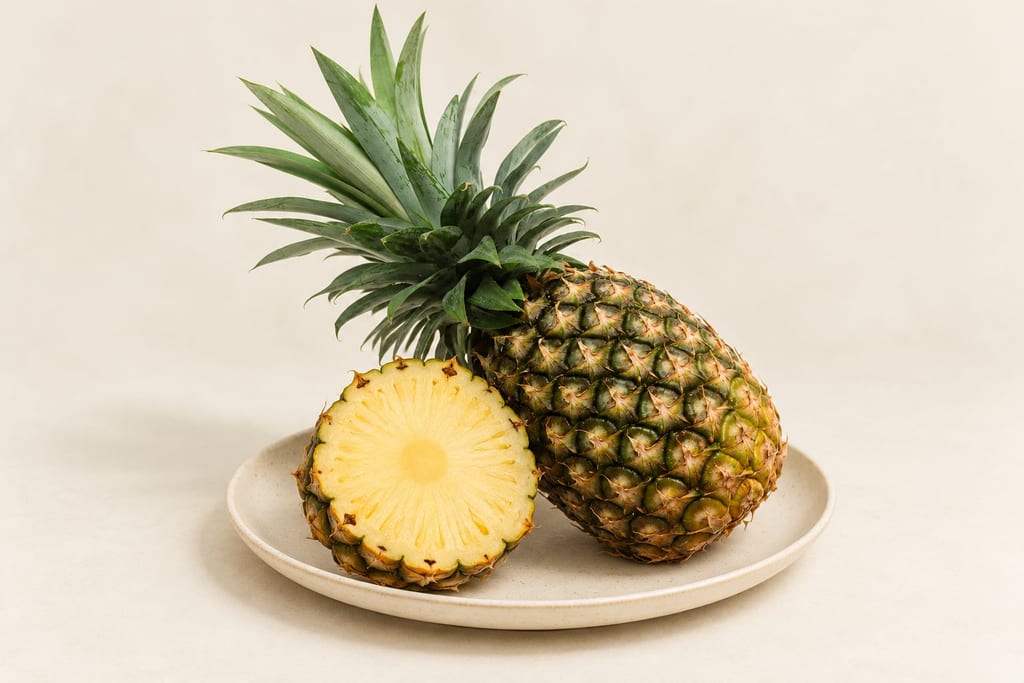
Pineapple is a sweet-tart tropical multiple fruit whose fresh flesh and peel supply sugars and acids to fruit ferments, while cultivar and maturity shape the balance.
 FermenteaWhere food goes to change
Mushrooms
Russell’s bolete is a woodland bolete now called Aureoboletus russellii, with documented regional food use in Mexico and an unresolved historical China claim.
The name found in the supplied index remains familiar in field guides and older literature, but the accepted combination is Aureoboletus russellii. Frost first published the species as Boletus russellii in the nineteenth century. It was later placed in Boletellus, then transferred to Aureoboletus in 2016. Older literature also records combinations in Ceriomyces, Frostiella and Suillus. These are not five culinary species: they are historical names attached to one taxonomic subject. For catalogue searches, Boletellus russellii should remain an alias so records under the supplied index name still lead here.
The transfer reflects a change in how bolete relationships are understood. The broad historical genus Boletellus grouped several forms that later phylogenetic and morphological work placed in different lineages. In the 2016 combination, A. russellii is classified in Boletaceae, within the bolete order Boletales. Its spores have longitudinal grooves or ridges, a character relevant to taxonomic placement and microscopic study. Name changes can make older food reports hard to compare with recent records, so this account keeps the name used by each source when describing its evidence.
The name Russell honours the nineteenth-century American naturalist John Lewis Russell. Common English names include Russell’s bolete and jagged-stemmed bolete; “shagnet” and “pitted bolete” also occur in field sources. Common names vary by region and are not dependable evidence that two people are discussing the same mushroom. A name such as “squirrel mushroom,” recorded locally in Hidalgo, belongs to that community’s own vocabulary and should not be treated as a universal synonym.
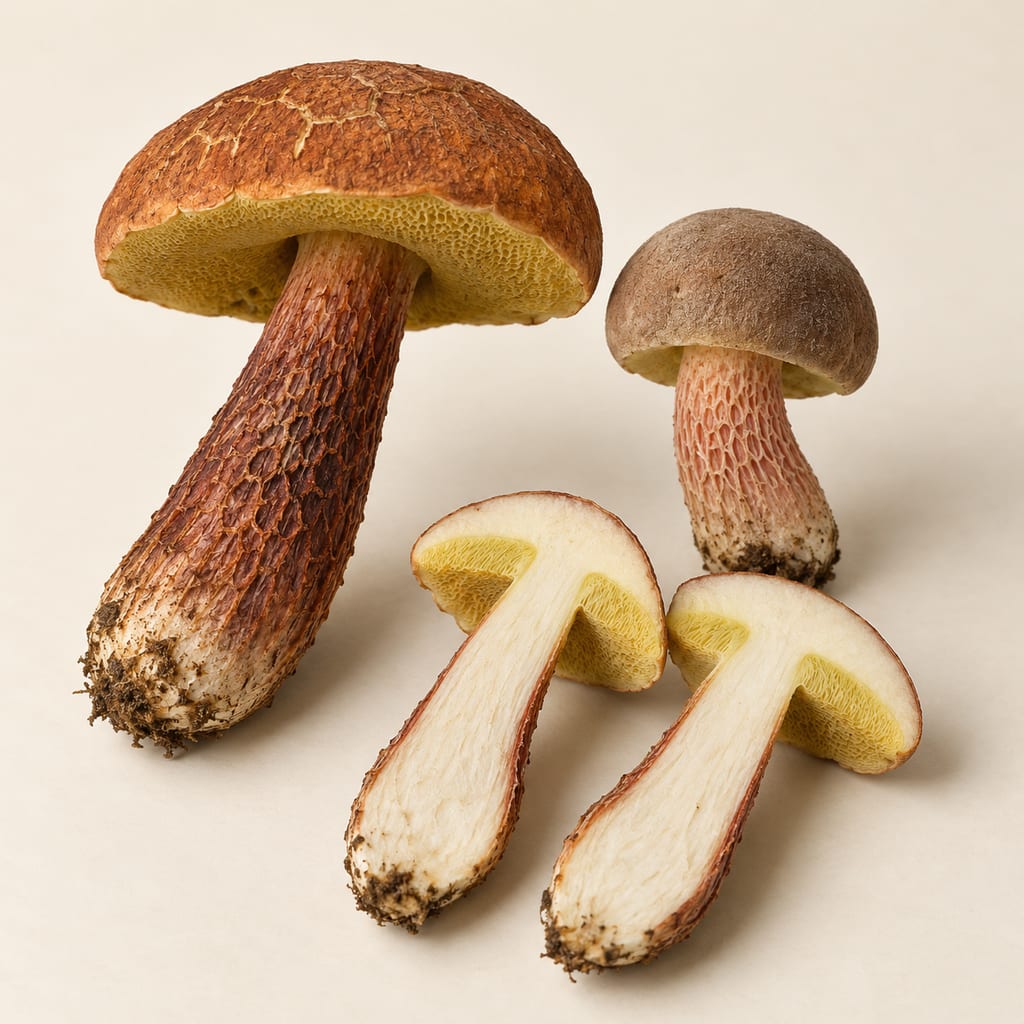
Field descriptions characterize the fruit body as a medium to large terrestrial bolete. The cap begins convex, with its edge often rolled inward, and broadens as it matures. Its surface is dry, initially finely velvety, and may become cracked into patches as the cap ages. Descriptions record yellow-brown, reddish-brown, cinnamon, buff and olive-gray tones. Exact size and colour vary with age, weather and observer; the published range is broad rather than a single diagnostic measurement.
The underside is a layer of tubes ending in pores, not gills. Young pores are yellow and may become greenish yellow with age. The pores are relatively large and angular in some descriptions. Flesh is pale yellow to yellow; North American field accounts report little or no blue colour change when cut or bruised. These traits describe the literature, not a complete identification test. Colour can be distorted by light and photography, and a single view rarely captures all the details a specialist considers.
The stem is the conspicuous part of the species’ appearance: long relative to the cap, solid, reddish brown to pinkish tan, and marked by deep longitudinal furrows and raised ridges. Those ridges may branch or tear, producing a coarse, shaggy, pocketed or net-like surface. The stem can be curved and may widen slightly toward the base. Published measurements often give a length around 10–20 cm and a much smaller thickness, but specimens do not conform to a ruler. There is no partial veil or ring. The spore deposit is described as olive to dark olive-brown, and spores are elongated and ornamented with grooves or ridges under the microscope.
One North American guide describes its flesh as soft and its taste as mild or bland. Another field book calls the species edible and good. These are source-specific sensory judgements, not a settled culinary consensus or a reason to infer that every bolete with similar pores and stem is safe. The Mexican community study is more useful for this page’s culinary account because it records a local preparation; it does not provide a standardized taste panel or a universal culinary profile.
Russell’s bolete is described as ectomycorrhizal. Its underground fungal tissue associates with fine tree roots, exchanging minerals and water captured from the soil for carbon supplied by the living host. This is different from a mushroom that feeds on a dead log. The visible cap and stem are short-lived fruit bodies; most of the organism is a network in the soil and root zone. This ecological relationship helps explain why A. russellii is sought in woodland rather than cultivated like a saprotrophic mushroom on straw or sawdust.
Oaks are the most consistently reported tree partners. Regional field sources also report other hardwoods and, less often, conifers such as pine or hemlock. In the Hidalgo study, the mushroom appears in an oak-forest setting at La Loma del Maguey. The Oaxaca survey took place in pine–oak forest, though that broad habitat label does not establish which individual tree hosted every specimen. A photograph of a mushroom near an oak is not proof of its root partner; precise host associations require ecological and sometimes microscopic study.
Its dependence on living forest roots also separates habitat from food supply. The fungus is not a crop with predictable yields from a substrate recipe. Weather, tree communities, soil and local forest structure all affect when fruit bodies appear. A site that produced mushrooms in one survey year may produce few or none in another. Studies of edible mushrooms in Oaxaca emphasize that abundance and distribution can vary sharply even among relatively nearby sampling locations, a useful reminder against treating one village record as a regional harvest forecast.
North American field accounts place fruiting in summer and early autumn; one older regional description gives July through September. These windows summarize observations from temperate North America and should not be copied onto a calendar in Mexico or Asia. Rainfall, elevation and local woodland conditions change the timing. General “mushroom season” dates are not a species-specific fruiting record.
The Mexican evidence also needs careful wording. The 2024 study of Tierras Coloradas, Hidalgo, conducted field trips during the rainy seasons of 2022 and 2023. Its methods describe a regional survey window, not the exact month when each A. russellii specimen appeared. The 2009 study of edible mushroom sporocarps in Ixtlán de Juárez, Oaxaca, found Boletellus russellii in one sampled site in 2001, but not in its 2002 species list; the published summary does not supply a separate month for that record. The Jalisco photograph discussed later was taken in October. Together these sources establish local observations in different times and landscapes, but not a single Mexican season.
The difference between a collection date and a fruiting calendar matters. A dated specimen proves that the mushroom was present at that place on that day. It does not show that fruit bodies were available continuously before or after the visit. Where a paper reports only an overall rainy-season field period, the species should not inherit every month of that broader survey as its own fruiting season.
The clearest recent food-use account here comes from Tierras Coloradas in the municipality of Mineral del Chico, Hidalgo, Mexico. Researchers describe the community’s edible mushrooms, interviews with residents about the fungi they consumed and their methods of preparation, and collection work on La Loma del Maguey. The site lies in the central part of the state, between roughly 2,052 and 2,231 metres elevation. Oak woodland is dominant; the paper names Quercus potosina, Q. laeta and Q. rugosa, with smaller areas of pine and juniper vegetation.
In that study’s species table, Aureoboletus russellii is listed under the local Spanish name “de ardilla” (“squirrel mushroom”), associated with oak forest, with “grilled” as its cooking mode. This is valuable evidence of food practice in a small community, based on fieldwork and interviews in 2022–2023. The paper does not give a species-specific grilling time, temperature, serving recipe, storage instruction or toxicological test. The row should therefore preserve the local preparation report without turning it into a home-processing protocol.
An earlier Oaxaca study supplies a second Mexican context. In pine–oak forests of Ixtlán de Juárez, researchers surveyed the abundance and distribution of wild edible mushroom fruit bodies in 2001 and 2002. Boletellus russellii appears in the species inventory and was recorded at one of the sampling locations in the first year. That work studies availability and spatial variation; it is not a detailed culinary ethnography of this bolete. Its inclusion in an edible-mushroom survey is evidence of a published food classification, not proof that every local household gathered it.
Taxonomic work also documents the species in temperate Mexican forests, including an Oaxaca distribution record. A photograph of a Jalisco specimen by Alan Rockefeller is dated 7 October 2007. The photograph supports a dated occurrence record in Jalisco, not food use there. Keeping these categories separate matters: a taxonomic collection, a field photograph, an edible-species checklist and an interview about preparation answer different questions.
The FAO’s 2004 overview adds older country-level claims. Its Annex 3 includes Boletellus russellii as “food,” and Annex 2 lists an edible claim under Mexico and China. The annexes compile published sources and explicitly warn that their records are not always clear about whether a species is actually eaten. These country headings document a bibliographic history; they do not establish current distribution, current household practice or independently verified safety.
The species-specific preparation detail in the recent community paper is brief: grilled. A separate older survey groups the mushroom among wild edible fungi in Mexico, while FAO records carry food or edible classifications. There is no basis in these sources for inventing a universal recipe, suggesting that grilling is the only preparation, or attaching cooking methods used for other boletes to this species. The article’s general discussion of local mushroom food practices cannot automatically be assigned to each individual taxon.
The name “squirrel mushroom” may help readers understand one place’s classification, but it does not identify the mushroom in another forest. The paper’s cultural context—knowledge held by residents, ecological setting, interviews and collected specimens—belongs alongside the word “grilled.” Removing the name from that setting would make the record look more universal than the evidence allows. A catalogue can preserve a local method while leaving unreported details unfilled.
The FAO wording also distinguishes “food” from “edible.” In its Annex 3, “food” is used when a source clearly reports use, while “edible” can mean a source classifies a mushroom that way without an explicit report of consumption. This distinction is useful for reading the older records but does not itself validate the underlying species identification. The recent Hidalgo report is stronger for actual local food practice than a country-level list, while the broad distribution claims in the annex remain historical references.
Food-use evidence is not the same as a toxicological evaluation. The sources reviewed here do not provide a clinical safety profile, establish a universally safe serving, or test the effects of preparation across different collections. They document how particular communities and authors classified the species. Those statements deserve attribution rather than conversion into a blanket “safe to eat” label.
Boletes are a diverse group, and several species can share brown caps, yellow pores or reticulated stems. Historical names add another layer of confusion: a source using Boletellus russellii may refer to the taxon now called Aureoboletus russellii, but an old identification cannot be assumed correct simply because the name matches. The recent literature gives this species a particular accepted combination, while the studies cited here preserve older determinations where they were made.
The literature reviewed for this account does not establish one poisonous species as a confirmed exact mimic of Russell’s bolete. That is a limit of this evidence, not a claim that look-alikes do not exist. The species’ distinctive stem is described in field guides, yet this page deliberately does not turn that description into a field key. Color, pore shape, stem pattern, habitat or a phone photograph alone are not sufficient grounds for eating a wild mushroom.
General poison-control guidance warns that toxic fungi can resemble edible species, that identification learned in one region may not transfer to another, and that cooking does not neutralize poisonous mushrooms. Those cautions are especially relevant when historical names and local terms cross regions. They do not mean that the Hidalgo community’s documented practice should be erased; they mean an online account cannot substitute for the local knowledge and expert identification behind a collection. Do not eat a wild mushroom on the authority of this page or its gallery. If a wild mushroom may have been eaten and illness is possible, contact local emergency services or a poison centre promptly.
Russell’s bolete is a forest-associated bolete with a long taxonomic history and documented regional food use in Mexico. The 2016 transfer to Aureoboletus supplies the current name; the supplied index name Boletellus russellii remains useful as an alias. Mexican studies connect the mushroom to a recorded grilled preparation in Tierras Coloradas and to older edible-mushroom field surveys in Oaxaca. North American sources describe a summer-to-early-autumn season, while Mexican surveys do not supply a precise species-wide calendar.
The historic China entry in the FAO compilation is unconfirmed. A modern taxonomic review places A. russellii in North America, and recent field literature documents it in Mexico. The older China claim may reflect a historical naming or identification issue, and it is not established. The species' current range is not extended to China, and records that may concern different taxa are not merged.
The evidence supports a careful draft with clear geography, taxonomic synonymy, local culinary context and an explicit safety boundary. It does not support a universal recipe, a definitive global range, or a promise that a mushroom matching a photograph is edible. Those limits are part of the story of the species and should remain visible wherever its food history is presented.
The study lists A. russellii as de ardilla from oak forest and reports it grilled; locality and practice are specific to this community.
An availability survey recorded B. russellii at one sample site; it is not a species-specific preparation report or calendar.
A preliminary 2004 bibliography lists the old name B. russellii as edible in China; this conflicts with modern sources that place the current A. russellii concept in North America and is not asserted as current distribution.
Pineapple is a sweet-tart tropical multiple fruit whose fresh flesh and peel supply sugars and acids to fruit ferments, while cultivar and maturity shape the balance.
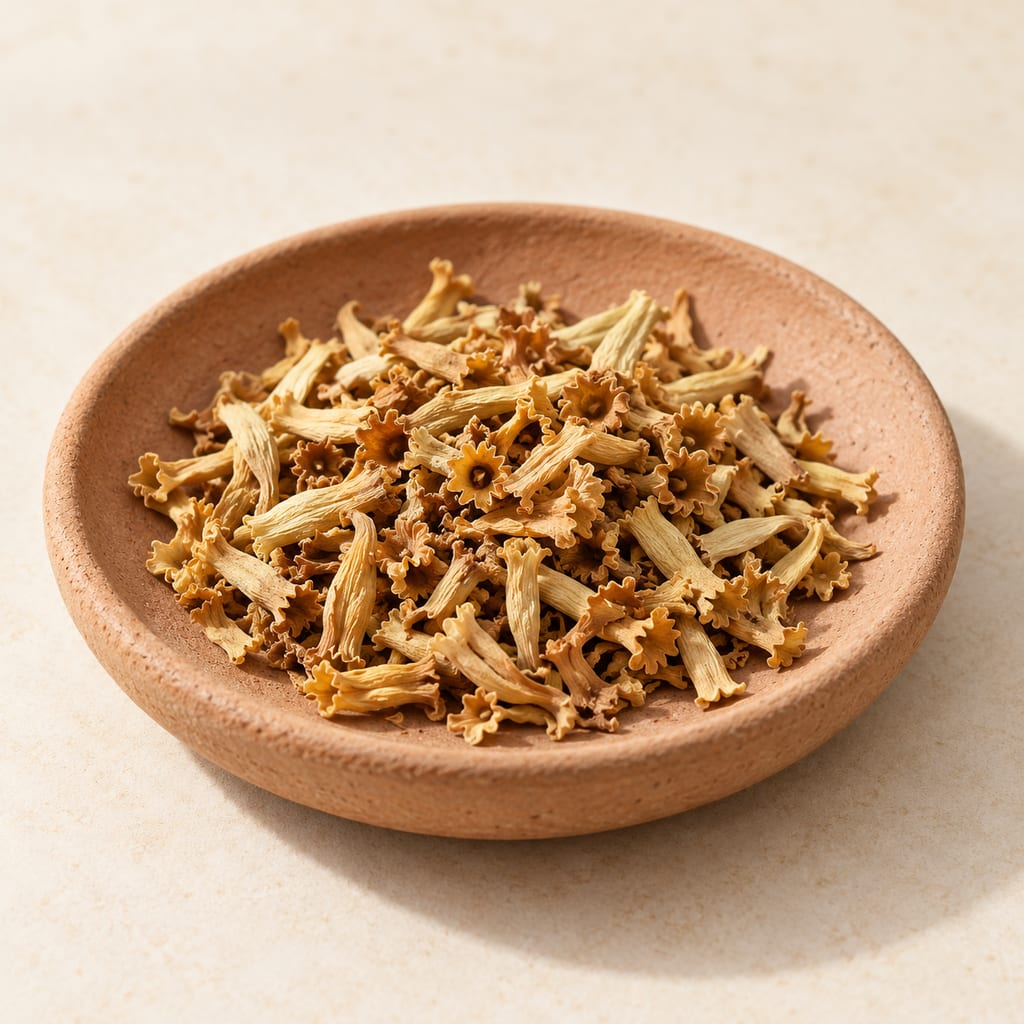
The aromatic flower of Quararibea funebris, dried and toasted for tejate in Oaxaca; despite its name, it is not cacao.
No community contributions have been published for this entry yet.
Sign in to contribute. Published comments and photos are free to read.
Index FungorumIdentity · Taxonomy
Aureoboletus russellii — Species recordAccepted name and taxonomic record for Aureoboletus russellii (Frost) G. Wu & Zhu L. Yang.
Cited in: One species, several names; Reading the record as a whole
Fungal DiversityTaxonomy
One hundred noteworthy boletes from China2016 taxonomic transfer and publication of Aureoboletus russellii.
Cited in: One species, several names; Reading the record as a whole
Studies in FungiTaxonomy · Description · Geography
Species of Boletaceae with ornamented spores from temperate forests at the state of Oaxaca, MexicoCurrent combination Aureoboletus russellii, synonymy and morphological description; Oaxaca distribution record.
Cited in: A bolete with a long, deeply ridged stem; Food records rooted in Mexican places; Identity and safety boundaries
Journal of FungiTaxonomy · Use · Geography
Five New Species of Aureoboletus and Chalciporus and Their Ethnomycological AspectsAureoboletus russellii among species reported as having food use in Mexico; context distinguishes older food-use records.
Cited in: Food records rooted in Mexican places
GSC Biological and Pharmaceutical SciencesUse · Geography · Ecology · Season
The edible mushrooms from small community Tierras Coloradas in Hidalgo, Mexico2022–2023 rainy-season fieldwork, Tierras Coloradas / La Loma del Maguey in Mineral del Chico, oak-forest setting; species table lists A. russellii as de ardilla and grilled.
Cited in: A partner of living trees; Season depends on place and year; Food records rooted in Mexican places; What the cooking evidence says—and leaves open; Reading the record as a whole
Revista Mexicana de Biodiversidad / SciELOUse · Geography · Ecology · Season
Edible mushroom sporocarp availability in pine-oak forests in Ixtlán de Juárez, Oaxaca2001–2002 Pinus-Quercus availability survey includes Boletellus russellii; the species was recorded at one sample site in 2001 and omitted from the 2002 list.
Cited in: Season depends on place and year; Food records rooted in Mexican places
Food and Agriculture Organization of the United NationsHistory · Use · Geography
Wild edible fungi: a global overview — Annex 2 country recordsPreliminary country compilation lists Boletellus russellii as edible in China and food in Mexico; Annex 2 explains bracketed uncertainty and warns that names and uses are source-derived.
Cited in: What the cooking evidence says—and leaves open; Reading the record as a whole
Food and Agriculture Organization of the United NationsHistory · Use
Wild edible fungi: a global overview — Annex 3Global historical list records Boletellus russellii as food and explains that it distinguishes food-use reports from edible classifications.
Cited in: What the cooking evidence says—and leaves open
Mycological Progress / PubMed CentralTaxonomy · Geography
The subfamily Xerocomoideae (Boletaceae, Boletales) in ChinaModern taxonomic review treats B. russellii as transferred to Aureoboletus and its known range as North America, creating a mismatch with the older FAO China record.
Cited in: Identity and safety boundaries; Reading the record as a whole
Minnesota SeasonsDescription · Ecology · Season · Geography · Use
Russell’s bolete (Aureoboletus russellii)Regional description, tree associations, summer/early-fall season, North American distribution and source-specific edible/sensory note.
Cited in: A bolete with a long, deeply ridged stem; A partner of living trees; Season depends on place and year
Michael KuoDescription · Ecology · Season · Use
Boletellus russellii — Mushrooms of the Midwest entryOlder-name field description, summer/fall fruiting, mycorrhizal tree associations and a source-specific food classification.
Cited in: A bolete with a long, deeply ridged stem; A partner of living trees; Season depends on place and year; What the cooking evidence says—and leaves open
Poison ControlSafety
Mushroom poisoning: Don’t invite “the death angel” to dinnerGeneral advice that wild mushrooms can be misidentified, regional familiarity may not transfer, and expert identification is necessary before consumption.
Cited in: Identity and safety boundaries