A fruit made from many flowers
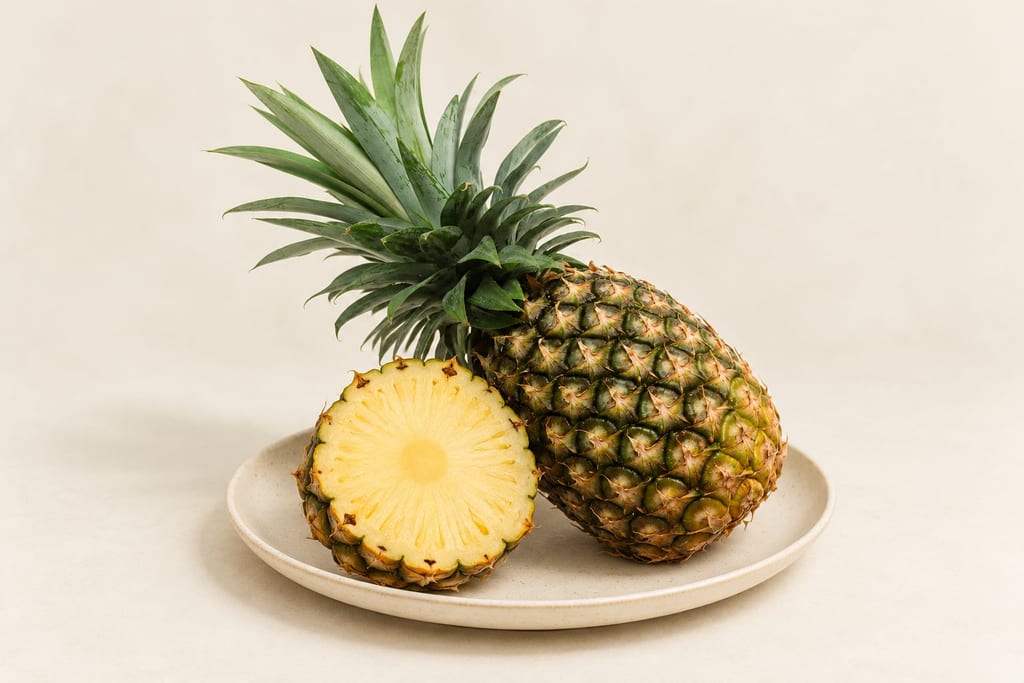
The accepted botanical name is Ananas comosus (L.) Merr., a member of the bromeliad family. What we eat is a syncarp: many small fruits fuse around one axis after the plant flowers. Kew describes a ripe fruit as juicy, seedless and capped by a leafy crown, with a tough waxy rind whose colour can remain green or turn yellow, orange-yellow or reddish. Pineapple is therefore not one berry or a single flower’s fruit.
Kew places the cultigen’s origin in southeastern and southern Brazil and Paraguay, while noting that its wild relatives are unknown. Its broad native range is described as extending from Costa Rica to southern tropical America. These are regional statements; they do not locate one first garden or prove a single birthplace.
The flowers sit in a dense head. Each one contributes to the fused surface of the mature fruit, leaving a regular pattern of bracts and floral parts around the rind. The crown is a group of leaves attached above the fruit; the leafy shoots at the plant base are separate propagation material. These distinctions matter when a source asks for fruit, crown, slips or suckers: they are not interchangeable recipe ingredients.
Across its range, names vary. Kew records Spanish piña among the common names and traces Ananas to Tupi nana; the Brazilian Academy of Letters defines Portuguese abacaxi as both the fruit and its plant. These names are not interchangeable with the peel ingredient or a cultivar name.
Sources for this section
Domestication and spread
Genome research treats pineapple as a South American domesticate. One study infers cultivation more than 6,000 years ago, notes archaeobotanical pineapple remains dated to roughly 3,500 years ago in South America, and places its spread into Mesoamerica more than 2,500 years ago. The inferred domestication date and the dated remains are different kinds of evidence: the latter show presence by that time, not the start of cultivation.
People have propagated pineapple vegetatively from crowns, slips and suckers as well as through seed. Genomic comparisons of 89 accessions show that cultivar histories are not one simple line of descent. ‘Queen’, ‘Smooth Cayenne’ and ‘Singapore Spanish’ carry different admixture and diffusion histories; the study traces Singapore Spanish from eastern Brazil toward Asia. Those names describe particular lineages, not a complete list of today’s market cultivars.
Sources for this section
Travel, gardens and changing status
People had moved pineapple through tropical America before European voyages began. Genomic work describes South American domestication and later distribution to Mesoamerica; that broad sequence should stay separate from European records. In 1493, Europeans recorded encountering pineapple in the Caribbean. A sixteenth-century printed image and descriptions helped circulate the fruit in Europe even while living plants were difficult to ship across the Atlantic.
Portuguese and Spanish routes then carried pineapple into other tropical regions. By the mid-sixteenth century, Portuguese-language accounts describe pineapple in Brazil, while institutional histories trace its movement through colonial trade networks to Africa and Asia. These routes depended on imperial shipping and landholding. The movement was not a neutral botanical exchange: Caribbean and South American plantation economies used enslaved labour, and the pineapple’s history sits within that wider colonial system.
In northern Europe, a living tropical plant was harder to keep than a written or printed description. In 1687, Dutch gardener and collector Agneta Block grew pineapple to fruit in a heated glasshouse. English gardeners achieved fruiting in the early eighteenth century; the work required costly heat, skill and long attention. For wealthy households, the plant and fruit became signs of access to land, glasshouses and skilled gardeners. As heating and transport improved, this status use faded. By the twentieth century, canning made pineapple more widely available and changed which fruit shapes growers selected for tins.
Sources for this section
From plant to harvest
Pineapple is a tropical herbaceous perennial, not a tree. Kew describes a compact rosette of long, firm leaves and a central flowering stalk. A fruit develops from the fused ovaries and surrounding tissues of many flowers, and a leafy crown sits on top. The plant can be multiplied by rooting that crown or by using side shoots. Commercial orchards therefore often replant vegetative pieces of selected plants rather than sowing seed for each crop.
That propagation preserves familiar cultivar characteristics, but it also means a fruit name is not a complete description of flavour or quality. ‘Smooth Cayenne’ is a cultivar group used in international trade; ‘Queen’ is another named group, and ‘MD-2’ is a modern hybrid. Research papers use their chosen cultivars as experimental material. A result from two cultivars or a single maturity stage should not be carried over to all fruit sold under the broad name pineapple.
In a temperate greenhouse, Kew advises strong light and warm conditions; its species profile gives a greenhouse minimum of 13–15 °C and says plants may take around three years to fruit. Those numbers describe Kew’s horticultural guidance for a plant grown under temperate conditions. They are not a commercial field recipe, a fermentation temperature or a prediction of how long a picked fruit will ripen.
Sources for this section
Canning and commercial change
The pineapple trade changed as ships, glasshouses, rail, refrigeration and canning altered where fruit could be grown and how far it could travel. A record of the Kahului Cannery on Maui documents a specific twentieth-century industry rather than a universal pineapple history. In 1924, California Packing Corporation contracted with two Maui growers to plant 500 and 250 acres and send ripe fruit to a new cannery for processing, marketing and shipment. After building the plant, the company acquired land and cannery operations; later changes in ownership joined growing, packing, marketing and shipping under one company.
The National Park Service identifies Hawaii’s twentieth-century pineapple industry as one of the islands’ major agricultural industries and a significant force in Maui County’s economic development. The report describes a cannery, growers and nearby transport as a connected system. It cannot stand for all growers or explain working conditions across the whole industry, but it shows how processed fruit and its supply chains became part of the ingredient’s modern history.
Canning also changes the fruit the reader sees. Oxford’s plant history notes that commercial fruit had to fit tins conveniently. Slices, rings, chunks, juice and crushed pineapple come from processing decisions, and none has the same texture or surface area as a fresh whole fruit. A fermentation formula written for fresh peel or core should not silently substitute canned fruit or juice; the published batch and intended substrate need to match.
Modern cultivation relies on selected plant material, and cultivation history has reshaped the fruit available to buyers. Repeated vegetative propagation can keep a cultivar in production while mutations and later breeding create variation. Genome comparisons show both clonal descent and admixture among cultivated lineages. The commercial label therefore helps identify a type, but source, crop conditions and maturity still affect the fruit in a particular batch.
Sources for this section
Cultivars change the sweet–acid balance
Ripe pineapple balances sweetness with clear acidity and a fragrant fruit aroma. In a study of ‘Comte de Paris’ and ‘MD-2’, sucrose was the dominant measured sugar and citric acid the dominant organic acid in mature fruit. Both concentrations shifted during development, and the researchers measured differences between cultivars and stages. Cultivar and ripeness therefore affect flavour; the study does not supply one sweetness or acidity number for every pineapple.
Pineapple’s soluble sugars can feed yeasts and bacteria, while its natural acids contribute to the starting flavour. Peel, core, juice and flesh are not interchangeable ingredients: they differ in how much edible pulp, rind, soluble sugar and aroma enters a batch. A recipe that names peel is using a particular part of the fruit, not a general pineapple quantity.
Sweetness and sourness arrive together rather than as a fixed ratio. The Frontiers study followed fruit development and showed that sugar and acid levels move during maturation. A less mature fruit in that experiment was not chemically the same as a mature one; it follows that a pineapple’s fermentation contribution can change with cultivar and picking stage. The study measured two named cultivars under its own field and sampling conditions. It does not support estimating fermentable sugar from colour alone or assigning a standard acid level to an untested fruit.
Sources for this section
Pineapple in tepache
Tepache is one documented use of pineapple, especially its peel. A 1984 Mexican review records maize-associated descriptions alongside fruit-based preparations; a name that appears with pineapple in later sources does not establish when pineapple first entered the drink or prove one continuous recipe. Sources call for pineapple peel or shell in some preparations, while the whole fruit and its peel remain distinct ingredients.
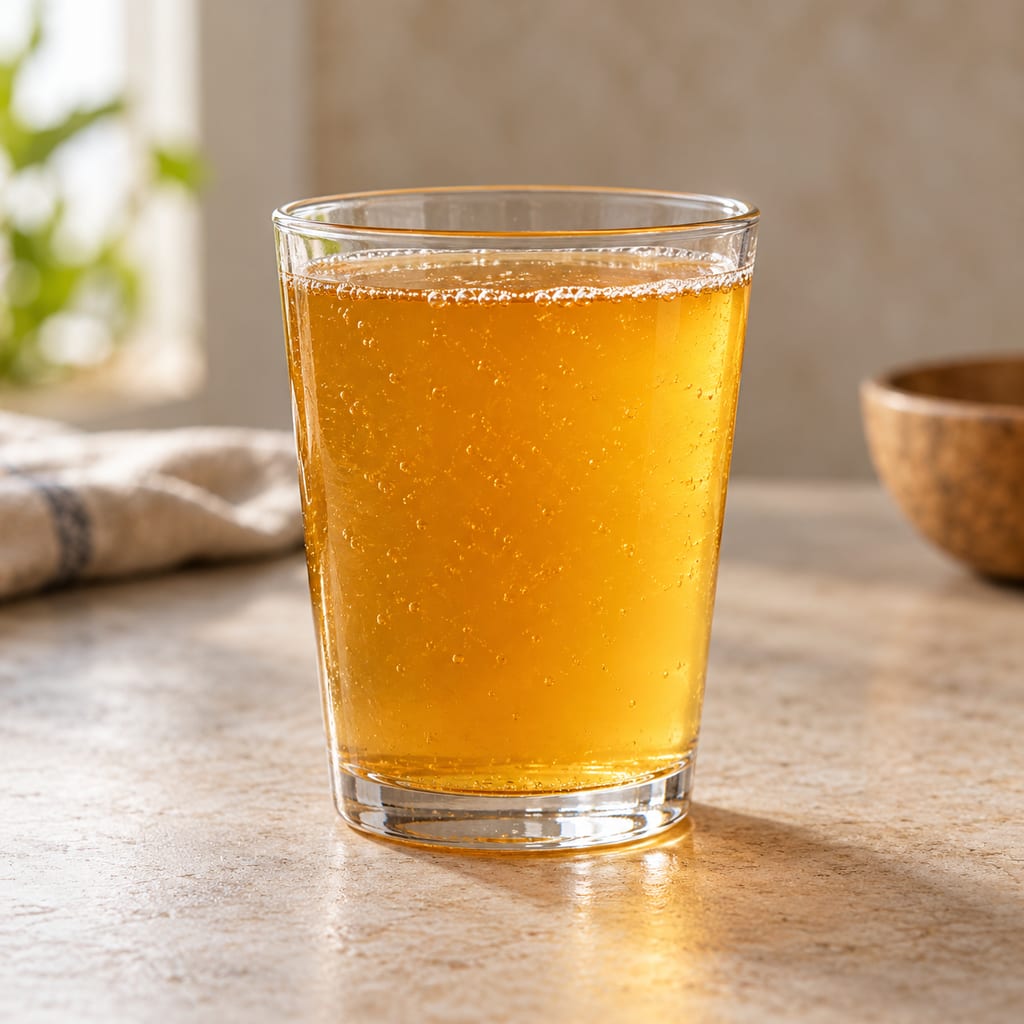
A modern Oregon State Food Science handout turns peel and core into one small batch with piloncillo, water, jalapeño, cinnamon and clove. It directs the reader to wash before peeling and to refrigerate the strained liquid. Its stated 3–5 days and estimated alcohol range belong to that particular handout; they are not a universal endpoint or shelf-life study.
A separate laboratory paper studied a different tepache batch in Tuxtla Gutiérrez, Chiapas, using MD-2 pineapple sourced from Loma Bonita, Oaxaca. The authors used pineapple shell pieces and panela, held sealed flasks at 30 °C for 72 hours and measured ethanol, sugars and organic acids. Ethanol was reported in grams per litre, not as a general alcohol percentage. The microbial community shifted during the experiment, with lactic-acid bacteria and yeasts prominent before later acetic-acid bacteria. One controlled batch describes that experiment; it does not validate an unsupervised household process.
A peel fermentation uses the rind as a substantial part of its substrate. The plant tissues bring different amounts of flesh, fibre and juice; trimming style changes how much pulp remains on the peel. The OSU batch includes the core and deliberately saves the flesh, while the 2022 laboratory work specifies small shell pieces. Their different methods illustrate that “pineapple tepache” is a family of documented preparations, not one standard ratio. Neither source isolates pineapple alone as the cause of all flavour or microbial change: sugar, water, spices, containers, contact with air and organisms from the environment also matter.
Sources for this section
Choose and prepare the fruit
For a fresh preparation, choose intact fruit and rinse it before cutting or peeling. The FDA advises gently rubbing produce under plain running water; it says soap and commercial produce wash are unnecessary. A rinse can reduce dirt and some surface contamination, but it does not sterilize fruit or establish that a later fermentation is safe.
Use the fruit parts named by the preparation. The OSU handout saves the flesh for other uses while fermenting skin and core. A peel-based drink uses the fibrous outside and whatever flesh remains attached; replacing peel and core with flesh, juice or canned fruit changes the substrate and makes a different formula. The handout’s refrigeration direction applies to its strained drink. The sources here do not establish a general fresh-pineapple shelf life or a universal fermentation time, temperature, alcohol level or safe storage period.
Rinse the outside before a knife passes through the rind. This reduces the chance that dirt on the skin will move onto the cut surface or flesh as the fruit is peeled. Keep a clean board and knife for the cut fruit, and remove visibly damaged portions as FDA guidance advises for produce. Washing is a preparation step, not a method for removing every microorganism. A recipe that depends on spontaneous organisms should describe its own preparation and controls; the presence of natural microbes does not prove that a ferment will be safe or reach a particular alcohol level.
Sources for this section
Beyond fermentation
Fresh flesh is eaten on its own and appears in preserves and pastry fillings. The fermentation handout also suggests salsa, snacks, drying or garnish for the flesh left after peeling.
Sources for this section
Leaves, rind and other uses
The fruit is only one useful part of the plant. Kew records bromelain, a group of protein-breaking enzymes, as an extracted product used to tenderize meat. It also notes that pineapple leaves supply fibre used for thread and cloth, while processing trimmings can enter animal-feed products. Those materials have different uses and risks from edible flesh and peel; a leaf-fibre museum specimen is not a pineapple fruit reference or a food ingredient.
The fruit parts also go to different destinations in kitchens. A peel-and-core ferment uses portions left after the flesh is removed, while the pulp can be eaten fresh, preserved, baked or dried. Keeping these materials distinct helps a cook follow what a particular preparation actually names.
Sources for this section
Places
Central and South America
Historical attestation · Region evidenceKew’s broad native-range statement; it does not identify one birthplace.
South America
Historical attestation · Region evidenceKew identifies southeastern and southern Brazil and Paraguay as the cultigen area; genomic work supports South American domestication but not a precise birthplace.
Loma Bonita
Documented use · Locality evidenceThe study sourced its MD-2 pineapples here; this is a supply location for one experiment, not a domestication claim.
Tuxtla Gutiérrez
Documented preparation · Locality evidenceThe paper says its tepache fermentation work was carried out in a laboratory here; this is a study site, not a typical household location.
Kahului
Documented use · Locality evidenceThe National Park Service history documents a Maui cannery and contracted pineapple production; this is one historical industry site, not a claim of pineapple origin.