Koumiss starter
Koumiss starter is a retained previous-batch liquid or bulk dairy culture used to inoculate fresh milk. Its bacteria, yeasts and activity depend on the culture and production method.
 FermenteaWhere food goes to change
Mushrooms
Auricularia villosula, the short-haired wood ear, is an Asian wood fungus that China lists as edible and that is cultivated in Inner Mongolia. It is easily confused with the cultivated black wood ear, so a market label does not settle the species.
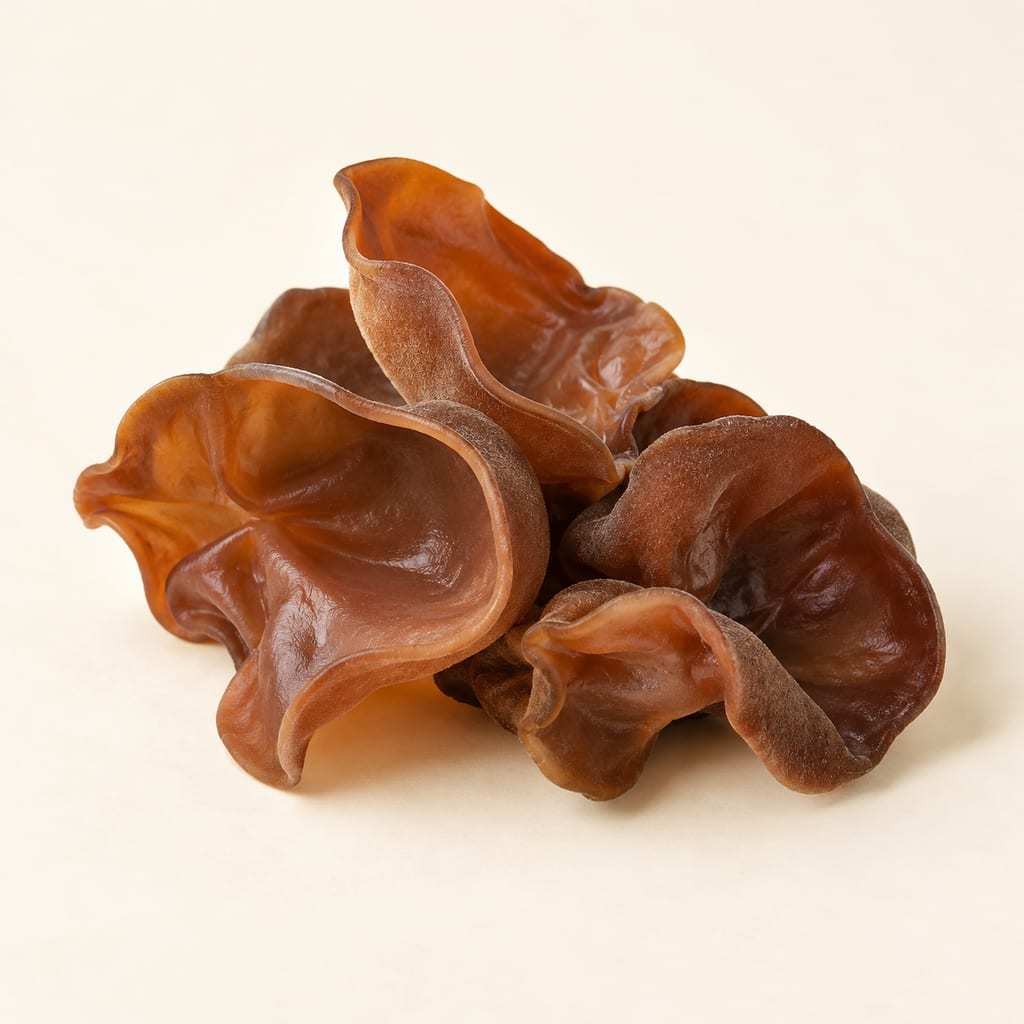
Auricularia villosula is an Asian wood-ear fungus. Its gelatinous, ear-shaped fruit bodies are fawn to buff or orange-yellow when fresh, often folded, with obvious folds on the fertile surface. Dried, they become thin and grey to vinaceous brown. In Chinese it is called 短毛木耳, which translates as short-haired wood ear, and the English name in this entry follows that literal rendering.
The fungus grows on fallen broadleaf trunks and branches and occasionally on living broadleaf trees. It belongs to the same genus as the cultivated black wood ear, Auricularia heimuer, and the two are hard to tell apart in the field. The species was separated from its relatives by microscopic study and phylogenetic analysis, not by appearance, and the authors who described it state that identification relies on those methods.
The 2021 Chinese catalogue of edible and medicinal fungi lists the species as edible under its Chinese name, and the 2026 catalogue lists it again. These are published Chinese food-status records. They are not a universal regulatory approval for every market.
A 2018 study from Erdos in Inner Mongolia reports that local people eat the species and that it is popular there. The same authors grew its fruit bodies in a cultivation study, collected from a shrub host, Artemisia ordosica, that they describe as unusual for this fungus. Their specimen's internal tissue also differed from the earlier species description, so that host record should be read with care.
The sources reviewed describe local eating and cultivation but do not establish a named dish or a preparation method specific to this species. Cooks who handle it should follow ordinary handling for wood-ear mushrooms from a trusted supplier.
Voucher records place the species in China, in the provinces of Anhui, Hunan, Inner Mongolia, Jiangxi and Sichuan, and in the Primorye region of Russia's Far East. Thailand has records from Doi Mae Salong in Chiang Rai, and Taiwan has a museum voucher from Miaoli County. The Chinese and Russian collections were made from May through August, and the Thai collections in June and July. Those are dates of specimen collection, not a defined season, and they vary by location.
The species is easily confused with Auricularia heimuer in the field, and it has been sold commercially under that name. Shape, colour and texture overlap, and dried material looks much alike. A label or a photograph does not establish the species, and the sources reviewed treat microscopy and DNA as the only reliable identification.
For that reason this entry gives no advice on foraging or on identifying wild specimens. Use of the ingredient should rest on correctly identified, food-grade cultivated material from a supplier who can say which species it is.
The Chinese catalogue states that its catalogue source was not independently assessed by the editors of this entry. That annotation is kept as the catalogue's own assessment state. It is not a finding of toxicity, and this entry is not a regulatory or toxicity assessment.
No source reviewed gives a species-specific storage life or a cooking time for Auricularia villosula. None is given here.
Country-level food status and collection records; the catalogue is not a regulatory approval.
Local eating and cultivation are reported for this area.
Voucher collection record; no food use is reported for this area.
No community contributions have been published for this entry yet.
Sign in to contribute. Published comments and photos are free to read.
Journal of FungiTaxonomy · Description · Distribution
Global Diversity and Updated Phylogeny of AuriculariaFresh fruit bodies are gelatinous, fawn to buff or orange-yellow, often folded
Dried fruit bodies are thin and grey to vinaceous brown
Confusion with A. heimuer in the field and in markets
Specimens from China and Primorye, collected May to August
Cited in: Overview; Food use and cultivation; Range and collection records; Confusion with the black wood ear
Journal of the Faculty of Agriculture, Kyushu UniversityFood use · Cultivation · History
Biological Characteristics and Cultivation of Fruit Body of Wild Edible Mushroom Auricularia villosulaEaten and popular in Erdos, Inner Mongolia
Fruit body cultivated in a study
Specimen collected from Artemisia ordosica in 2016
Cited in: Food use and cultivation
PhytotaxaDistribution
Diversity of Auricularia in ThailandThai records at Doi Mae Salong, Chiang Rai, collected 27 June and 30 July, reported as a new country record
Cited in: Range and collection records
MycosystemaFood status
Catalogue of edible and medicinal fungi in ChinaLists A. villosula (short-haired wood ear) as edible in the 2026 catalogue
Cited in: Notes
National Museum of Natural Science, TaiwanDistribution · Identification
Voucher F0031838, Auricularia villosulaVoucher from Miaoli County, Taiwan, collected 23 April 2017
Cited in: Range and collection records