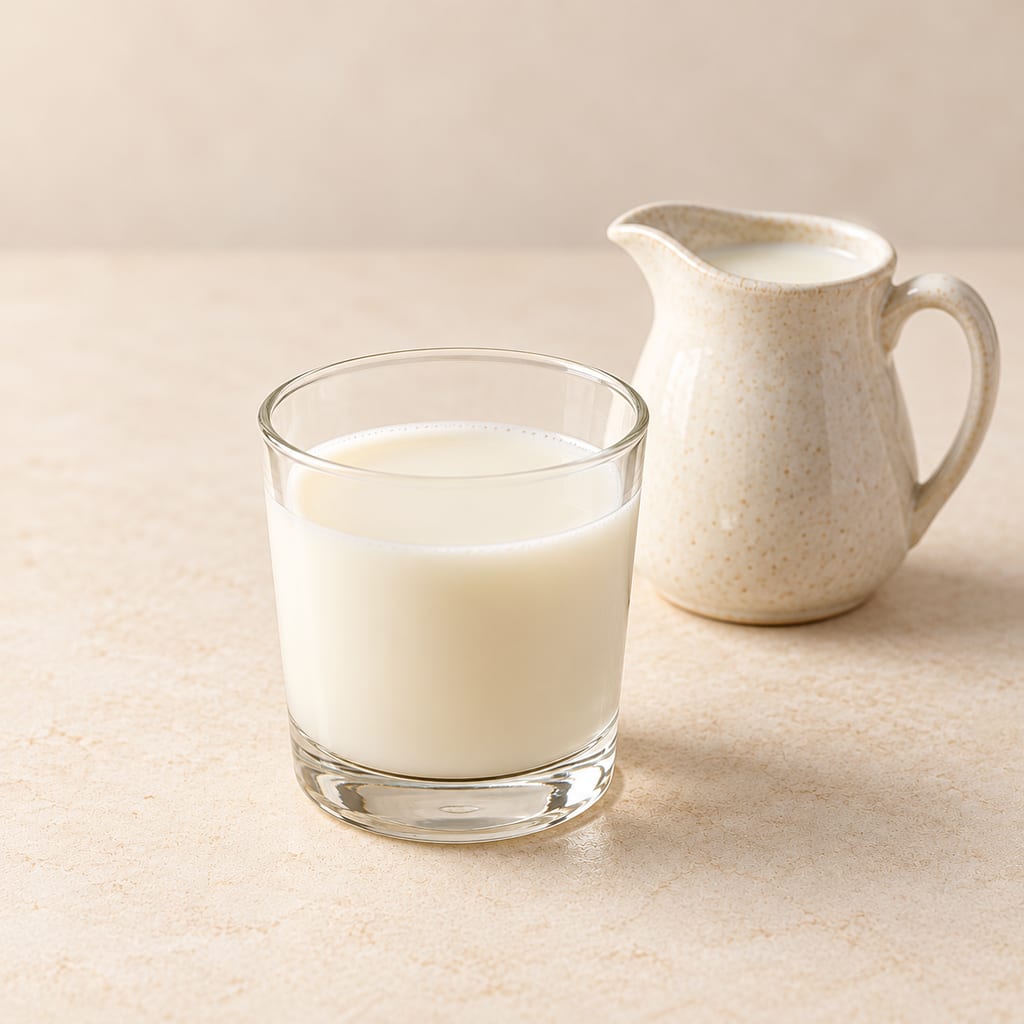
Koumiss (pasteurized mare milk)
Koumiss is a sour, lightly alcoholic mare-milk drink made by lactic bacteria and yeasts. This technical method uses pasteurized milk, a previous-batch starter and staged cooling.
 FermenteaWhere food goes to change
Cultures
Koumiss starter is a retained previous-batch liquid or bulk dairy culture used to inoculate fresh milk. Its bacteria, yeasts and activity depend on the culture and production method.
Koumiss starter is living inoculum used to begin a mare-milk fermentation. In the form described here, it is a portion retained from an earlier koumiss batch or an active culture prepared in bulk. It is liquid dairy material carrying a community of microorganisms, rather than a grain-like culture or a single named yeast. Its role is to introduce that community to fresh milk.
The distinction is one of use. A previous batch can be a drink when served and a starter when a portion is retained to inoculate more milk. This page concerns that retained or bulk culture. The koumiss preparation has its own account and method. Calling the inoculum starter does not establish a separate recipe for manufacturing it from pure organisms.
Nor does the name define a standard composition. Lactic acid bacteria and yeasts participate in koumiss fermentations, but their identities and proportions vary. A family culture, a dairy's bulk starter and a laboratory mixture of selected strains are distinct systems. Knowing which one a method requires matters more than assuming that every culture associated with the word koumiss behaves alike.
A retained starter connects one making to the next. In G. F. Müller's travel notes, reproduced in a later account of Yakut food, fresh mare milk entered a leather vessel with ferment from old koumiss. Milk was added after milking and fermented drink was drawn off. The vessel was therefore part of a continuing household practice, rather than simply a container filled once and emptied at a fixed endpoint.
The same notes connect access to starter with household resources. Families with more livestock could maintain production differently from those making koumiss only around the foaling season; starter could be obtained from another household. Culture continuity depended on people sharing material as well as knowing how to handle it. This historical account records a particular social and pastoral setting, not one universal starter-maintenance routine.
William of Rubruck's thirteenth-century description of mare-milk processing likewise places the drink in a world of foals, milking, skin vessels and repeated beating. He described the making and drinking of the beverage without identifying the microorganisms. Such accounts establish long-standing practice and its material setting. They cannot supply a species list for a surviving culture, or demonstrate that a modern bulk starter descends from one particular historical vessel.
In Mongolia, airag making in a khokhuur, a cowhide vessel, is recognised as a living heritage practice. Starter remains in the vessel as cooled fresh milk is added and repeatedly churned with a buluur paddle. Knowledge of preparing and maintaining the culture accompanies the skills of making and using the equipment. The material culture and the retained inoculum belong together in that particular practice; they do not prescribe the vessel or handling for an industrial bulk starter.
Transferring starter moves organisms and some already-fermented milk into a new supply of food. The bacteria and yeasts then encounter a different mixture: fresh milk dilutes accumulated fermentation products and provides more nutrients. As growth resumes, the milk changes again. Carrying a culture forward is consequently a biological process, not merely preserving an unchanged liquid.
The surroundings also matter. Milk, utensils, vessels and handling can contribute organisms, while the conditions of fermentation favour some members over others. A 2024 comparison in Xilingol, Inner Mongolia, followed five koumiss batches made with their own starters. Both the traditional and industrial modes used previous-batch inoculum. Source-tracking analysis identified starter as a major contributor to the industrial bacterial communities, while starter and environment both contributed substantially to the traditional bacterial communities.
That difference does not mean the industrial bacterial community contains only starter bacteria or that a traditional vessel has a fixed bacterial community. Source tracking estimates contributions from the sampled material; it is not a pedigree for every cell. The practical insight is that the inoculum belongs to a whole production system. Treating the starter as interchangeable while changing the milk and handling can change that system.
Lactic acid bacteria use milk sugars for energy and form lactic acid. As acid accumulates, the milk's pH falls and its taste and protein behaviour change. Yeasts contribute alcoholic fermentation, producing ethanol and gas from sugars they can use. These activities help account for koumiss as an acidic, mildly alcoholic milk drink rather than a simple sour milk with a yeast added only for aroma.
The available food differs among organisms. Lactose is a disaccharide, a sugar made from two smaller sugar units. Organisms differ in their ability to transport and break it down, and in which sugars they can ferment afterwards. A yeast that can use glucose or galactose is not necessarily able to ferment intact lactose. The presence of milk sugar therefore does not tell us that every yeast in a mixed culture has equal access to it.
Protein breakdown adds another set of reactions. Proteolytic enzymes release peptides and amino acids from milk protein; cells can take up suitable smaller compounds for growth. Amino acids can also participate in flavour formation. Sugar use, acid production and protein metabolism thus run together, but they are different processes. A stronger sour taste cannot reveal the extent of each one.
In the Xilingol comparison, lactose declined while acids, ethanol and free amino acids accumulated during fermentation. The two production modes reached different chemical profiles. Those measured changes explain why the starter's activity matters to flavour and composition, without turning a particular study's final values into specifications for every starter or batch.
Mixed cultures are often described as bacteria and yeasts helping each other, but the actual relationship can be less symmetrical. In an experiment using isolates from Xinjiang koumiss, the yeast Kluyveromyces marxianus promoted growth of Lactobacillus casei MLS5. That bacterial strain inhibited the yeast in return. Lactococcus lactis WLB5, tested in the same work, instead enhanced yeast growth. The names here identify tested organisms and strains, not a formula for the starter used by the linked recipe.
This is why a list of species cannot be treated as a ready-made culture. The individual strains, their starting proportions and the conditions in which they grow affect the result. Detecting two organisms together is also different from experimentally showing that one stimulates the other. Community surveys describe who was detected; co-culture experiments can test selected interactions under specified conditions.
The organisms common in one set of koumiss samples may not dominate another. A culture can retain its practical identity as a koumiss starter while differing from another household's or dairy's culture. That variability is part of the subject, rather than a reason to invent a single canonical bacterial-and-yeast mixture.
Modern analyses examine starter communities in more than one way. Culturing a sample on laboratory media allows organisms that grow under those conditions to be counted and isolated. DNA-based methods can detect a wider range of community members, including organisms that grow poorly on the chosen media. The two approaches answer related questions, but their results need not be identical.
A study of a traditional fermentation at one Xilingol site sampled the liquid over time and examined bacterial DNA and chemical composition. The relative abundance of bacterial groups changed as fermentation progressed. Its metagenomic analysis identified genes associated with functions such as carbohydrate and amino-acid metabolism. Those genes indicate biological capabilities represented in the sampled community; their detection alone is not a direct measurement of every reaction happening at that moment.
Such work helps explain succession: the community at inoculation and the community later in fermentation need not have the same balance. It does not turn an unnamed starter into a defined commercial blend. Nor can a survey of one site establish which organisms belong in every traditional culture. The living material retained for the next batch has to be understood within its own method and history.
Technical descriptions distinguish a culture built in bulk from a portion carried from a previous production batch. Both can supply active organisms, but they reach that role through different handling. A bulk starter may be grown separately before production; previous-batch inoculum carries the community from the preceding koumiss making. Neither label supplies its complete microbiological specification.
The handbook manufacturing diagram behind the linked recipe calls for 30% bulk starter or previous koumiss. It does not state the percentage basis clearly enough to calculate an absolute quantity from that line alone. Adjacent prose describes a separate propagation method using pure cultures. The organisms and stages in that separate method must not be silently assigned to the diagram's unspecified inoculum.
The Xilingol study used its own back-slopping proportions and different traditional and industrial conditions. Those were research batches, not confirmation of the handbook's percentage. A starter amount belongs with the formulation and process in which it was used. A proportion from one account cannot resolve an unspecified basis in another.
In the Xilingol comparison, the traditional batches used raw mare milk and a warmer fermentation, while the industrial batches used pasteurized mare milk and a cooler fermentation. Batch sizes differed as well. The observed differences therefore describe two production systems; they cannot be attributed to temperature alone or used to prove that one starter would perform identically after the other changes were made.
Milk supplies both fermentable carbohydrate and the protein-rich medium in which the community develops. Changing the milk changes more than the drink's name. A culture selected or maintained in mare milk has an established context there, whereas a cow-milk adaptation may involve a different formulation and process. Neither a shared starter name nor a similar appearance establishes interchangeability.
The same reasoning applies to keeping a starter. A retained live culture continues to be biological material, with activity affected by its conditions. A storage interval used for experimental sampling is not automatically a recommended keeping time. There is no general shelf life or renewal schedule attached to the ingredient name. Use the maintenance and handling directions for the actual culture and preparation.
Identify the form the method asks for before choosing a starter. A retained previous-batch liquid is different from a concentrated commercial powder, a pure yeast isolate or a laboratory pair of bacterial and yeast strains. The word starter describes their intended role, but it does not supply a conversion between their doses.
For the linked preparation, the useful specification remains bulk starter or previous koumiss. Its source does not identify a manufacturer, strain mixture or measured activity. Keep those details open rather than assigning organisms from a survey or purchasing a similarly named culture as though it were the same material. A supplier's intended use and instructions are relevant to that particular product.
The inoculum is milk-derived. Fermentation changes sugars and other constituents, but it does not establish a lactose-free or milk-allergy-safe product. The starter and the milk used for the new batch both belong in any assessment of the finished preparation. Its value here is as a living culture with a documented role in koumiss making, carried through an identified process rather than inferred from the drink's name alone.
Milk-derived starter. Its lactose and milk-protein content are not established as absent.
Contemporary study sites document previous-batch starter use; no birthplace claim.
Reproduced historical travel notes describe retained old-koumiss culture and household sharing.
Koumiss is a sour, lightly alcoholic mare-milk drink made by lactic bacteria and yeasts. This technical method uses pasteurized milk, a previous-batch starter and staged cooling.
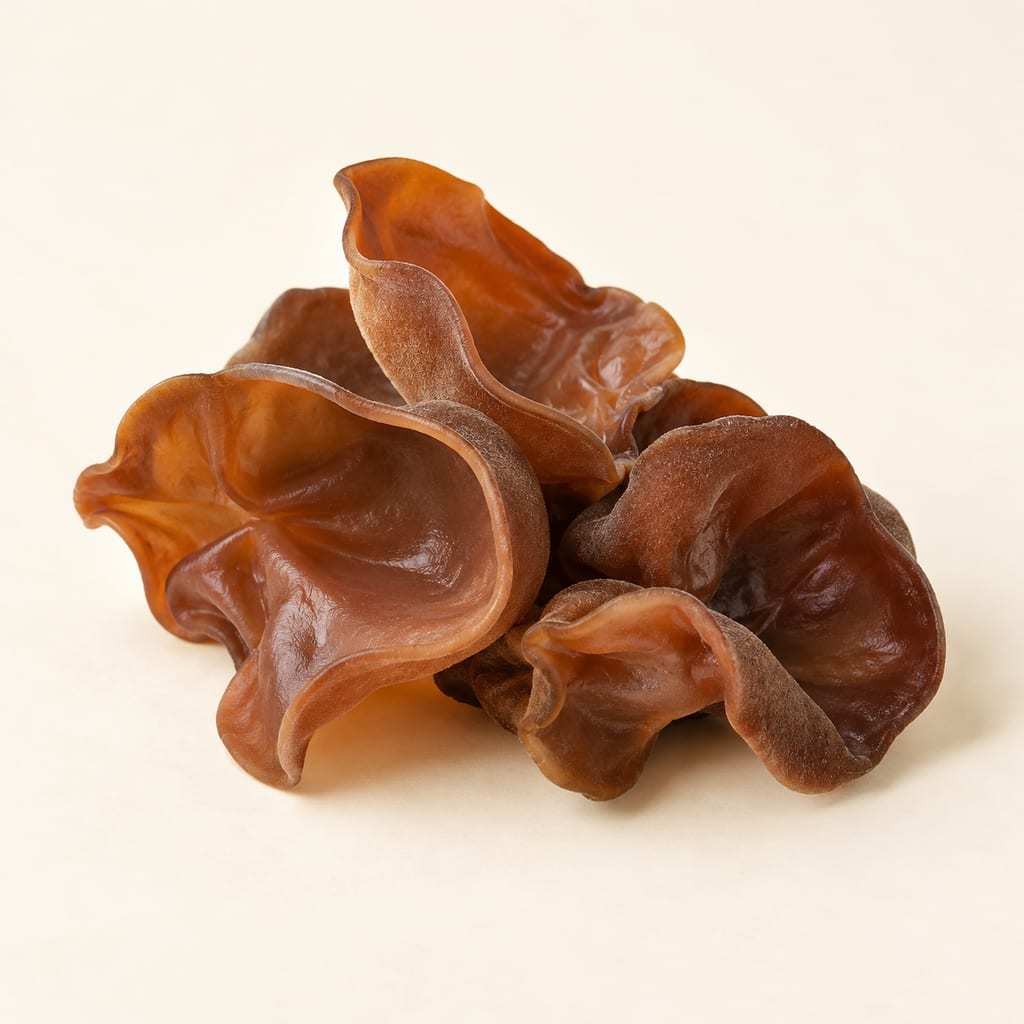
Auricularia villosula, the short-haired wood ear, is an Asian wood fungus that China lists as edible and that is cultivated in Inner Mongolia. It is easily confused with the cultivated black wood ear, so a market label does not settle the species.
Oat flour is milled oats, from fine whole-groat powder to flour with some bran removed; its low gluten-forming capacity changes how it behaves in dough.
No community contributions have been published for this entry yet.
Sign in to contribute. Published comments and photos are free to read.
Fermentation 10(1), 66 / MDPIIdentity · Fermentation function
Microbiological and Physicochemical Dynamics in Traditional and Industrial Fermentation Processes of KoumissMethods 2.1 and Results 3.3–3.6 compare five batches using previous-batch inocula, including bacterial source tracking and chemical changes. Differences in processing systems limit direct causal comparisons.
Cited in: The portion that begins the next batch; A culture grows in a changing environment; Acid, alcohol and the work of different organisms; Cooperation is specific to the partners; What a microbial survey can tell us; Previous-batch inoculum and prepared bulk culture; Milk and handling change the result; Choosing the inoculum for a koumiss preparation
Food Science & Nutrition 9, 4146–4155 / WileyIdentity · Fermentation function
Bacterial composition and function during fermentation of Mongolia koumissMethods 2.1–2.3 and Results 3.2–3.4 examine previous-koumiss inoculation, bacterial succession and metagenomic functions in a one-site time series.
Cited in: The portion that begins the next batch; A culture grows in a changing environment; What a microbial survey can tell us
Marcel DekkerIdentity · Fermentation function
Fermented Liquid Milk Products, chapter 45 in Handbook of Food and Beverage Fermentation TechnologyChapter 45, pp 824–826 and Figure 3 on p 825, distinguishes previous-koumiss or bulk inoculum from a separate pure-culture procedure. The percentage basis is unresolved.
Cited in: The portion that begins the next batch; Previous-batch inoculum and prepared bulk culture; Choosing the inoculum for a koumiss preparation
Science First HandIdentity · Fermentation function
Yoghurt a la YakutThe article’s mediated Savvin/Romanova and Mueller/Elert historical accounts describe old koumiss inoculum, repeated milk additions, leather vessels and household culture maintenance.
Cited in: Continuity in the milk vessel
Hakluyt Society; University of Washington Silk Road SeattleIdentity · Fermentation function
The Journey of William of Rubruck to the Eastern Parts of the World,1253–1255: food selectionThe historical account describes mare milking, foals, a leather vessel and beating. It identifies neither microorganisms nor a durable starter lineage.
Cited in: Continuity in the milk vessel
AIMS MicrobiologyIdentity · Fermentation function
Lactic acid bacteria as starter cultures: An update in their metabolism and geneticsSections 2.1 and 2.3 explain general lactic-acid-bacterial sugar metabolism and protein breakdown, without specifying the composition of a koumiss starter.
Cited in: Acid, alcohol and the work of different organisms; Milk and handling change the result
Food ScienceIdentity · Fermentation function
Interaction between Lactic Acid Bacteria and Yeast during Koumiss FermentationThe abstract reports strain-specific interactions among Xinjiang isolates in single and mixed cultures. Those isolates are not identified as this recipe’s starter.
Cited in: Cooperation is specific to the partners; Choosing the inoculum for a koumiss preparation
UNESCO Intangible Cultural HeritageHistory · Regional use
Decision 14.COM 10.b.24: Traditional technique of making Airag in Khokhuur and its associated customsThe Mongolian heritage account describes khokhuur, buluur, retained starter and the knowledge needed to maintain the culture.
Cited in: Continuity in the milk vessel
Antonie van Leeuwenhoek 57(2):77–81Fermentation function
Modes of lactose uptake in the yeast species Kluyveromyces marxianusThe abstract distinguishes sugar-use characteristics among studied yeasts. It supports general differences in lactose use, not identification of an unspecified starter organism.
Cited in: Acid, alcohol and the work of different organisms