Koumiss starter
Koumiss starter is a retained previous-batch liquid or bulk dairy culture used to inoculate fresh milk. Its bacteria, yeasts and activity depend on the culture and production method.
 FermenteaWhere food goes to change
Modern method
Koumiss · Kumys
Koumiss is a sour, lightly alcoholic mare-milk drink made by lactic bacteria and yeasts. This technical method uses pasteurized milk, a previous-batch starter and staged cooling.
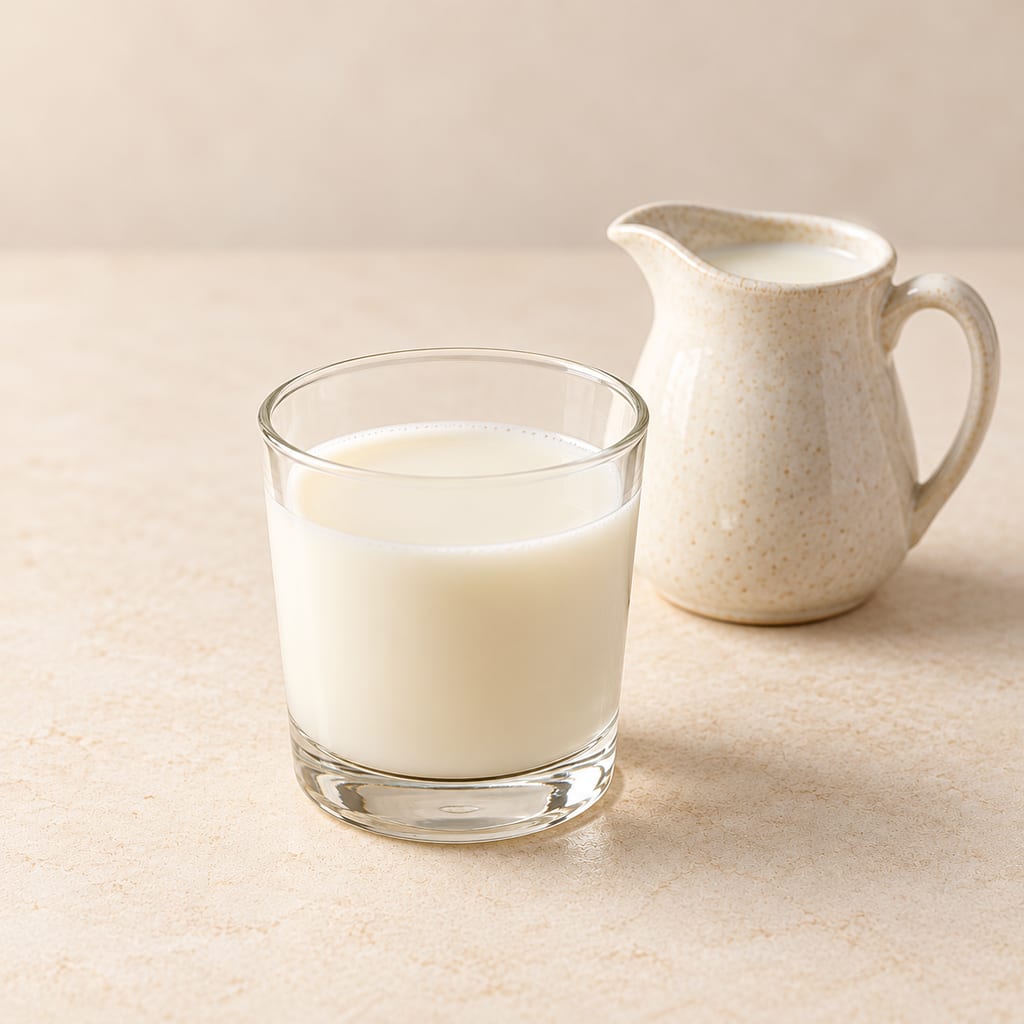
Koumiss is fermented mare milk, also written kumys or kumiss. It is a drink rather than a drained curd: pale, frothy and acidic, with alcohol and gas contributing to its character. Lactic acid bacteria and yeasts participate in the fermentation, making it a useful contrast with a dairy food described only as sour milk. Its texture, aroma and strength depend on the milk, culture and process used.
The pale appearance can hide substantial change. Sugar is consumed while acids, ethanol and other compounds develop. Froth can come from handling as well as gas, so the visible surface does not reveal how far each biological process has progressed. Nor does a mild taste demonstrate an absence of alcohol. The name covers drinks whose histories and production conditions differ, rather than one fixed strength.
The practical preparation here follows a technical handbook's flow diagram for pasteurized mare milk. It belongs beside the history of household koumiss, while remaining a separate manufacturing method. That choice makes the account specific: the reader can explore the wider food without silently combining a skin-vessel tradition, a laboratory study and a packaged-dairy schedule into an invented universal recipe.
William of Rubruck's account of his thirteenth-century journey through Mongol lands describes a drink he calls cosmos. In the translated passage, foals are brought near the mares to facilitate milking. Milk is collected in a large skin vessel and repeatedly beaten with a wooden implement. He describes foaming and souring, then a drink with a pungent bite and an aftertaste he compares with almond milk.
The account ties the drink to a seasonal horse economy. Rubruck presents it as especially important in summer and describes milk supplies reaching an elite household. Production required animals, access to their milk, vessels and repeated human work. Fermentation was one part of that system, rather than a container left apart from the daily management of horses.
His language also records an encounter between the food and a visitor. Wine and almond milk supplied comparisons familiar to him; they are descriptions, not modern analytical results. The text demonstrates a recognisable fermented-mare-milk practice in the world he visited. It cannot establish the drink's first invention, and his physiological explanations do not become current dairy science.
Herodotus describes Scythian mare milking and milk worked in wooden vessels. His account includes agitation and removal of the upper portion, which was valued above what settled. It is evidence for milk handling and separation. It does not name koumiss, describe a fermentation period or explicitly say that the milk soured into an alcoholic drink.
The distinction is small in wording but important to the history. “People used mare milk” and “people made this fermented drink” are different claims. Archaeological milk evidence, a written description of skimming and an eyewitness account of souring answer different questions. Placing them together can show the depth of human engagement with horse milk without pretending that each supplies a recipe for koumiss.
Rubruck's later description is more explicit about a fermenting drink, while Herodotus' passage provides an earlier dairy scene. Neither should be stretched into a precise birthplace. The food's history becomes more legible when the operations actually described—milking, agitating, skimming, souring and drinking—remain visible, rather than disappearing behind a single confident origin date.
Historical accounts from Siberia describe another way milk, access and fermentation were linked. G. F. Müller's notes, reproduced in Science First Hand, describe fresh mare milk entering a leather vessel with starter from old koumiss, followed by repeated stirring. The account also records repeated additions of fresh milk and drawing off fermented drink. This is a continuing household process, unlike a completely isolated batch with a fixed beginning and end.
Access to starter could be social as well as practical. The reproduced notes describe households with fewer animals obtaining ferment from wealthier neighbours, and differences in how long households could continue production. Milk supply and an active starter were both resources. The vessel, the next milking and the people sharing culture helped connect one preparation with another.
Modern research calls this carryover technique back-slopping. A portion of an earlier fermentation seeds new milk with a microbial community. That explains its biological function without assuming that every starter is identical. A culture carried through repeated batches responds to its surroundings and handling. Household inheritance can preserve a useful process while allowing variation in the organisms and flavours that develop.
Lactic acid bacteria use milk sugar and produce acid. Yeasts contribute alcoholic fermentation, and carbon dioxide helps give koumiss its fizz. These activities can occur together, so a single vessel holds several routes of transformation. Increasing sourness does not quantify ethanol, and a lively surface cannot measure acidity. The sensory result reflects their combined effects.
A study of traditional and industrial koumiss in Inner Mongolia followed microbial communities and the changing milk during fermentation. Lactose decreased while lactic acid, ethanol and measured flavour-related amino acids increased. The changes explain why fermented milk is more than the original milk with an acidic ingredient added: organisms consume substrates and produce a different mixture of compounds over time.
The researchers also found differences between their production modes. The traditional batches had greater microbial counts and diversity and a different final chemical profile from the industrial batches. Several conditions differed together, including starting milk, temperature, scale and starter, so the result cannot be attributed to temperature alone. It demonstrates that “koumiss fermentation” describes an interacting system. Naming one organism or one incubation setting cannot fully specify the taste and composition of the finished drink.
The choice of mare milk is central to the food. Milk from different animals differs in sugar, fat and protein composition, including the balance between casein and whey proteins. Mare milk has a lower viscosity than cow milk, making a direct substitution a poor way to reproduce its behaviour. A thin fermented drink and a firm cultured cow-milk gel do not begin with identical materials.
Lactose supplies a fermentable substrate, while the milk proteins and fat contribute to body and flavour. In the Inner Mongolia study, lactose remained after fermentation even as its concentration fell. Fermentation should therefore not be treated as a guarantee of lactose removal. Its extent depends on the particular community and conditions, not simply on whether the finished drink tastes sour.
Cow-milk koumiss adaptations are separate formulations. They adjust composition rather than merely relabel cow milk as mare milk, and some introduce other dairy components or sugar. Those procedures help explain the technical problem of substitution. They do not justify adding their ingredients to the mare-milk flow diagram used here. Preserving the starting milk's identity makes the practical recipe clearer and keeps distinct adaptations available for honest comparison.
Repeated movement is conspicuous across accounts of koumiss. A paddle in a skin vessel, a wooden shovel in an older account and controlled stirring in a technical method are different tools for working a liquid. Agitation distributes milk and starter and can introduce air. Its physical effects overlap with the conditions experienced by the organisms, but the movement itself is not fermentation.
Aeration supports yeast growth. This technical method divides stirring into an initial period and later intermittent movement. This makes attention part of the method: the maker is not merely waiting for a clock to run down. A different vessel or larger volume changes how milk moves, how air reaches it and how evenly conditions are maintained.
The historical descriptions should not be converted into a required number of paddle strokes. Their value is showing the work and the equipment involved. Likewise, foam is a visible consequence of a changing and agitated liquid, not an analytical endpoint. The souring, alcohol production and physical mixing must be understood together while keeping their measurements distinct.
In the technical flow used for this item, inoculation is followed by warm incubation and stirring, then a further stage after the milk has been packaged. Cooling comes later. The sequence matters because packaging does not automatically stop microbial activity. A filled container can still hold a changing drink, with acid, alcohol and gas continuing to develop.
Cooling changes the conditions for that activity; it does not erase what has already occurred. Acid and alcohol can continue to increase during storage and the product can become stronger. This connects quality at drinking with the history of the batch. A drink tasted earlier and the same batch held longer need not have the same balance.
The separate incubation stages also explain why a single total fermentation time would conceal useful information. The bulk vessel and the package are different settings, with different assigned conditions. Stirring in the former and subsequent fermentation in the latter give the process its sequence. The package must accommodate a drink that can continue producing gas; pressure and closure specifications are not given.
The Inner Mongolia comparison used back-slop starter in both traditional and industrial production. Industrial manufacture therefore need not mean abandoning previous-batch culture for a single pure organism. Conversely, using an inherited starter does not make two production modes identical. Milk treatment, environment and handling still shape the community that enters and develops in the vessel.
Source-tracking in that study associated the industrial community mainly with starter, while the traditional mode showed contributions from both starter and environment. This helps explain why cleaning, vessels and surroundings belong to an account of fermentation even when the recipe includes a deliberate culture. Those observations concern the sampled batches; the bulk starter in this preparation remains unspecified.
Kazakhstan's dairy sector provides a broader setting for coexistence. Household, small-enterprise and industrial dairying coexist, with seasonal supply and market access affecting production. A traditional fermented drink can remain associated with a region while also entering modern packaged production. Neither a factory line nor a household vessel alone represents every way people make and obtain koumiss.
Koumiss has been described as both an everyday food and an important drink offered within social life. Rubruck's account places it prominently in summer and describes its place around an elite household; Müller's reproduced notes connect production to household resources and season. These are particular observations, rather than a single serving custom shared by every population that ferments mare milk.
The drink also acquired a medical reputation. George L. Carrick's book, published in Edinburgh in 1881, is titled Koumiss, or fermented mare's milk, and its uses in the treatment and cure of pulmonary consumption and other wasting diseases. Its title records that historical medical framing. The presence of such claims in a period book does not establish that koumiss treats or prevents disease.
For the reader, the useful appreciation is culinary and historical: an acidic, gas-producing milk fermentation linked to horses, repeated work, seasonal supplies and shared cultures. Its strength and character can change with its making and keeping. That is enough to distinguish it as a food without attaching an unsupported promise of health or a universal ritual of consumption.
The retained method is a technical manufacturing chart using pasteurized mare milk. It supplies no absolute batch size, measured endpoint, package pressure specification, defined cooling rate or storage duration; the starter percentage has no stated basis. These omissions prevent it from becoming a complete validated home process merely by copying its temperatures. Keep these unresolved controls separate from the schedules of raw-milk traditions, cow-milk adaptations and laboratory batches.
Koumiss belongs to the mare-milk traditions of Central Asia. In Kazakhstan, kumys has been made by shaking mare’s milk in leather bags and leaving it to ferment; household and commercial production continue alongside each other. It also entered European medical writing: George L. Carrick published a book about fermented mare’s milk in Edinburgh in 1881. The pasteurized-milk sequence here is a later technical method, distinct from leather-bag household practices.
Scaling: source batch only
Raw milk can carry disease-causing microorganisms.
Hazard sourceAcid and alcohol production can continue after manufacture, making the drink stronger.
Hazard sourceUse pasteurized mare milk for this technical method.
Control sourceClean and sanitize equipment and containers before use.
Control sourceAfter the packaged hold, cool quickly to 4°C (39°F) and consume promptly.
Control sourceDo not substitute raw mare milk for the pasteurized milk in this method; raw dairy can carry foodborne pathogens.
Acid and alcohol can continue increasing during storage. Cool promptly after the packaged hold and consume promptly; do not assume a fixed alcoholic strength.
Koumiss starter — A previous batch or separately prepared bulk culture supplies lactic bacteria and yeasts. The diagram does not identify the species or proportions in the inoculum.
A country association for the kumys tradition; the technical diagram is not assigned to a particular Kazakh household or locality.
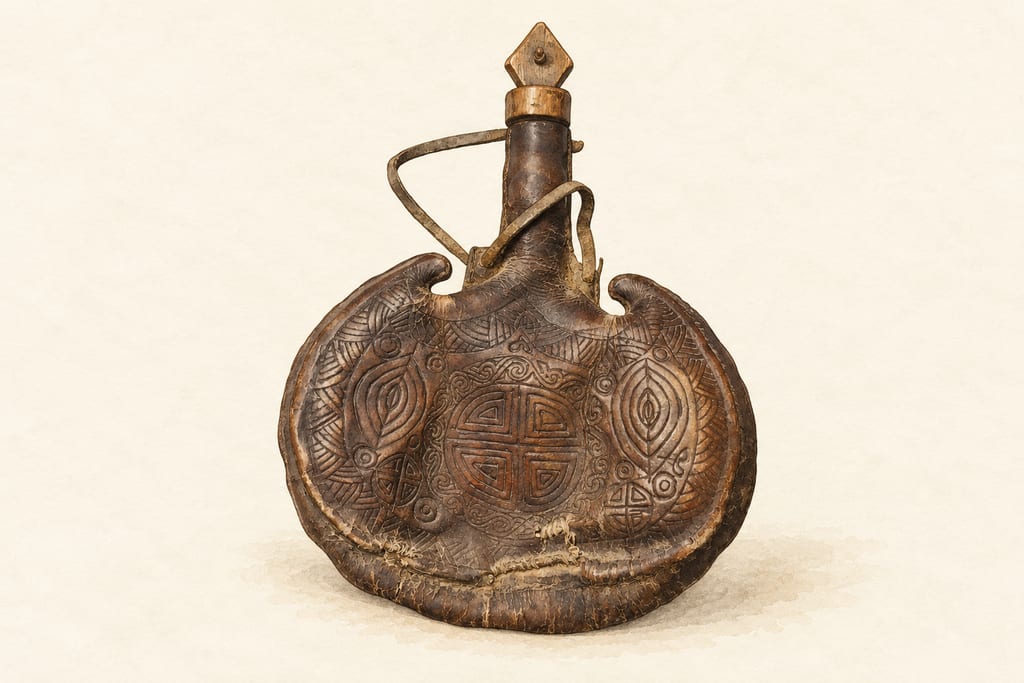
Torsyk is a portable Kazakh leather flask for carrying and keeping drinks such as kumis and shubat. Museum examples have a flattened decorated body, a narrow neck and a stopper; evidence for fermentation inside the travel flask is lacking.
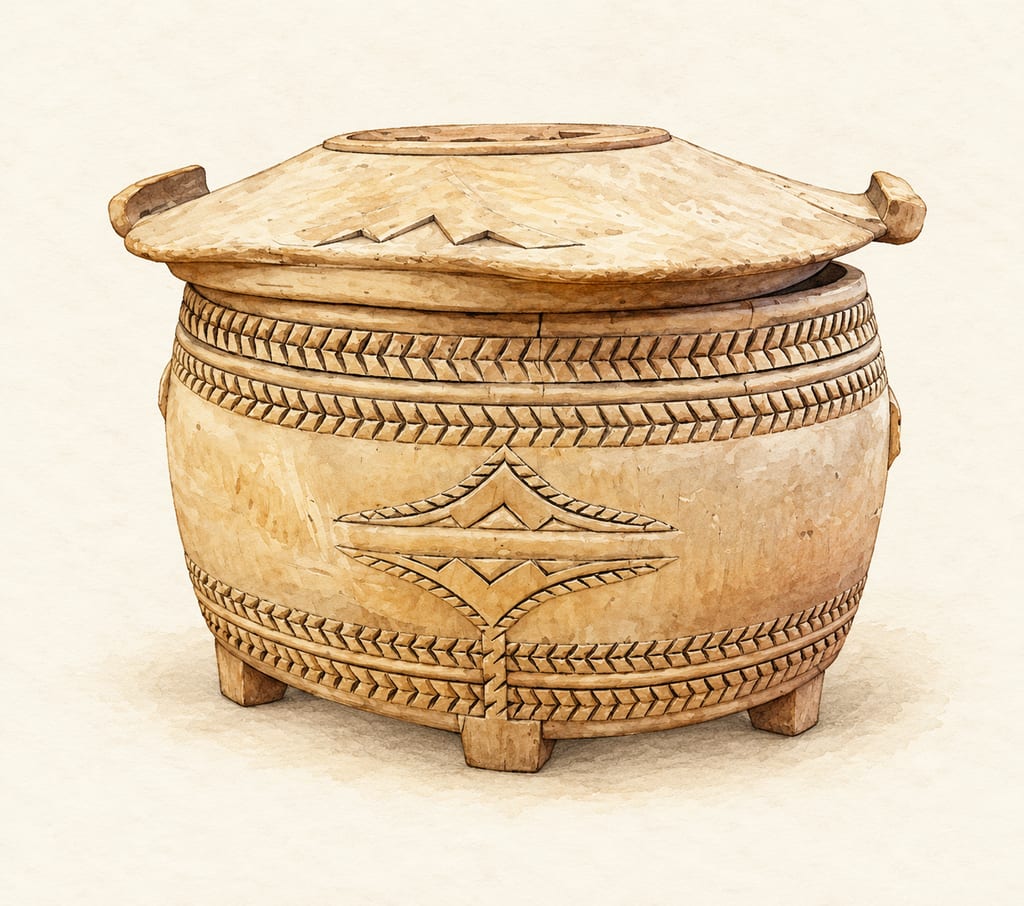
Tepen (тәпән) is a low Bashkir hollowed-linden tub used for serving kumys. A National Museum of Bashkortostan object preserves one carved, lidded example; the taller siläk tub had a different preparation role.
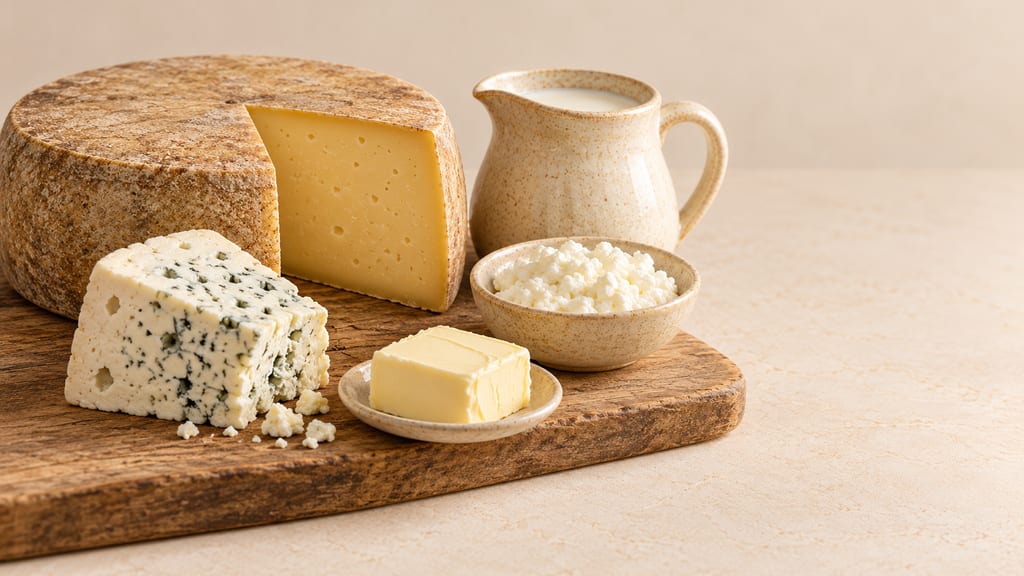
Follow milk into cheese, cultured drinks, butter, dried curds and sweets: a journey through the animals, seasons and household decisions behind the world's dairy foods.
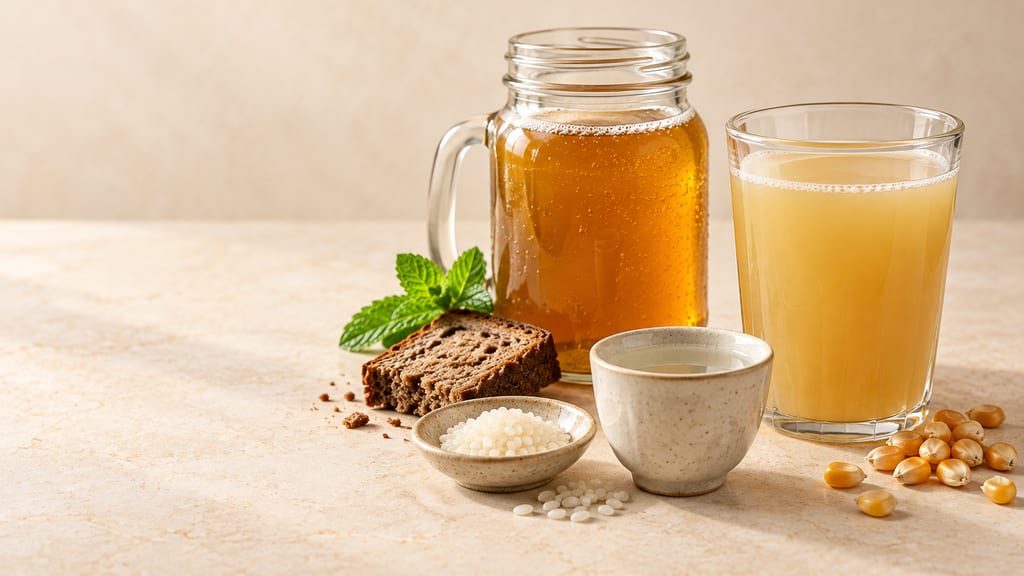
People kept, traded and steered living ferments for thousands of years before anyone saw a yeast cell. This is that history, region by region, and a guide to what a yeast strain is today.
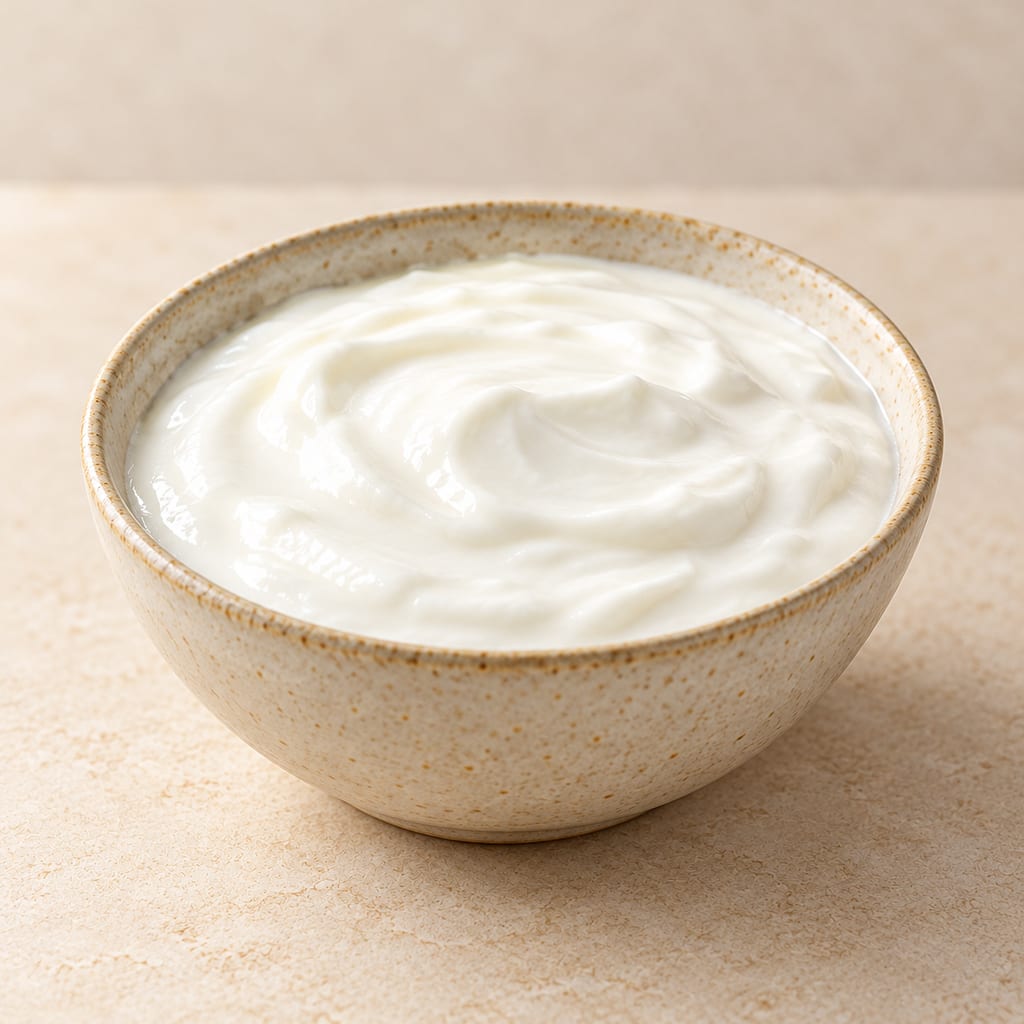
Katyk is a traditional fermented milk of Turkic-speaking peoples, made by souring heated milk with lactic bacteria, often with a spoonful of the last batch, into a thick, sour curd.
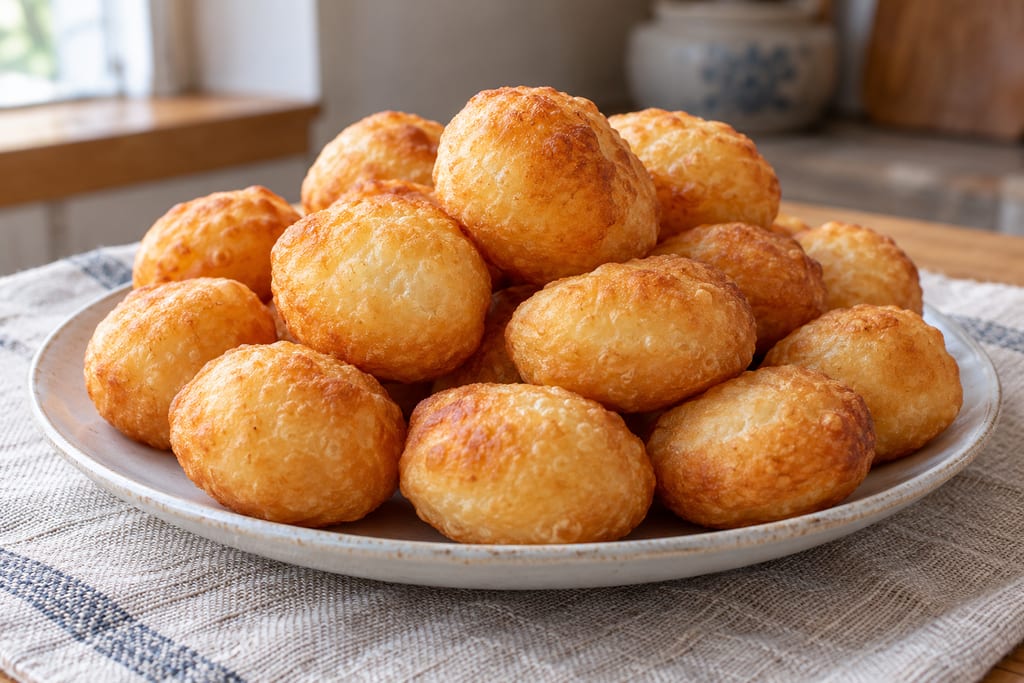
Small rounds of yeasted milk dough, fried in batches. This Kazakh home recipe lists 27 servings.
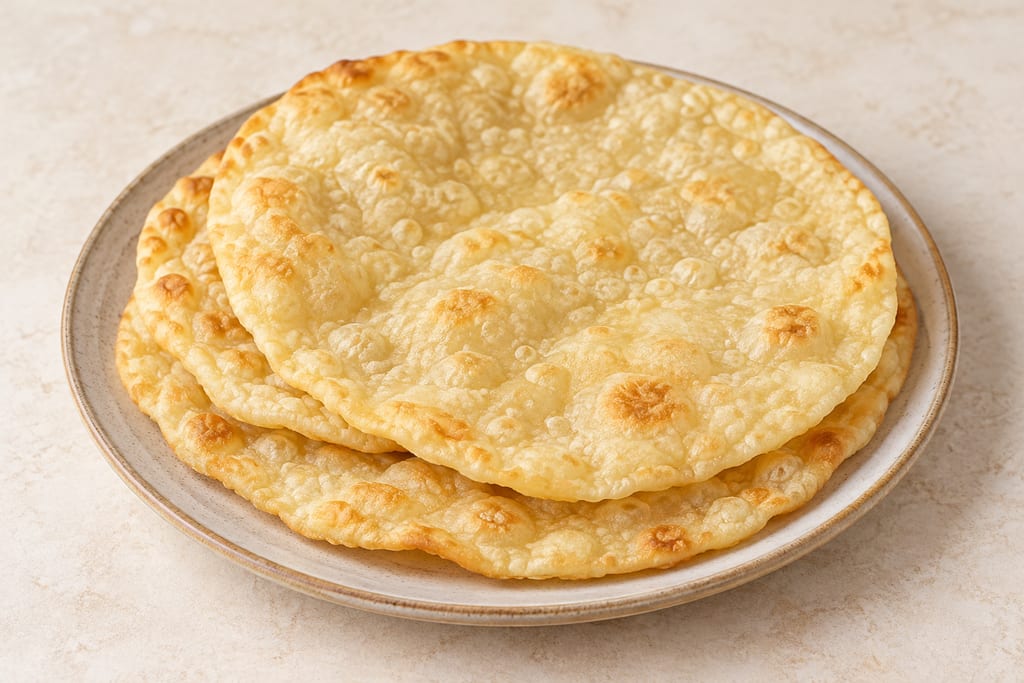
Shelpek is a round Kazakh flatbread fried in oil. This ten-piece flour-and-water version follows a documented Kazakh home-cooking demonstration; zheti shelpek ritual contexts remain distinct.
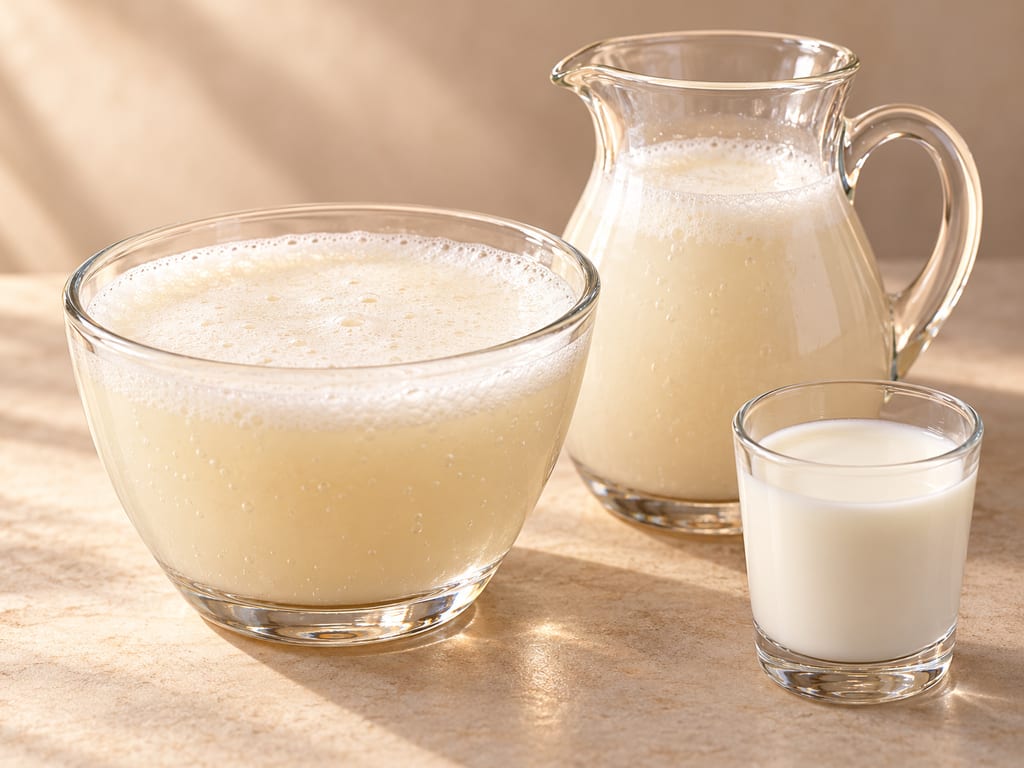
Airag is Mongolia’s fermented mare’s-milk drink, traditionally churned with saved starter in a reusable cowhide khokhuur.

Ayran is Turkey’s cold, savoury yogurt drink: plain yogurt is loosened with water and lightly salted, then whisked smooth or aerated into a soft cap of foam.
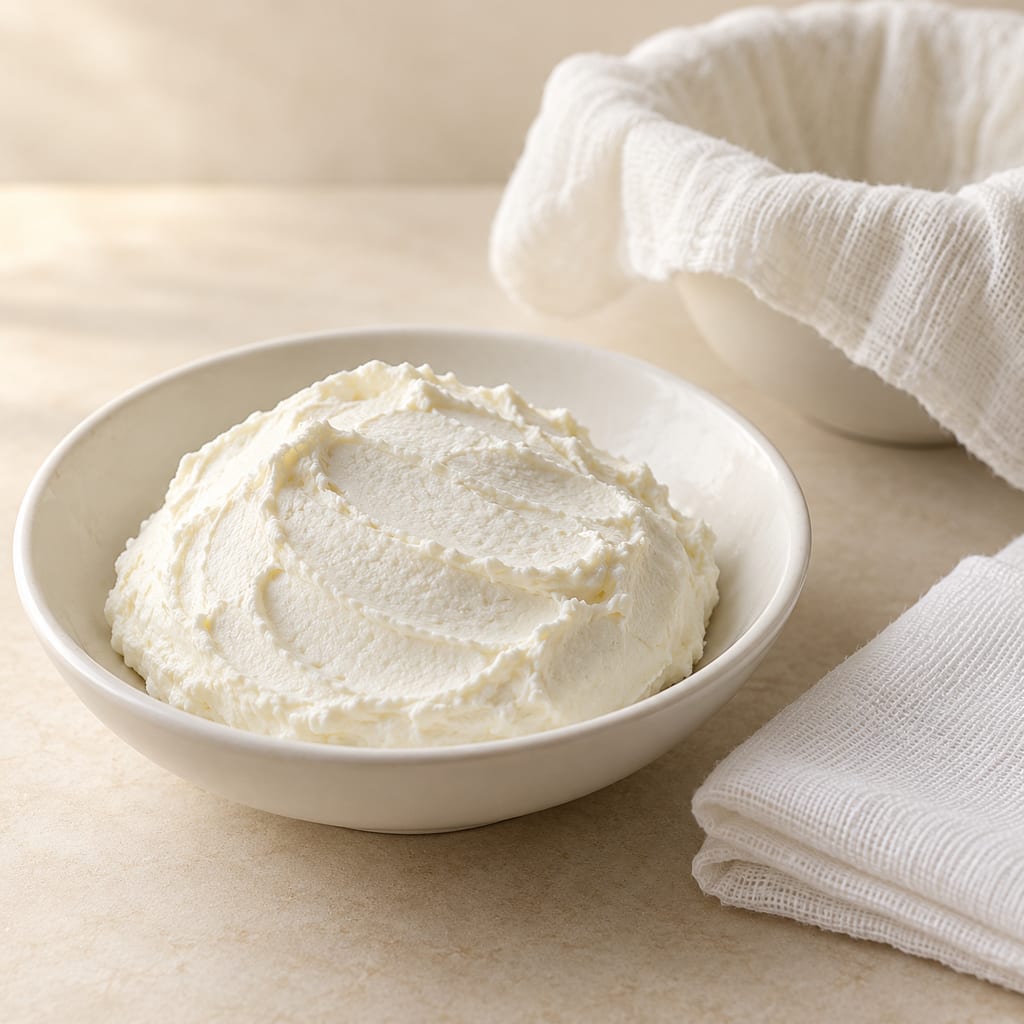
A soft cheese made by setting aside part of the day's milk kefir, draining it in a cloth and salting it through the evening, ready the next morning.
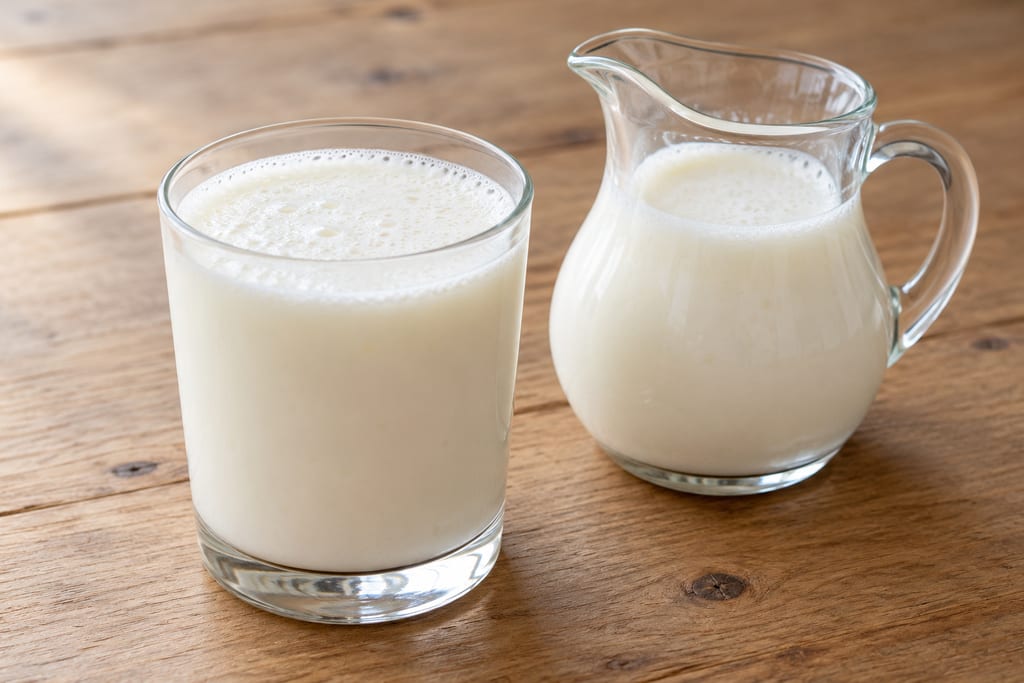
Khurunga is a traditional Buryat fermented milk made with a kept mixed bacteria-and-yeast starter, giving a sour, lightly alcoholic and often fizzy drink that is also the base for milk spirit and curds.
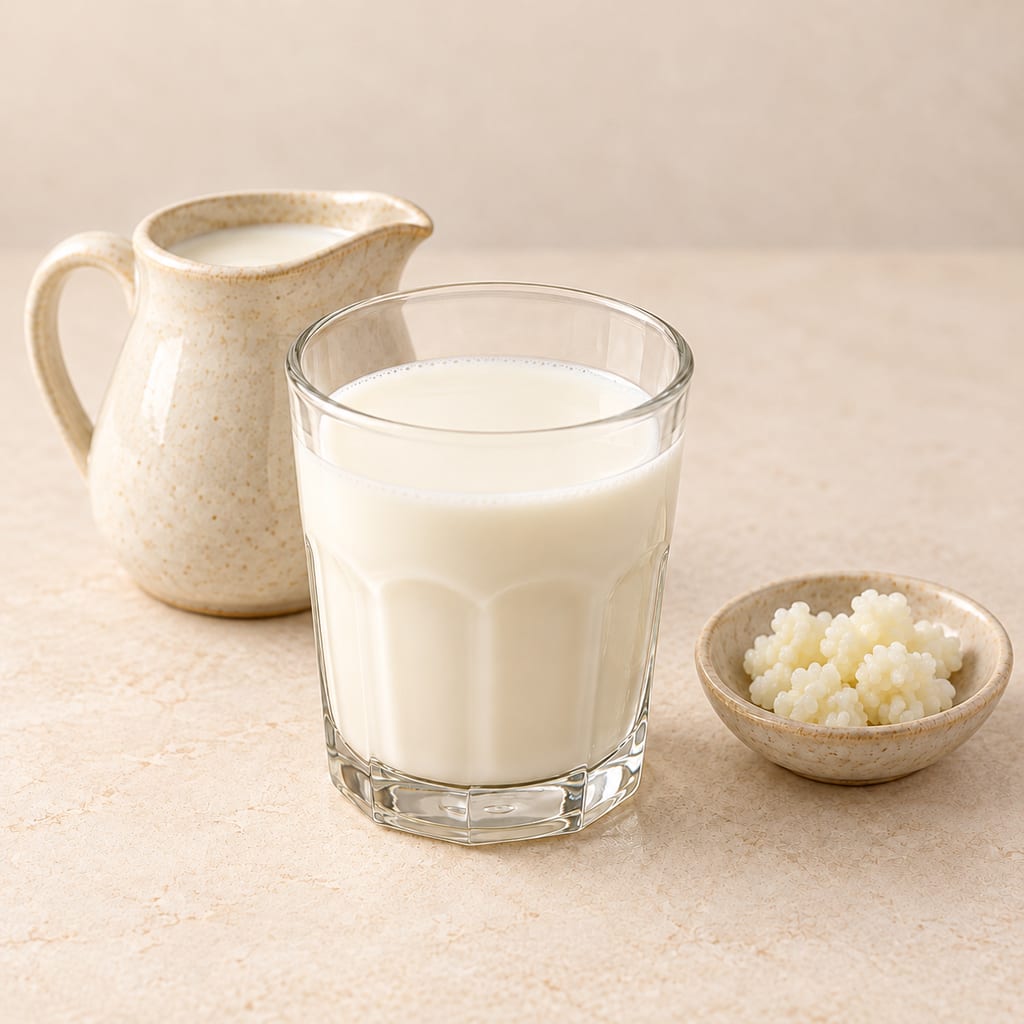
Milk kefir is a tangy fermented drink made with reusable grains of bacteria and yeasts. Grain fermentation can give the milk a light fizz and some alcohol.
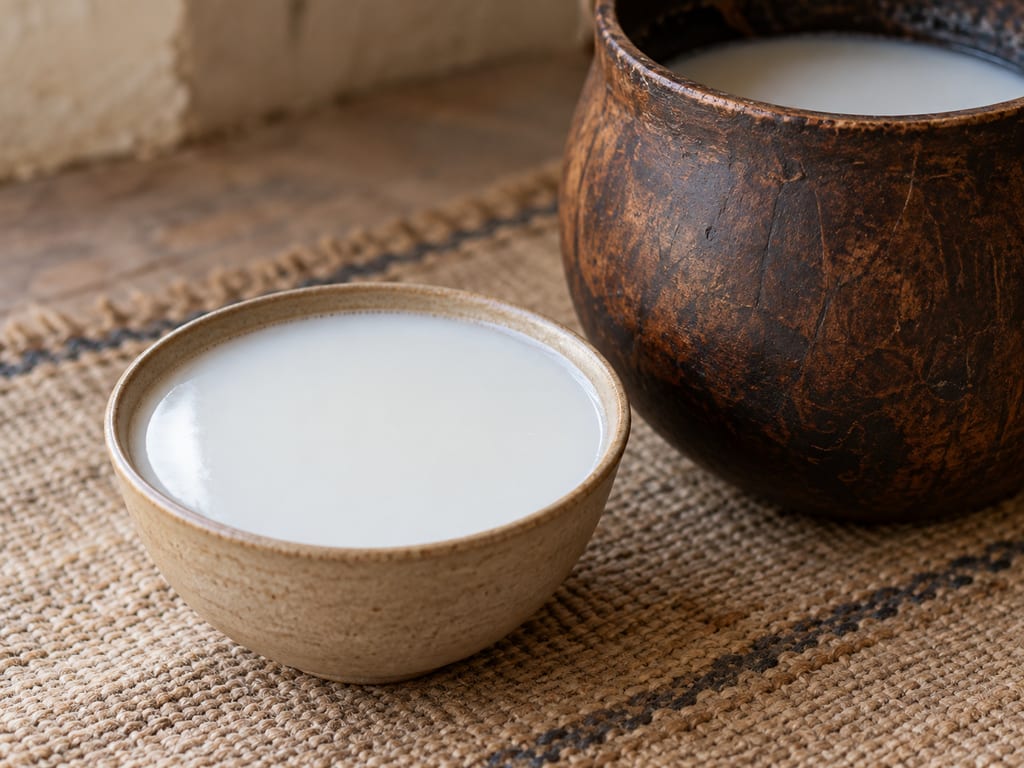
Suusac is a traditional fermented camel-milk drink of Somali pastoral communities in Kenya and Somalia, soured spontaneously in smoke-treated vessels into a thin, acid, smoky milk.
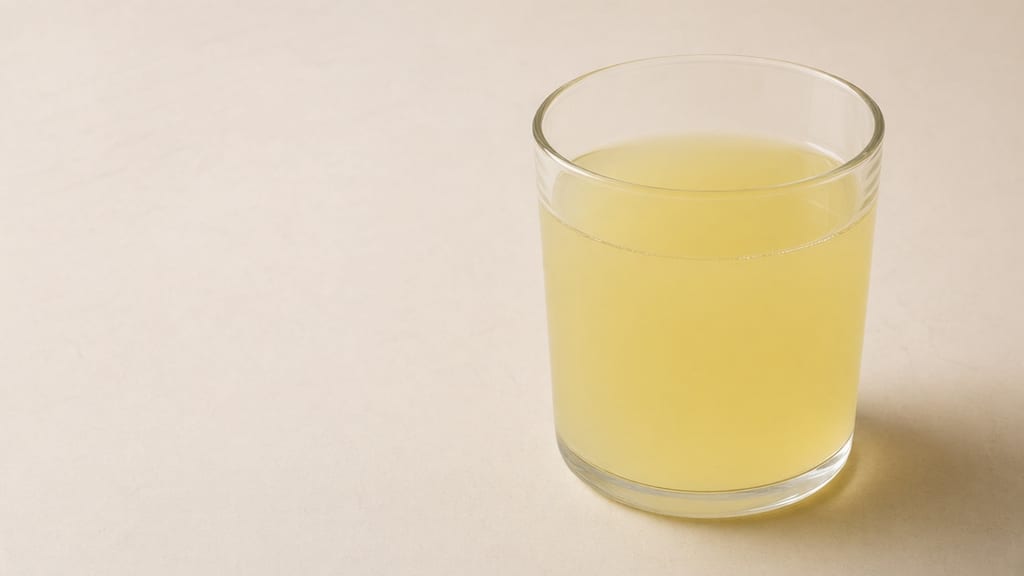
Sýra is Icelandic soured skyr whey kept as a household acid store: a drink when diluted, and historically the medium for súrmatur. Fresh leftover whey is not the same material.

A Cap-Pelé boucanière is an Acadian herring-smoking building. The documented Willie Niles example is a one-storey wood-frame structure with a ridge smoke vent and interior bays for hanging fish-bearing cannes.

Achcharu is a family of Sri Lankan vinegar pickles made with mixed vegetables or seasonal fruit and a piquant spice dressing. This version is a quick, refrigerated, non-fermented mixed-vegetable pickle.

The acocote is a long, hollowed and dried gourd used to draw aguamiel from a mature maguey. It is a harvesting tool: the sap is transferred to a separate vessel before it ferments into pulque.

Adrak murabba preserves young ginger in sugar syrup, a sweet South Asian preparation recorded in Indian cookery and food-processing sources.

Parkia biglobosa seeds are fermented into regional West African seasonings, including nététou, iru, dawadawa and soumbala. The yellow fruit pulp is a separate food, and names and methods vary by place.

Japanese reddish-brown vinegar from sake lees matured about three years, turned to vinegar by acetic bacteria; the vinegar of Handa and Edomae sushi rice.

A refined common-wheat flour blended for a broad range of baking; its protein and behavior vary with wheat, milling and market.

The almond mushroom, Agaricus subrufescens, was cultivated in eastern North America in the 1800s, lost its market, and returned as a cultivated mushroom from Brazil, where it is grown under several names.
No community contributions have been published for this entry yet.
Sign in to contribute. Published comments and photos are free to read.
Marcel DekkerInspiration · Process
Handbook of Food and Beverage Fermentation Technology: Manufacture of KoumissVikram V. Mistry, Fermented Liquid Milk Products, in Handbook of Food and Beverage Fermentation Technology (2004), printed p.825/PDF p.841, Fig.3: pasteurized mare milk at 28°C; 30% bulk or previous-batch starter; stir 30–60 min then intermittently for up to 4h total incubation; package warm; 20°C packaged hold 2h; cool quickly to4°C. Adjacent text describes lactic/yeast starter preparation and warns acid and alcohol can continue increasing during storage. Full PDF downloaded from www.rexresearch1.com and diagram visually inspected.
Agriculture CanadaSafety · Process
Home-made dairy products, Publication 1669Dairy process and handling context.
Food and Agriculture Organization of the United NationsHistory · Geography
Dairy Development in KazakhstanAnton van Engelen, 2011, printed pp. 2 and 6–7: kumys as fermented mare milk; leather-bag production; household and commercial production in Kazakhstan.
Executive summary; household/small-enterprise/industrial chapters: Contemporary dairy-sector geography and seasonal supply context; not authority for the exact technical chart.
Cited in: Household and industrial koumiss share a principle, not every condition
Centers for Disease Control and PreventionSafety
Raw Milk31 January 2025: raw milk can carry foodborne pathogens; choose pasteurized dairy. General milk guidance, not validation of the koumiss manufacturing diagram.
Key points and safer choices: Raw milk risks; pasteurized dairy choice. Does not validate recipe fermentation.
Cited in: Limits of the practical flow
Wellcome CollectionHistory
Koumiss, or fermented mare’s milk, and its uses in the treatment and cure of pulmonary consumption and other wasting diseases : with an appendix on the best methods of fermenting cow’s milk.Catalogue metadata identifies George L. Carrick’s book, Edinburgh: Blackwood, 1881. Only the bibliographic record and title were read; the book’s process and therapeutic claims are not used.
Title, author, publication/creation metadata only: 1881 book documents historical medical framing; no efficacy or unread book contents adopted. Public Domain Mark.
Cited in: Drinking, medicine and the stories attached to the food
Marcel DekkerProcess
Fermented Liquid Milk Products, chapter45, Handbook of Food and Beverage Fermentation TechnologyPrinted pp.824–826, especially Fig.3 p.825 / PDF p.841; full PDF and rendered chart retained: Exact technical mare-milk diagram; general sensory description, mixed acid/alcohol/gas, milk composition contrasts, aeration and continuing fermentation in storage. Cow-milk and pure-culture methods kept separate.
Cited in: A milk drink with more than sourness; Bacteria and yeasts change different parts of the drink; Mare milk gives the culture a particular starting material; Agitation belongs to both the vessel and the fermentation; A packaged process has more than one fermentation stage; Limits of the practical flow
Fermentation 10(1),66 / MDPIProcess
Microbiological and Physicochemical Dynamics in Traditional and Industrial Fermentation Processes of KoumissAbstract; Methods2.1; Results3.3–3.4 and source-tracking discussion; CC BY4.0: Primary five-batch comparison: lactose reduction, acids/ethanol/amino-acid change, microbial variation, several changing conditions, starter/environment contributions. No health efficacy claims adopted. Full PDF retained.
Cited in: A milk drink with more than sourness; Starter-sharing connected households to the next batch; Bacteria and yeasts change different parts of the drink; Mare milk gives the culture a particular starting material; A packaged process has more than one fermentation stage; Household and industrial koumiss share a principle, not every condition
Hakluyt Society; hosted by University of Washington Silk Road SeattleHistory
The Journey of William of Rubruck to the Eastern Parts of the World,1253–1255: food selectionIntro; cosmos manufacture; summer food and elite milk supply: Primary historical account in1900 translation: foals/milking, skin vessel, beating, foaming/souring, sensory comparisons, summer importance. Historical physiology not adopted.
Cited in: A travelling witness describes milk, foals and a skin vessel; Earlier mare-milk evidence asks a different question; Agitation belongs to both the vessel and the fermentation; Drinking, medicine and the stories attached to the food
Lexundria, public-domain translationHistory
Histories4.2.1Entire passage and translator notes: Mare milk, wooden vessels, agitation and skimming; no explicit fermentation/koumiss claim.
Cited in: Earlier mare-milk evidence asks a different question
Science First HandHistory
Yoghurt a la YakutFrom G. F. Mueller’s travel notes; surrounding household-production context: Reprinted primary historical notes: old-koumiss starter, leather vessel, repeated milk additions and stirring, shared starter and household resource differences. Old physiology/nutrition assertions excluded.
Cited in: Starter-sharing connected households to the next batch; Agitation belongs to both the vessel and the fermentation; Drinking, medicine and the stories attached to the food