
Dairy intake
Milk, curd and the world's dairy stores
Follow milk into cheese, cultured drinks, butter, dried curds and sweets: a journey through the animals, seasons and household decisions behind the world's dairy foods.
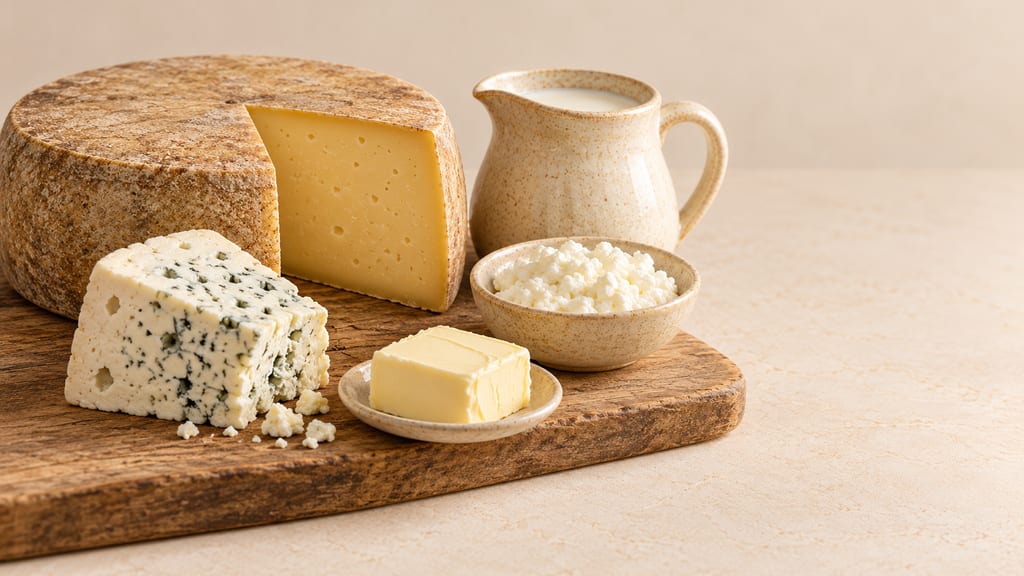
A wheel of Comté and a wedge of Roquefort: two of the countless ways milk is turned into something that keeps.
One milking, many foods
In an Ethiopian household, one batch of milk seldom ends as a single food. It sours into ergo, a fermented milk that can be eaten as it is or churned for qibe, the butter. What is left in the churn is arera, a sour liquid, and heated, it yields ayib, a crumbly curd. Each step feeds the next. Morocco has its own chain, binding raib, butter and lben together. These are distinct local systems, not different spellings of a universal yogurt recipe, and the foods become easier to recognise when the sequence stays intact.
Follow only the final cheese and much of that work disappears. The cream taken for butter changes the curd that can be made afterward. The first curd leaves whey, which may feed another food. What looks like a catalogue of separate delicacies is often a record of decisions about one perishable resource: a drink, butter, a fresh cheese, a dried store.
Cheese is therefore only part of this journey. Cultured milks, clotted creams, clarified fats, whey foods, dried curds and milk sweets belong beside it. Some depend on microbes, others on enzymes, heat, evaporation or freezing. Knowing which transformation took place tells us more than whether a food is white, sour, solid or sold under a familiar name.
What the pots remember
Dairy archaeology rarely hands anyone a labelled wheel. What it finds is residue, and each kind of residue answers a different question. Fat absorbed into pottery can establish that milk was processed, while proteins and microbial DNA answer others. Seventh-millennium BCE evidence from the Iranian Plateau connects sheep and goat milk exploitation with early dairying. It does not identify a cheese bearing a modern name.
In Kuyavia, in present-day Poland, milk fats in perforated pottery from the sixth millennium BCE provide strong evidence for separating curds from whey. The holes alone would not have settled their use; the residues make the interpretation more persuasive. The find identifies a practice and its equipment, without locating a single moment when all cheesemaking began.
At Kotada Bhadli in Gujarat, residues dating to approximately 2300–1950 BCE establish dairy processing in the Indus civilisation. They cannot tell us that the food was paneer or dahi made by a current method. Around 3,500-year-old solid dairy material from Xiaohe in Xinjiang preserves a different kind of evidence: proteins and ancient DNA connect it with kefir-derived cheese. That is a surviving food, distinct from today's drinkable kefir.
Written evidence brings the craft into sharper focus. In the first century CE, Columella described coagulants, drainage, pressing and salting, and distinguished fresh cheeses from those intended for transport. A differentiated craft was already familiar. Neither his account nor an archaeological residue establishes that a later named cheese has survived unchanged. History is more informative when the evidence keeps its actual scale.
How milk becomes curd
Milk contains water, fat, proteins, lactose and minerals. Cheesemaking reorganises those materials. A protein gel retains some fat and water; draining separates a liquid fraction, whey. Acidification and enzyme coagulation offer different routes into that gel, and makers often combine them. Cutting, stirring, heating and pressing then influence how much liquid remains.
Starter organisms commonly convert lactose into lactic acid. In acid-set foods, this change helps form the gel itself. An enzyme-set cheese relies on a coagulant as well, frequently alongside bacterial acidification. Paneer uses heat and added acid; it needs no fermentation stage merely because it forms a curd. A fresh rennet cheese and a fresh acid cheese can look similarly pale while having different processes.
Coagulants also cross the animal–plant divide. Cardoon flowers are central to Torta del Casar and several Portuguese sheep cheeses. In Guangdong's ginger milk pudding, ginger protease supplies the milk-clotting enzyme. The existence of a gel does not identify its cause, and a plant coagulant does not turn enzymatic setting into acid-only coagulation.
Later stages create further differences. A suitable acidified curd can be heated and worked into the fibres of stretched cheese. Surface and internal ripening bring microbial and enzymatic changes after manufacture. Drying chiefly removes water; it is not simply another name for ripening. Washing curd before forming a cheese also differs from washing its rind later. Those small distinctions explain why apparently related foods behave differently.
The animal sets the terms
Sheep milk is generally richer in fat and protein than cow or goat milk, which helps explain its role in concentrated cheeses. Buffalo milk supports both rich curds and fat products. Mare milk has comparatively little casein and more lactose, favouring processing choices unlike those of a conventional firm cow-milk cheese. Fermented mare-milk drinks belong to a dairy history that a wheel-only view would miss.
Species never supplies the whole explanation. Breed, feeding, lactation and season also affect milk, and a product's national name cannot establish one fixed composition. Camel milk supports several distinct fermented drinks, including Mongolian khoormog and other locally named traditions; they should not be exchanged for one generic camel yogurt.
The phrase yak cheese deserves particular care. Himalayan dairy foods may use milk from female yaks or from cattle–yak hybrids, called chauri in some Nepalese systems. Butter extraction and the curd recovered afterward produce foods unlike Nepal's Alpine-style pressed and ripened cheeses, developed through Swiss and FAO work in the 1950s. Modern technical exchange is part of their history, alongside older household processing.
Europe: wheels, winter milk and a cave
A large wheel is also a social arrangement. Jura fruitières pooled farmers' milk to make substantial Comté cheeses for storage. In the Haut-Doubs, Mont d'Or grew out of a different problem: smaller winter milk volumes made large wheels less practical, and its soft body and spruce-bound presentation belong to that distinct dairy economy. Production, maturation and the season when a cheese appears for sale need not coincide.
Butter-making offers another way to read European cheese. Skimmed milk supplies the lean acid curd behind Tiroler Graukäse and related sour-milk cheeses. The low fat is not merely a dietary specification imposed on an otherwise full-fat wheel; it follows a decision to recover cream for butter. Fresh quark and strongly ripened acid cheeses can therefore share a broad starting route without being interchangeable foods.
Emmentaler shows how a long-standing regional name can outlive changes in form. A sixteenth-century reference to cheese from Emmental does not necessarily describe today's enormous, regularly eyed wheel. Later standardisation and export helped shape that familiar product. A historical mention, a modern specification and a supermarket style each tell us something different.
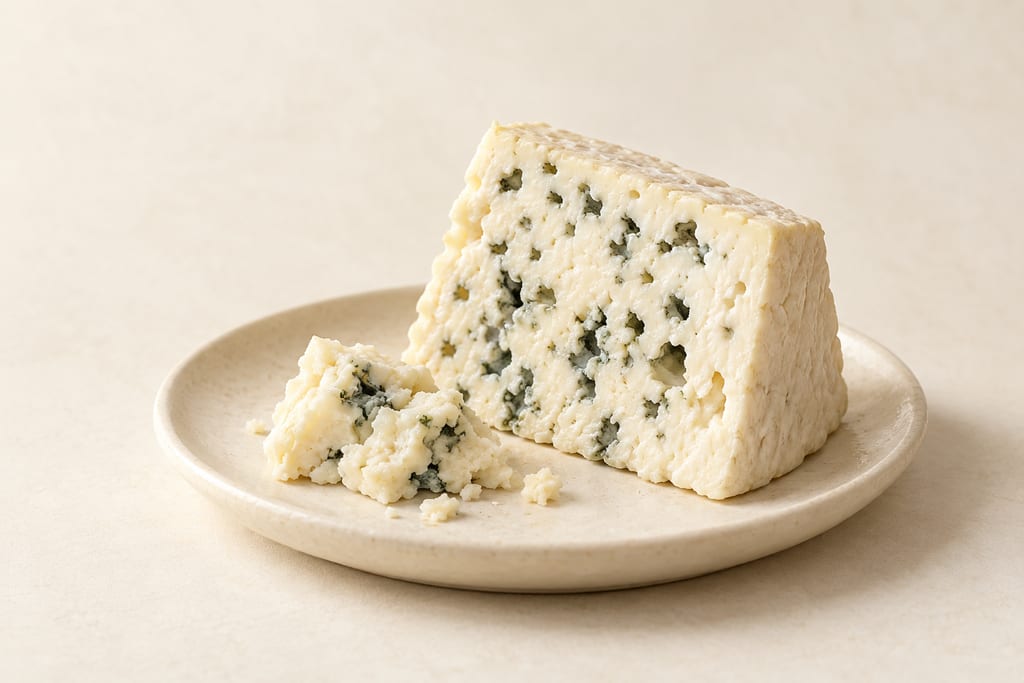
Roquefort adds a cave to the picture. It connects sheep dairying over a supply territory with specialised maturation at Roquefort-sur-Soulzon, and its blue interior and cave setting are parts of an organised craft. The familiar shepherd who forgot bread and cheese in a cave belongs to legend; the French appellation date of 1925 records recognition, rather than the first making of blue cheese. Blue cheeses and surface-ripened cheeses are different microbial environments. Piercing helps air reach an interior where mould develops, and repeated surface treatment tends a rind. Neither practice is equivalent to leaving an arbitrary cheese until something grows on it: the intended organism, the food's composition and the controlled conditions matter.
Torta del Casar offers a different surprise: a sheep-milk cheese that develops a soft, flowing paste through its particular coagulant and maturation system. That texture should not be confused with cream simply because both can be spooned. Across Europe, small fresh cheeses, brined curds, cooked-curd wheels, washed rinds and stretched cheeses coexist, and texture alone cannot reconstruct their making. A hard cheese may owe much to drying, pressing, maturation or a combination; a soft one can still begin with rennet. The useful comparison follows milk treatment and curd handling before it follows a national border.
Africa: the rains, the churn and the long dry store
In Benin, wagashi gassirè belongs to a fresh-cheese family whose production commonly uses Calotropis procera as a plant coagulant. Local boiling, drying and frying practices produce further variations. Related West African names do not define one uniform recipe across every border. The food's identity rests in particular producers and methods, rather than a loose resemblance to another white curd.
Niger's tchoukou makes seasonality visible in its thin dried sheets. Pastoral producers turn rainy-season milk surplus into food for leaner months. It can be eaten directly, softened in tea or combined with millet. A development project beginning in 1989 marks an intervention in the craft, not its invention.
Fermented milk deserves equal attention. A Zambian field study distinguished seven broad mabisi production methods, including Tonga, Ila and Barotse forms. Calling them all African sour milk would lose the differences the makers maintain. A household culture and a selected commercial starter can also produce different accounts of the same named food.
The Ethiopian chain of ergo, qibe, arera and ayib returns us to the whole dairy. Its butter and curd are connected without being the same product, and a fresh ayib is different again from a subsequently fermented cheese derived from it. Recording each stage preserves both the food and the labour that links it to the others.
West Asia and the Caucasus: stores with local names
Skin containers, brine, dried curds and concentrated cultured milk recur across West Asia and the Caucasus. Their recurrence does not make every regional cheese one preparation. Tushetian Guda, for example, is a cheese matured in a sheepskin vessel, with a production calendar tied to movement between lowland and highland pasture. A vessel can be part of a local technical identity rather than interchangeable packaging.
The Levant's dried dairy stores include foods with substantially different ingredients. Lebanese kishk combines fermented dairy with wheat or bulgur before drying; it is a dairy–cereal preserve. A dried dairy curd without that cereal component has another identity, and similar spellings such as Iranian kashk and Levantine kishk cannot settle the matter for the cook.
Central Asian qurt or kurut offers another family of concentrated, shaped and dried sour curds. Kyrgyz distinctions include boiled and unboiled forms. The finished pieces can be snacks or ingredients for reconstitution, connected to strained suzma and the fermented milk that preceded it, while retaining differences in handling and use.
These stores make sense within a fluctuating milk supply. They also carry specific culinary purposes: a sour component for a soup, a concentrated snack, or a seasonal product kept for later meals. Their documented use is more useful than an unsupported claim that one traditional method makes every batch safe indefinitely.
South and East Asia: curds, skins and concentrated milk
In South Asia, paneer and chhana sit beside cultured dahi without sharing its microbial route. Paneer is generally drained and pressed; the softer chhana feeds sweet-making. Dahi can be eaten as a set cultured milk or drained into a concentrated base for other foods. The English word curd can refer to either the cultured milk or the separated solids, so it needs a second description.
Khoa takes a different path: evaporation concentrates milk into a dense mass that becomes the basis of sweets, and sugar and further cooking create new finished foods. Ghee concentrates milk fat through clarification, while butter is the earlier fat product. Fermentation may belong to a particular starting material, but is not a necessary stage in every commercial ghee.
Japanese sō likewise comes from reducing milk, rather than from a demonstrated rennet or fermentation process. Court records and a modern reconstruction belong to different moments in its history. The 1987 reconstruction helped lead to commercial revival in Nara; it does not establish uninterrupted household production from antiquity.
Guangdong ginger milk pudding shows why a dairy map needs room for foods outside cheese and yogurt. A milk-clotting enzyme in ginger helps form the gel. Its setting is neither evidence of bacterial souring nor a reason to group it with soy tofu. Following the transformation makes the food more intelligible than borrowing the nearest familiar category.
Southeast Asia's buffalo dairies
West Sumatran dadih traditionally ferments buffalo milk in bamboo containers. In South Sulawesi, dangke uses papaya latex and heat to form a fresh curd. The shared animal does not make them one cultured food: papaya's coagulating enzymes and a maintained or spontaneous fermentation perform different work. Modern cow-milk and selected-starter experiments should keep their own descriptions rather than replacing the buffalo traditions in retrospect.
Philippine kesong puti and its regional relatives include both vinegar and abomasal-rennet routes, so even neighbouring white cheeses can need different accounts. Buffalo milk also becomes pastillas de leche, a milk-and-sugar confection; a household or small dairy may make more than one product from the same supply.
New dairy enterprises belong on the map with their actual dates. Near Luang Prabang, Laos Buffalo Dairy records its first production-facility mozzarella in April 2017. That dated beginning is useful evidence of contemporary local manufacture. It need not be converted into an ancestral Lao cheese tradition to deserve attention.
Steppe and highland: foods that resist translation
Mongolian dairy includes tarag, a cultured milk; airag, fermented mare milk; khoormog, fermented camel milk; dried curds and rich milk-surface foods. Bacteria and yeasts can work together in the drinks, so lactic fermentation does not automatically mean alcohol-free. Findings from sampled households describe those samples first, rather than establishing one unchanging culture for every maker.
The Himalayas offer soft curds, hard chewing cheeses and stronger matured foods. Drying chhurpi and ripening a soft curd produce different changes. Butter may have been removed earlier in the sequence, which matters to the curd's composition. A transportable hard piece and a flavouring paste answer different household needs even where English labels call both yak cheese.
Kurut is an especially useful warning against translating by name alone. In Central Asia it commonly identifies dried sour curd; in Qinghai research it identifies naturally fermented yak milk, a liquid or gel. Place and process prevent a reader from picturing the wrong food.
Modern drinking kefir belongs in this varied landscape, with bacteria and yeasts associated with reusable grains. Those grains are microbial structures, rather than cereal. The ancient Xiaohe material and the modern beverage are connected research subjects, but a surviving ancient cheese does not establish the precise identity of every current household drink.
The Americas: introduced dairying, local invention
Dairy livestock and techniques introduced through colonisation and migration became part of distinct American food economies. Local development matters as much as the ancestry of a method. Mexico's Oaxaca or quesillo is a stretched-curd cheese; panela is a fresh enzyme-set curd; requesón recovers whey proteins. Their shared place on a dairy stall does not make them variants of one coagulation route.
North American dairying includes farm cheese, factories, migrant craft and university experimentation. Washington State University's Cougar Gold developed through packaging and culture research in the late 1930s and 1940s. Although it is matured and sold in cans, it is a Cheddar-related cheese rather than the same heat-emulsified category as ordinary processed cheese. A container alone cannot identify what happened to the curd.
Brazil's artisan Minas cheesemaking includes locally maintained knowledge and the reuse of cultures associated with production. UNESCO's 2024 inscription recognises traditional ways of making the cheeses and transmitting that knowledge. It does not certify one uniform formula for every cheese called Minas.
Names also travel badly within the Americas. Brazilian requeijão is a heated milk-curd product, often enriched during finishing. Portuguese requeijão and some Spanish-language requesón identify whey curds. A shopper comparing the words without the process would expect the wrong texture and ingredient role.
Chile's Chanco shows how a familiar name can survive a major change in raw material: archival histories describe substantial sheep-milk production, while modern descriptions generally identify cow milk. In Jamaica, canned processed cheese became part of Easter eating with spiced bun. A twentieth-century manufactured food can acquire a strong cultural place without needing an ancient origin.
Oceania and the Pacific: local manufacture has a history
New Zealand's dairying developed from introduced cattle through cooperative manufacture and refrigerated transport. The beginning of refrigerated exports in 1882 marks a change in access to distant markets. Cheese maturation and cold storage can separate the season of milking from the season when a customer buys the food.
Australian and New Zealand dairy ranges include international cheese methods developed in local farms, factories and migrant communities. Contemporary regional names deserve their actual histories. A Māori name used for a modern commercial cheese, for example, is not proof of precolonial cheesemaking.
Pacific evidence also needs to distinguish milk produced locally, foods manufactured from imported ingredients and finished products brought in from elsewhere. In New Caledonia, Socalait records yogurt and fromage blanc production from 1973 and the Le Broussard cheese launch in 1991. These are specific manufacturing histories; a shop selling cheese alone cannot establish them.
Many Pacific areas remain unevenly documented. That absence describes the available evidence, rather than a hierarchy of cuisines. Coconut milk and cream have their own extensive food histories, but lie outside this animal-milk collection.
Whey, cream and the sweet branch
Whey still contains lactose, soluble proteins and minerals. Recovering its proteins by heating can yield a fresh whey cheese; reducing the liquid more extensively creates a different food. The brown concentrated whey foods of Nordic dairying should therefore be distinguished from white whey curds. Modern whey powders and protein concentrates are further processing routes, rather than traditional ricotta by another name.
Fat products divide just as clearly. Culturing cream changes it biologically; churning separates butter; clarification removes water and non-fat material from a fat product. Clotted cream arises through heating and cooling. None becomes cheese merely by being thick.
The sweet branch of dairying extends from khoa and milk-and-sugar concentrates to frozen desserts. Kulfi concentrates milk before freezing in its documented traditional route. Maraş dondurması combines a regional goat-milk formulation with salep and mechanical working to develop an elastic body. Gelato includes different milk, cream and sometimes egg bases; the name cannot supply one universal formula.
Freezing creates dessert structure, while ripening changes cheese after manufacture. Both can demand specialised equipment, but they are different operations. A complete dairy account includes them without describing every transformation as fermentation.
Four clocks govern the dairy year
The first clock is the animal's: when milk is available. The second belongs to manufacture: when that milk is turned into food. Maturation supplies a third clock, and festivals or retail traditions supply a fourth. A cheese eaten in winter may have been made from summer pasture milk months earlier.
Tchoukou records a rainy-season surplus becoming a later store. Tushetian Guda connects production to highland movement. Mont d'Or has a defined sales season as well as its making and maturation history. Jamaica's Easter bun-and-cheese custom concerns consumption, not a rule that canned cheese is manufactured only for Easter.
Hemisphere and locality matter as well. A northern summer calendar cannot simply be carried to Chile or New Zealand. Even two official descriptions of the same regional food may use slightly different month ranges. Preserving that variation is more truthful than making every calendar look precise.
For the reader, the useful questions are concrete: which animals supplied the milk, what fraction was used, how was it transformed, and what happened afterward? Answer them and the family resemblance becomes visible without erasing the differences. Butter, a bowl of cultured milk, a dried curd and a mature wheel can then be read as connected foods with their own histories.
Reading a dairy food in your own kitchen
This is a guide to recognising processes and traditions. It does not combine their descriptions into a household manufacturing method. A historical skin cheese, a modern brined cheese and a fresh acid curd need their own documented controls. Saltiness, sour taste, a firm texture, bubbles or an attractive rind cannot establish microbiological safety.
When choosing a recipe, identify its exact milk treatment, starter, coagulant and finished form. Use the method and storage instructions that apply to that preparation, rather than borrowing a number from a neighbouring food. A culture's name or a home acidity reading alone does not validate an altered process.
The linked preparations let each food retain those details. The larger comparison remains useful at the table: ask whether a dairy food is fresh or matured, whether it carries concentrated fat or drained protein, and whether sourness, sweetness, smoke or a developed rind is part of its identity. Those are differences a cook can work with.
Related
Discussed in this article
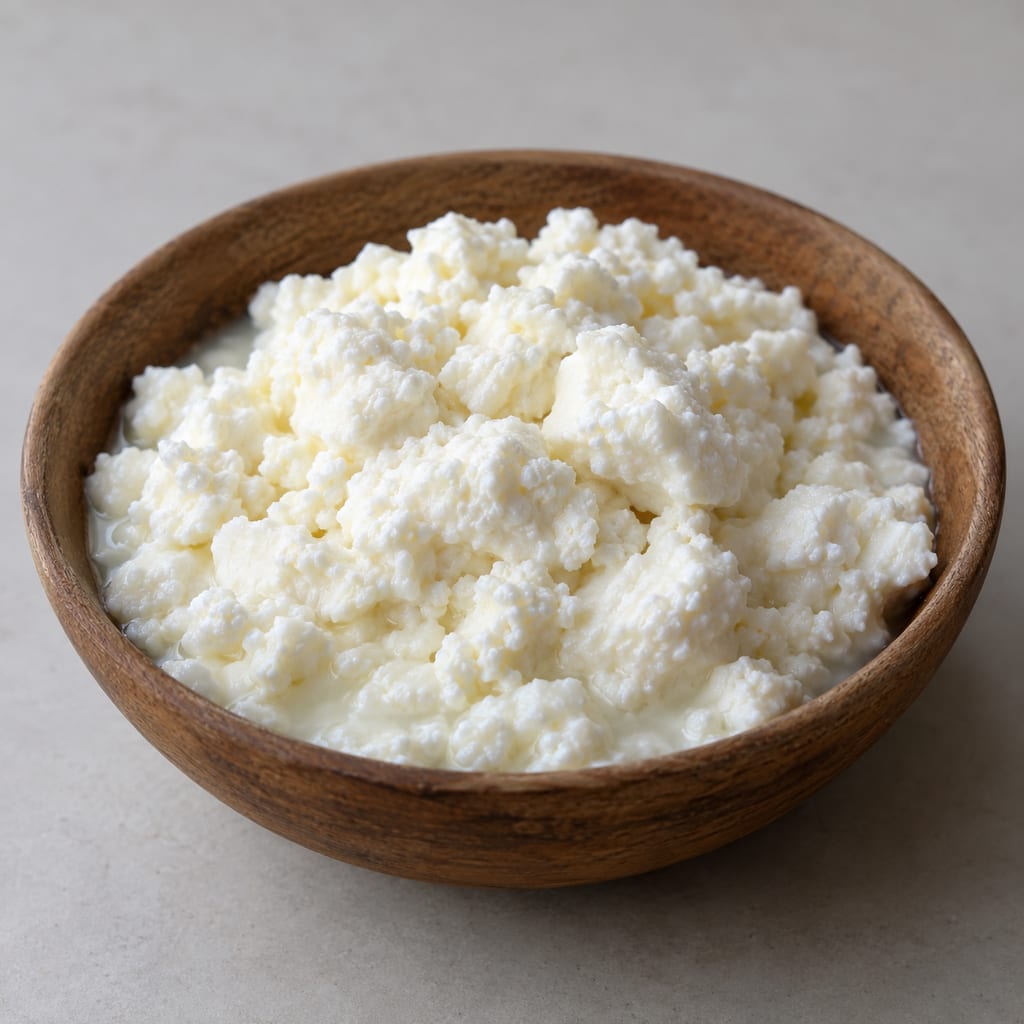
Aarts (Mongolian fermented-milk curds)
Aarts is a soft Mongolian curd made by draining boiled fermented yogurt; it remains wet, unlike aaruul, which is dried.

Airag
Airag is Mongolia’s fermented mare’s-milk drink, traditionally churned with saved starter in a reusable cowhide khokhuur.

Ayran
Ayran is Turkey’s cold, savoury yogurt drink: plain yogurt is loosened with water and lightly salted, then whisked smooth or aerated into a soft cap of foam.
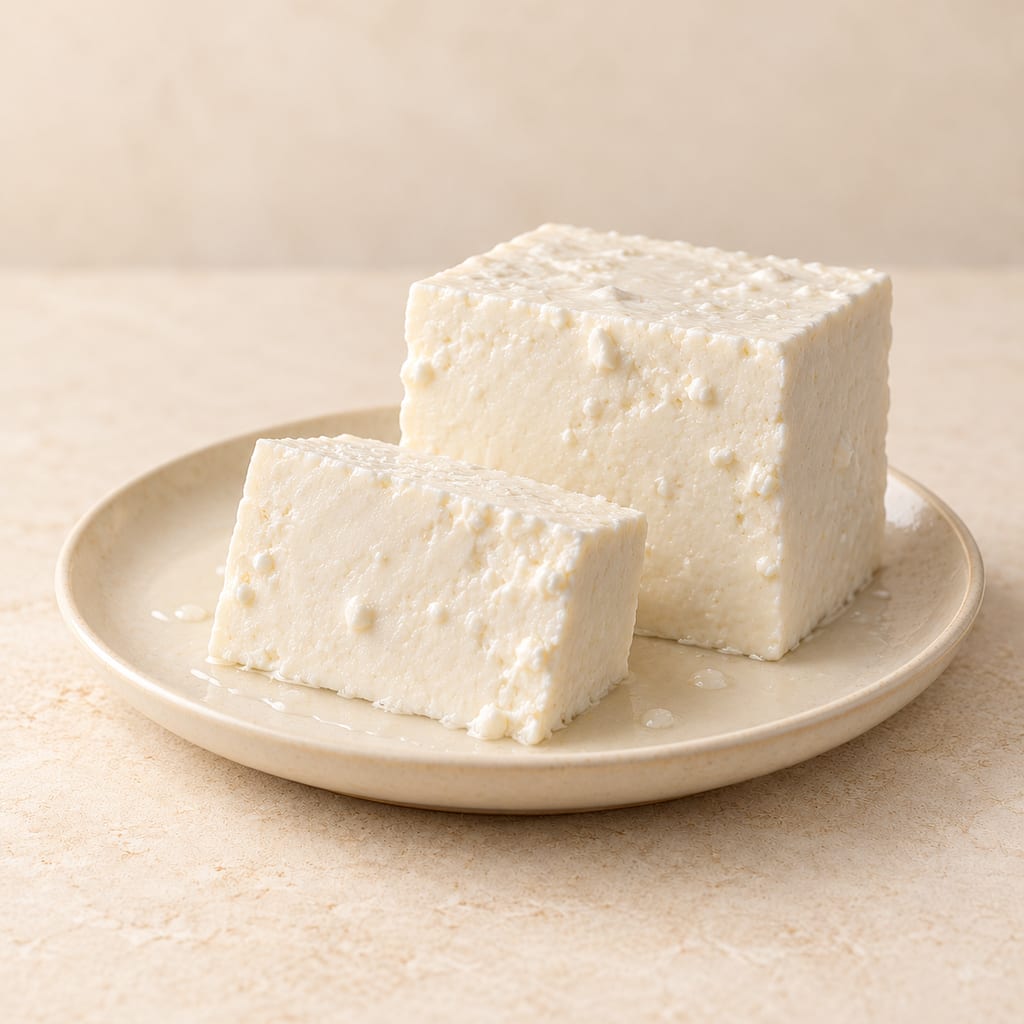
Beyaz peynir
Beyaz peynir is a Turkish white cheese matured in brine. Sheep milk, alone or mixed with other milks, gives a close-textured cheese cut into blocks and packed in cans.
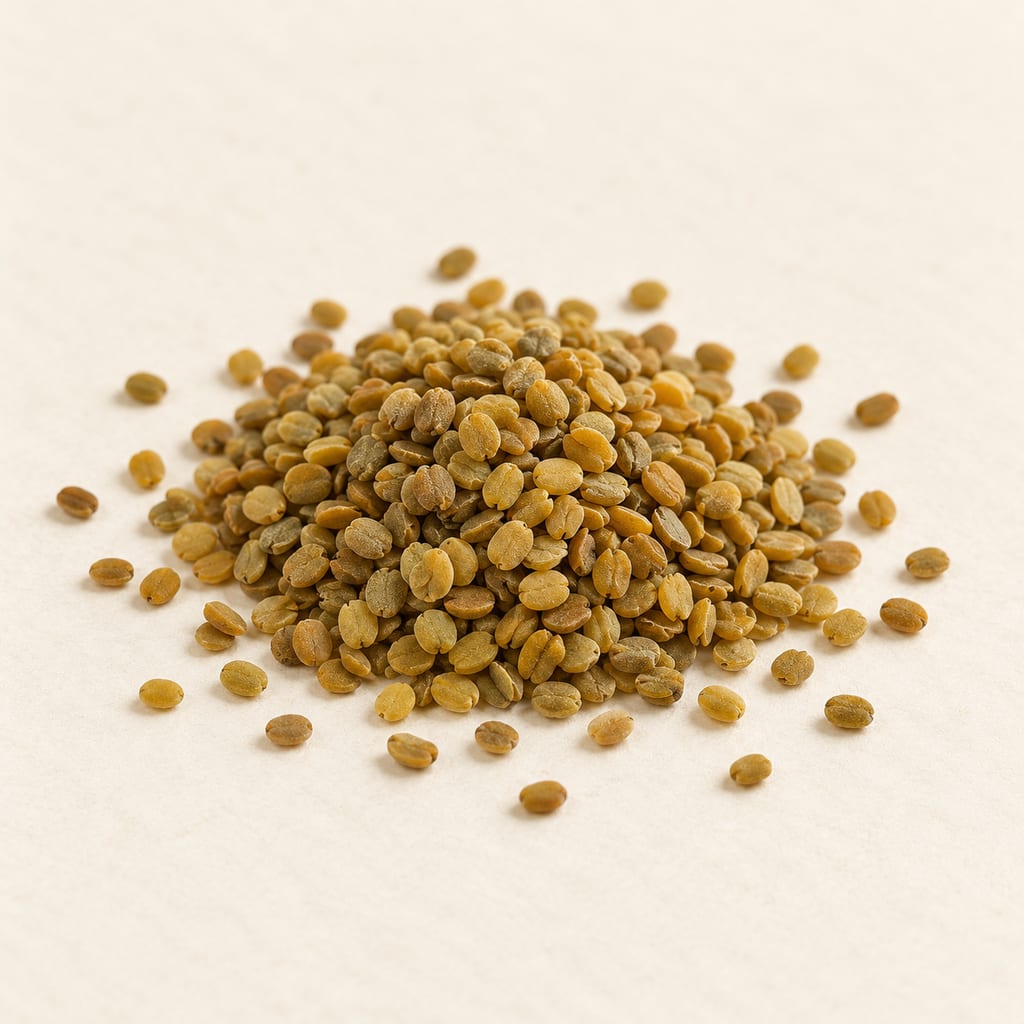
Blue fenugreek
Blue fenugreek (Trigonella caerulea) is an aromatic annual used as an herb in Alpine cheese and bread and as a seed spice in Georgian cooking; its identity differs from common fenugreek.
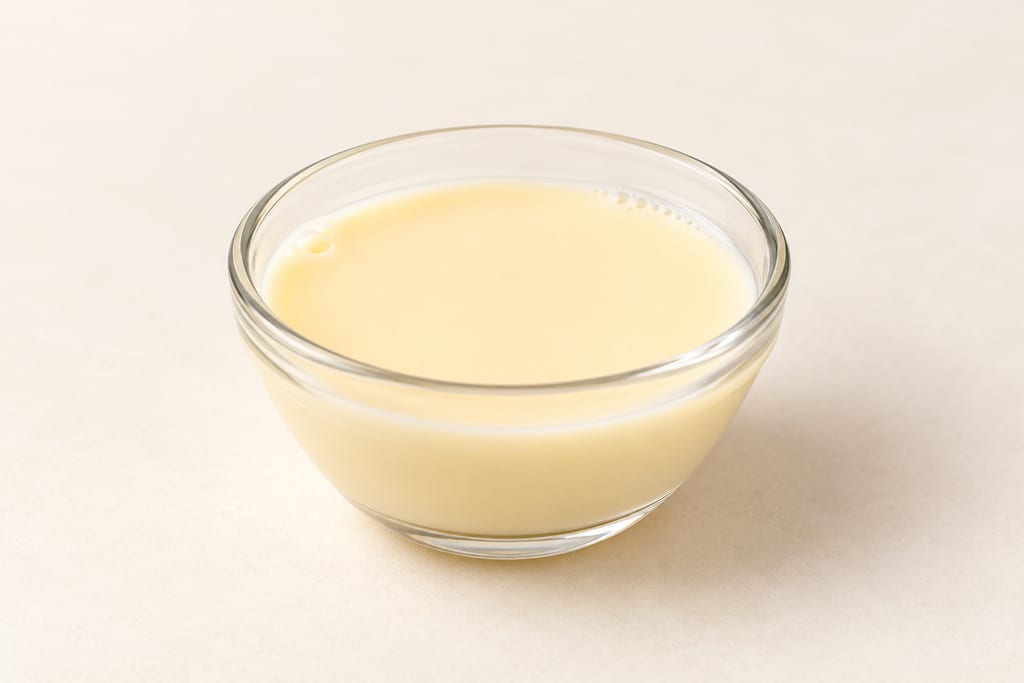
Bovine colostrum
Bovine colostrum is the changing first secretion around calving, concentrated in proteins and maternal immune components; it feeds newborn calves and appears in seasonal foods and processed products.
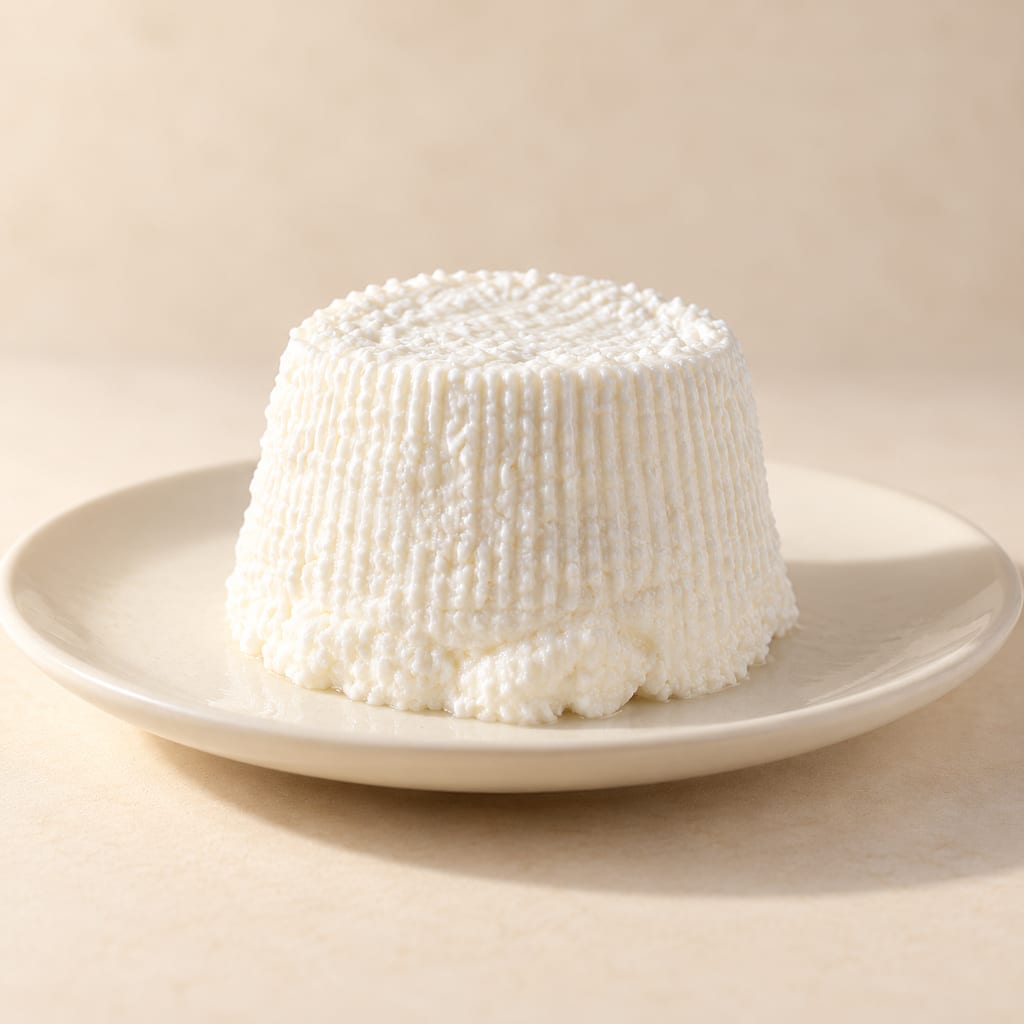
Brocciu
Corsican Brocciu is a whey cheese made by heating sheep's or goat's whey with whole milk and salt, then gently draining the flocculated curds. It is eaten fresh or salted and ripened as Brocciu passu.
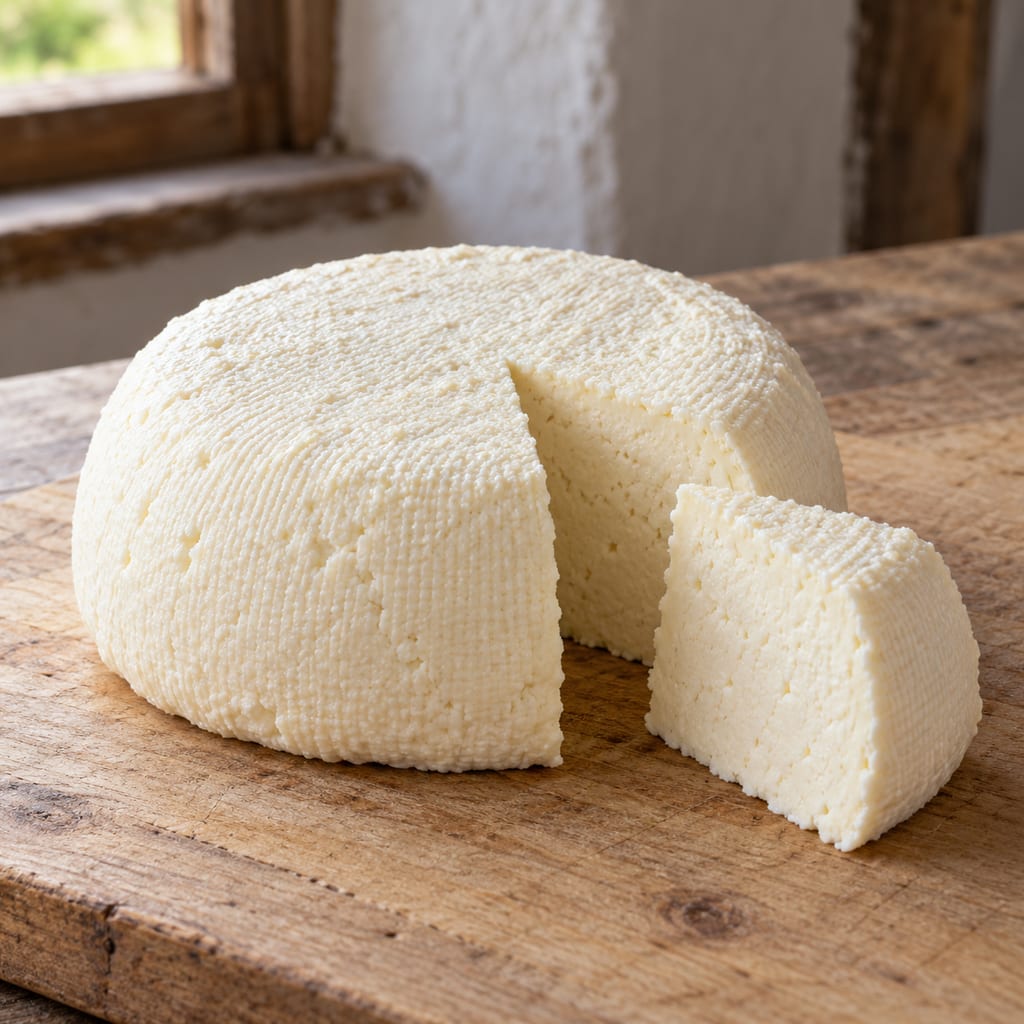
Budz (Hutsul rennet cheese)
Budz is a traditional Hutsul rennet-set cheese made from sheep, cow or goat milk in the Ukrainian Carpathians, forming a fresh curd that can be eaten, smoked or processed into salted bryndza.
Community
No community contributions have been published for this entry yet.
Share what you made
Sign in to contribute. Published comments and photos are free to read.
Sources
Arthur Hill and Mary Ann Ferrer, University of Guelph
Cheese Making Technology e-Book: The Basic ProcessCited in: One milking, many foods; How milk becomes curd; West Asia and the Caucasus: stores with local names; Reading a dairy food in your own kitchen
University of Guelph
Cheese FamiliesCited in: How milk becomes curd; Europe: wheels, winter milk and a cave; Reading a dairy food in your own kitchen
University of Guelph
Cultured Dairy Products and CheeseCited in: How milk becomes curd; Reading a dairy food in your own kitchen
University of Guelph
Whey ProcessingCited in: One milking, many foods; Whey, cream and the sweet branch
FAO
Types and characteristicsCited in: Oceania and the Pacific: local manufacture has a history; Whey, cream and the sweet branch
University of Bristol
Earliest evidence for cheese making in the sixth millennium BCCited in: What the pots remember
Chakraborty and colleagues, Scientific Reports
Compound specific isotope analysis of lipid residues provides the earliest direct evidence of dairy product processing in South AsiaCited in: What the pots remember
Liu and colleagues, Cell
Bronze Age cheese reveals human–Lactobacillus interactions over evolutionary historyCited in: What the pots remember
Columella, Latin transcription
De re rustica VII.8: De caseo faciendoCited in: What the pots remember
Casanova and colleagues, Nature Human Behaviour
Caprine dairy exploitation on the Iranian Plateau from the seventh millennium BCCited in: What the pots remember
French Ministry of Agriculture
Le Roquefort AOP, le fromage emblématique de l’AveyronCited in: Europe: wheels, winter milk and a cave
French Ministry of Agriculture
Le Mont d’Or AOP, Vacherin du Haut-DoubsCited in: Europe: wheels, winter milk and a cave; Four clocks govern the dairy year
Consejo Regulador Torta del Casar
ElaboraciónCited in: How milk becomes curd; Europe: wheels, winter milk and a cave
Abed Hamama, National Research Council
Moroccan Traditional Fermented Dairy ProductsCited in: One milking, many foods
Dossou and colleagues
Processing and preservation methods of Wagashi Gassirè, a traditional cheese produced in BeninCited in: Africa: the rains, the churn and the long dry store
J.-C. Lambert and A. Soukehal, FAO
Amélioration de la technologie du fromage tchoukou au NigerCited in: Africa: the rains, the churn and the long dry store; Four clocks govern the dairy year
FAO
Traditional dairy-product technologyCited in: One milking, many foods; Africa: the rains, the churn and the long dry store
FAO
Regional cheese technologyCited in: One milking, many foods; Africa: the rains, the churn and the long dry store
Moonga and colleagues, PLOS ONE
The art of mabisi production: A traditional fermented milkCited in: Africa: the rains, the churn and the long dry store
Sakpatenti
Tushetian Guda specificationCited in: West Asia and the Caucasus: stores with local names; Four clocks govern the dairy year
Chedid and colleagues
The Lebanese Kishk: A Traditional Dairy Product in a Changing Local Food SystemCited in: West Asia and the Caucasus: stores with local names
Zhyldyz Kazieva, ICH Courier / UNESCO ICHCAP
Traditional Dairy Products: KurutCited in: West Asia and the Caucasus: stores with local names; Steppe and highland: foods that resist translation
Oki and colleagues
Pyrosequencing Analysis of Microbial Diversity of Airag, Khoormog and TaragCited in: The animal sets the terms; Steppe and highland: foods that resist translation
FAO
The Yak: Products from yak and their utilizationCited in: The animal sets the terms; Steppe and highland: foods that resist translation
Campbell and Sallis, Interface Focus
Low-carbon yak cheese: transition to biogas in a Himalayan socio-technical nicheCited in: The animal sets the terms; Steppe and highland: foods that resist translation
Sun and colleagues
Identification and characterization of the dominant lactic acid bacteria from kurut: the naturally fermented yak milk in Qinghai, ChinaCited in: Steppe and highland: foods that resist translation
Huang and colleagues, Journal of Dairy Science
Purification, characterization, and milk coagulating properties of ginger proteasesCited in: How milk becomes curd; South and East Asia: curds, skins and concentrated milk
National Dairy Development Board
Fermented Dairy ProductsCited in: South and East Asia: curds, skins and concentrated milk
National Dairy Development Board
Khoa and Khoa-based ProductsCited in: South and East Asia: curds, skins and concentrated milk; Whey, cream and the sweet branch
Japan Ministry of Agriculture, Forestry and Fisheries
蘇(そ)Cited in: South and East Asia: curds, skins and concentrated milk
National Dairy Development Board
Paneer, Cheese, Spreads and PickleCited in: How milk becomes curd; South and East Asia: curds, skins and concentrated milk
Secretaría de Agricultura, Mexico
Quesos mexicanos genuinos, delicias que nos distinguenCited in: The Americas: introduced dairying, local invention
Secretaría de Agricultura, Mexico
10 quesos que no puedes dejar de probarCited in: The Americas: introduced dairying, local invention
Tastee Cheese
Canned Cheese HistoryCited in: The Americas: introduced dairying, local invention; Four clocks govern the dairy year
UNESCO
Traditional ways of making artisan Minas cheese in Minas GeraisCited in: The Americas: introduced dairying, local invention
Paulette Aguilera Salazar, RIVAR
El queso de Chanco: un producto típico de la industria popular de Chile (siglos XVIII y XIX)Cited in: The Americas: introduced dairying, local invention
Brazil, Portaria MA 359/1997
Regulamento técnico para fixação de identidade e qualidade do requeijão ou requesónCited in: The Americas: introduced dairying, local invention
Te Ara — The Encyclopedia of New Zealand
Dairying and dairy productsCited in: Oceania and the Pacific: local manufacture has a history; Four clocks govern the dairy year
Codex Alimentarius
Standard for Fermented Milks, CXS 243-2003Cited in: Steppe and highland: foods that resist translation; Reading a dairy food in your own kitchen
Solanki, Rani and Gaur, Indian Journal of Dairy Science
Development and characterization of herbal Kulfi (Ice Cream) using Tulsi, Ginger, and CloveCited in: Whey, cream and the sweet branch
Carpigiani Gelato University
Ricettario—Corso Base, 2025–26Cited in: Whey, cream and the sweet branch
R. Sunarlim, Indonesian Ministry of Agriculture repository
Potensi Lactobacillus Sp. Asal dari Dadih sebagai Starter pada Pembuatan Susu Fermentasi Khas IndonesiaCited in: Southeast Asia's buffalo dairies
Indonesian higher-education ministry
Begini Hikmah Bakteri Baik pada Produk PeternakanCited in: Southeast Asia's buffalo dairies
T. Tsuji, Southeastern Philippines Journal of Research and Development
The Conventional and Modern Uses of Water Buffalo Milk in the PhilippinesCited in: Southeast Asia's buffalo dairies
Washington State University Creamery
HistoryCited in: The Americas: introduced dairying, local invention
Câmara Municipal de Oliveira do Hospital
Roteiro Queijo Serra da EstrelaCited in: How milk becomes curd
Pengjiang District culture bureau, Jiangmen
手冲姜撞奶制作技艺Cited in: How milk becomes curd; South and East Asia: curds, skins and concentrated milk
Hariyani and colleagues, Indian Journal of Dairy Science
Comparative appraisal of antioxidant profile & shelf life of ghee obtained from cow, goat & buffalo milkCited in: South and East Asia: curds, skins and concentrated milk
INIA Chile
Dairy-processing technical material: modern ChancoCited in: The Americas: introduced dairying, local invention
Australian Academy of Technological Sciences and Engineering
Technology in Australia 1788–1988: cheese and dairy technologyCited in: Oceania and the Pacific: local manufacture has a history
Gaps
- Coverage is representative rather than a census. Several parts of equatorial Africa, Central Asia, the Caribbean and the Pacific need more direct local records.
- Product names can describe several formulations. The descriptions here do not supply transferable manufacturing controls, storage lives or a universal home recipe.
Updated 2026-10-29