
Yeast intake
Yeast and the world's fermented drinks
People kept, traded and steered living ferments for thousands of years before anyone saw a yeast cell. This is that history, region by region, and a guide to what a yeast strain is today.
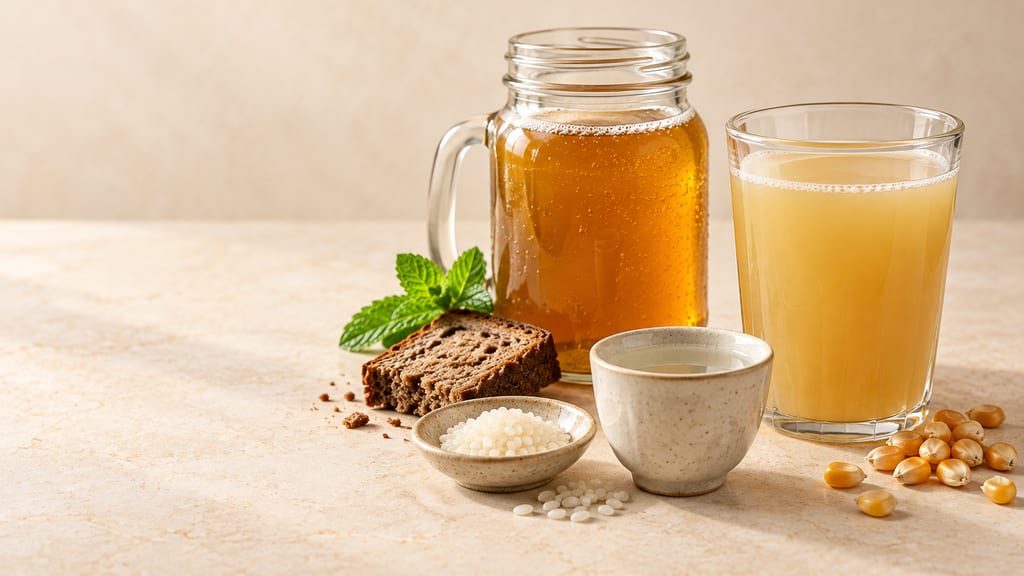
Kvass, chicha de jora and sake: drinks from bread, maize and rice, all raised by yeast.
A craft before a science
Long before microscopes, brewers knew things about their ferments that science would take centuries to explain. A brewer could know that last week's froth would start this week's beer, that a certain jar made better wine, or that summer brews behaved differently from winter ones, without any idea that a microorganism was doing the work. The history of yeast is therefore not one discovery. It is a run of separate achievements, reached in different places and in different orders: noticing a useful change, keeping the material that caused it, supplying sugar, controlling warmth and air, seeing cells, proving what they do, separating one lineage from a crowd, explaining the chemistry, and finally reading and rewriting genes.
The forms in which people kept a ferment show how much skill went into the first steps. A Roman writer saw the foam of a grain drink used as leaven for bread. Medieval brewers sold the yeast of their finished beer to bakers. Sorghum-beer brewers in Ghana and Côte d'Ivoire keep dried yeast to start new wort. Chinese qu, Korean nuruk and the starter cakes of Southeast Asia are grain cakes colonised by moulds, yeasts and bacteria, dried so they keep and travel. Finnish sahti brewers once skimmed the foam from a brew, dried it, wrapped it in cloth and added it to the next. Milk kefir lives in rubbery grains that are lifted out of one batch and dropped into the next. Calling all of this "wild yeast" hides the knowledge involved.
There are also several routes to the sugar that yeast needs. Fruit juice, honey diluted with water and palm sap already contain fermentable sugar. Grain and cassava hold their energy as starch, which has to be broken down first. Brewers found at least four ways to do that: sprouting the grain so its own enzymes work (malting), growing a mould on it whose enzymes release sugar (koji, qu, and the Rhizopus stage of Guyanese parakari), relying on yeasts that themselves break down starch (Saccharomycopsis fibuligera in Philippine starters), and chewing, so that enzymes in saliva start the conversion, as women do with boiled cassava for Amazonian masato. Each route produced a different family of drinks and a different microbial ecology.
None of this needed a theory of microbes. What it needed was repetition, memory and control: keeping the successful material, recognising failure, cleaning vessels, choosing ingredients, timing each step. The rest of this account follows that practical knowledge region by region, then follows the scientists who explained it, and ends with a guide to what a "yeast strain" means today.
What each kind of evidence can show
The record of early fermentation is made of very different kinds of evidence, and each answers a different question. A chemical residue in a pot can show compounds consistent with grapes, honey, rice or barley, and sometimes the marker of a fermented product, but not the strength of the drink, its recipe or the identity of the yeast. Starch grains damaged in particular ways, plant silica bodies (phytoliths) and fungal remains can suggest malting, cooking and the presence of moulds or yeast-like cells, but not a species or a strain. Ancient DNA and proteins come closer to the organism itself, yet finding a microbe's DNA does not prove it was alive, abundant or responsible for the drink. Calcium oxalate, the scale brewers call beerstone, can trap proteins from both barley and brewer's yeast; a 2024 study of modern beerstone showed what such a residue might preserve, as a guide for future archaeological work.
Texts are a different kind of evidence. Recipes, accounts, laws and travellers' reports name practices, materials, trades and drinks at a known time. They rarely tell us which organisms were present, and they never date an invention: a traveller who describes a drink shows that it existed when he saw it. Modern sampling of a traditional drink shows which organisms are in that drink now. It cannot prove that the same community fermented the drink a thousand years ago. Genomes show relatedness, hybrid ancestry and candidate mechanisms, but rarely give a firm date for a migration or a reliable prediction of flavour.
Two dating rules run through everything that follows. First, "the earliest evidence found so far" is a statement about what has survived and been analysed; it does not mean nobody fermented anything earlier. Second, radiocarbon dates expressed as calibrated years before present (cal BP) count back from 1950, not from today. A date of 10,000 cal BP is roughly 8050 BCE, not 10,000 BCE.
The oldest traces in the Near East and China
The oldest claimed evidence for brewing comes from Raqefet Cave in present-day Israel, a burial site of the Natufians, people who foraged and lived partly settled lives between about 13,700 and 11,700 cal BP. In 2018 Li Liu and colleagues combined experiments with use-wear and residue analysis of three stone mortars. They concluded that the Natufians stored plant foods, including malted wheat or barley, in fibre containers set in boulder mortars, and used bedrock mortars to pound and cook plant foods, including a wheat- or barley-based beer likely served at ritual feasts around 13,000 years ago, several thousand years before domesticated cereals appear in the region. The archaeologist David Eitam answered that the evidence showed cereal food, not beer: in his reading, the narrow conical mortars were made for husking and milling barley into flour for bread. The authors replied in turn, defending their reading of the fermentation, the mortars and the link between beer and the move to farming. Raqefet is an important, early and disputed case, not a sealed bottle or proof of the first beer ever made.
The same region complicates any simple "beer before bread" story. At Shubayqa 1 in northeastern Jordan, a Natufian site dated to 14.6 to 11.6 thousand years ago, charred food remains show that people made flat, bread-like foods from wild cereals and club-rush tubers at least 4,000 years before farming. Bread and beer could both grow out of a wider skill with wild plant foods; one site's oldest residue cannot settle which came first anywhere else.
East Asia has changed the older timelines most. At Shangshan in the Lower Yangzi valley of China, pottery from the site's earliest phase, about 10,000 to 9,000 cal BP, carried rice starch, phytoliths and fungal remains. The fungal particles were dominated by the fruiting bodies of the mould Monascus, alongside yeast cells. The 2024 study read this as rice beer made with a qu starter of Monascus mould and yeast, with Job's tears, other cereals, acorns and lily added, and called it the earliest known alcoholic fermentation technique in East Asia. The identification rests on the shapes of microscopic remains compared with modern references; it is not a genome.
At Jiahu in Henan province, a 2004 chemical study of residues in early Neolithic jars found a mixed fermented drink of rice, honey and fruit (hawthorn and/or grape) dating back to the seventh millennium BCE. The drink does not fit modern categories: it was beer, mead and fruit wine at once. In calendar terms it dates to about 7000 to 6600 BCE. In 2026 a new team examined microfossils in residues from 16 Jiahu sherds and found rice and other cereal starches, Monascus remains and yeast cells, with starch damage from enzyme action, mashing and cooking. They concluded that Jiahu brewing relied mainly on a qu-type starter, with some malting, while honey and fruit may have added sugar. The two studies are not a contradiction so much as two methods looking at the same jars. The newer assemblage is dated about 9000 to 7500 cal BP. Neither publication supplies a complete recoverable recipe or a genetically identified prehistoric yeast, and how the older chemistry and the newer microfossil reading fit together is still an open research question.
At Qiaotou in Zhejiang, dated to 9,000 to 8,700 cal BP, painted pots from a platform mound with human burials held residues of beer made from rice, Job's tears and starchy roots and tubers, with evidence for a mould-based saccharification and fermentation starter. The authors suggest the beer was served in rituals for the dead. The find matters both technologically and socially: mould starters and yeast may have made starch fermentation possible, while the unusual pottery and the burial setting point to ceremonial drinking. The study gives no alcohol content, no yeast species and no reason to think everyone in the region drank the same thing every day.
Grapes, jars and a cave winery
Grape wine has its own trail of evidence, and it is easy to confuse three different kinds of find: a chemical trace of grapes in a jar, a jar shaped for fermenting and storing, and a built installation for making wine.
At Gadachrili Gora and Shulaveris Gora in Georgia, chemical analysis of compounds absorbed into pottery, supported by grape pollen, starch and plant tissue and by climate reconstruction, pointed to grape wine at about 6000 to 5800 BCE. The very large jars, among the earliest pottery made in the Near East, probably served for fermenting, ageing and serving. The 2017 announcement placed the Georgian evidence 600 to 1,000 years earlier than evidence previously found in Iran. The best-known Iranian find, jars from Hajji Firuz Tepe dated about 5400 to 5000 BCE, had been published in 1996 as Neolithic resinated wine. Resin could have served several purposes, among them treating the vessel and flavouring or preserving the drink, so that reading rests on the whole assemblage rather than on one compound; resin alone does not prove wine. None of these finds names a yeast; none gives a modern country a monopoly on the invention of wine.
At Areni-1, a cave complex in southern Armenia, excavators finished uncovering a large clay vat beside a shallow clay basin in 2010. The arrangement suggests grapes trodden in the basin, with juice running into the vat to ferment, and jars for storage. Sherds from the site were radiocarbon dated to between 4100 and 4000 BCE, and tests found malvidin, the pigment that colours red wine. About twenty burials lay around the pressing area, with drinking cups in and around the graves. An installation like this is a different class of discovery from a residue: it shows an organised process in a place. Its chemistry still needs care: tartaric acid, resins and syringic acid also occur in other plant products, and residues can migrate, so tartaric acid needs contextual support before it can establish alcoholic wine.
Beer as organised work in Mesopotamia and Egypt
At Godin Tepe in the Zagros mountains of Iran, a site excavated by the Royal Ontario Museum, a Late Uruk jar of the late fourth millennium BCE, commonly dated about 3500 to 3100 BCE, had criss-cross grooves cut into its inner wall. In 1992 Michel, McGovern and Badler reported that a pale yellowish residue in the grooves tested positive for oxalate, the main component of beerstone, and argued that the jar was a beer container; the early Sumerian sign for beer shows a jar with similar markings. Carbonised six-row barley was common at the site. It became an influential early chemical identification of beer, but beerstone is not unique to beer, and modern studies look for converging evidence. Because yeast is widespread outside brewing, finding Saccharomyces proteins alone is not an exclusive marker of beer either.
For southern Mesopotamia the richest evidence is not residue but writing. Hundreds of administrative tablets record the production, distribution and consumption of beer. They were written for people who already knew how beer was made, so their technical terms are often obscure. They show beer as part of organised labour and provisioning, not a brewing manual. One of them, a clay tablet of about 3100 to 3000 BCE in the British Museum, records beer allocations. Such ledgers explain why brewing belongs in histories of labour, taxation, provisioning and institutions as well as of ritual and pleasure, but one ration list does not establish a universal daily allowance.
The Hymn to Ninkasi, the goddess of beer, survives in three Old Babylonian copies of about 1800 BCE. In the Oxford translation the goddess mixes beerbread with sweet aromatics, waters the malt, soaks it in a jar, spreads the cooked mash on large reed mats, holds the great sweetwort "brewing it with honey and wine", sets the fermenting vat on a collector vat and pours out the filtered beer. It has often been read as a recipe. Its form is itself evidence: it presents brewing through a goddess and a song-like structure, so religious and technical understanding sat together. Peter Damerow cautioned against that reading: the meaning of key terms such as bappir, usually translated "beer bread", is debatable; the strophes do not clearly follow the brewing stages in order; reconstructions lean on modern brewing chemistry; and a modern brewing experiment shows only that one interpretation can work. Given how little is known of the process, he wrote, we cannot even be sure that Sumerian beer contained alcohol.
Egypt preserves an unusual mix of equipment, depictions and remains. At Abydos, excavators working at a brewery dated to around the reign of King Narmer, about 3000 BCE, found structures more than 35 metres long holding over 80 emplacements for the ceramic vats used to cook the mash. Of eight structures first noted early in the twentieth century, seven have been relocated since 2018. If all eight were of similar size, the team estimated in 2022, capacity would approach 50,000 litres per batch. That figure is larger than the one given when the mission of Matthew Adams of New York University and Deborah Vischak of Princeton announced the find with Egypt's Supreme Council of Antiquities in February 2021: then, eight units about 20 metres long and 2.5 metres wide, each with about 40 basins in two rows, and press reports of about 22,400 litres at a time. The estimate grew with the excavated area. The team is testing the idea that the beer was made for royal ritual. The change Abydos records is one of scale and organisation, not Egypt's first fermentation or a single Egyptian method.
A painted wooden model from the tomb of Meketre, about 1981 to 1975 BCE, shows a bakery and brewery as two rooms of small working figures. Men and women both appear in the workflow, which is strong evidence for specialised, organised labour; the suggestion that one basin held yeast is an interpretation, and the model gives no molecular identification of what it represents. Old Kingdom figures in painted limestone show women bent over large jars, working the contents by hand. Pictures like these shaped the usual account of Egyptian brewing, which Delwen Samuel tested in 1996 by examining desiccated bread and beer residues under light and scanning electron microscopes. Her results called for that account to be revised: bread made sometimes with malt and with yeast, and beer brewed by blending cooked and uncooked malt with water, straining the mixture free of husk and then inoculating it with yeast. Not all ancient beer was a thick mass of husks: practice differed between sites and over time.
Can yeast from these breweries still be alive? In 2019 Tzemach Aouizerat and colleagues isolated living yeasts from the pores of ancient vessels, including Egyptian-style beer basins from En Besor in the Negev (late fourth millennium BCE) and Tel Aviv, and Philistine vessels from Tell es-Safi/Gath, but not from control samples of stone and sediment. Genetically the isolates resembled yeasts from traditional African drinks, and most made drinkable beer. The authors argue that the cells descend from the original fermenting yeast, surviving as microcolonies in the ceramic for millennia. They name the central difficulty themselves: whether these yeasts really descend from the ancient brew. The age of a pot does not date the living cells in it, and a pleasant beer is, in their words, only "some support" for authenticity.
Northern Europe and the Roman world
Residues from three sites in Denmark and one on the Swedish island of Gotland, spanning about 1500 BCE to the first century CE, point to a mixed drink in which honey, local fruits such as bog cranberry and lingonberry, and wheat, rye or barley were fermented together, flavoured with bog myrtle, yarrow, juniper and birch resin, and sometimes mixed with grape wine imported from the south from about 1100 BCE. The researchers call it "Nordic grog". It breaks the tidy pattern of wine in the south, beer in the north and mead for the Vikings.
At Hallstatt in Austria, the salt mines preserved human faeces from the Bronze Age to the eighteenth century. In one Iron Age sample, about 2,700 years old, the fungi Penicillium roqueforti and Saccharomyces cerevisiae made up an exceptionally large share of the DNA and proteins. Genome-wide analysis indicated that both were fermenting food, which the authors read as the first molecular evidence of blue cheese and beer in Iron Age Europe. This is about as close to an ancient brewing yeast as archaeology gets, and still it does not give a recipe, a strength or a style.
Roman writers described northern drinks from the outside. Tacitus, writing about the Germanic peoples near the end of the first century CE, said their drink was a liquor made from barley or wheat, "brought by fermentation to a certain resemblance of wine", and that those near the Rhine also bought wine. It is an outsider's description, carrying his own judgements, not a neutral recipe for everyone north of Rome. Pliny the Elder recorded a direct reuse of fermenting material: in Gaul and Spain, where people made a drink by steeping grain, they used the foam that thickened on its surface as leaven, and their bread was lighter for it. Here, centuries before brewer's and baker's yeast were sold as separate products, the same living froth served both crafts. The passage does not identify a strain or show that every ancient brewer kept the practice.
Roman winemaking was not passive either. Cato's farming manual of the second century BCE tells the farmer to add must boiled down from untrodden grapes, or salt, to new wine, to make "Greek wine" with old sea water, and to brew a winter drink for the workers from must, sharp vinegar, boiled must and fresh water. Boiling down must concentrated sugar and flavour; it was not pasteurisation, but it shows how much producers intervened. In Roman practice sugar concentration, flavour, storage and preservation were intertwined.
Monks, brewsters and the medieval yeast trade
The Plan of Saint Gall, drawn at Reichenau in about 819 or 827 to 830 for the abbey of St Gall, is the oldest surviving architectural drawing in the Western world: an ideal monastery of 52 buildings with 333 Latin annotations. It sets out three brewhouses, each sharing space with a bakery: one where "beer is prepared by the brothers" for the community's daily supply, and two for honoured guests and for pilgrims and the poor. It is a plan, not a record of a working brewery, but it shows brewing built into the economy of a great house from the start. It does not show that monks invented beer or alone preserved it. Monastic rules also regulated drink. Chapter 40 of the Rule of Benedict judges that "a hemina of wine a day is enough for each person", while praising those given strength to abstain; how much a hemina held is still debated. Converting it confidently into a modern half-bottle hides that debate; monastic rules show regulation of drinking, not a universal medieval diet.
Monks were not the only brewers, and not the main ones. Judith Bennett's history of English brewing from 1300 to 1600, published in 1996 and built from court records and accounts, shows that women brewed and sold most of the ale drunk in medieval England, and that after 1350 men slowly took over the trade, so that by 1600 most brewers in London were men. The change ran across centuries, varied in timing, and followed shifts in commerce, guilds, regulation, technology and gender hierarchy; it cannot be explained by witch persecution or a sudden abandonment of brewing by women. The household and commercial brewsters of that world kept and selected their ferments long before any scientist named one.
Yeast was a traded material centuries before Pasteur. An account from St Paul's in London recorded income in 1283 from the sale of "dregs", which may or may not mean yeast. The firmer case is Magdeburg: on 24 November 1309, after a revolt against their archbishop, the brewers of the old town won the freedom "to look for yeast where they want". Until then they had been made to buy it from the archbishop's brewery, which means yeast gathered from earlier brews was already being kept and sold. A Dutch beer recipe in a manuscript now in Ghent, probably from the early fifteenth century, tells the brewer to take yeast and add it to the wort himself, and names two kinds, heve and ondergyst. Paris by-laws of 1489 ordered that beer yeast "shall not be hawked about the streets" but sold in the brewhouses to bakers and pastry cooks. In the same year the owner of the Schlenkerla brewery in Bamberg was recorded as a hefner, a yeast specialist; Nuremberg later regulated such craftsmen in a yeast ordinance of its own, and the Gouda brewers' ordinance of 1515 required yeast to be measured only with calibrated cups. People knew yeast as a material and a trade; what they lacked was a microscope.
The Bavarian ordinance of 1516, now called the Reinheitsgebot, is often quoted as proof that brewers did not know about yeast, because it lists only barley, hops and water. It was a Bavarian regional rule, dated 24 April 1516 and printed after debate that July, and it also set the price of beer. Earlier local rules had named the same ingredients (Landshut in 1486, Munich in 1487), and a Bamberg rule of 1489 named malt, hops and water. The brewing historian Marco Daane suggests the omission was a matter of definition: yeast was not counted as an ingredient, because an ingredient stayed in the beer. The word Reinheitsgebot itself was first used in 1909, in a Reichstag petitions committee. The ordinance tells us about grain, prices and regulation, not about ignorance of yeast. Hops, fermentation and yeast ancestry should be kept apart as well: a change in seasoning or keeping quality does not identify a new yeast, and not every medieval mention of "cold beer" is the modern S. pastorianus.
Medieval ale did not replace water everywhere. In Ælfric's Colloquy, written around the year 1000, a pupil says he drinks ale when he has it and water when he does not. That does not prove every water supply was clean or that ale was unimportant; availability, class, local water, taste, food energy, hospitality and work varied by region, and medieval ale was not a universally sterile substitute for water.
Recipes, barm and farmhouse yeasts
Early modern household manuals make the inoculation explicit. A brewing passage in Gervase Markham's edition of Richard Surflet's translation of the French Maison Rustique, quoted in The English Housewife (1615), tells the maker to let the wort run "into the dish with the barm" standing in the vat, to fill hogsheads "clean washed and scalded", and to keep a vent hole open for a day or two before closing the cask. Markham also describes three grades of beer: March beer for guests, household beer for the family, and small beer for ploughmen and servants. The grades reflect social order as much as technique, and they cannot be reduced to one early modern strength.
Kenelm Digby's recipes, printed in 1669 as The Closet of Sir Kenelm Digby Knight Opened, show the same material crossing from beer to mead. His meads and metheglins are strengthened with honey until "an Egge may swim in it", boiled, cooled to blood warmth or until cold, then started with "some Ale-barm, to make it work". There was no separate mead yeast; the ferment came from the brewhouse. Digby's makers also watched the rise and fall of the fermenting head, reproducing results through observation and household measures.
Producers also managed second fermentations. Christopher Merrett presented a paper on 10 December 1662, read on 17 December, to the newly formed Royal Society on the ordering of wines, noting that wine-coopers used "vast quantities of Sugar and Melosses" to make wines "drink brisk and sparkling". He was describing an existing trade practice; crediting him alone with Champagne would be as simplistic as the familiar story about Dom Pérignon. The Society's records also show the craft of cider. John Evelyn's Sylva of 1664 included Pomona, an appendix on cider with John Beale's advice on apples and routines, and a paper sent by a Cornish clergyman in January 1744 recommended "several rackings" to stop the cider over-working and a cellar kept "as cleanly ... as a maid in her dairy". Cider and perry had their own orchard economies, and their management of selection, racking and clean vessels linked craft to organised inquiry.
In the Nordic countries, farmhouse brewing kept older ways of preserving yeast into living memory. Farmhouse brewing declined from the nineteenth century as transport improved and commercial yeast arrived, and many house yeasts disappeared. In western Norway some farm brewers still keep their own cultures, called kveik, passed down for generations and reportedly in some families for hundreds of years, and traditionally pitch them into warm wort. Objects survive too: the Nordic Museum in Stockholm holds a yeast ring, a jästkrans, from 1877 or earlier. Living traditions like these show how culture-keeping could work in the past, but they do not date a particular strain to the Viking Age; a culture's microbes can change while the family and the name stay the same. The same holds for Lithuanian, Latvian and Russian house cultures.
Finnish sahti shows how such traditions change. Sahti brewers once kept their own house yeasts, harvesting the surface foam, drying it in a cloth or keeping it as a slurry; those yeasts died out in the twentieth century, and sahti is now fermented with commercial baker's yeast, which became available in the late nineteenth century. The brewer and writer Mika Laitinen separates what is documented (the harvesting and storing methods) from his own inferences, such as why brewers switched. Modern work has shown that traditional farmhouse cultures are usually mixtures of strains, so a single modern isolate, or a substituted Norwegian kveik, recreates only part of what a farm once kept.
East Asia: qu, koji and nuruk
China's starter cakes are the oldest starter technology with a long written record. The agricultural treatise Qimin yaoshu, compiled by Jia Sixie in the sixth century CE, documents the methods behind Shaoxing rice wine. Its seventh volume describes different preparations of wheat, shaped starter cakes, drying and cleaning, careful handling and successive additions of cooked grain, with practical prescriptions beside ritual language: systematic process knowledge long before microscopy, and the archaeology of Shangshan, Jiahu and Qiaotou suggests that mould-and-yeast starters are thousands of years older still. A qu is not a yeast. It is a community of moulds, yeasts and bacteria grown on grain, in which the moulds supply enzymes that turn starch into sugar while the yeasts make alcohol. Qu is a starter system, a yeast isolate is one organism recovered from it, and baijiu is a distilled product whose making includes fermentation.
Modern studies show how a drink can shape its organisms. In 2014 a team sequenced YHJ7, a strain of Saccharomyces cerevisiae from Chinese rice wine (huangjiu), and compared it with a laboratory strain, the Japanese sake strain K7 and an industrial bioethanol strain. YHJ7 differed in its subtelomeric regions and in the expression of genes for sugar transport, changes the authors link to its niche. Their estimate that Japanese sake strains derived from Chinese rice-wine strains at least about 2,300 years ago is a model-based inference, not a dated migration. In the grain fermentation behind xiaoqu baijiu, a distilled spirit, a 2021 study found five core organisms, including S. cerevisiae, the yeast Pichia kudriavzevii, two Rhizopus moulds and a lactic acid bacterium. Counting gene activity rather than cells showed that P. kudriavzevii was more active than S. cerevisiae, and the mechanised process carried a different community from the traditional one.
Japanese sake shows two fungi doing two jobs. Koji is steamed rice grown with a mould, chiefly Aspergillus oryzae, whose enzymes break rice starch into sugar; sake yeast, a selected S. cerevisiae, turns that sugar into alcohol. In the mash both happen at once. Sake's history runs from court production and brewing in temples and shrines in the Heian period (794 to 1185), taxation under the Muromachi shogunate, and large wooden tubs that allowed bulk production. In 1895 Kikuji Yabe isolated sake yeast from a fermenting mash for the first time, and since 1906 the Brewing Society of Japan has distributed selected strains as Kyokai sake yeast. Isolation, naming, distribution and later breeding are separate events. Distributed strains gave brewers reproducible access while koji was still cultivated separately, and later selection brought differences in fragrance, fermentation and foam.
Heat preservation came early too. A heat treatment called hi-ire was developed in the later sixteenth century, and the Tamon'in diary shows hi-ire being carried out by 1568 at the latest. Calling it pasteurisation describes what it does, not what its users knew: the brewers who heated their sake had no microbial theory, three centuries before Pasteur. Heating does several jobs at once, reducing spoilage organisms, restraining renewed fermentation and inactivating enzymes, so not every historical heating step was simply "killing the yeast"; boiling down, sterilisation and pasteurisation are different operations.
Korean nuruk is a starter ecosystem rather than a packet of one yeast. A survey of 42 nuruk samples from several provinces found Pichia jadinii as the main yeast in most of them; the alcohol yeast S. cerevisiae turned up in only 18, and the classic saccharifying mould A. oryzae in only 13, while another mould, Lichtheimia corymbifera, was widespread. Makgeolli, the cloudy rice drink, comes from simultaneous saccharification and fermentation driven by nuruk. In one brewing study Saccharomyces dominated the fungi throughout, while lactic acid bacteria grew and lowered the pH; another found that makgeolli brewed with nuruk carried more lactic bacteria than makgeolli brewed with koji, because each starter supplies its own dominant organisms. Clearer drinks such as cheongju belong to the same tradition, and soju adds distillation; neither experiment defines a universal makgeolli.
Politics changed the drink as well. Household brewing was suppressed during the Japanese occupation and production concentrated. After food shortages that followed the Korean War, a 1965 ban on making liquor from pure grain under the Grain Management Act pushed brewers to replace rice with imported wheat flour, and makgeolli made this way was less sweet and more sour. A drink sold under an old name today may have a different grain, starter and scale from its predecessors. Today's recovery of household traditions is adaptation as well as continuity.
Southeast Asia, South Asia and the Himalayas
Across Southeast Asia, dry starter cakes made fermentation portable. They go by many names (bubod in the Philippines, men in Vietnam, ragi in Indonesia and Malaysia, the starters for Thai sato) and they are related technologies, not one culture. A 1990 study of Philippine bubod and the rice wine tapuy isolated 36 moulds, 62 acid-producing bacteria and 100 yeasts. The yeast Saccharomycopsis fibuligera broke down starch more strongly than the Rhizopus moulds, while S. cerevisiae made the alcohol; the authors concluded that tapuy was made by two yeast genera working in parallel. Not every starch-converter is a mould. A Thai survey published in 2002 found S. fibuligera widely distributed in loog-pang starters and separated strong starch degradation from strong alcohol production: the most abundant organism in a dry cake need not make most of the ethanol. Local makers choose substrates, botanicals, wrappings, drying and earlier starter material, so villages and producers differ. In Indonesia and Malaysia tapai or tape straddles food and drink, rice or cassava eaten as a soft solid with a sweet alcoholic liquid, and tuak can mean a rice drink in parts of Borneo and a palm drink elsewhere, so a name alone identifies neither raw material nor yeast.
In Vietnam's Mekong Delta, home-made and cottage-industry wines of purple glutinous rice depend on starters called men. A study of 29 commercial men selected six for strong liquefaction, high ethanol and good flavour and colour. Their moulds were Amylomyces and Rhizopus species, and the yeasts with excellent fermentation were all S. cerevisiae. In Thailand, researchers who had earlier picked one starter out of 114 samples for sato, a rice drink, rebuilt it as a defined mixture of its own microbes, which fermented much like the original. These studies turn village biodiversity into measured functions without starting from a European brewery strain.
Control of a drink could become a political fight. Basi, the Ilocano sugarcane wine of northern Luzon, came under a Spanish government monopoly in 1786 that regulated drinking and forced makers to sell at a low official price. In 1807 Ilocanos revolted. In 1821 Esteban Villanueva, a painter from Vigan, painted the revolt in fourteen oils now in the National Museum of the Philippines. Basi's making and exchange linked communities beyond the household, and the paintings show that control of a fermented drink could become a struggle over livelihood and authority.
In South Asia, ferment was a named and regulated material in antiquity. Book II, chapter 25 of the Arthashastra appoints a Superintendent of Liquor, who employs people "acquainted with the manufacture of liquor and ferments (kinva)". It lists medaka, prasanna, asava, arishta, maireya and madhu, and gives recipes: medaka from water, rice and kinva; prasanna from flour, kinva, spices and the bark and fruit of a tree. The text's compositional history is complex, so its passages cannot all be assigned to one fourth-century-BCE author, and kinva names a practical ferment, not a pure culture of brewer's yeast.
In the eastern Himalayas, marcha is a dry starter for the sweet-sour drinks called jaanr. Twenty yeast strains isolated from six marcha samples in Sikkim fell into four groups: three produced ethanol, and the fourth, including Saccharomycopsis species, had strong starch-degrading activity. Every sample contained both kinds. DNA sequencing of other regional dry starters has since revealed diversity that culture-based work missed, and older species names may now be synonyms. Kodo ko jaanr is fermented finger millet. In forty samples from Darjeeling and Sikkim, yeasts including S. cerevisiae and Saccharomycopsis fibuligera lived alongside lactic acid bacteria, and the fermented product averaged 4.8 per cent alcohol. The drink is made by pouring warm water over the fermented millet in a tongba vessel and sipping it through a straw, so the grain's alcohol is not the strength of every cup. Bhaati jaanr, from steamed glutinous rice, is eaten as a food-drink; moulds disappeared after the fifth day of fermentation while yeasts multiplied, and Saccharomycopsis fibuligera and Rhizopus led the saccharification. Further south, Santal people in rural West Bengal prepare haria from steamed rice and starter tablets called bakhar, made with ten plant species and one lichen; commercial producers now often leave the plants out. Haria's bacterial community changes during fermentation, and the medicinal uses these studies record are ethnography, not clinical proof.
Steppe milk, Persian wine and Arabic recipes
Alcoholic fermentation does not have to start from fruit or grain. The Franciscan William of Rubruck, who travelled to the Mongol court in 1253 to 1255, described mare's milk churned until it began "to boil up like new wine and to sour or ferment", drunk when "mildly pungent", and a clarified "black cosmos" made for the great lords. His account dates his sighting, not the invention of the drink, and his physiological explanations belong to his own time. Modern koumiss is fermented by a natural mixed starter of lactic acid bacteria and yeasts. In 96 samples from three regions of China, the dominant yeasts were Kluyveromyces marxianus, Kazachstania unispora and S. cerevisiae, out of twelve species found. In Kazakhstan, the same two non-Saccharomyces yeasts dominated both koumiss and shubat, fermented camel's milk; the drinks overlap in their microbes without being the same drink.
Milk kefir keeps its community in a grain, a polysaccharide matrix made by the microbes themselves. A 2021 study found that the grains grow without changing their composition, while the milk is colonised in sequence, early species releasing amino acids and lactate that later species need. Lifting a grain from one batch to the next keeps the whole partnership, which a single isolated yeast cannot. Grains can also pick up new members: kefir grains passaged in unpasteurised milk acquired the yeast K. marxianus from the milk. Water kefir, or tibicos, is a sugar-water system rather than a milk one; a Mexican study of 1981 identified S. cerevisiae and Pichia membranaefaciens in tibicos, evidence about those samples, not about every grain or its origin.
Grape wine belonged to the same world. In his memoirs of the early sixteenth century Babur wrote that "Bukhara wine is the strongest made in Mawara'u'n-nahr; that was what I drank while in Samarkand", a drinker's judgement rather than a measurement. It places grape-wine expertise in the Persianate world from which the Mughal dynasty came, beside the region's milk ferments. In the Islamic world, medieval Arabic cookbooks include recipes for intoxicating drinks (Ibn Sayyār al-Warrāq's tenth-century Baghdadi book lists grape wine, raisin wine, honey wine and shamsī, a wine fermented in the sun) whose names, compositions and methods changed over time, evidence of practical knowledge alongside legal debate about the prohibition. A large Persian jar dated 1282 to 1283 bears verses that end "Drink!", and the Metropolitan Museum suggests it may have held wine or another beverage. In Sufi poetry wine is both the drink and a symbol of divine love, so a verse about wine is not a drinking record. A drink's name cannot always be tied to one recipe or strength, and none of these texts names a yeast.
Africa: dried yeast, palm sap and honey
West African sorghum beers combine several fermentations. In the making of dolo in Burkina Faso and pito in Ghana, lactic acid bacteria are present from the malt through mashing and the acidification of the wort, with Lactobacillus fermentum dominant throughout, before the yeast's alcoholic fermentation begins; this is not a European beer made with another grain. Brewers keep the yeast. A 2005 survey sampled dried yeast from commercial pito producers in eight regions of Ghana: almost all 249 isolates looked like S. cerevisiae, and DNA tests confirmed that representative isolates were S. cerevisiae although many behaved unusually in sugar tests. In Côte d'Ivoire, tchapalo wort inoculated with dry yeast from two regions was fermented mainly by an S. cerevisiae-like yeast, with smaller and different minor species depending on where the yeast came from. Traditional does not mean that every batch starts by accident.
South African umqombothi is made in stages, with a first fermentation, cooking, a second fermentation and sieving; a 2024 study followed the microbes and chemistry through two-stage schedules at different temperatures. Those schedules belong to the study, not to a universal recipe, and a fresh community beer and a packaged industrial one have different aims and keeping behaviour. Palm wines take sugar straight from the tree. Over 25 to 30 days of tapping in Côte d'Ivoire, S. cerevisiae dominated the early stages of oil-palm wine and Hanseniaspora yeasts the later ones, with the pattern reversed for ron palm, and lactic and acetic acid bacteria rising and falling. Twenty-three S. cerevisiae strains from palm wine in eastern Nigeria formed a closely related local group, consistent with local domestication, while some other African strains were close to European bread, beer or wine yeasts or showed mixed ancestry. Local adaptation and migration both matter.
Ethiopian tej is honey wine. Two hundred samples from ten producers showed significant variation within and between production units. A 2022 project selected Saccharomyces and Lactobacillus strains from tej and used them as a mixed starter; the resulting tej matched the traditional control in chemistry, aroma compounds and sensory scores. The aim was to steady a regional drink, not to turn it into grape wine. Ethiopian tella, a grain beer of malt and other cereals flavoured with gesho (Rhamnus prinoides), shows another caution: in household samples from Gondar studied in 2013, yeast isolates contributed far less starch-degrading activity than malt, so an organism able to perform a reaction need not drive it. Older accounts record the same drinks from outside. Jerónimo Lobo, in Samuel Johnson's translation, wrote that "the common drink of the Abyssins is beer and mead". Richard Burton's account of East Africa in 1860 mentions pombe or millet beer, cocoa toddy, plantain wine and palm toddy. In Uganda, tonto is a banana beer whose traditional production and storage were studied in 2000. That study's own low-alcohol product is one formulation, not the strength of all tonto. Visitors' records show that these drinks existed when they were seen; they do not date their beginnings, and they carry the visitors' own prejudices.
The Americas, Australia and the Pacific
In the Wari period, about 600 to 1000 CE, an imperial colony held the mesa of Cerro Baúl in southern Peru for centuries, and its final evacuation was marked by brewing, drinking, feasting, smashing vessels and burning buildings. The brewery's vessels and plant remains show organised production and feasting, and molle, the fruit of Schinus molle, is central to the interpretation, distinguishing it from generic maize chicha; no Wari yeast survives. At Teotihuacan, where pulque from fermented agave sap may have served as a dietary supplement, chemists found bacterial lipid markers in 14 of more than 300 sherds. They came from Zymomonas mobilis, a bacterium that makes ethanol: pulque's alcohol need not come only from yeast. At Puerto Escondido in Honduras, residues show cacao drinks before 1000 BCE; the researchers suggest the earliest were probably made by fermenting the sweet pulp around the seeds, which remains a hypothesis rather than proof of a "chocolate beer". The chemistry could not tell pulp from seed drinks or preserve the alcohol, and later finds have superseded the claim to the earliest cacao.
Living traditions are just as varied. Chicha is an umbrella name. In Ecuador, samples of chicha de jora, seven-grain chicha, chicha de yuca and chicha de morocho held 26 yeast species, mostly S. cerevisiae and Torulaspora delbrueckii, and 121 S. cerevisiae isolates showed 68 different mitochondrial profiles: many strains, not one "chicha yeast". The Tapirapé people of Brazil make cauim from several substrates; a rice and cassava batch was dominated by Candida tropicalis, with S. cerevisiae among other yeasts. Among the Shawi of the Peruvian Amazon, women chew pieces of boiled cassava and spit them into the mash for masato, a drink that is frequently the only form in which people take water; in one study, 2 of 11 masato samples carried coliform bacteria compared with all 26 communal water sources. The study looked at practice and coliforms; it did not identify the yeasts or establish a health benefit, and saliva itself is not "the yeast".
Parakari, made by Wapisiana people in Guyana, uses an amylolytic Rhizopus mould to break down cassava before an alcoholic fermentation. Its makers follow thirty steps, choose particular cassava varieties, control culture temperature and boost the mould with purified starch. The researcher called it the only known indigenous New World fermentation using an amylolytic mould, and argued that it arose independently of the similar Asian method. "Only known" reflected knowledge in 2005.
Mexico has its own families of drinks. Rarámuri women ferment sprouted maize into tesgüino. A 1973 study isolated S. cerevisiae from it. Pulque begins with aguamiel, the sap collected from inside the agave. Tepache is now usually made from pineapple rind and brown sugar, though its name comes from a Nahuatl word for an older maize drink; in a 2022 study, ethanol, lactic acid and acetic acid rose over 72 hours while sugar fell. Tejuino, a maize drink, carried S. cerevisiae and a lactic bacterium in artisanal samples and Pichia yeasts in commercial ones. Maya balché, documented by Mexico's INAH, is a sacred drink of fermented Lonchocarpus (balché tree) bark and honey. In the Sonoran Desert, the fruit of the saguaro cactus is fermented into nawait. Tohono O'odham preparation of nawait, saguaro-fruit wine associated with rain ceremonies, was photographed by Helga Teiwes in 1982 and 1994. These records describe culture and ingredients, not dated inventions, and they refute any claim that Indigenous American drinks were only maize beer.
In Tasmania, the Palawa people made way-a-linah from the sap of the cider gum, Eucalyptus gunnii. Modern sampling of the tree and its sap found yeasts such as Hanseniaspora and Lachancea, and isolates from way-a-linah and from Torres Strait tuba produced distinct aromas when used to ferment wort, apple juice and grape juice. These are modern yeasts from traditional systems, not revived ancient ones. Tuba, made from the sap of the coconut palm's flower bud on Erub Island and elsewhere in the Torres Strait, arrived with contact and labour migration from the Pacific and Southeast Asia in the nineteenth century. Kava is different again: the traditional drink is a cold-water extraction of the kava plant's roots, with no fermentation step. Fermented breadfruit belongs to food preservation and does not by itself show an alcoholic drink, and for many Arctic and island communities the evidence here does not establish a pre-contact yeast-fermented drink, a limit of the record rather than a rule that every community used the same technology.
Seeing the cell
Fermentation is older than people. Laboratory reconstructions of an ancestral digestive enzyme, ADH4, suggest that our ape ancestors gained the ability to metabolise ethanol efficiently about 10 million years ago, around the time they began using the forest floor, where fallen fruit holds more fermenting yeast and ethanol than fruit on the tree. That is evidence about diet and evolution, not about brewing. The classic Crabtree-effect experiments showed that some yeasts ferment certain sugars even with air present, so fermentation is not simply life without oxygen, though oxygen still shapes growth and which organisms thrive; real fermentations also make biomass, glycerol, organic acids and many flavour compounds. Yeast also moves without human help. Queens of social wasps can carry Saccharomyces cerevisiae through the winter and pass it to their offspring, and several wasp isolates were closely related to grape and wine yeasts from the same region.
Antoni van Leeuwenhoek looked at yeast through his own microscopes. In a letter from Delft to Thomas Gale dated 14 June 1680, now in the Royal Society, he reported microscopic observations of beer while it ferments and of yeast, and drew clusters of globules. He saw the structures; he did not show that they caused fermentation.
Chemistry came next. In his Elements of Chemistry (1789; English translation 1790), Antoine Lavoisier treated vinous fermentation as an account of matter: sugar mixed with about four times its weight of water, started "by means of a little yeast from beer", yields alcohol and carbonic acid. He was weighing inputs and outputs, not describing a living agent. He gave neither the full pathway nor a taxonomy.
In the 1830s three researchers reported, almost simultaneously, that yeast consisted of living plant cells: Charles Cagniard-Latour in Paris, Theodor Schwann in Berlin and Friedrich Kützing in Nordhausen. Cagniard-Latour's memoir, presented to the Academy of Sciences on 12 June 1837 and printed in 1838, concluded that yeast globules were organised, reproduced by budding and acted on sugar only while alive. Eduard Buchner, looking back in 1907, gave Cagniard-Latour priority for the observation and Schwann credit for the strict experimental proof. Schwann also linked yeast with fungi, and his heated-air experiments tied fermentation and decay to living agents; in 1854 Schröder and von Dusch filtered incoming air through cotton wool. The living-yeast view was a cumulative change, not Pasteur's alone.
Names followed their own path. The register Species Fungorum traces Saccharomyces cerevisiae to Meyen in 1838, based on Mycoderma cerevisiae, named by Desmazières in 1827, and cites its validation in Hansen's Carlsberg publication of 1883. A nineteenth-century name does not always match a modern molecular species.
Pasteur, Hansen and the lager puzzle
Louis Pasteur turned fermentation into an experimental system that tied particular microbes to particular chemical changes. By 1857 he had explained the role of microbes in fermentation, declaring it "a process of life", and his memoir on lactic fermentation is regarded as a founding text of microbiology. Commercial problems drove the work. On 11 April 1865 he filed a patent for preserving wine by heating it to between 60 and 100 degrees Celsius, and the word pasteurisation appeared around 1867. His Studies on Fermentation, on the diseases of beer, opens by saying he began the research "immediately after the war of 1870", to help French brewing compete with Germany.
Pasteur explained heat preservation; he did not invent heating as a practice. Japanese brewers were heating sake by 1568, and Nicolas Appert published his method for preserving foods in sealed containers in 1810. Heat is not the only way to stop microbes either: sterile membrane filtration at bottling removes them physically, so "unpasteurised" does not prove a drink contains live yeast.
At Carlsberg in Copenhagen, Emil Christian Hansen showed that bad beer was not only the result of bacterial infection. He isolated a single cell of good yeast and grew it into a pure culture, and the new strain, which Carlsberg called Saccharomyces carlsbergensis, was used at production scale for the first time in November 1883. Carlsberg then gave the pure yeast to other brewers free. Pasteur had shown that microbes mattered; Hansen gave brewers a defined lineage they could choose, reproduce and exchange. The formal name came later: Hansen named S. carlsbergensis in 1908, and Species Fungorum now treats it as a synonym of S. pastorianus, named by Reess in 1870.
Lager yeast turned out to be a hybrid. In 2011 Libkind and colleagues described Saccharomyces eubayanus from Southern beech forests in Patagonia; its draft genome was 99.5 per cent identical to the non-cerevisiae part of the lager yeast genome, solving the question of lager's missing cold-tolerant parent. That discovery did not show how the parent reached Europe. A 2023 hypothesis by Hutzler and colleagues, built on Central European brewing records, proposes that bottom fermentation in parts of Bavaria, perhaps by mixed yeasts including S. eubayanus, preceded the hybrid by a couple of centuries, and that the hybrid formed in the Munich Hofbräuhaus between 1602 and 1615, when wheat beer and lager were brewed side by side. No preserved cell records that event; it is a reconstruction. Genomic work also distinguishes two lager groups: Group I or Saaz strains, typically triploid and missing many S. cerevisiae chromosomes, and Group II or Frohberg strains, mainly tetraploid. They may have arisen from separate hybridisations, each with a different ale-yeast parent.
Inside the cell, and the partners that stayed
In 1897 Eduard Buchner showed that yeast extract with no living yeast in it could turn sugar into alcohol. He attributed the activity to an enzyme he called zymase and won the 1907 Nobel Prize in Chemistry "for his biochemical researches and his discovery of cell-free fermentation". This did not overturn Pasteur. Organisms make and regulate the machinery; the machinery can be studied outside them. Arthur Harden and William Young then traced two factors in boiled yeast juice that boosted fermentation: phosphates, and a heat-stable "co-ferment or co-enzyme" without which alcoholic fermentation cannot proceed. Harden shared the 1929 Nobel Prize in Chemistry with Hans von Euler-Chelpin for investigations on the fermentation of sugar and fermentative enzymes.
Pure culture did not end mixed fermentation; it helped explain it. In 1904 Niels Hjelte Claussen, at the Carlsberg laboratory, identified a new yeast from English stock ale and named it Brettanomyces, "British fungus"; his paper concerned using Hansen's pure-yeast system to make well-conditioned stock beers. In 1892 Harry Marshall Ward studied the "ginger-beer plant" used in domestic ginger-beer making and described it as a structure of fermentation yeasts and bacteria.
Several cereal and sugar drinks still rely on partnerships. A commercial kvass contained S. cerevisiae alongside lactic bacteria, with ethanol, lactate and acetate as products. Turkish boza made from maize, wheat and rice flours developed both yeasts and lactic bacteria, reaching 0.79 per cent alcohol in that experiment. In 23 American kombuchas, the most common microbes were the bacterium Komagataeibacter rhaeticus and the yeast Brettanomyces bruxellensis, and pairs of these two were enough to make a working kombucha with a biofilm. Water kefir grains carry most of their ecosystem on the grain, with lactobacilli, S. cerevisiae and Dekkera bruxellensis among the main organisms.
Distilled spirits belong here because distillation concentrates alcohol that yeast made first. Richard Ligon, describing Barbados in 1657, wrote of "kill-Divell", a drink made "of the skimmings of the Coppers, that boyle the Sugar". His plan of a sugar works shows a cistern that holds the skimmings "till it begin to be soure", and two stills beside it. The plantation he described came with 96 enslaved Africans as well as Indian slaves, and his account is a colonist's view. It names materials, vessels and stills, not organisms.
Cold, capital and control
Industrial brewing needed control of temperature as much as of yeast. Before refrigerating machines, brewers relied on winter, cool storage and ice cut from lakes and ponds; machines reduced that dependence, refrigerated rail cars extended how far beer could travel, and Carl Linde's refrigeration patent application dates from January 1873. In 1876, to Carl Linde's design, the Maschinenfabrik Augsburg built a refrigerating machine that from January 1877 ran for 31 years at the Dreher brewery in Trieste; it is now displayed in Regensburg as a symbol of Bavarian beer's industrial success. Cold made lager's conditions reproducible outside the winter season. It did not invent lager, and its capital and maintenance costs tie it to how breweries were financed.
Science became an institution. The Versuchs- und Lehranstalt für Brauerei in Berlin, whose founding protocol was signed in December 1882, began work on 1 January 1883, had 150 members by the end of its first year, launched the Wochenschrift für Brauerei in 1884 and opened an experimental and teaching brewery in May 1891. Culture collections preserved the organisms themselves. The National Collection of Yeast Cultures in Britain lists a Californian wine yeast deposited by Anheuser-Busch in July 1927, a Hungarian wine yeast from July 1934, South Australian lager production strains from May 1951, and mead strains from 1951 and 1953. A deposit date records when a strain entered the collection, not when it evolved or was first used.
Industrial lager took root far from Bavaria. In May 1888 Japan Brewery, established in 1885, launched a German-style lager as Kirin Beer with an exclusive distribution contract with Meidi-Ya; Kirin Brewery Company was established in 1907. Tsingtao Brewery in Qingdao traces its predecessor to a business founded by German and British merchants in August 1903, in a country with thousands of years of its own fermentation.
Control could also be colonial. The Native Beer Act of 1908 in Natal gave municipalities the monopoly of brewing and selling traditional beer, and in Durban municipal beer halls became the only places where Africans could legally drink it; the profits paid for the policing and "native administration" of the city's African population. Home brewing, an income for many women, was heavily penalised. From June 1929 a boycott of the beer halls lasted eighteen months, and in 1959 women surrounded the Cato Manor beer hall demanding its closure. The drink stayed familiar while ownership of it changed hands by force, and Durban's history differed from that of other cities.
From the 1960s the choices widened again. In 1965 a pure culture of an S. cerevisiae wine strain from Red Star became commercially available to winemakers in California, the same year to which Australian wine history dates the first two commercial active dry wine yeasts, and today some 250 commercial wine strains are sold as active dry yeast. A dry starter separates where a culture is grown from where it ferments juice: a change in logistics, not the start of yeast use in wine. In Britain, four enthusiasts founded what began in March 1971 as the Campaign for the Revitalisation of Ale and took its present name, the Campaign for Real Ale, in 1973, opposing brewery concentration; the real ale it campaigns for contains live yeast that keeps conditioning the beer until it is served. Lager, keg beer and large-scale brewing have their own relationships with living yeast. In the United States, Public Law 95-458, approved on 14 October 1978, let any adult produce beer "for personal or family use and not for sale" without tax, up to 200 gallons a year for a household of two or more adults, from the first month beginning more than 90 days after enactment, which was 1 February 1979. State rules were separate, and selling homebrew stayed illegal. Specialist suppliers followed: Wyeast began supplying pitchable liquid yeast to professional and home brewers in 1986, and White Labs launched pitchable homebrew-size yeast in 1995. A small brewer no longer needed a laboratory to choose a yeast. A commercial code alone does not prove a strain's ancestry or its identity with a famous brewery's culture.
Reading genomes
In 1996 an international collaboration published the complete genome of Saccharomyces cerevisiae: about 12 million DNA letters on 16 chromosomes, with 5,885 potential protein-coding genes. S. cerevisiae became the first eukaryote with a completed genome. It became a shared reference for genetics and cell biology, though a laboratory strain's genome is not an inventory of every brewing or wine yeast.
The industrial strains were read twenty years later. In 2016 Gallone and colleagues sequenced and tested 157 industrial S. cerevisiae strains and found that they fall into five sublineages, separated from wild strains and descended from a few ancestors. Beer yeasts showed signs of human selection: better use of maltose and other beer sugars, and broken copies of PAD1 and FDC1, the two genes needed to make 4-vinyl guaiacol, the clove-like phenol many brewers regard as an off-flavour. In 2018 Peter and colleagues sequenced 1,011 isolates from wild and domestic sources. They proposed a single origin of the species in China followed by several independent domestications, and found that copy-number changes had larger effects on traits than single-letter mutations. Where the species began and where people first fermented are different questions. Detecting a microbe's DNA, likewise, does not show that it was alive, abundant, active or responsible for an aroma.
Genomes also test catalogues. Sequencing 212 strains, including 119 commercial wine and brewing starters, showed that commercial wine yeasts are genetically very similar and inbred, and that many products from different suppliers are nearly identical. Different names need not mean different lineages, and close ancestry does not guarantee the same behaviour under every condition.
Studies of kveik show what domestication outside industry looks like. Kveik from nine Norwegian sources formed a genetically distinct group of domesticated beer yeasts, with high flocculation, fast fermentation, tolerance of heat and alcohol, and a new mutation that removes phenolic off-flavour. Later tests found that not all kveik strains perform equally across temperatures, and linked their tolerance partly to the sugar trehalose stored inside the cell. One kveik culture yielded "Muri", a hybrid of S. cerevisiae and S. uvarum whose parents were closest to English ale and Central European cider and wine strains. A cultural name does not fix a species.
The same tools now reach beyond brewer's yeast. In 2025 Loegler and colleagues sequenced and tested 1,060 isolates of Brettanomyces bruxellensis and found a structured population shaped by repeated doubling of genomes, in which acquired subgenomes had outsized effects on traits. A 2026 study of 771 diploid S. cerevisiae isolates found that domesticated lineages had repeatedly lost or altered their sexual life cycle, through poor spore formation, poor spore survival and broken mating-type switching. Domestication changed how yeasts reproduce, not only what they taste of.
Species, strains and products
"Ale yeast", "wine yeast", "IPA yeast" and "Champagne yeast" are application labels, not ranks in a classification. A useful record separates at least five things: the species, the particular strain, its ancestry, its measured behaviour, and the commercial product in which it is sold. A product can hold one strain or a blend, and two products sold for the same style need not hold the same organism. Living cultures are sold or kept as dry yeast, liquid cultures, freeze-dried ampoules or frozen stocks; these are formats, not species.
The main beverage species are few but varied. S. cerevisiae makes most ales, many wines, sake and many spirits and traditional drinks, and it contains distinct wine, beer, sake and other populations. Lager yeast, S. pastorianus, is a hybrid of S. cerevisiae and the cold-tolerant S. eubayanus. Its other relative S. uvarum is used in wine and in experimental brewing crosses, while the name S. bayanus covers a tangle of pure and hybrid lineages, so an old "bayanus" label on a product says little about its present classification, and lager hybrids hold rearranged and unequal parental genomes. Natural hybrids of S. cerevisiae and S. kudriavzevii from cold-climate European wine regions grow well at low temperature; a study of 23 of them found that the share of S. kudriavzevii genome mattered, and that hybrids differed from one another.
Outside Saccharomyces, Brettanomyces bruxellensis is sold for some beers and is a regular member of lambic and kombucha communities. Lachancea thermotolerans produces lactic acid as well as alcohol. Torulaspora delbrueckii and Metschnikowia pulcherrima are sold as wine partners. Schizosaccharomyces pombe, a fission yeast, removes malic acid from wine. Starmerella bacillaris, long called Candida zemplinina, is strongly fructose-loving, makes little ethanol and much glycerol, and may leave glucose unconsumed. Kluyveromyces marxianus belongs to dairy ferments, though kefir, which can acquire new yeasts, is not synonymous with it. Brettanomyces anomalus has strain properties of its own, and cultures once sold as "claussenii" may belong to it. Lachancea fermentati appears among experimental sour-beer isolates. Hanseniaspora vineae, H. valbyensis and their relatives are studied for wine aroma, mixed fermentation and low-alcohol beer, though some leave much sugar or unwanted compounds. Selected Pichia kluyveri strains make low-alcohol beer, Wickerhamomyces anomalus (formerly Pichia anomala) is studied for aroma and for low-alcohol and sour beer, and Saccharomycodes ludwigii uses few wort sugars; low alcohol is a process outcome, never guaranteed by a species name. Zygosaccharomyces rouxii and its relatives tolerate high sugar, and some are persistent spoilers. Names can mislead: the yeast sold industrially as Pichia kudriavzevii, and used to make glycerol and succinate, is the same species as Candida krusei, which causes about 2 per cent of Candida infections in people. Where a microbe lives and whether it makes a good starter are separate questions.
What distinguishes one strain from another is measurable: which sugars it uses (fruit sugars, or also the maltose and maltotriose of wort), how far it ferments, how fast, when and how strongly its cells clump and settle (flocculation), its temperature range and stress tolerance, its aromas, its nutrient demands and its stability over repeated use. Every figure belongs with the conditions under which it was measured. A wine strain can be vigorous in must yet weak on wort sugars, a quoted attenuation range is not a universal final gravity, and fast early activity does not guarantee a complete fermentation. Two traits deserve care. "Diastatic" strains carry STA1, a gene for an enzyme that breaks down dextrins, and keep fermenting sugars other yeasts leave behind; a 1,162-letter deletion in the gene's promoter makes some STA1 strains only weakly diastatic, so a positive DNA test alone does not predict behaviour. Some wine and cider strains are listed as "killer" strains, active against sensitive yeasts, and others as sensitive or neutral, which matters when cultures are combined.
Brewing yeasts, sour beer and the IPA laboratory
Brewing suppliers sell yeasts by application. Among dry yeasts, SafAle US-05 is an S. cerevisiae described as producing "neutral and well-balanced ales", while SafAle S-04 is an English ale yeast chosen for fast fermentation, with fruity and floral notes and strong flocculation. SafLager W-34/70 comes from Weihenstephan and gives clean lagers with restrained fruity and floral notes, S-189 from the Hürlimann brewery in Switzerland, fairly neutral with herbal or floral nuances, and S-23 from Berlin, the last for "fruitier and more estery lagers"; all three are S. pastorianus, and lager yeast is not uniformly neutral. SafAle BE-256 ferments fast with strong fruity esters and is distinguished from the company's spicy Belgian yeasts, so a Belgian label does not mean phenolic. SafAle T-58 is sold for banana, clove and peppery notes and leaves a powdery sediment, and W-68 for German wheat beer, listed as POF-positive, meaning it makes clove-like phenols. W-68 can leave a powdery haze. SafAle BE-134 and WB-06 are S. cerevisiae var. diastaticus: BE-134 gives extensive attenuation with fruity, floral and spicy notes, and WB-06 attenuates strongly. LalBrew Belle Saison is another diastaticus strain, with high attenuation, low flocculation and citrus and pepper character. LalBrew Voss came from the kveik Sigmund Gjernes has kept in Voss since the 1980s and is sold for 25 to 40 degrees Celsius. Omega lists Lutra (OYL-071) as a neutral, nonphenolic and nondiastatic kveik ale yeast, whatever lager-like beers it is used for. Kölsch and alt yeasts are ale yeasts used in cool traditions, and a conditioning strain can differ from the primary one, so bottle sediment does not prove which yeast fermented the beer.
New lager yeasts are now bred. Lallemand describes NovaLager as an S. cerevisiae × S. eubayanus hybrid obtained by classical, non-GMO breeding, defining a "Group III" lager lineage; that is a modern product line, not a third ancient lager origin. Laboratory crosses of the same kind, published in 2015, combined a strongly flocculent ale yeast with S. eubayanus and produced hybrids that fermented faster at 12 degrees Celsius than either parent.
Sour beer has several biological routes, not one sour yeast. Wort can be acidified by lactic acid bacteria before an ordinary yeast ferments it (kettle souring). Yeasts, lactic bacteria and often Brettanomyces can ferment and mature together or in sequence. A spontaneous fermentation can take in an environmental community and mature it for years. Or a yeast can make lactic acid and alcohol in one step. Lambic shows the third route in detail. Over two years in a traditional Belgian brewery, enterobacteria dominated the first month, Pediococcus damnosus and Saccharomyces took over by two months, and Dekkera (Brettanomyces) bruxellensis by six. A later study tied these shifts to changing sugars and metabolites and found that acidifying the wort with lactic acid at the start shortened the enterobacterial phase.
Brettanomyces aroma and lactic sourness are different things. B. bruxellensis can make acetic acid, and in a controlled study more oxygen meant more acetic acid and less ethanol; that does not make every Brett beer sour. The fourth route was named "primary souring" in a study published in 2018, in which researchers who isolated 284 wild yeast strains of 54 species in the American Midwest found isolates of five species, Hanseniaspora vineae, Lachancea fermentati, L. thermotolerans, Schizosaccharomyces japonicus and Wickerhamomyces anomalus, that made lactic acid and ethanol in wort. Tests of L. thermotolerans strains in 2016 likewise suggested a sour beer in one fermentation without lactic bacteria. A commercial example is WildBrew Philly Sour, a Lachancea yeast selected from nature that produces lactic acid and ethanol in one step. A sour IPA combines acidification and hop expression; naming the acid producer, the alcoholic fermenter, the inoculation order and the hop regime says more than "sour yeast".
An IPA is a style, not a yeast. Clean ale strains suit beers where hops should dominate; hazy styles often use strains chosen for fruit esters. LalBrew Verdant IPA was selected with Verdant Brewing Co. for apricot notes and medium-high attenuation. LalBrew Pomona shows a newer route: Escarpment Laboratories crossed a highly aromatic strain with a robust one, then used adaptive laboratory evolution in strong, heavily hopped IPA fermentations. "Hybrid" here means a cross between strains, not species.
"Biotransformation" covers several reactions. Yeast converts hop terpenes: in lager fermentations, geraniol fell sharply in the first three days while β-citronellol rose, and small amounts of these compounds add to hop flavour together. Yeast also releases thiols, the tropical-fruit aromas, from bound precursors, using a carbon–sulfur lyase encoded in S. cerevisiae by IRC7. The medium matters: ten commercial strains released different amounts of thiol in wort than in a laboratory medium. Breeding can raise thiol release without genetic engineering. In crosses of brewing strains with wild S. uvarum or S. eubayanus, selected hybrids released more thiols, and the clove-like off-flavour from the wild parent was removed by sporulation. Engineering is a separate route. Omega Yeast describes rebuilding the promoter of IRC7 and moving an always-on copy into its British Ale V strain with CRISPR/Cas9 to make Cosmic Punch, and adding a bacterial lyase, PatB, for "more lift". Its named thiol strains, including Helio Gazer, Star Party, Lunar Crush, Vossa Nova and Little DIPA, differ by parent and intended expression. In 2018 a team engineered brewer's yeast with genes from yeast, mint and basil to make linalool and geraniol; tasters in a double-blind test found its beers hoppier than conventionally hopped ones, though bitterness and other hop qualities are separate matters.
Two process problems show why mechanisms must be named. Hop creep happens when amylolytic enzymes on hops break unfermentable dextrins into sugars during dry-hopping; with live yeast in suspension, the beer ferments again and can go out of specification for alcohol, diacetyl and carbon dioxide. That is not the same as STA1 diastatic activity, although both raise attenuation. Diacetyl itself can be headed off inside the cell: Berkeley Yeast's FRESH strains are made to produce the enzyme ALDC, which breaks down α-acetolactate before it can become diacetyl. Omega's DKO strains likewise express ALDC inside the cell, redirecting the precursor toward acetoin. Lower diacetyl is a different trait from consuming residual sugar. Thiol release, terpene synthesis and ALDC expression answer three different questions; "designer hop yeast" hides all three.
Wine, cider, mead, sake and spirits
Wine strains are compared for completing fermentation, tolerating stress, nutrient demand, aroma and compatibility with the bacteria of malolactic fermentation. Labels can lag behind taxonomy. Lalvin EC1118 is described on a Lallemand product page as "Saccharomyces cerevisiae bayanus", while its technical sheet reads "Saccharomyces cerevisiae GAL- (ex var. bayanus)" and lists an active killer factor. Other Lalvin strains are sold for particular tasks: 71B partially metabolises malic acid to soften high-acid musts and adsorbs some polyphenols, suiting lighter tannins, ICV D47 is a high polysaccharide producer for barrel-fermented Chardonnay and lees contact, with moderate fermentation speed, QA23 suits clarified juice, has low nutrient needs and converts thiols, RC212 limits colour loss in Pinot Noir, adds fruit and spice, and needs high nutrient additions, and V1116, isolated in 1972 at INRA Montpellier, ferments under difficult conditions while producing esters.
Non-Saccharomyces partners allow deliberate community design. LEVEL² BIODIVA (T. delbrueckii) is paired with an S. cerevisiae strain; LEVEL² FLAVIA (M. pulcherrima) is used "in sequential inoculation" with a compatible S. cerevisiae to influence terpenes and thiols. Selected S. pombe strains remove malic acid and lower biogenic amines and ethyl carbamate precursors without a bacterial malolactic step, and three of the strains screened looked suitable for winemaking. Flor yeasts are S. cerevisiae strains that float as a biofilm on wine; two changes in the FLO11 gene, including a 111-letter deletion in its promoter, largely explain the floating.
Cider and mead often borrow wine and beer strains. White Labs lists its WLP715 Champagne yeast for cider, dry and sweet mead and white wine, which shows how far one strain can travel. Fermentis sells four SafCider yeasts (AB-1, AS-2, AC-4 and TF-6) with different sensory aims, described from trials with French cider recipes. A yeast sold for sweet mead does not guarantee sweetness; substrate and process decide.
Sake yeast and koji remain separate organisms. Almost all sake yeasts form a thick foam on the mash because their cells are hydrophobic; the gene AWA1 encodes the cell-wall protein responsible. Brewers bred nonfoaming mutants to reduce the foam, and Kyokai No. 701 went into distribution in 1971. Its nonfoaming trait was later traced to a chromosomal rearrangement that cut off the anchoring end of AWA1 in its parent, Kyokai No. 7. The useful phenotype came first; the gene explanation decades later. Kyokai No. 9 is associated with pronounced ginjō aroma in short fermentations and No. 901 is its nonfoaming form; No. 1801 is a bred nonfoaming yeast selected for high isoamyl acetate and ethyl hexanoate, low acidity and strong fermentation. A yeast isolated from flowers does not necessarily carry their scent; that needs chemical and sensory evidence.
Distilling yeast ferments before the still; it distils nothing. Lallemand's DistilaMax RM, for example, is sold for spirits from sugarcane juice such as cachaça and aguardente, fermenting at 28 to 35 degrees Celsius. Lallemand's DistilaMax range as a whole is supplied for whisky, rum, tequila, cachaça and brandy; substrate and desired flavour, not a single distiller's species, are the real distinctions. At the other extreme, yeasts that cannot use maltose make low-alcohol beer possible. Fermentis sells SafBrew LA-01, an S. cerevisiae var. chevalieri that does not assimilate maltose or maltotriose, for beers under 0.5 per cent alcohol, and in a 2023 study seven non-Saccharomyces yeasts produced beers below 1.2 per cent. SafBrew BR-8, a dry B. bruxellensis, is sold for secondary fermentation in bottle or cask.
How laboratories find, make and keep a yeast
"A new yeast" can mean several things: a newly described species, a useful strain isolated from somewhere, a culture recovered from a traditional producer, offspring of a cross, a rare variant, a population adapted by repeated growth, an edited strain, or an existing culture released under a new name. Each has its own date and its own history, and a laboratory that characterises a farm culture does not start that culture's history.
Discovery runs from documenting the source, through isolating and identifying candidates, testing them in the intended wort or must, measuring chemistry and taste and checking stability, to preserving and propagating the chosen lineage. Development then takes four broad forms. Selection keeps what repeated use has already shaped; domestication in breweries is visible in the genomes. Crossing mates compatible strains or species and screens the offspring, as in the new lager hybrids and the thiol hybrids. Adaptive laboratory evolution grows a population for many generations under a chosen stress and keeps the lines that cope, as with Pomona; mutation selection keeps rare useful variants, as with nonfoaming sake yeast. Targeted editing changes specified DNA, as with the engineered thiol and monoterpene strains. Legal labels such as non-GMO sit on top of these methods and depend on jurisdiction.
Once a culture is valuable, keeping it unchanged matters as much as finding it. The National Collection of Yeast Cultures stores safe-deposited strains in two ways, in liquid nitrogen at minus 196 degrees Celsius and freeze-dried in ampoules, keeps a back-up of all strains at a remote site, tests viability and contamination before and after preservation, and uses DNA fingerprinting to detect genetic changes, so that the original strain can be re-supplied if a working culture mutates or becomes contaminated. A house strain is more than a jar of reused sediment when its identity and history are on record.
How to read a yeast claim
A few questions sort most claims about yeast.
Is it about a drink, an organism or a product? A residue, a recipe or a traveller's report is evidence about a drink and its makers. A genome or an isolate is evidence about an organism. A catalogue entry describes a product and is only as strong as the supplier's tests.
What exactly is dated? "Earliest" means earliest found so far. A cal BP date counts back from 1950. A deposit date, a naming date, an isolation date and a release date are different events, and none of them is the date a lineage evolved or first fermented anything.
Is it species, strain or blend? A style name does not identify a species, a species name does not predict a strain's behaviour, and two products with similar names are not the same culture unless genomic or supplier evidence says so.
Was the organism doing the work? Finding DNA shows presence, not life or activity. The most abundant microbe in a starter cake need not make most of the alcohol, and an organism able to perform a reaction in a test tube need not drive it in the vat.
Which mechanism? Terpene conversion, thiol release, ALDC expression, STA1 activity and hop creep are different processes. Breeding, mutation selection, adaptive evolution and editing are different methods. Bacteria are not yeast, and koji is not sake yeast.
Does modern evidence describe the past? Sampling a traditional drink today describes that drink today. Living farmhouse cultures show how keeping a culture can work, not that the same cells have survived since antiquity.
Open questions
Much is still unknown. No prehistoric drink has yielded a complete recipe or a securely identified strain. The Raqefet reading is disputed, yeasts recovered from ancient vessels still need authentication, and the place and date of the lager hybrid's birth are a reconstruction. Most traditional starters and drinks have been sampled only a few times, in a few places, so their published communities are snapshots rather than fixed recipes. There is no permanent, finite list of commercial cultures either: private strains, blends, renamed products and new releases keep changing the catalogue.
Related
Discussed in this article

Abydos royal brewery
At North Abydos in Egypt, a fixed early Dynastic brewery comprised parallel semi-subterranean installations with rows of ceramic mash vats; excavation reports revise their number, scale and estimated batch capacity.

Areni-1 wine-production installation
A fixed Late Chalcolithic installation in Areni-1 cave combined a shallow clay pressing basin with a large jar set into the cave floor and storage vessels nearby.
Brewer’s yeast
Brewer’s yeast is a working name for living cultures selected for brewing, not one strain or always one species. Ale and lager cultures differ, and older household books may use the term for foam or sediment from brewery beer.
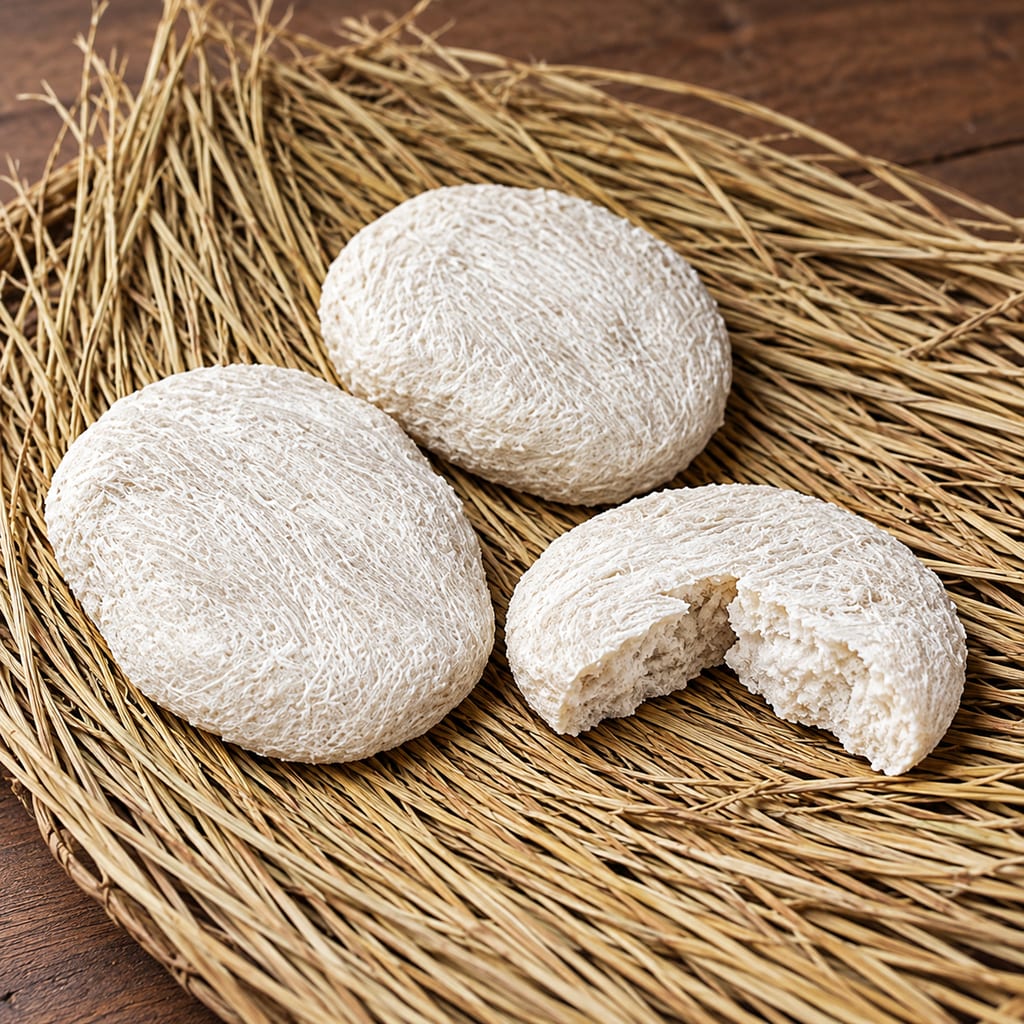
Bubod (Philippine starter)
Bubod is the Philippine rice starter behind Cordillera tapuy and tapey: dry mixed-culture cakes of molds, yeasts and bacteria, plus a standardized granular version developed by DOST.
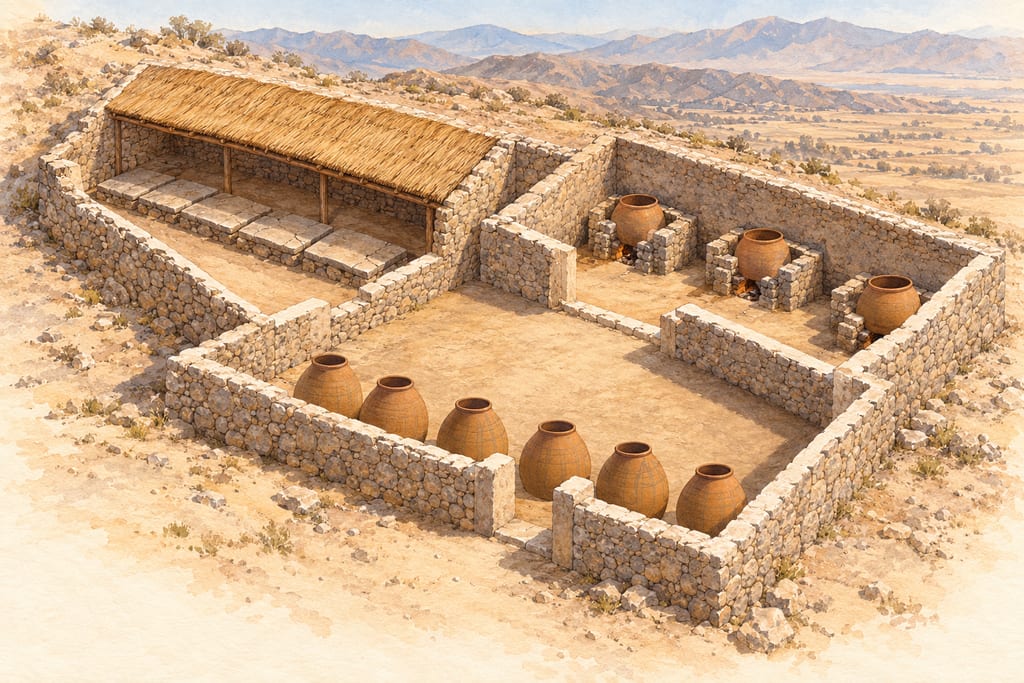
Cerro Baúl brewery
The fixed Wari brewery at Cerro Baúl in southern Peru had a trapezoidal plan with separate milling, boiling and fermentation/storage areas. Excavations document its layout, not a complete construction sequence or dimensions.
Finger millet
Finger millet (Eleusine coracana) is a small-grained cereal grown across parts of Africa and Asia. It is milled, cooked, malted and fermented in distinct food traditions.
Ginger beer plant
The ginger beer plant is a retained, grain-like mixed culture of yeasts and bacteria in a polysaccharide gel, used to ferment a ginger-flavoured sugary drink; it is not a ginger bug.
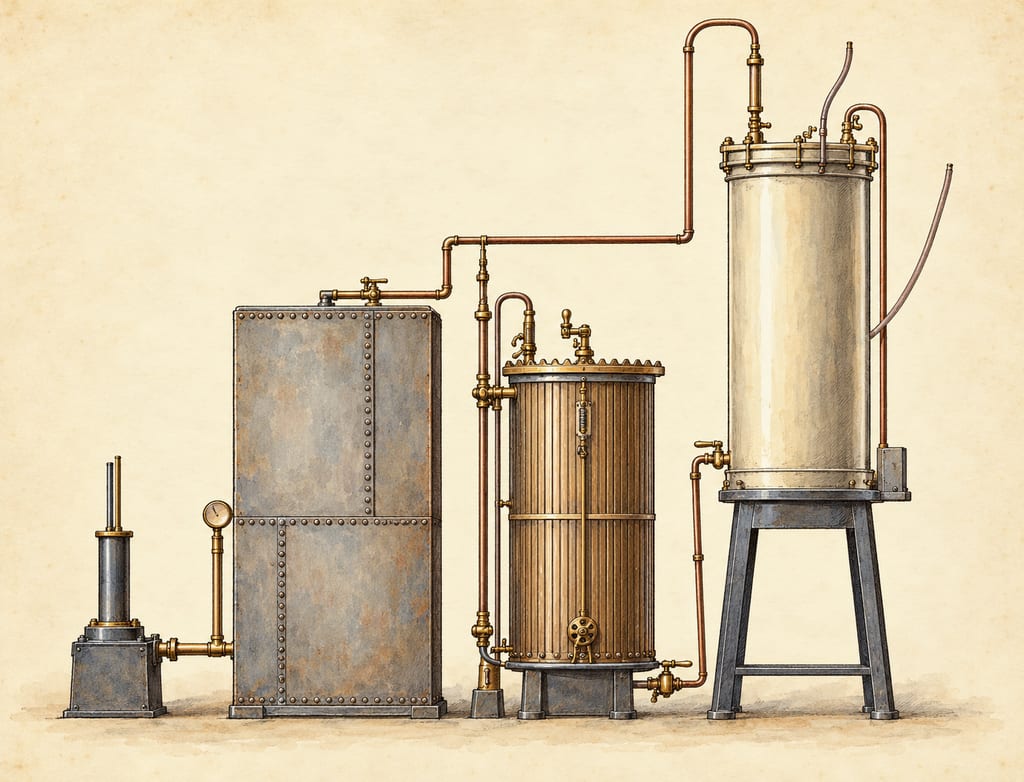
Hansen–Kühle yeast propagation apparatus
The Hansen–Kühle apparatus was late-nineteenth-century brewery plant for scaling up selected yeast cultures, distinct from Emil Christian Hansen’s method of isolating yeast from a single cell.
Community
No community contributions have been published for this entry yet.
Share what you made
Sign in to contribute. Published comments and photos are free to read.
Sources
Pliny the Elder, translated by John Bostock and H. T. Riley; Project Gutenberg ebook 61113
The Natural History of Pliny, Volume 4, Book XVIIICited in: A craft before a science; Northern Europe and the Roman world
Marco Daane; Brewery History 176, pp. 2-13 (2018)
Early European Days of Beer YeastCited in: A craft before a science; Monks, brewsters and the medieval yeast trade
R. L. K. Glover and colleagues; Systematic and Applied Microbiology 28 (2005)
Biodiversity of Saccharomyces cerevisiae isolated from a survey of pito production sites in various parts of GhanaCited in: A craft before a science; Africa: dried yeast, palm sap and honey
K. F. N'guessan and colleagues; Antonie van Leeuwenhoek 99 (2011)
Identification of yeasts during alcoholic fermentation of tchapalo, a traditional sorghum beer from Côte d'IvoireCited in: A craft before a science; Africa: dried yeast, palm sap and honey
Mika Laitinen, Brewing Nordic
Is Kveik Authentic Yeast for Sahti?Cited in: A craft before a science; Recipes, barm and farmhouse yeasts
Sonja Blasche and colleagues; Nature Microbiology 6 (2021)
Metabolic cooperation and spatiotemporal niche partitioning in a kefir microbial communityCited in: A craft before a science; Steppe milk, Persian wine and Arabic recipes
Li Liu and colleagues; PNAS 121 (2024)
Identification of 10,000-year-old rice beer at Shangshan in the Lower Yangzi River valley of ChinaCited in: A craft before a science; What each kind of evidence can show; The oldest traces in the Near East and China
S. H. Song and colleagues; Journal of Microbiology and Biotechnology 23 (2013)
Analysis of microflora profile in Korean traditional nurukCited in: A craft before a science; East Asia: qu, koji and nuruk
M. Kozaki and T. Uchimura; Journal of the Brewing Society of Japan 85 (1990)
Microorganisms in Chinese starter 'Bubod' and rice wine 'Tapuy' in the PhilippinesCited in: A craft before a science; Southeast Asia, South Asia and the Himalayas
National Research Institute of Brewing, Japan (2017)
The Story of Sake, Issue 2Cited in: A craft before a science; East Asia: qu, koji and nuruk; Wine, cider, mead, sake and spirits
Terry W. Henkel; Mycologia 97 (2005)
Parakari, an indigenous fermented beverage using amylolytic Rhizopus in GuyanaCited in: A craft before a science; The Americas, Australia and the Pacific
Alejandra Bussalleu and colleagues; EcoHealth 17 (2020)
Cultural Values and the Coliform Bacterial Load of 'Masato,' an Amazon Indigenous BeverageCited in: A craft before a science; The Americas, Australia and the Pacific
Lukas Paskulin and colleagues; Journal of Archaeological Science 168, 106019 (2024)
Leave no stone unturned: Exploring the metaproteome of beerstone for the identification of archaeological beer productionCited in: What each kind of evidence can show; Beer as organised work in Mesopotamia and Egypt
Frank Maixner and colleagues; Current Biology 31 (2021)
Hallstatt miners consumed blue cheese and beer during the Iron Age and retained a non-Westernized gut microbiome until the Baroque periodCited in: What each kind of evidence can show; Northern Europe and the Roman world; How to read a yeast claim
Li Liu and colleagues; Journal of Archaeological Science: Reports 21 (2018)
Fermented beverage and food storage in 13,000 y-old stone mortars at Raqefet Cave, Israel: Investigating Natufian ritual feastingCited in: The oldest traces in the Near East and China; Open questions
David Eitam; Journal of Archaeological Science: Reports 28 (2019)
'... Yo-ho-ho, and a bottle of [beer]!' (R.L. Stevenson) no beer but rather cereal-Food. Commentary: Liu et al. 2018Cited in: The oldest traces in the Near East and China; Open questions
Li Liu and colleagues; Journal of Archaeological Science: Reports 28 (2019)
Response to comments on archaeological reconstruction of 13,000-y old Natufian beer making at Raqefet Cave, IsraelCited in: The oldest traces in the Near East and China
Amaia Arranz-Otaegui and colleagues; PNAS 115 (2018)
Archaeobotanical evidence reveals the origins of bread 14,400 years ago in northeastern JordanCited in: The oldest traces in the Near East and China
Patrick E. McGovern and colleagues; PNAS 101 (2004)
Fermented beverages of pre- and proto-historic ChinaCited in: The oldest traces in the Near East and China
Li Liu and colleagues; Heritage 9(8), 335 (2026)
Revisiting Jiahu's 9000-Year-Old Fermented Beverage: New Microfossil Evidence for Early Qu-Based and Malt-Based Brewing Technologies in North ChinaCited in: The oldest traces in the Near East and China
Jiajing Wang, Leping Jiang and Hanxiang Sun; PLOS ONE 16 (2021)
Early evidence for beer drinking in a 9000-year-old platform mound in southern ChinaCited in: The oldest traces in the Near East and China
Patrick McGovern and colleagues; PNAS 114 (2017)
Early Neolithic wine of Georgia in the South CaucasusCited in: Grapes, jars and a cave winery
Pam Kosty, Penn Today, University of Pennsylvania (13 November 2017)
Penn Researchers Discover Evidence of Stone Age Wine Predating Earlier FindingsCited in: Grapes, jars and a cave winery
Patrick E. McGovern, Donald L. Glusker, Lawrence J. Exner and Mary M. Voigt; Nature 381, 480-481 (1996)
Neolithic resinated wineCited in: Grapes, jars and a cave winery
James Owen, National Geographic (12 January 2011)
Earliest Known Winery Found in Armenian CaveCited in: Grapes, jars and a cave winery
Hans Barnard and colleagues; Journal of Archaeological Science 38 (2011)
Chemical evidence for wine production around 4000 BCE in the Late Chalcolithic Near Eastern highlandsCited in: Grapes, jars and a cave winery
R. H. Michel, P. E. McGovern and V. R. Badler; Nature 360, 24 (1992)
Chemical evidence for ancient beerCited in: Beer as organised work in Mesopotamia and Egypt
Peter Damerow; Cuneiform Digital Library Journal 2012:2
Sumerian Beer: The Origins of Brewing Technology in Ancient MesopotamiaCited in: Beer as organised work in Mesopotamia and Egypt
Electronic Text Corpus of Sumerian Literature, University of Oxford
A hymn to Ninkasi: translationCited in: Beer as organised work in Mesopotamia and Egypt
Cuneiform Digital Library Initiative, tablet record 552
Beer: Hymn to NinkasiCited in: Beer as organised work in Mesopotamia and Egypt
North Abydos Archaeology Expedition, Abydos Archaeology blog (2022)
What Would King Narmer Do with 100,000 Pints of Beer?Cited in: Beer as organised work in Mesopotamia and Egypt
The Metropolitan Museum of Art, collection API record 544258
Model Bakery and Brewery from the Tomb of Meketre (20.3.12)Cited in: Beer as organised work in Mesopotamia and Egypt
Delwen Samuel; Science 273, 488-490 (1996)
Investigation of Ancient Egyptian Baking and Brewing Methods by Correlative MicroscopyCited in: Beer as organised work in Mesopotamia and Egypt
Tzemach Aouizerat and colleagues; mBio 10 (2019)
Isolation and Characterization of Live Yeast Cells from Ancient Vessels as a Tool in Bio-ArchaeologyCited in: Beer as organised work in Mesopotamia and Egypt; Open questions
The British Museum
Beer-record clay tablet, 1989,0130.4Cited in: Beer as organised work in Mesopotamia and Egypt
Associated Press via NBC News (February 2021)
Archaeologists unearth ancient beer factory in EgyptCited in: Beer as organised work in Mesopotamia and Egypt
The National (AFP), February 2021
Oldest brewery may have been discovered in EgyptCited in: Beer as organised work in Mesopotamia and Egypt
Patrick E. McGovern, Gretchen R. Hall and Armen Mirzoian; Danish Journal of Archaeology 2 (2013)
A biomolecular archaeological approach to 'Nordic grog'Cited in: Northern Europe and the Roman world
Tacitus, hosted by Elfinspell
The Germany and the Agricola of Tacitus: the Oxford translation revised, chapter 23Cited in: Northern Europe and the Roman world
Cato the Elder, English translation on LacusCurtius (Bill Thayer, University of Chicago)
De AgriculturaCited in: Northern Europe and the Roman world
e-codices, Virtual Manuscript Library of Switzerland (Stiftsbibliothek St. Gallen)
Cod. Sang. 1092: Plan of Saint GallCited in: Monks, brewsters and the medieval yeast trade
Christine Axen, Medievalists.net (29 January 2022)
What the St Gall Plan tells us about Medieval MonasteriesCited in: Monks, brewsters and the medieval yeast trade
The Rule of Benedict, PALNI Pressbooks edition
40. The Measure of DrinkCited in: Monks, brewsters and the medieval yeast trade
Judith M. Bennett; Oxford University Press (publisher's description on a bookseller page)
Ale, Beer, and Brewsters in England: Women's Work in a Changing World, 1300-1600Cited in: Monks, brewsters and the medieval yeast trade
Klaus Rupprecht, Historisches Lexikon Bayerns (2016)
Reinheitsgebot, 1516Cited in: Monks, brewsters and the medieval yeast trade
Internet Shakespeare Editions, University of Victoria
Brewer (trades in Shakespeare's time)Cited in: Recipes, barm and farmhouse yeasts
Kenelm Digby (1669); Project Gutenberg ebook 16441
The Closet of Sir Kenelm Digby Knight OpenedCited in: Recipes, barm and farmhouse yeasts
The Royal Society, Science in the Making, RBO/2i/14
Some observations concerning the Ordering of Wines, by Christopher MerrettCited in: Recipes, barm and farmhouse yeasts
Royal College of Physicians history blog
Christopher Merrett and the beginnings of champagneCited in: Recipes, barm and farmhouse yeasts
Fiona Callaghan, Royal Society blog (November 2019)
Divine fermentationCited in: Recipes, barm and farmhouse yeasts
Richard Preiss and colleagues; Frontiers in Microbiology 9 (2018)
Traditional Norwegian Kveik Are a Genetically Distinct Group of Domesticated Saccharomyces cerevisiae Brewing YeastsCited in: Recipes, barm and farmhouse yeasts; Reading genomes
Nordiska museet (Nordic Museum), via Wikimedia Commons, CC BY 4.0
NM.0019545 Jästkrans (yeast ring)Cited in: Recipes, barm and farmhouse yeasts
Baoyu Peng and colleagues; Foods 14, 2544 (2025)
Rice Wine Fermentation: Unveiling Key Factors Shaping Quality, Flavor, and Technological EvolutionCited in: East Asia: qu, koji and nuruk; Open questions
Yudong Li and colleagues; Genome Biology and Evolution 6 (2014)
Genomic evolution of Saccharomyces cerevisiae under Chinese rice wine fermentationCited in: East Asia: qu, koji and nuruk
Yuanliang Hu and colleagues; Food Research International 140 (2021)
Study on microbial communities and higher alcohol formations in the fermentation of Chinese Xiaoqu Baijiu produced by traditional and new mechanical technologiesCited in: East Asia: qu, koji and nuruk; How to read a yeast claim
National Research Institute of Brewing, Japan
The Story of Sake, Issue 1Cited in: East Asia: qu, koji and nuruk
蟹井英敬 (Kanii Hidetaka), Tax College research paper 113, National Tax Agency of Japan (2024)
日本酒の文化・伝統性の言説の確立について (On establishing accounts of sake's culture and tradition)Cited in: East Asia: qu, koji and nuruk; Pasteur, Hansen and the lager puzzle
Changhoon Chai and colleagues; Journal of the Institute of Brewing 121 (2015)
Microbial community changes in Makgeolli during brewingCited in: East Asia: qu, koji and nuruk
Jaeho Cha and colleagues; Food Research International 172 (2023)
Effects of saccharification agents on the microbial and metabolic profiles of Korean rice wine (makgeolli)Cited in: East Asia: qu, koji and nuruk
National Archives of Korea, Korea of Record topic page
막걸리와 소주 (Makgeolli and soju)Cited in: East Asia: qu, koji and nuruk
Jia Sixie; Chinese Text Project
齊民要術 (Qimin yaoshu), volume 7Cited in: East Asia: qu, koji and nuruk
Republic of Korea Ministry of Culture, Sports and Tourism
Traditional liquor historyCited in: East Asia: qu, koji and nuruk
N. T. P. Dung, F. M. Rombouts and M. J. R. Nout; LWT - Food Science and Technology 40 (2007)
Characteristics of some traditional Vietnamese starch-based rice wine fermentation starters (men)Cited in: Southeast Asia, South Asia and the Himalayas
Luangkhlaypho and colleagues; ScienceAsia 40 (2014)
Development of a defined starter culture mixture for the fermentation of sato, a Thai rice-based alcoholic beverageCited in: Southeast Asia, South Asia and the Himalayas
CCP Encyclopedia of Philippine Art, Cultural Center of the Philippines
Basi RevoltCited in: Southeast Asia, South Asia and the Himalayas
Translated by R. Shamasastry; Internet Archive text
Kautilya's Arthashastra, Book II, Chapter XXV: The Superintendent of LiquorCited in: Southeast Asia, South Asia and the Himalayas
N. Tsuyoshi and colleagues; International Journal of Food Microbiology 99 (2005)
Identification of yeast strains isolated from marcha in Sikkim, a microbial starter for amylolytic fermentationCited in: Southeast Asia, South Asia and the Himalayas
Saroj Thapa and Jyoti Prakash Tamang; Food Microbiology 21 (2004)
Product characterization of kodo ko jaanr: fermented finger millet beverage of the HimalayasCited in: Southeast Asia, South Asia and the Himalayas
Jyoti Prakash Tamang and Saroj Thapa; Food Biotechnology 20 (2006)
Fermentation Dynamics During Production of Bhaati Jaanr, a Traditional Fermented Rice Beverage of the Eastern HimalayasCited in: Southeast Asia, South Asia and the Himalayas
Ghosh, Sen and Mondal; Journal of Ethnic Foods 9, 26 (2022)
Ethnobotanical perspectives of Bakhar: an indigenous starter culture used to prepare traditionally fermented rice beverage in rural West Bengal, IndiaCited in: Southeast Asia, South Asia and the Himalayas
Tan Kofli and Mohd Dayaon; Journal of Applied Sciences 10 (2010)
Identification of Microorganism from Ragi for Bioethanol Production by API KitCited in: Southeast Asia, South Asia and the Himalayas
Shankar Prasad Sha, Mangesh Suryavanshi and Jyoti Prakash Tamang; Frontiers in Microbiology 10 (2019)
Mycobiome Diversity in Traditionally Prepared Starters for Alcoholic Beverages in India by High-Throughput Sequencing MethodCited in: Southeast Asia, South Asia and the Himalayas
Ghosh and colleagues; Frontiers in Sustainable Food Systems 5 (2021)
Physicochemical Characteristics and Lactic Acid Bacterial Diversity of an Ethnic Rice Fermented Mild Alcoholic Beverage, HariaCited in: Southeast Asia, South Asia and the Himalayas
Silk Road Seattle, University of Washington (W. W. Rockhill translation)
William of Rubruck's Account of the MongolsCited in: Steppe milk, Persian wine and Arabic recipes
Zhishen Mu, Xiaojing Yang and Hongli Yuan; Food Microbiology 31 (2012)
Detection and identification of wild yeast in KoumissCited in: Steppe milk, Persian wine and Arabic recipes; Species, strains and products
Almagul Baubekova and colleagues; Journal of Camel Practice and Research 22 (2015)
Biodiversity study of the yeast in fresh and fermented camel and mare's milk by denaturing gradient gel electrophoresisCited in: Steppe milk, Persian wine and Arabic recipes
Loughlin Gethins and colleagues; FEMS Microbiology Letters 363 (2016)
Acquisition of the yeast Kluyveromyces marxianus from unpasteurised milk by a kefir grain enhances kefir qualityCited in: Steppe milk, Persian wine and Arabic recipes; Species, strains and products
Silk Road Seattle, University of Washington (after Annette Beveridge's translation)
The Memoirs of Babur (selections)Cited in: Steppe milk, Persian wine and Arabic recipes
Limor Yungman; Revue des mondes musulmans et de la Méditerranée 151, 41-64 (2022)
Tracing the Origins of a Practice: The Earliest Recipes for Alcoholic Beverages in Medieval Arabic CookbooksCited in: Steppe milk, Persian wine and Arabic recipes
The Metropolitan Museum of Art
Large Jar (56.185.3)Cited in: Steppe milk, Persian wine and Arabic recipes
Courtney A. Stewart, The Metropolitan Museum of Art (2018)
Art of the SufisCited in: Steppe milk, Persian wine and Arabic recipes
César Ojeda-Linares and colleagues; Foods 10, 2390 (2021)
Traditional Fermented Beverages of Mexico: A Biocultural Unseen FoodscapeCited in: Steppe milk, Persian wine and Arabic recipes; The Americas, Australia and the Pacific
H. Sawadogo-Lingani and colleagues; Journal of Applied Microbiology 103 (2007)
The biodiversity of predominant lactic acid bacteria in dolo and pito wort for the production of sorghum beerCited in: Africa: dried yeast, palm sap and honey
Thembelani Xolo, Zanephyn Keyser and Victoria Jideani; Heliyon 10 (2024)
Physicochemical and microbiological changes during two-stage fermentation production of umqombothiCited in: Africa: dried yeast, palm sap and honey
Théodore Djeni and colleagues; Frontiers in Microbiology 13 (2022)
Dynamics of microbial populations and metabolites of fermenting saps throughout tapping process of ron and oil palm trees in Côte d'IvoireCited in: Africa: dried yeast, palm sap and honey
O. U. Ezeronye and J.-L. Legras; Journal of Applied Microbiology 106 (2009)
Genetic analysis of Saccharomyces cerevisiae strains isolated from palm wine in eastern Nigeria. Comparison with other African strainsCited in: Africa: dried yeast, palm sap and honey
Bahiru Bahiru, Tetemke Mehari and Mogessie Ashenafi; Food Microbiology 23 (2006)
Yeast and lactic acid flora of tej, an indigenous Ethiopian honey wine: variations within and between production unitsCited in: Africa: dried yeast, palm sap and honey
Eskindir Getachew Fentie and colleagues; Scientific Reports 12 (2022)
Development of mixed starter culture for the fermentation of Ethiopian honey wine, TejCited in: Africa: dried yeast, palm sap and honey
Jerónimo Lobo, translated by Samuel Johnson; Project Gutenberg ebook 1436
A Voyage to AbyssiniaCited in: Africa: dried yeast, palm sap and honey
Richard F. Burton (1860); Project Gutenberg ebook 66812
The Lake Regions of Central Africa, Volume 1Cited in: Africa: dried yeast, palm sap and honey
R. M. Gensi, W. Kyamuhangire and J. F. Carasco; Acta Horticulturae 540 (2000)
Traditional production method and storage characteristics for banana beer (tonto) in UgandaCited in: Africa: dried yeast, palm sap and honey
Michael E. Moseley and colleagues; PNAS 102 (2005)
Burning down the brewery: establishing and evacuating an ancient imperial colony at Cerro Baúl, PeruCited in: The Americas, Australia and the Pacific
Marisol Correa-Ascencio and colleagues; PNAS 111 (2014)
Pulque production from fermented agave sap as a dietary supplement in Prehispanic MesoamericaCited in: The Americas, Australia and the Pacific
John S. Henderson and colleagues; PNAS 104 (2007)
Chemical and archaeological evidence for the earliest cacao beveragesCited in: The Americas, Australia and the Pacific
Fernanda B. Piló and colleagues; Brazilian Journal of Microbiology 49 (2018)
Saccharomyces cerevisiae populations and other yeasts associated with indigenous beers (chicha) of EcuadorCited in: The Americas, Australia and the Pacific
Rosane F. Schwan and colleagues; FEMS Yeast Research 7 (2007)
Yeast diversity in rice-cassava fermentations produced by the indigenous Tapirapé people of BrazilCited in: The Americas, Australia and the Pacific
Wilbert Gutiérrez-Sarmiento and colleagues; Microbiological Research 260 (2022)
Microbial community structure, physicochemical characteristics and predictive functionalities of the Mexican tepache fermented beverageCited in: The Americas, Australia and the Pacific
Ángel Eduardo Rubio-Castillo and colleagues; Foods 10, 2446 (2021)
Tejuino, a Traditional Fermented Beverage: Composition, Safety Quality, and Microbial IdentificationCited in: The Americas, Australia and the Pacific
Cristian Varela and colleagues; Scientific Reports 10 (2020)
Discovering the indigenous microbial communities associated with the natural fermentation of sap from the cider gum Eucalyptus gunniiCited in: The Americas, Australia and the Pacific
Cristian Varela and colleagues; Food Microbiology 112 (2023)
A special drop: Characterising yeast isolates associated with fermented beverages produced by Australia's indigenous peoplesCited in: The Americas, Australia and the Pacific
Maggie Brady and Vic McGrath; Journal of Pacific History 45 (2010)
Making tuba in the Torres Strait Islands: the cultural diffusion and geographic mobility of an alcoholic drinkCited in: The Americas, Australia and the Pacific
Food Standards Australia New Zealand (2021)
Supporting document 1: Risk and technical assessment, Proposal P1057 KavaCited in: The Americas, Australia and the Pacific
Matthew A. Carrigan and colleagues; PNAS 112 (2015)
Hominids adapted to metabolize ethanol long before human-directed fermentationCited in: Seeing the cell
Irene Stefanini and colleagues; PNAS 109 (2012)
Role of social wasps in Saccharomyces cerevisiae ecology and evolutionCited in: Seeing the cell
The Royal Society, Science in the Making
Letter, from Antoni van Leeuwenhoek to Thomas Gale, dated at Delft (EL/L1/57)Cited in: Seeing the cell
Antoine Lavoisier, translated by Robert Kerr (1790); Project Gutenberg ebook 30775
Elements of Chemistry, chapter XIIICited in: Seeing the cell
Charles Cagniard-Latour; Annales de chimie et de physique 68 (1838), BIU Santé digitised copy
Mémoire sur la fermentation vineuseCited in: Seeing the cell
Eduard Buchner; NobelPrize.org
Cell-free fermentation (Nobel Lecture, 11 December 1907)Cited in: Seeing the cell; Inside the cell, and the partners that stayed
Species Fungorum, Royal Botanic Gardens, Kew
Saccharomyces cerevisiae (Desm.) Meyen ex E.C. Hansen, record 163963Cited in: Seeing the cell
R. H. De Deken; Journal of General Microbiology 44 (1966)
The Crabtree effect: a regulatory system in yeastCited in: Seeing the cell
James A. Barnett; Yeast 21 (2004)
A history of research on yeasts 8: taxonomyCited in: Seeing the cell
Institut Pasteur (2022, updated 2024)
Louis Pasteur : un héritage universelCited in: Pasteur, Hansen and the lager puzzle
Louis Pasteur, translated by Frank Faulkner and D. Constable Robb (Macmillan, 1879); Project Gutenberg ebook 63355
Studies on Fermentation: the Diseases of Beer, their Causes, and the Means of Preventing ThemCited in: Pasteur, Hansen and the lager puzzle
Nicolas Appert (1810); Gallica scan mirrored by the Institut de tourisme et d'hôtellerie du Québec
L'art de conserver, pendant plusieurs années, toutes les substances animales et végétalesCited in: Pasteur, Hansen and the lager puzzle
The Australian Wine Research Institute
Filtration – physical removal of microorganismsCited in: Pasteur, Hansen and the lager puzzle
Species Fungorum, Royal Botanic Gardens, Kew
Saccharomyces carlsbergensis E.C. Hansen, record 118816Cited in: Pasteur, Hansen and the lager puzzle
Diego Libkind and colleagues; PNAS 108 (2011)
Microbe domestication and the identification of the wild genetic stock of lager-brewing yeastCited in: Pasteur, Hansen and the lager puzzle; Species, strains and products
Mathias Hutzler and colleagues; FEMS Yeast Research 23 (2023)
A new hypothesis for the origin of the lager yeast Saccharomyces pastorianusCited in: Pasteur, Hansen and the lager puzzle; Open questions
Roberto de la Cerda Garcia-Caro and colleagues; PLOS Genetics 18 (2022)
Aneuploidy influences the gene expression profiles in Saccharomyces pastorianus group I and II strains during fermentationCited in: Pasteur, Hansen and the lager puzzle
Barbara Dunn and Gavin Sherlock; Genome Research 18 (2008)
Reconstruction of the genome origins and evolution of the hybrid lager yeast Saccharomyces pastorianusCited in: Pasteur, Hansen and the lager puzzle
Arthur Harden; Project Gutenberg ebook 44985
Alcoholic Fermentation (second edition, 1914)Cited in: Inside the cell, and the partners that stayed
NobelPrize.org
The Nobel Prize in Chemistry 1929Cited in: Inside the cell, and the partners that stayed
Marc Stålhane Colomer and colleagues; Frontiers in Microbiology 11 (2020)
Assessing Population Diversity of Brettanomyces Yeast Species and Identification of Strains for Brewing ApplicationsCited in: Inside the cell, and the partners that stayed
N. Hjelte Claussen; Journal of the Institute of Brewing 10, 308-331 (1904)
On a Method for the Application of Hansen's Pure Yeast System in the Manufacturing of Well-Conditioned English Stock BeersCited in: Inside the cell, and the partners that stayed
H. Marshall Ward; Philosophical Transactions of the Royal Society B 183 (1892)
The ginger-beer plant, and the organisms composing it: a contribution to the study of fermentation-yeasts and bacteriaCited in: Inside the cell, and the partners that stayed
Ekaterina Dlusskaya, André Jänsch, Clarissa Schwab and Michael G. Gänzle; European Food Research and Technology 227 (2008)
Microbial and chemical analysis of a kvass fermentationCited in: Inside the cell, and the partners that stayed
O. Hancioğlu and M. Karapinar; International Journal of Food Microbiology 35 (1997)
Microflora of Boza, a traditional fermented Turkish beverageCited in: Inside the cell, and the partners that stayed
Elizabeth A. Landis and colleagues; mSystems 7 (2022)
Microbial Diversity and Interaction Specificity in Kombucha Tea FermentationsCited in: Inside the cell, and the partners that stayed; Species, strains and products
David Laureys and Luc De Vuyst; Applied and Environmental Microbiology 80 (2014)
Microbial species diversity, community dynamics, and metabolite kinetics of water kefir fermentationCited in: Inside the cell, and the partners that stayed
Richard Ligon (1657); Project Gutenberg ebook 70489
A True and Exact History of the Island of BarbadosCited in: Inside the cell, and the partners that stayed
Verein Historische Kälte- und Klimatechnik e.V., press release
Original Linde-Kältemaschine zieht ins Museum einCited in: Cold, capital and control
VLB Berlin (19 December 2022)
140th anniversary of the founding of VLB BerlinCited in: Cold, capital and control
National Collection of Yeast Cultures, Quadram Institute
Brewing strainsCited in: Cold, capital and control
Independent on Saturday, IOL (5 December 2020)
Durban's bitter brewCited in: Cold, capital and control
Isak S. Pretorius; FEMS Yeast Research 20 (2020)
Tasting the terroir of wine yeast innovationCited in: Cold, capital and control
United States Government Publishing Office (approved 14 October 1978)
Public Law 95-458, 92 Stat. 1255Cited in: Cold, capital and control
Something's Brewing exhibition, University of Chicago Library
RefrigerationCited in: Cold, capital and control
Brij Maharaj; International Journal of Urban and Regional Research 20 (1996)
The Historical Development of the Apartheid Local State in South Africa: The Case of DurbanCited in: Cold, capital and control
André Goffeau and colleagues; Science 274, 546-567 (1996)
Life with 6000 GenesCited in: Reading genomes
Brigida Gallone and colleagues; Cell 166 (2016)
Domestication and Divergence of Saccharomyces cerevisiae Beer YeastsCited in: Reading genomes; Species, strains and products; How laboratories find, make and keep a yeast
Jackson Peter and colleagues; Nature 556 (2018)
Genome evolution across 1,011 Saccharomyces cerevisiae isolatesCited in: Reading genomes
Anthony R. Borneman and colleagues; G3 6 (2016)
Whole Genome Comparison Reveals High Levels of Inbreeding and Strain Redundancy Across the Spectrum of Commercial Wine Strains of Saccharomyces cerevisiaeCited in: Reading genomes; How to read a yeast claim
Barret Foster and colleagues; Frontiers in Microbiology 13 (2022)
Kveik Brewing Yeasts Demonstrate Wide Flexibility in Beer Fermentation Temperature Tolerance and Exhibit Enhanced Trehalose AccumulationCited in: Reading genomes
Kristoffer Krogerus, Richard Preiss and Brian Gibson; Frontiers in Microbiology 9 (2018)
A Unique Saccharomyces cerevisiae × Saccharomyces uvarum Hybrid Isolated From Norwegian Farmhouse Beer: Characterization and ReconstructionCited in: Reading genomes; Species, strains and products
Victor Loegler and colleagues; Nature Communications 16 (2025)
Whole-genome sequencing of 1,060 Brettanomyces bruxellensis isolates reveals significant phenotypic impact of acquired subgenomes in allopolyploidsCited in: Reading genomes
Carmen Becerra-Rodríguez and colleagues; PNAS 123 (2026)
Domestication drives repeated evolution of sexual-asexual life cycle trade-offs in yeastCited in: Reading genomes
Fermentis
SafAle US-05Cited in: Species, strains and products; Brewing yeasts, sour beer and the IPA laboratory
National Collection of Yeast Cultures, Quadram Institute
Yeast Bank - Safe DepositCited in: Species, strains and products; How laboratories find, make and keep a yeast
Kristoffer Krogerus, Nils Rettberg and Brian Gibson; European Food Research and Technology 249 (2023)
Increased volatile thiol release during beer fermentation using constructed interspecies yeast hybridsCited in: Species, strains and products; Brewing yeasts, sour beer and the IPA laboratory; How laboratories find, make and keep a yeast
Laura Pérez-Través and colleagues; PLOS ONE 9 (2014)
On the complexity of the Saccharomyces bayanus taxon: hybridization and potential hybrid speciationCited in: Species, strains and products
Ortiz-Tovar and colleagues; International Journal of Food Microbiology 274 (2018)
A comparison of the performance of natural hybrids Saccharomyces cerevisiae × Saccharomyces kudriavzevii at low temperatures reveals the crucial role of their S. kudriavzevii genomic contributionCited in: Species, strains and products
Freek Spitaels and colleagues; PLOS ONE 9 (2014)
The microbial diversity of traditional spontaneously fermented lambic beerCited in: Species, strains and products; Brewing yeasts, sour beer and the IPA laboratory
Paola Domizio and colleagues; Journal of the Institute of Brewing 122 (2016)
Lachancea thermotolerans as an alternative yeast for the production of beerCited in: Species, strains and products; Brewing yeasts, sour beer and the IPA laboratory
Lallemand Wine
LEVEL² BIODIVACited in: Species, strains and products; Wine, cider, mead, sake and spirits
Lallemand Wine
LEVEL² FLAVIACited in: Species, strains and products; Wine, cider, mead, sake and spirits
Ángel Benito and colleagues; PLOS ONE 11 (2016)
Selected Schizosaccharomyces pombe Strains Have Characteristics That Are Beneficial for WinemakingCited in: Species, strains and products; Wine, cider, mead, sake and spirits
Vasileios Englezos and colleagues; Applied and Environmental Microbiology 84 (2018)
Specific Phenotypic Traits of Starmerella bacillaris Related to Nitrogen Source Consumption and Central Carbon Metabolite Production during Wine FermentationCited in: Species, strains and products
Alexander P. Douglass and colleagues; PLOS Pathogens 14 (2018)
Population genomics shows no distinction between pathogenic Candida krusei and environmental Pichia kudriavzevii: One species, four namesCited in: Species, strains and products
Kristoffer Krogerus and colleagues; Applied Microbiology and Biotechnology 103 (2019)
A deletion in the STA1 promoter determines maltotriose and starch utilization in STA1+ Saccharomyces cerevisiae strainsCited in: Species, strains and products; How to read a yeast claim
Lallemand Wine
Lalvin EC1118 (Prise de mousse)Cited in: Species, strains and products; Wine, cider, mead, sake and spirits
Fermentis
SafCider AB-1 (with the AS-2, AC-4 and TF-6 pages)Cited in: Species, strains and products; Wine, cider, mead, sake and spirits
Kara Osburn and colleagues; Food Microbiology 70 (2018)
Primary souring: A novel bacteria-free method for sour beer productionCited in: Species, strains and products; Brewing yeasts, sour beer and the IPA laboratory
Joana Simões and colleagues; Microorganisms 11, 316 (2023)
Exploiting Non-Conventional Yeasts for Low-Alcohol Beer ProductionCited in: Species, strains and products; Wine, cider, mead, sake and spirits
Vanesa Postigo and colleagues; Foods 11 (2022)
Impact of Non-Saccharomyces Wine Yeast Strains on Improving Healthy Characteristics and the Sensory Profile of Beer in Sequential FermentationCited in: Species, strains and products
Kristoffer Krogerus and colleagues; Journal of Industrial Microbiology and Biotechnology 42 (2015)
New lager yeast strains generated by interspecific hybridizationCited in: Brewing yeasts, sour beer and the IPA laboratory; How laboratories find, make and keep a yeast
Jonas De Roos, Peter Vandamme and Luc De Vuyst; Frontiers in Microbiology 9 (2018)
Wort Substrate Consumption and Metabolite Production During Lambic Beer Fermentation and Maturation Explain the Successive Growth of Specific Bacterial and Yeast SpeciesCited in: Brewing yeasts, sour beer and the IPA laboratory
M. G. Aguilar Uscanga, M.-L. Délia and P. Strehaiano; Applied Microbiology and Biotechnology 61 (2003)
Brettanomyces bruxellensis: effect of oxygen on growth and acetic acid productionCited in: Brewing yeasts, sour beer and the IPA laboratory
Lallemand Brewing
LalBrew PomonaCited in: Brewing yeasts, sour beer and the IPA laboratory; How laboratories find, make and keep a yeast
Kiyoshi Takoi and colleagues; Journal of Agricultural and Food Chemistry 58 (2010)
Biotransformation of hop-derived monoterpene alcohols by lager yeast and their contribution to the flavor of hopped beerCited in: Brewing yeasts, sour beer and the IPA laboratory
Ryan W. Molitor and colleagues; Journal of Agricultural and Food Chemistry 71 (2023)
Examining How the Fermentation Medium Influences Thiol Expression and Its Perceived Aroma in Commercial Brewing Yeast StrainsCited in: Brewing yeasts, sour beer and the IPA laboratory
Omega Yeast Labs
Thiolized Yeast Guide: Tropical Thiols from Hops and MaltCited in: Brewing yeasts, sour beer and the IPA laboratory; How laboratories find, make and keep a yeast
Charles M. Denby and colleagues; Nature Communications 9 (2018)
Industrial brewing yeast engineered for the production of primary flavor determinants in hopped beerCited in: Brewing yeasts, sour beer and the IPA laboratory; How laboratories find, make and keep a yeast
Arnbjørn Stokholm and Thomas H. Shellhammer, Brewers Association
Hop Creep - Technical BriefCited in: Brewing yeasts, sour beer and the IPA laboratory; How to read a yeast claim
Berkeley Yeast
Low Diacetyl Yeast: The Science Behind FRESH StrainsCited in: Brewing yeasts, sour beer and the IPA laboratory
Omega Yeast Labs
Introducing Diacetyl Knock Out (DKO) technologyCited in: Brewing yeasts, sour beer and the IPA laboratory
Manuel Fidalgo and colleagues; PNAS 103 (2006)
Adaptive evolution by mutations in the FLO11 geneCited in: Wine, cider, mead, sake and spirits
Hitoshi Shimoi and colleagues; Applied and Environmental Microbiology 68 (2002)
The Awa1 gene is required for the foam-forming phenotype and cell surface hydrophobicity of sake yeastCited in: Wine, cider, mead, sake and spirits; How laboratories find, make and keep a yeast
Kazuo Miyashita and colleagues; Journal of Bioscience and Bioengineering 97 (2004)
Cloning and analysis of the AWA1 gene of a nonfoaming mutant of a sake yeastCited in: Wine, cider, mead, sake and spirits
Lallemand, hosted by Mapa da Cachaça
DistilaMax RM technical data sheet (Portuguese, V2, October 2021)Cited in: Wine, cider, mead, sake and spirits
Brewing Society of Japan
Kyokai sake yeast specificationsCited in: Wine, cider, mead, sake and spirits
Gaps
- Whether the Raqefet mortars held beer or cereal food is disputed between the excavators and their critics.
- Yeasts isolated from ancient vessels have not been shown to descend from the yeast that fermented the original drinks; contamination remains the central problem.
- The place and date of the lager hybrid's formation (the Munich Hofbräuhaus, 1602-1615) is a reconstruction from brewing records; no dated cell records it.
- How much wine a Benedictine hemina held is still debated.
- Most traditional starters and drinks (nuruk, marcha, men, pito, tej, chicha, koumiss) have been sampled only a few times in a few places, so their published communities are snapshots.
- Whether Sumerian beer contained alcohol, and what bappir was, remain uncertain.
- The Abydos brewery's capacity has two published estimates (about 22,400 litres in 2021, close to 50,000 litres per batch in 2022) because excavation was still extending the structures.
Updated 2026-10-27