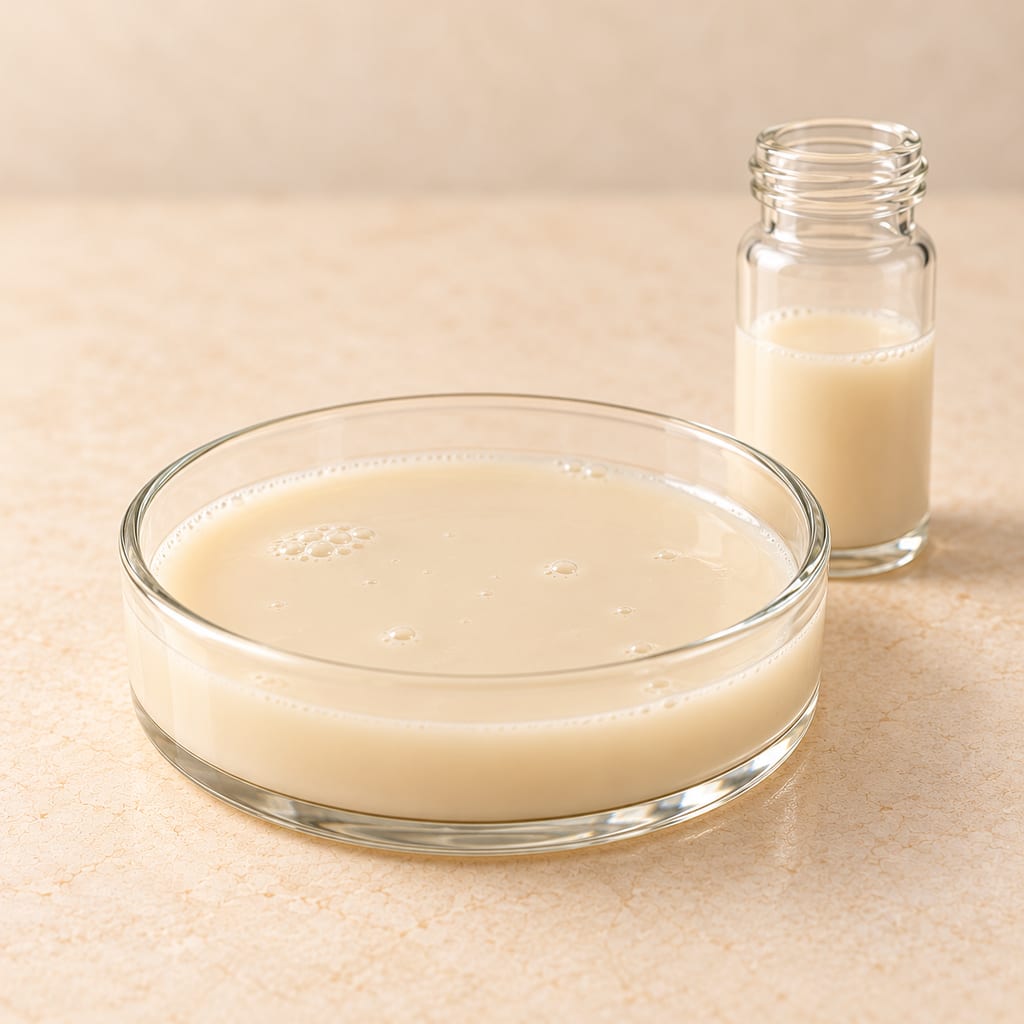
Brewer’s yeast
Brewer’s yeast is a working name for living cultures selected for brewing, not one strain or always one species. Ale and lager cultures differ, and older household books may use the term for foam or sediment from brewery beer.
 FermenteaWhere food goes to change
Equipment · Industrial and laboratory plant
Hansen–Kühle pure-culture apparatus · Hansen-Kühle yeast-growing apparatus · Hefereinzuchtapparat von Hansen und Kühle
The Hansen–Kühle apparatus was late-nineteenth-century brewery plant for scaling up selected yeast cultures, distinct from Emil Christian Hansen’s method of isolating yeast from a single cell.
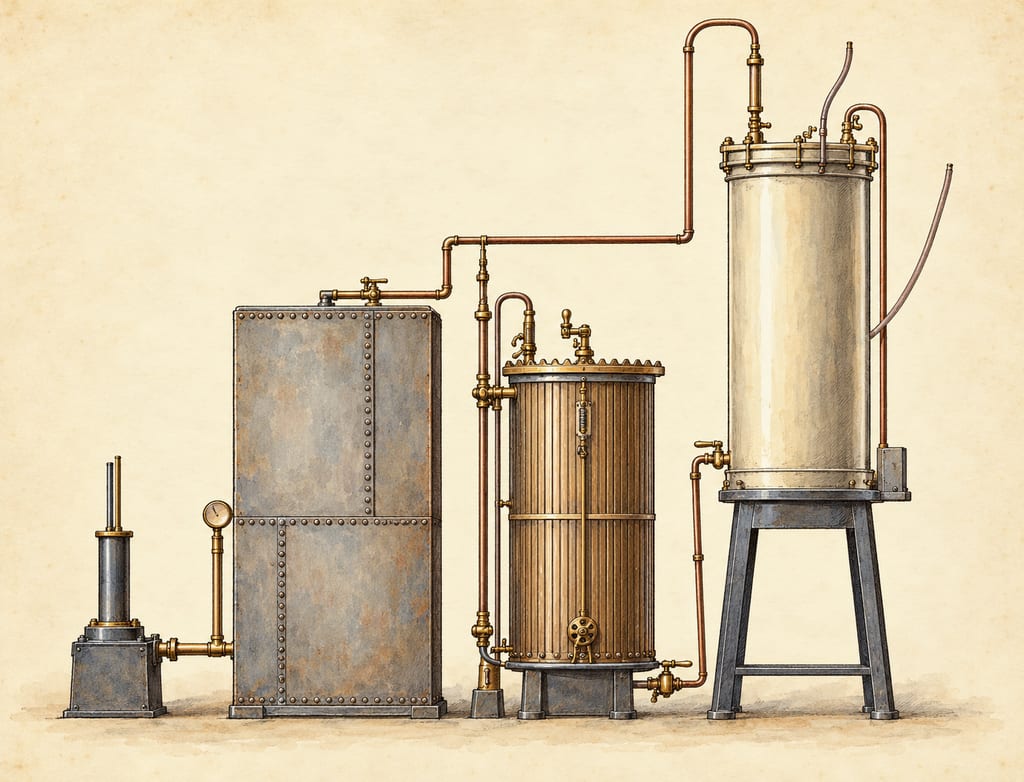
The name can blur two related but different things. Hansen’s pure-culture method selected yeast originating from a single cell; Carlsberg records that it entered production in November 1883. The Hansen–Kühle apparatus was later brewery plant intended to extend selected yeast propagation beyond laboratory scale. C. J. Lintner’s 1891 account attributes its design to Hansen and Captain Kühle, director of Old Carlsberg, and reports that it had been described in 1888. The apparatus did not itself define the single-cell selection method.
The historical descriptions present an installation rather than one portable jar: an air-supply arrangement with pump and pressure reservoir, a wort cylinder, and a fermentation cylinder connected by pipework. A 1903 laboratory handbook captions its illustration as the Hansen–Kühle pure-yeast apparatus; the drawing gives a sense of the installation’s vertical vessels and connections. Details in an illustration should not be mistaken for a universal specification: the sources consulted do not establish standard dimensions, capacity, materials or power drive. The generated hero is an interpretive drawing informed by the historical diagram, not a surviving specimen or measured reconstruction.
The equipment addressed the practical problem of making selected yeast available at brewery scale. It was not a substitute for the method that selected a culture, and the historical account cautions that contamination could recur. A machine’s presence therefore cannot be treated as proof that every later culture remained pure. These sources are valuable for the history and broad arrangement of the installation, but they do not support a current operating procedure or modern hygienic validation.
The documented installation belongs to Old Carlsberg in Copenhagen, Denmark. The 1888 date is an attestation attached to the pictured apparatus, while the 1891 publication gives a contemporary description; neither establishes that 1888 was its invention date or that identical plants were used throughout the brewing industry. No capacity, dimensional standard, maker’s catalogue or end-of-use date for this exact design was found in the consulted sources.
Carlsberg reports production use of Hansen’s single-cell pure-culture method from November 1883. The brewery-scale propagation apparatus was a separate development associated with Emil Christian Hansen and Captain Kühle, director of Old Carlsberg; it was described in 1888. The method and the later apparatus should not be conflated.
The apparatus description does not replace Hansen’s method for selecting yeast from a single cell.
Source →Contamination could recur; the historical apparatus is not evidence of permanent culture purity.
Source →The consulted sources do not establish standard capacity, dimensions, a current supply route or present-day operating specifications.
Source →Sources document the specific apparatus at Carlsberg in Copenhagen in an 1888 caption and an 1891 account; this does not claim a broader Danish origin or distribution.
Brewer’s yeast is a working name for living cultures selected for brewing, not one strain or always one species. Ale and lager cultures differ, and older household books may use the term for foam or sediment from brewery beer.
People kept, traded and steered living ferments for thousands of years before anyone saw a yeast cell. This is that history, region by region, and a guide to what a yeast strain is today.
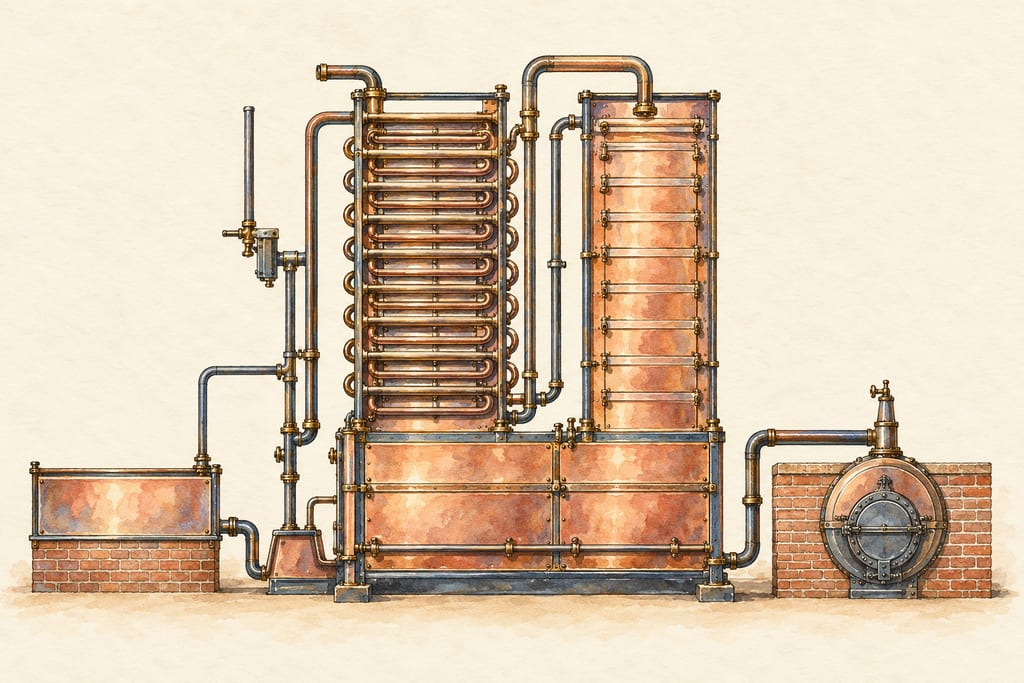
A column still is a distillation apparatus built around one or more vertical columns. Its continuous and rectifying designs appear in several spirits traditions, but materials and product character vary by installation.
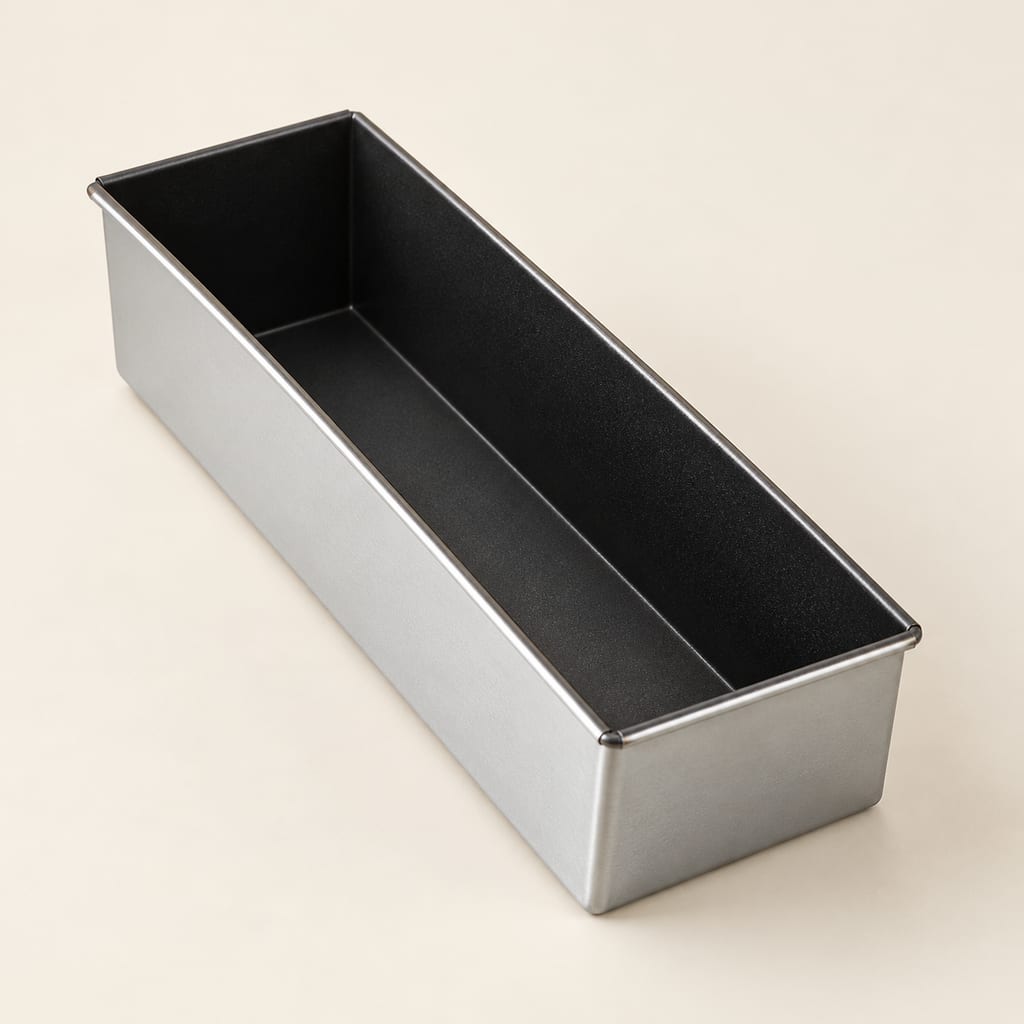
A greased rye-bread tin holds rugbrød dough while it proofs and bakes. Denmark’s National Museum documents a family recipe using three tins, but does not specify their material, shape or capacity.
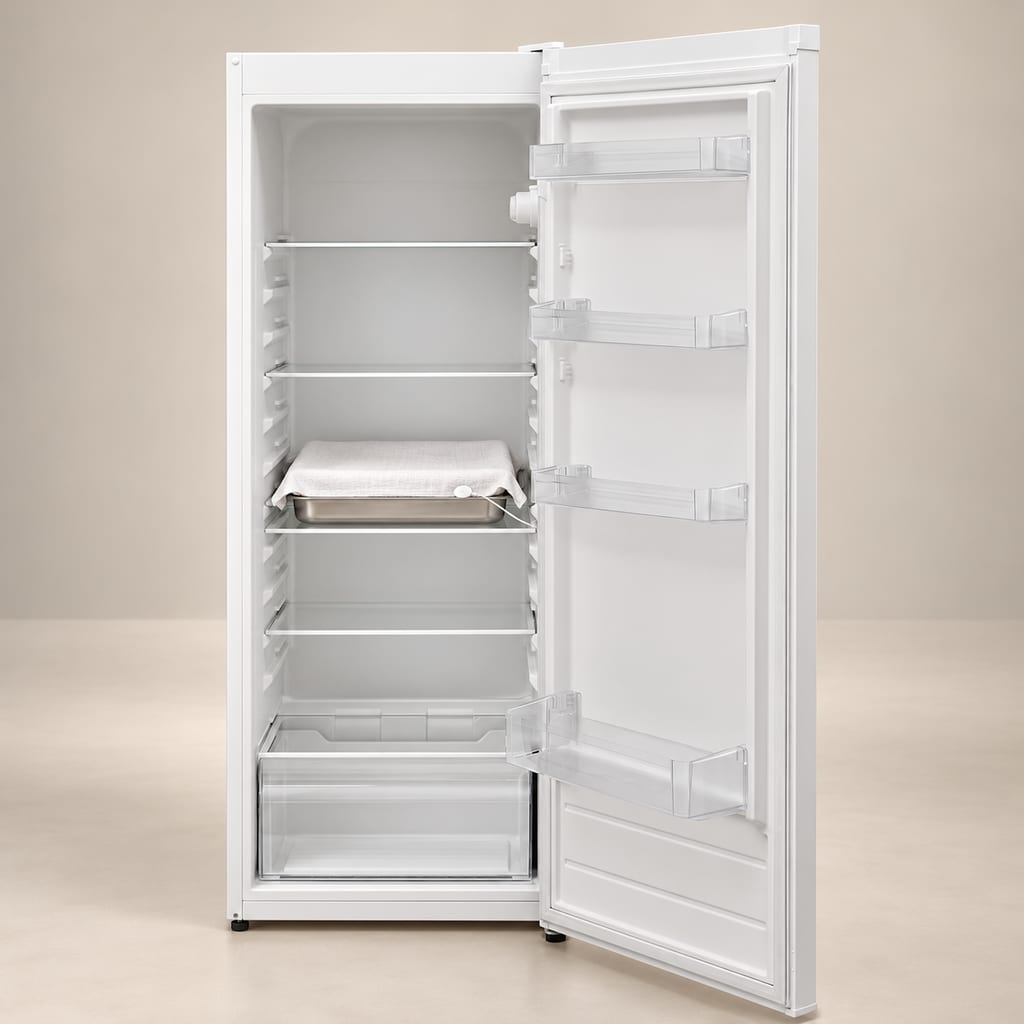
A modified cabinet or switched-off fridge can enclose growing koji. One source documents a heating mat and probe with a PID controller. This modern setup needs monitoring of grain temperature, airflow, condensation and cleanliness.
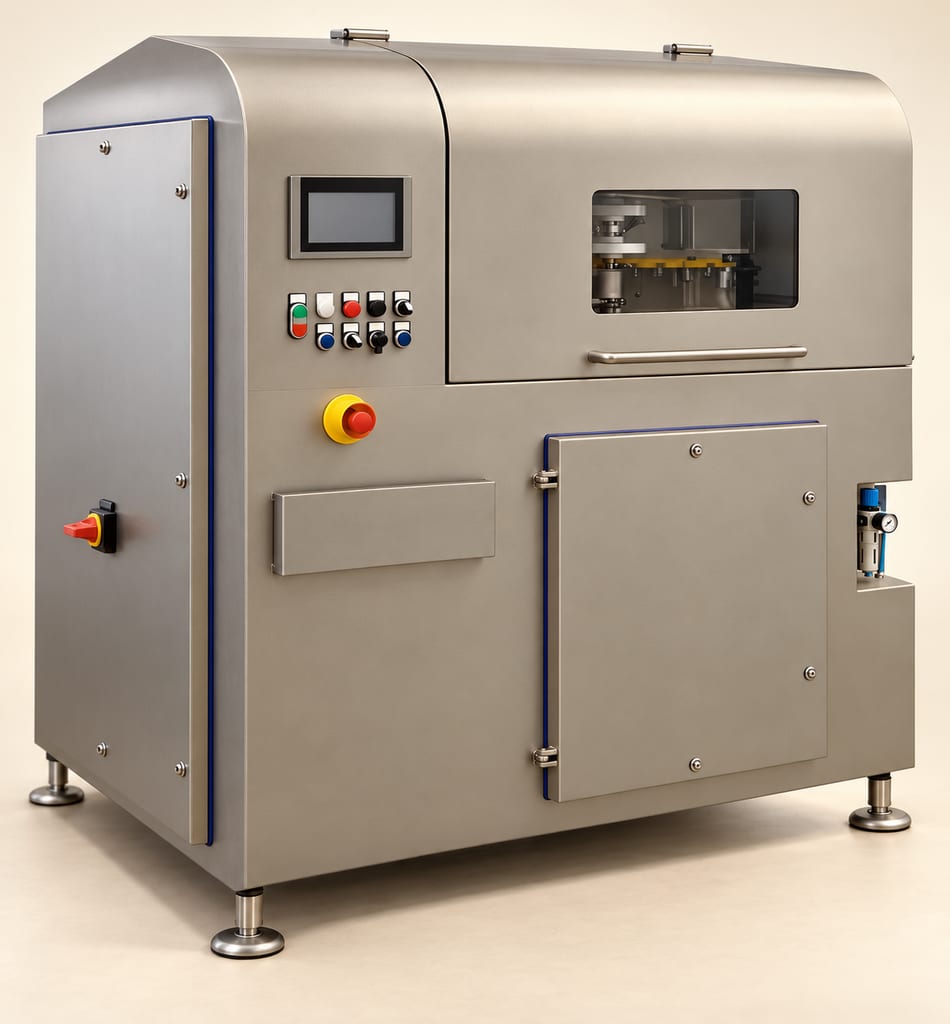
A pulsed electric field (PEF) unit sends brief high-voltage pulses through food in a treatment zone. Systems may treat flowing liquids or batches; the result depends on the food, equipment and validated process.

A Cap-Pelé boucanière is an Acadian herring-smoking building. The documented Willie Niles example is a one-storey wood-frame structure with a ridge smoke vent and interior bays for hanging fish-bearing cannes.

Achcharu is a family of Sri Lankan vinegar pickles made with mixed vegetables or seasonal fruit and a piquant spice dressing. This version is a quick, refrigerated, non-fermented mixed-vegetable pickle.

The acocote is a long, hollowed and dried gourd used to draw aguamiel from a mature maguey. It is a harvesting tool: the sap is transferred to a separate vessel before it ferments into pulque.

Adrak murabba preserves young ginger in sugar syrup, a sweet South Asian preparation recorded in Indian cookery and food-processing sources.

Parkia biglobosa seeds are fermented into regional West African seasonings, including nététou, iru, dawadawa and soumbala. The yellow fruit pulp is a separate food, and names and methods vary by place.

Japanese reddish-brown vinegar from sake lees matured about three years, turned to vinegar by acetic bacteria; the vinegar of Handa and Edomae sushi rice.

A refined common-wheat flour blended for a broad range of baking; its protein and behavior vary with wheat, milling and market.

The almond mushroom, Agaricus subrufescens, was cultivated in eastern North America in the 1800s, lost its market, and returned as a cultivated mushroom from Brazil, where it is grown under several names.
No community contributions have been published for this entry yet.
Sign in to contribute. Published comments and photos are free to read.
Carlsberg GroupMethod history · Context
Purifying yeastCarlsberg identifies Hansen’s selection of yeast originating from a single cell.
Carlsberg dates first production use of the pure-culture method to November 1883.
Cited in: A brewery apparatus, distinct from Hansen’s method; Scale did not guarantee permanent purity
Polytechnisches Journal / Dingler OnlineEquipment history · Equipment form · Limits
Hansen’s Reform in der GährungsindustrieLintner attributes the apparatus to Hansen and Captain Kühle, director of Old Carlsberg, and reports its description in 1888.
The account describes an air pump and pressure reservoir, wort cylinder and fermentation cylinder as main assemblies.
Lintner notes contamination may recur, so the apparatus does not guarantee enduring purity.
Cited in: A brewery apparatus, distinct from Hansen’s method; Connected vessels for scale-up; Scale did not guarantee permanent purity; Carlsberg, Copenhagen
John Wiley & SonsHistorical illustration · Equipment identification
Fermentation Organisms: A Laboratory HandbookThe 1903 handbook includes an illustration captioned Hansen-Kühle Pure Yeast Culture Apparatus.
Cited in: Connected vessels for scale-up
Lars Marius GarsholEquipment history · Image caption · Location
Emil Chr. Hansen and the yeast revolutionThe article identifies the historical drawing as Hansen’s yeast propagation apparatus at Carlsberg, 1888, and describes Hansen and Kühle’s involvement.
Cited in: A brewery apparatus, distinct from Hansen’s method; Connected vessels for scale-up; Carlsberg, Copenhagen
YeastMethod history
A history of research on yeasts 3: Emil Fischer, Eduard Buchner and their contemporaries, 1880–1900Barnett’s historical review distinguishes Hansen’s single-cell pure-culture method from the later practical problem of scaling yeast propagation.