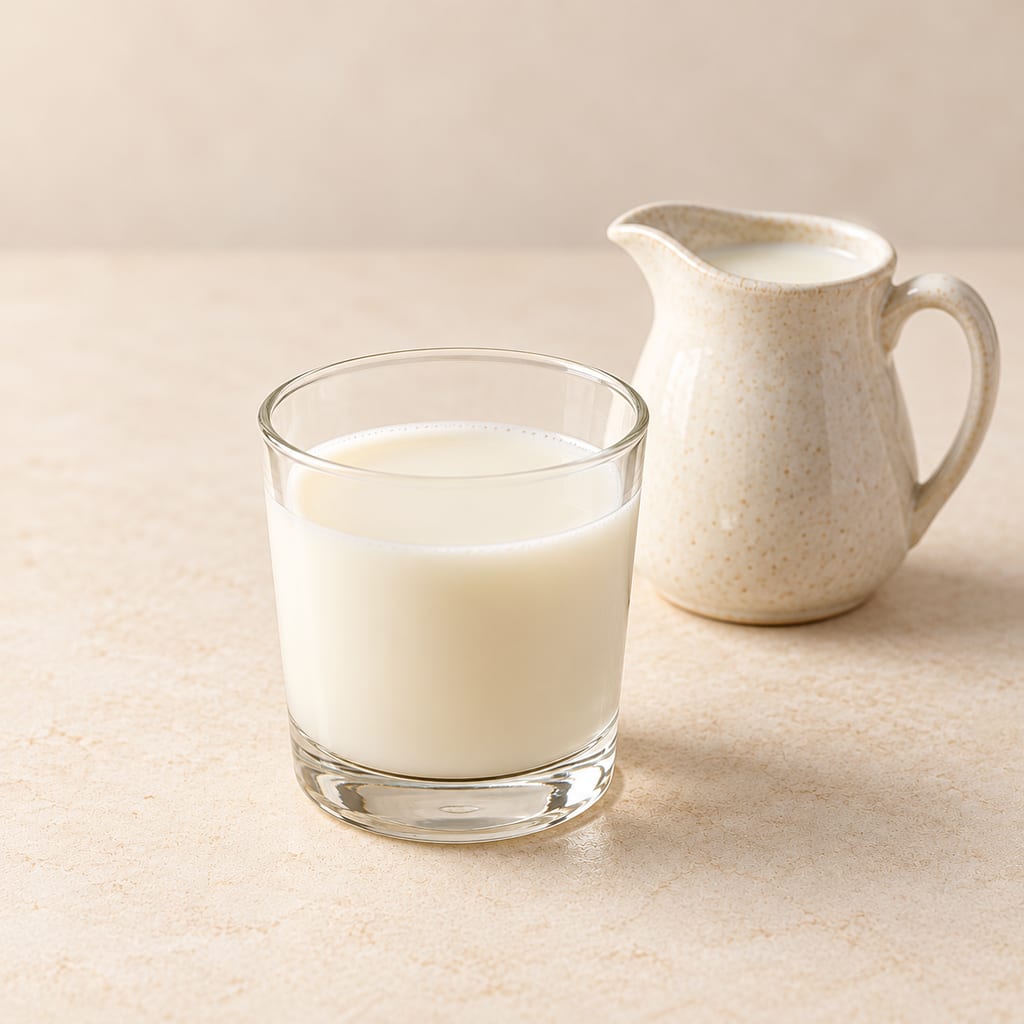
Koumiss (pasteurized mare milk)
Koumiss is a sour, lightly alcoholic mare-milk drink made by lactic bacteria and yeasts. This technical method uses pasteurized milk, a previous-batch starter and staged cooling.
 FermenteaWhere food goes to change
Equipment · Skins and bladders
торсық
Torsyk is a portable Kazakh leather flask for carrying and keeping drinks such as kumis and shubat. Museum examples have a flattened decorated body, a narrow neck and a stopper; evidence for fermentation inside the travel flask is lacking.
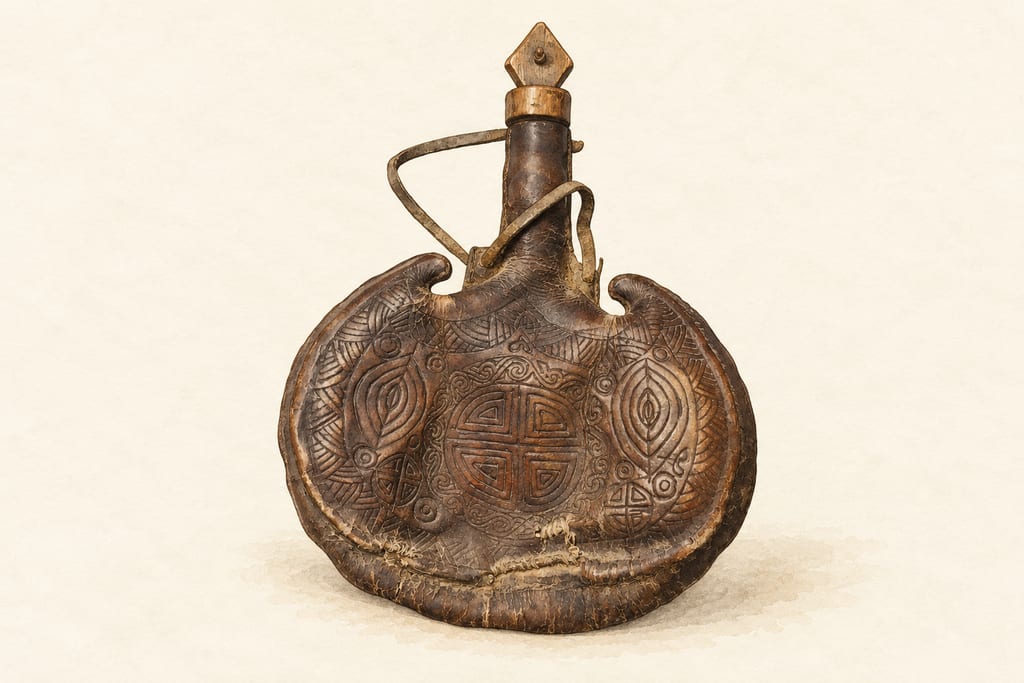
Torsyk (торсық) is a portable vessel associated with Kazakh nomadic life. Museum records describe it as a container for holding and carrying drinks, including kumis and shubat, during journeys. That purpose matters: the flask keeps a drink available for travel, while the larger leather saba is separately described as a vessel for preparing and keeping kumis. The two share hide construction but have different documented roles. The records do not show that the torsyk itself was the fermentation vessel.
A torsyk is shaped around a relatively narrow mouth and a broad, flattened body. In a museum example from the I. Zhansugurov Historical and Local Lore Museum, the neck rises above rounded shoulders and the body spreads laterally, giving it a flask-like silhouette. The visible bag is dark brown, with deep embossed ornament and a strap looping beside the neck. The object appears soft and thick rather than rigid like pottery. Its outline, stopper and surface decoration are useful identifiers, but a single richly ornamented example should not be mistaken for a universal pattern.
The museum descriptions identify animal hide that has been processed or tanned, shaped with a mold and sewn. A stitched lower edge helps maintain the form. One record describes hand-carved or embossed Kazakh ornament across the surface. These features show that a torsyk is a made object: the hide is formed and joined before the flask is carried, rather than being a structure built into a place.
The mouth is narrow and fitted with a stopper in the museum examples. A carrying strap can be attached to a saddle or belt, or used to hang the vessel inside a yurt. One nineteenth-century catalogue describes two metal rings near the neck through which a leather strap passes; another museum model identifies a wooden stopper and leather straps. Those components are documented on particular objects, not mandatory parts of every historical torsyk. The pictured flask also has pronounced shoulder wings and dense decoration. Other recorded examples may differ in silhouette and finish.
The available collection records place individual torsyk examples in the nineteenth and twentieth centuries. A nineteenth-century specimen is catalogued at 40 × 27 cm, while a separate twentieth-century flask model is recorded as 25 cm wide and 43 cm long. The records do not make these figures a type-wide size range, and the axes are not consistently specified. No capacity is given for these examples, so a standard volume cannot be assigned.
These records document historical objects and customary use but do not establish a single invention date or a complete chronology.
A vessel can be connected to fermentation without being where fermentation occurs. Here, the evidence supports a carrying and storage role for finished drinks; it does not describe a torsyk-specific starter, agitation schedule, maturation period or fermentation control. Treating the flask as a portable container keeps the documented distinction from saba intact and avoids transferring one vessel's process to another merely because both are made of leather.
The published koumiss preparation is a related reader resource for the drink that museum records name. The link indicates the torsyk's documented association with carrying kumis; it does not imply that the linked recipe was developed for this vessel or that the flask is required by that recipe.
The museum catalogue records a nineteenth-century torsyk specimen and a separate twentieth-century flask model. These dates attest to particular objects; they do not identify when the vessel type began.
The sources support torsyk as a vessel for storing or transporting drinks, including already fermented kumis, but do not establish that fermentation takes place in this particular flask or that it serves the same working role as a large saba.
Source →Broad cultural association only; the museum location is not treated as the object's place of manufacture or the vessel's origin.
Koumiss is a sour, lightly alcoholic mare-milk drink made by lactic bacteria and yeasts. This technical method uses pasteurized milk, a previous-batch starter and staged cooling.
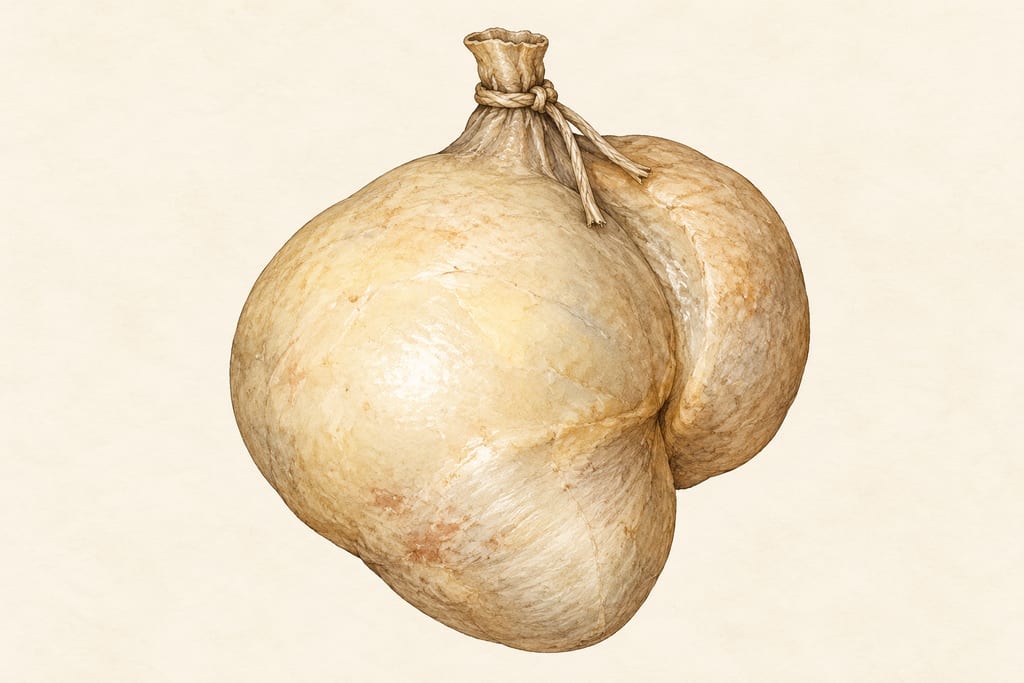
A prepared animal-stomach pouch holds butter in Kazakh and Kyrgyz traditions. Field images document empty and filled qarın in southern Kyrgyzstan, while a Kazakh tutorial distinguishes animal-specific qaryn forms.
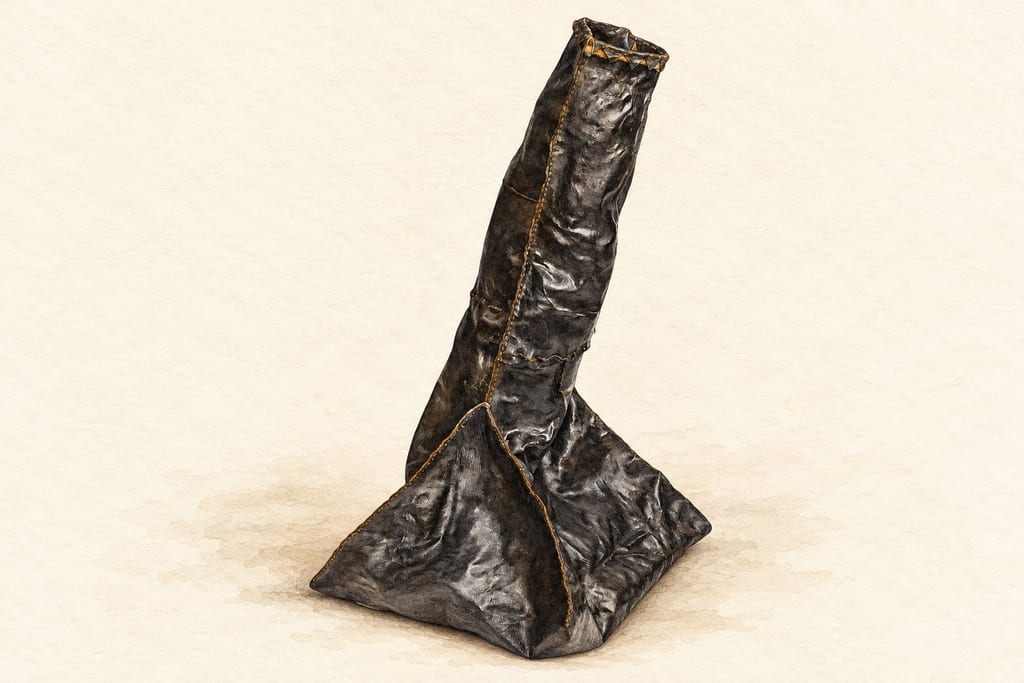
Saba is a large Kazakh horsehide vessel used to prepare and keep kumis. An Omsk museum specimen shows a tall, narrow neck above a broad, gusseted body, with seams stitched in hair thread and hide smoked to make it water-resistant.

A Cap-Pelé boucanière is an Acadian herring-smoking building. The documented Willie Niles example is a one-storey wood-frame structure with a ridge smoke vent and interior bays for hanging fish-bearing cannes.

Achcharu is a family of Sri Lankan vinegar pickles made with mixed vegetables or seasonal fruit and a piquant spice dressing. This version is a quick, refrigerated, non-fermented mixed-vegetable pickle.

The acocote is a long, hollowed and dried gourd used to draw aguamiel from a mature maguey. It is a harvesting tool: the sap is transferred to a separate vessel before it ferments into pulque.

Adrak murabba preserves young ginger in sugar syrup, a sweet South Asian preparation recorded in Indian cookery and food-processing sources.

Parkia biglobosa seeds are fermented into regional West African seasonings, including nététou, iru, dawadawa and soumbala. The yellow fruit pulp is a separate food, and names and methods vary by place.

Japanese reddish-brown vinegar from sake lees matured about three years, turned to vinegar by acetic bacteria; the vinegar of Handa and Edomae sushi rice.

A refined common-wheat flour blended for a broad range of baking; its protein and behavior vary with wheat, milling and market.

The almond mushroom, Agaricus subrufescens, was cultivated in eastern North America in the 1800s, lost its market, and returned as a cultivated mushroom from Brazil, where it is grown under several names.
No community contributions have been published for this entry yet.
Sign in to contribute. Published comments and photos are free to read.
The I. Zhansugurov Historical and Local Lore Museum via e-Museum.kzDesign · Materials · Use · Geography · History
Torsyk (traditional leather vessel for liquids)The museum describes torsyk as a Kazakh nomadic-life vessel for carrying and storing kumis, shubat and water, with a narrow neck, stopper and strap for a saddle, belt or yurt.
It describes processed hide shaped on a mold and sewn, decorated with carved or embossed ornaments, with reinforced stitching at the bottom.
The catalogue dates its specimen to the nineteenth century and records 40 × 27 cm; it does not establish that measurement as a standard for the type.
Cited in: A portable flask, not a fermentation bag; Hide shaped, sewn and closed for carrying; What the dated objects can tell us; Reading its role alongside kumis
Memorial Museum of Akyn Sara via e-Museum.kzDesign · Materials · Use · Geography · History
TorsykThe museum describes a tanned animal-hide vessel associated with Kazakh nomadic travel and the storage and transport of kumis, shubat and other drinks.
Its particular example has a jug-like elongated neck, widened wing-like sides, metal rings and a leather strap; the catalogue dates it to the nineteenth century.
The details describe one museum specimen and are not universal requirements for every torsyk.
Cited in: A portable flask, not a fermentation bag; Hide shaped, sewn and closed for carrying; What the dated objects can tell us
Zhambyl Regional Historical and Local Lore Museum via e-Museum.kzDesign · Materials · Dimensions · Use · History
Flask (Torsyk)The museum describes a tanned-leather flask used to pour and store beverages, mold-shaped and decorated with Kazakh patterns.
Its twentieth-century model has a wooden stopper and leather straps; the catalogue records 25 cm width and 43 cm length for this object.
The model documents one form and does not establish that all torsyk have the same decoration, dimensions or fittings.
Cited in: Hide shaped, sewn and closed for carrying; What the dated objects can tell us