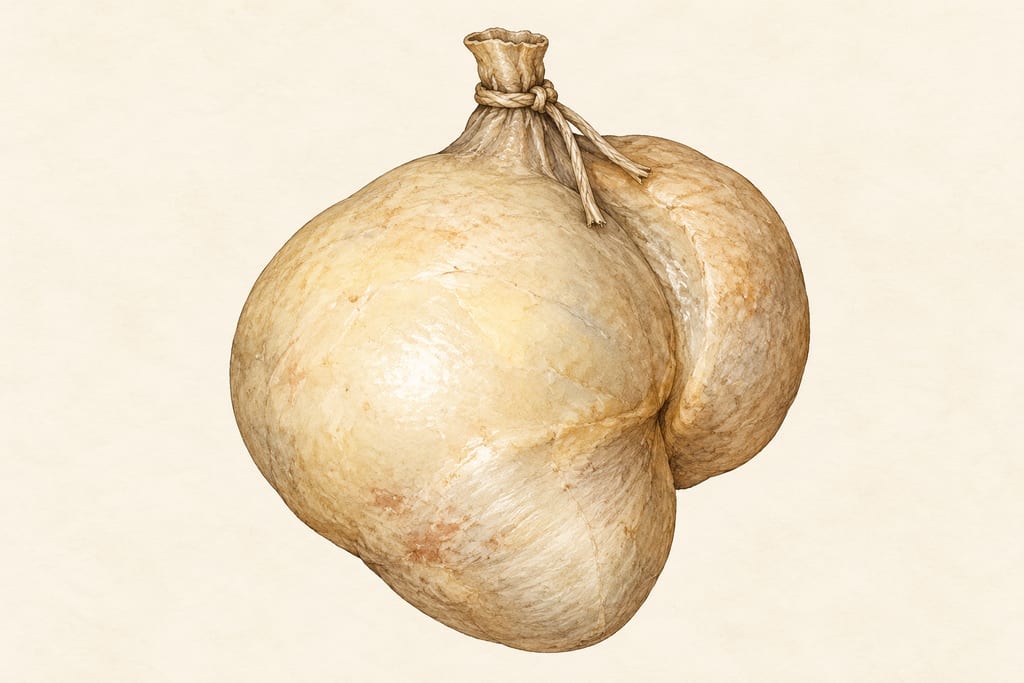
Qaryn butter stomach
A prepared animal-stomach pouch holds butter in Kazakh and Kyrgyz traditions. Field images document empty and filled qarın in southern Kyrgyzstan, while a Kazakh tutorial distinguishes animal-specific qaryn forms.
 FermenteaWhere food goes to change
Equipment · Skins and bladders
Saba is a large Kazakh horsehide vessel used to prepare and keep kumis. An Omsk museum specimen shows a tall, narrow neck above a broad, gusseted body, with seams stitched in hair thread and hide smoked to make it water-resistant.
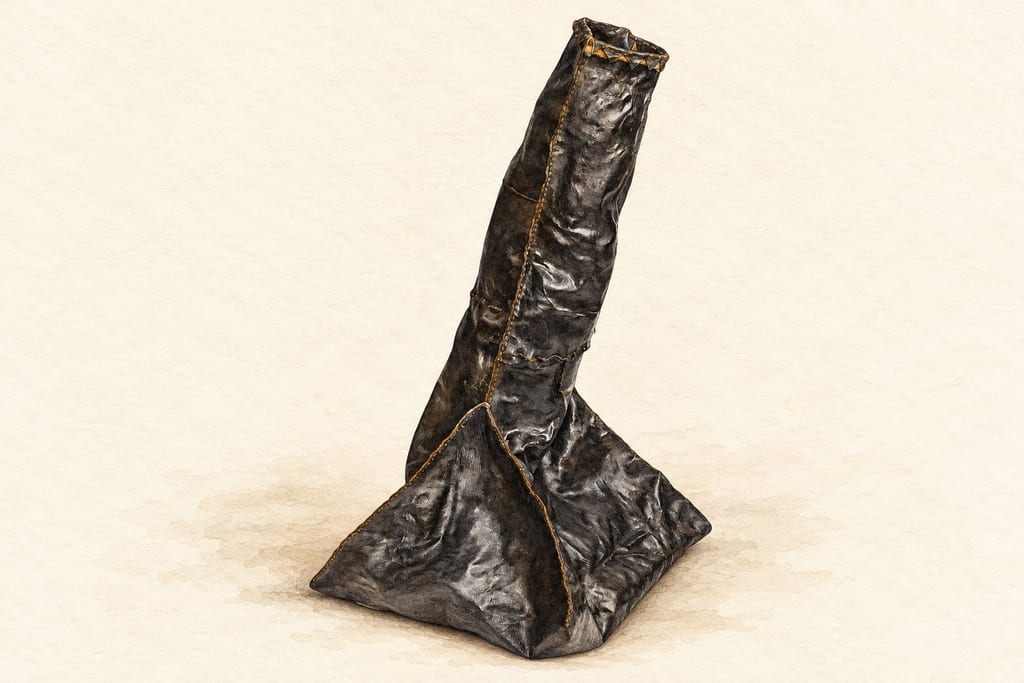
Saba (саба) is a large leather vessel used to prepare and keep kumis, the fermented mare's-milk drink. The Omsk Museum of History and Regional Studies describes its specimen as a leather bag shaped like a truncated pyramid with an elongated top. In the museum photograph, the lower body spreads into a broad, roughly squared base while the upper portion narrows into a long open neck. That overall profile makes the saba readily distinguishable from a smaller travel flask, even though both belong to the wider family of Kazakh leather vessels.
The catalogue dates this object to the second half of the nineteenth to early twentieth century and records its place of creation as the Steppe region of the Russian Empire. Its dimensions are 76 × 38 × 38 cm. The museum does not name which measurement is height or assign the other two to particular axes, so the figures describe this specimen as recorded rather than a template for saba generally. The museum collection is in Omsk; that fact does not establish that the object was made there.
The Omsk museum says its vessel was sewn from one horse skin, while noting that other examples could be made from the skins of two or three animals. It identifies triangular gussets sewn to the sides as the pieces that give this specimen its broad, tapering shape. The photograph shows joined panels and seams running between the lower body and the neck. This is a flexible container formed from treated hide rather than a rigid wooden or fired-clay vat.
Preparing the skin for a saba required sustained craft work. In the museum's account, the wool was removed from the outside and fat cleaned from the inside. The hide was dried in shade, cut and stretched; the maker then smoke-treated it with meadowsweet or birch fumes until it was soft and water-resistant. The description gives a prolonged process, with smoke maintained once or twice a day for almost a month, and says that a saba could take more than three months to make. Those details describe the historical process in the catalogue, not a modern how-to specification.
The museum identifies horsehair or camel-hair thread as stitching material. The stronger seam also appears as a visible line on the darkened specimen. The catalogue does not say which of these two threads was used on this particular object, so the image and written record support the material family but not a more exact identification.
The museum describes the saba as equipment for preparing as well as storing kumis. Before use, it says, a vessel was washed and filled with ayran for several days to reduce the smell of hide. It was then stretched and coated with wet soot, butter or kaimak cream. These are historical notes recorded by the museum; they do not establish modern cleaning advice or a food-safe procedure for a newly made hide container. The source does not specify a single fermentation schedule or starter culture for the Omsk object.
Capacity figures also need to be read as general descriptions rather than object specifications. The museum says a saba could hold up to 50 litres, with some special cases reaching 100 litres. A separate Qazaqstan Tarihy encyclopedia entry calls it a large smoke-treated horsehide container and gives an approximate capacity of 100 litres. The figures may reflect different sizes or descriptive conventions; neither source states a standardized volume, and the Omsk catalogue does not report the measured capacity of its own specimen.
The important distinction is scale and purpose. The museum describes a broad, flexible bag suitable for preparing and keeping a substantial quantity of kumis, while smaller leather flasks such as torsyk are associated with transporting drinks. Similar material does not make these objects interchangeable: the sources do not support treating every leather flask as a fermentation vessel or assigning one shared form to all of them.
The Culture.ru catalogue calls saba a traditional Kazakh vessel and records this example's broad creation region as the Steppe region of the Russian Empire. Qazaqstan Tarihy likewise describes the vessel in the context of traditional Kazakh society, emphasizing processed, smoked horsehide and a broad lower section narrowing to a neck. Together, the records support associating saba with Kazakh kumis-making while preserving the limits of what they say about geography: neither source identifies a specific historical workshop or locality for the Omsk object.
The Omsk object is therefore best read as one documented historical form, not as a universal pattern or a photograph of contemporary use. Its dark smoked hide, extended neck, gussets and stitched construction are visible and named in the museum record. Details such as a stand, suspension cord, stopper, ornamental carving or a particular hanging arrangement are not established for this specimen, so they are not included in the depiction. The linked museum photograph preserves the source object; the generated illustration is a separate, reference-based rendering.
The Omsk Museum of History and Regional Studies dates its saba specimen to the second half of the nineteenth to early twentieth century and gives the Steppe region of the Russian Empire as its place of creation. This attests to one object, not the invention date or full historical range of the vessel type.
The documented Omsk object is one late nineteenth- to early twentieth-century specimen. Its single-piece construction, measurements and visible seams should not be made universal; the catalogue itself notes that other bags could use skins from more than one animal.
Source →Sources disagree in how they describe capacity: up to 50 litres, exceptionally 100 litres in the museum account, versus approximately 100 litres in the encyclopedia. Neither gives a standardized capacity for this vessel type.
Source →Saba is a large kumis vessel; it is distinct from a torsyk, a smaller leather container associated with carrying or keeping drinks. The Omsk object description does not establish a universal fermentation schedule, starter culture, or current household practice.
Source →The source supports a country-level traditional-use association only; it does not identify a specific Kazakh locality.
Collection location for the specific object; not its place of manufacture or evidence that the practice originated in Omsk.
A prepared animal-stomach pouch holds butter in Kazakh and Kyrgyz traditions. Field images document empty and filled qarın in southern Kyrgyzstan, while a Kazakh tutorial distinguishes animal-specific qaryn forms.
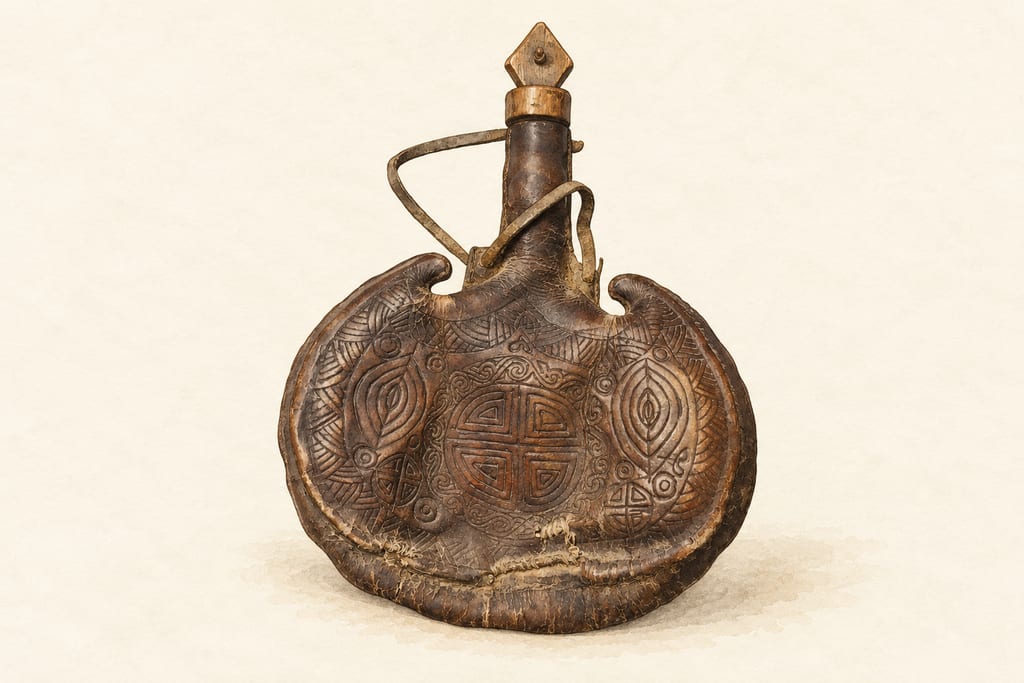
Torsyk is a portable Kazakh leather flask for carrying and keeping drinks such as kumis and shubat. Museum examples have a flattened decorated body, a narrow neck and a stopper; evidence for fermentation inside the travel flask is lacking.

A Cap-Pelé boucanière is an Acadian herring-smoking building. The documented Willie Niles example is a one-storey wood-frame structure with a ridge smoke vent and interior bays for hanging fish-bearing cannes.

Achcharu is a family of Sri Lankan vinegar pickles made with mixed vegetables or seasonal fruit and a piquant spice dressing. This version is a quick, refrigerated, non-fermented mixed-vegetable pickle.

The acocote is a long, hollowed and dried gourd used to draw aguamiel from a mature maguey. It is a harvesting tool: the sap is transferred to a separate vessel before it ferments into pulque.

Adrak murabba preserves young ginger in sugar syrup, a sweet South Asian preparation recorded in Indian cookery and food-processing sources.

Parkia biglobosa seeds are fermented into regional West African seasonings, including nététou, iru, dawadawa and soumbala. The yellow fruit pulp is a separate food, and names and methods vary by place.

Japanese reddish-brown vinegar from sake lees matured about three years, turned to vinegar by acetic bacteria; the vinegar of Handa and Edomae sushi rice.

A refined common-wheat flour blended for a broad range of baking; its protein and behavior vary with wheat, milling and market.

The almond mushroom, Agaricus subrufescens, was cultivated in eastern North America in the 1800s, lost its market, and returned as a cultivated mushroom from Brazil, where it is grown under several names.
No community contributions have been published for this entry yet.
Sign in to contribute. Published comments and photos are free to read.
Omsk Museum of History and Regional Studies via Artefact / Culture.ruDesign · Materials · Dimensions · History · Geography · Use · Care
Saba, a bag for making koumissThe museum dates its object to the second half of the nineteenth to early twentieth century, attributes its creation to the Steppe region of the Russian Empire and records dimensions of 76 × 38 × 38 cm.
Its description identifies a horsehide leather bag with an elongated top, a broad truncated-pyramid form and triangular side gussets; the specimen was sewn from one horse skin, though other bags could use two or three.
The catalogue describes smoking with meadowsweet or birch fumes, horsehair or camel-hair stitching, preparation and storage of kumis, and a general capacity statement up to 50 litres and in exceptional cases 100 litres.
Cited in: A large hide vessel for kumis; Horsehide shaped with gussets and smoke; Preparation and storage, without a single capacity standard; A Kazakh vessel and a particular museum record
Qazaqstan Tarihy (e-history.kz), QazContent JSCDesign · Materials · Use · History
СабаThe encyclopedia entry describes saba as a large smoke-treated horsehide wineskin for keeping kumis, with a broad base, narrower neck, stitched sections and a cord for suspension.
It gives an approximate capacity of 100 litres, which differs from the Omsk museum's broader range; neither figure should be treated as a standard for every vessel.
Cited in: Preparation and storage, without a single capacity standard; A Kazakh vessel and a particular museum record