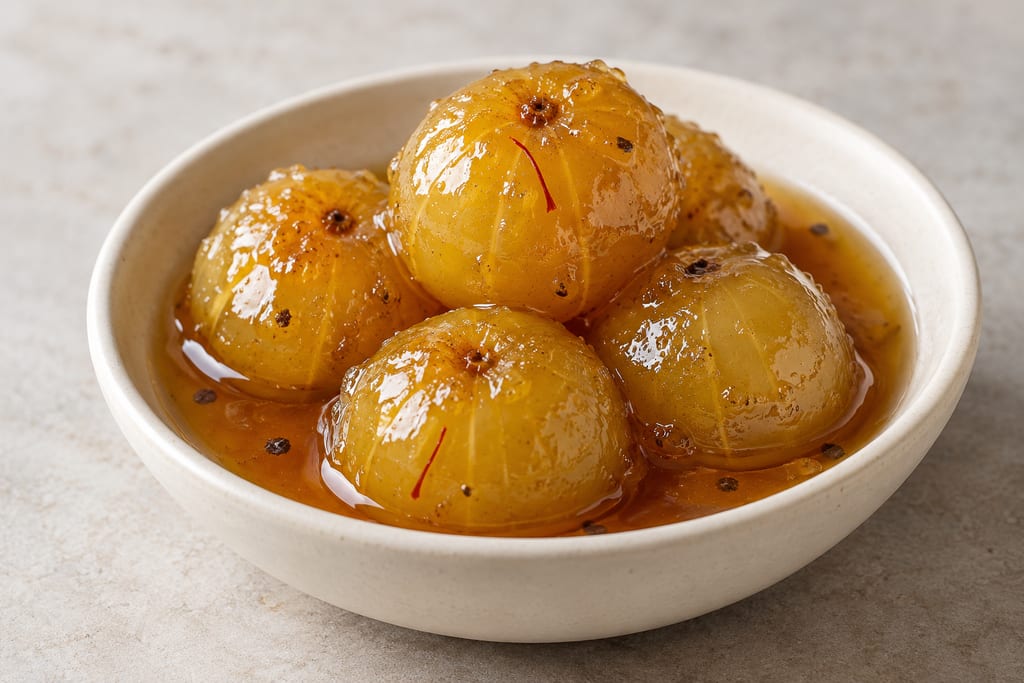
Amla murabba
Amla murabba preserves whole Indian gooseberries in a heavy sugar syrup scented with cardamom and sharpened with pepper and black salt. This household method soaks the fruit before cooking.
 FermenteaWhere food goes to change
Salt
Black salt, or kala namak, is a South Asian rock salt fired with plant material until it holds sulphur compounds and smells of boiled eggs. It seasons chaats, chutneys and fruit, and it gives vegan egg dishes their eggy note.
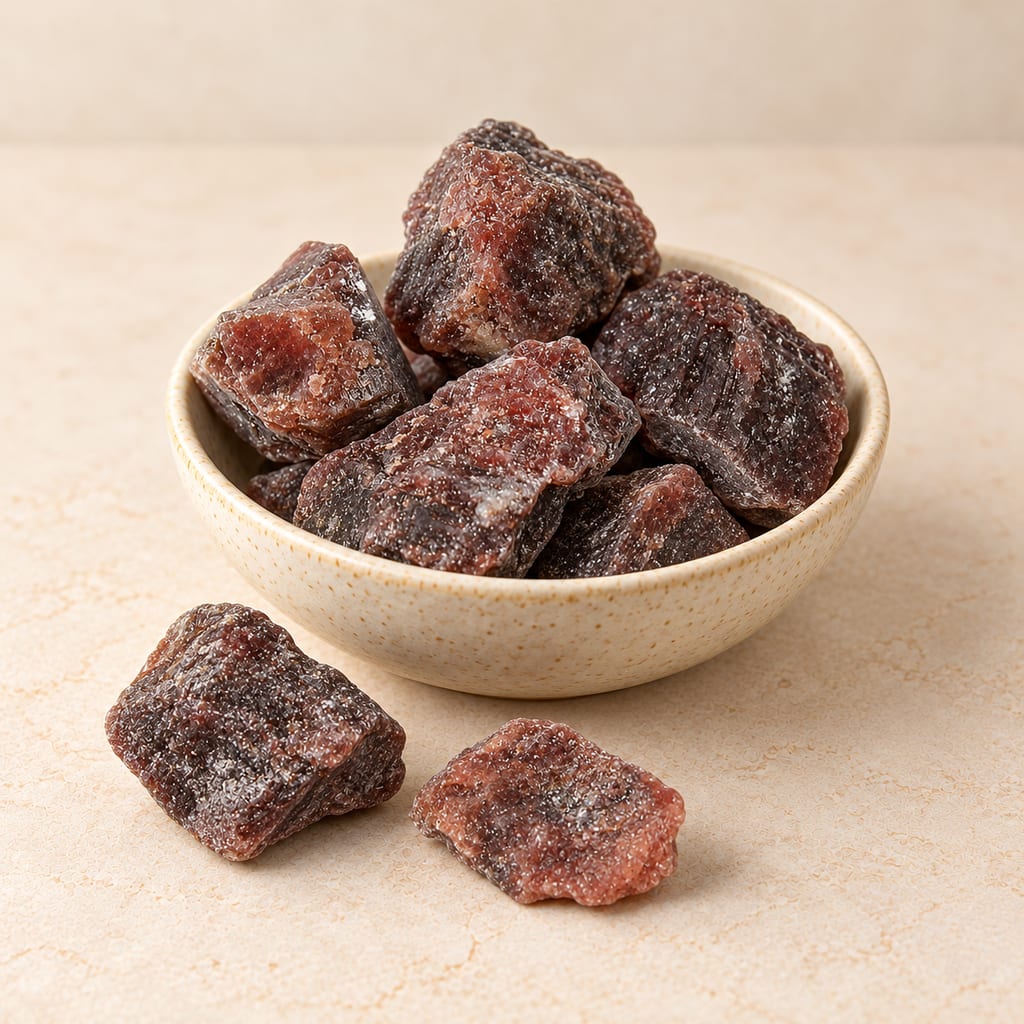
Black salt is the English name of kala namak (काला नमक), the sulphurous rock salt of the Indian subcontinent, also sold as Himalayan black salt. In Indian cooking the same salt also goes by the names rock salt and saindhav. It is a very light, finely ground salt, and despite its name it is not black: its colour runs from reddish grey to pink, which German risk assessors attributed to its content of minerals, above all iron. Used sparingly it gives food a sulphurous taste that resembles an older boiled egg.
It is a seasoning of northern India, Pakistan and Bangladesh. In Indian kitchens it goes into fruit salads and chutneys and is sprinkled over raita, the yoghurt dish made with cucumber and tomato. It is also used in naturopathic treatments and in vegan cooking, where its egg smell stands in for egg.
The European Commission calls it an Indian-Pakistani speciality. No place of origin and no date for its first making is recorded.
The salt takes its character from firing. In the European Commission's description, a rock salt is heated together with harad seeds, from the tree Terminalia chebula, or with parts of the plant Salsola stocksii until it melts and the plant material carbonises. A 2023 paper on rural manufacture adds that white nuggets of salt are converted with Ayurvedic ingredients in a kiln at 800 to 850 degrees Celsius, in work that is laborious and time-consuming. Firing leaves the salt with the sulphur smell that gives it its identity.
Chemically, kala namak is mostly sodium chloride. It carries trace impurities of sodium sulphate, sodium bisulphate, sodium bisulphite, sodium sulphide, iron sulphide and hydrogen sulphide. Hydrogen sulphide, a gas that smells of rotten eggs at very low concentrations, is the compound that gives the food its egg note; German food inspectors, who do not know from which compound in the salt the gas is released, found about 200 mg per kilogram by a semi-quantitative test in one imported sample, and a Swiss laboratory measured 28,351 micrograms, about 28 mg, per kilogram in a commercial kala namak in 2025. The two figures come from different samples and methods, and they show that the hydrogen sulphide content of black salt varies from product to product.
It is not the same as Himalayan pink salt, which is mined at the Salt Mines in Pakistan and made up of 95 to 98% sodium chloride with 2 to 4% polyhalite. A study of Himalayan black rock salt using electron microscopy and X-ray diffraction found irregular crystals with quadrilateral and cubic forms, lower sodium than common sea salt and Himalayan pink salt, and measurable iron, calcium and magnesium. It is not clear that the sample tested was a kiln-fired product.
Hydrogen sulphide is one of the compounds that makes an egg smell like an egg. In a 2025 analysis of scrambled chicken egg it measured 967 micrograms per kilogram, with a dose-over-threshold factor of 97, meaning it was far above the level at which people can smell it. A commercial vegan scramble made from pea protein contained 498 micrograms per kilogram, and the vegan product lacked five other important egg odorants, including a cucumber-like aldehyde and a butter-like diketone, while it had extra mushroom, grassy, sweaty and metallic notes.
Kala namak is a common way to put the sulphur back. It is sold commercially as a flavouring to mimic the sulphur flavour of egg in vegan egg products, and the Zurich researchers built their aroma models with kala namak as the hydrogen sulphide source: 170 mg of salt supplied the 4.84 micrograms needed for 5 g of model egg. Even without hydrogen sulphide, a simplified six-compound model resembled scrambled egg for 75% of the panel, but taking hydrogen sulphide out of that model lowered the sulphury, malty, seasoning-like and metallic notes and raised the nutty one.
The gas is smelled at tiny concentrations. German risk assessors cite an odour threshold of 0.025 ppm in air, a clear smell at 0.3 ppm and an unpleasant one from 3 to 5 ppm.
In Indian cooking kala namak is used sparingly, on fruit salads, in chutneys and over raitas. It provides the sulphur note that ordinary salt cannot. A Hindi recipe for amla murabba adds it to a sweet preserve. A kilogram of amla is cooked in a syrup of 1.5 kg of sugar and left to cool, and then 8 to 10 ground cardamom pods, half a teaspoon of black pepper, 1 teaspoon of black salt and optionally half a teaspoon of saffron are stirred in. The salt goes in with the other flavourings after the cooking, so it seasons a finished syrup rather than a boiling pan. The recipe does not say why the salt is there.
Hydrogen sulphide is a toxic gas, and the salt that carries it was assessed for that reason. In 2003 the German Federal Institute for Risk Assessment was asked to judge a black salt in which a food inspection laboratory had found about 200 mg per kilogram of the gas. The Institute said the data did not allow a certain statement about the toxicological significance, but concluded that when the salt is used as intended in Indian cooking, in small amounts as a seasoning, consumers face no health hazard. The sample was not objected to under food law because it was imported from Britain, where it was presumably sold lawfully.
In the European Union a novel food is one not eaten to a significant degree before 15 May 1997. A 2021 European Commission consultation record, Ares(2021)2856980, with Germany's federal office for consumer protection and food safety as recipient, found that kala namak is not novel. The Austrian authority had confirmed that it is listed as a special salt in the Austrian Food Code, and the listing rests on information from the United Kingdom that kala namak was traditionally used in foods there before that date. In India, a 2023 article on its manufacture says that the food regulator monitors the making and marketing of black salt closely.
The legal status says nothing about how much to use. The salt is mostly sodium chloride, and its sodium must be counted like that of any other salt.
No date for the first making of kala namak is recorded, and the accounts of its manufacture differ on the starting salt, the plant material, the firing time and the temperature: the European record names harad seeds or Salsola stocksii, and the only temperature given is 800 to 850 degrees Celsius. The role of the salt in the amla murabba recipe is not stated.
An Indian-Pakistani speciality of Indian cooking; no place of origin is named.
Amla murabba preserves whole Indian gooseberries in a heavy sugar syrup scented with cardamom and sharpened with pepper and black salt. This household method soaks the fruit before cooking.
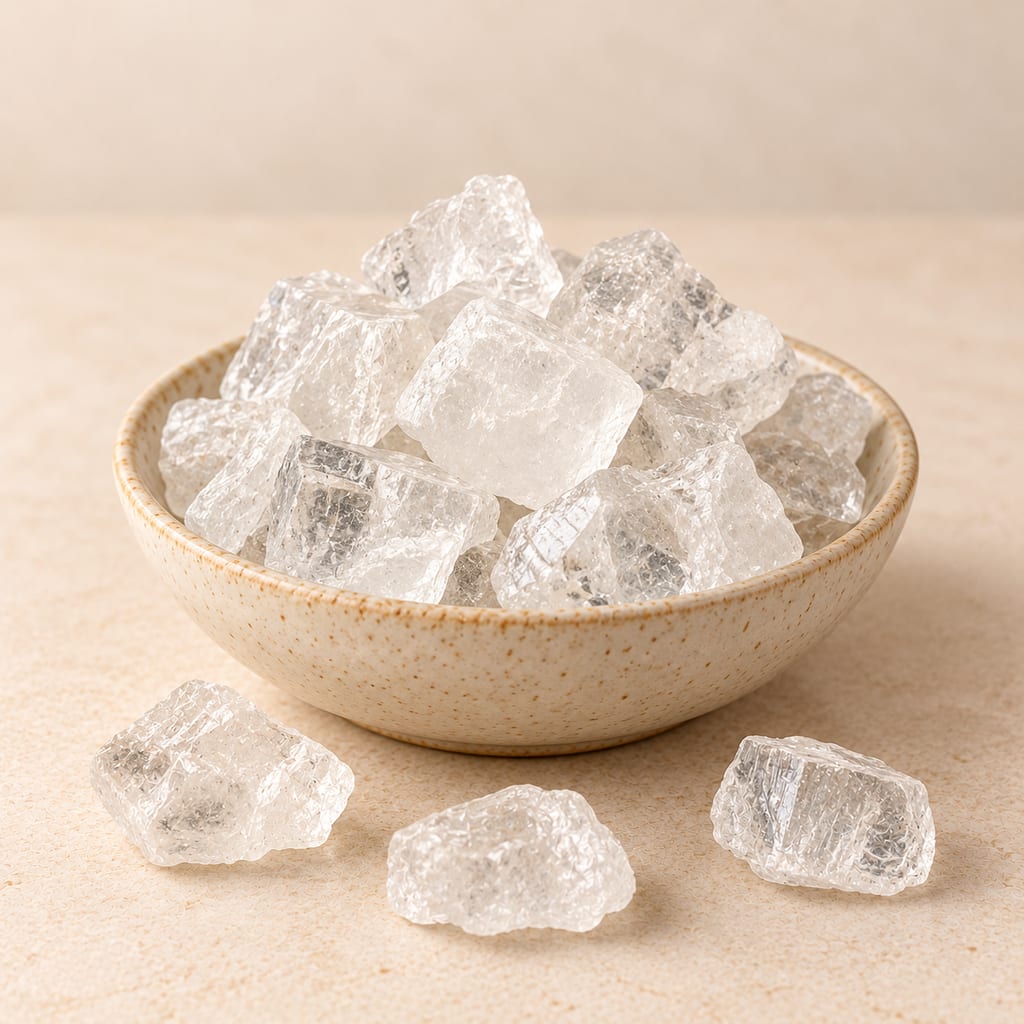
Rock salt is sodium chloride mined from ancient salt beds, sold from coarse grey chunks to pink Himalayan crystals and the fired black salt, kala namak, used in Indian cooking.
No community contributions have been published for this entry yet.
Sign in to contribute. Published comments and photos are free to read.
European Commission, Regulation (EU) 2015/2283 consultation record (recipient Member State: Germany, BVL)Identity · Regulation
Consultation request for a determination of novel food status: Kala namak (Himalayan black salt), Ares(2021)2856980, 29 April 2021Kala namak is a rock salt heated together with harad seeds (Terminalia chebula) or parts of Salsola stocksii until it melts and the plant material carbonises; it contains small quantities of hydrogen sulphide; an Indian-Pakistani speciality; not a novel food; listed as a special salt in the Austrian Food Code; traditionally used in the United Kingdom before 15 May 1997
Cited in: A salt that tastes of eggs; Made in the kiln; Safety and the law; Notes and open questions
Bundesinstitut fuer Risikobewertung (BfR), German Federal Institute for Risk AssessmentIdentity · Use · Safety
Vorkommen von Schwefelwasserstoff in Schwarzsalz (Occurrence of hydrogen sulfide in black salt), statement of 25 August 2003Black salt, called kala namak or black salt and also rock salt or saindhav in Indian cooking, is a very light, finely ground special salt from the ground that is reddish grey to pink and gives an old boiled-egg sulphur taste; used on fruit salads and chutneys and sprinkled over raitas; one sample held about 200 mg/kg hydrogen sulfide by a semi-quantitative test; the source compound of the hydrogen sulfide is not known; the institute found no health hazard under the intended use in Indian cooking
Cited in: A salt that tastes of eggs; The chemistry of the egg note; In the kitchen and in the preserving pan; Safety and the law
The Pharma Innovation Journal, Singh, Tyagi, Chaudhary and Baliyan, 2023Processing
Traditional and rural manufacturing process of black saltWhite nuggets of salt with some Ayurvedic ingredients converted in a kiln at 800-850 C; laborious and time-consuming; manufacture and marketing monitored by the food regulator
Cited in: Made in the kiln; Safety and the law; Notes and open questions
Journal of Agricultural and Food Chemistry, Tran and colleagues, 2025Science
Decoding the Aroma Gap: Sensomics-Based Characterization of Key Odorants in the Plant-Based Egg and Chicken EggHydrogen sulfide 967 ug/kg in scrambled chicken egg and 498 ug/kg in a vegan scramble (dose over threshold 97 in egg); a commercial kala namak held 28,351 ug/kg hydrogen sulfide in a 12% solution assay and served as the hydrogen sulfide source in aroma models (170 mg of salt per 4.84 ug); omitting hydrogen sulfide lowered sulfury, malty, seasoning-like and metallic notes
Cited in: The chemistry of the egg note
Foods, Boukid and Gagaoua, 2022Use
Vegan Egg: A Future-Proof Food Ingredient?Himalayan black salt or kala namak is sold as a flavouring to mimic the sulfur flavour of egg in vegan egg formulations
Cited in: The chemistry of the egg note
Cureus, Pai, Ramanarayanan and Rajeev, 2024Use
Analysis of Fluoride Content of Different Types of Salts Used in the Indian Diet: An In Vitro StudyMade by a firing process; pungent sulfur smell; used in cooking, naturopathic treatments and vegan diets; commonly used in northern India, Pakistan and Bangladesh
Cited in: A salt that tastes of eggs; Made in the kiln
Environmental Science and Pollution Research, Kuttykattil and colleagues, 2023Composition
Consuming microplastics? Investigation of commercial salts as a source of microplastics (MPs) in dietBlack salt is commonly sodium chloride with trace sodium sulphate, sodium bisulphate, sodium sulphide, iron sulphide, hydrogen sulphide and sodium bisulphite; Himalayan pink salt is mined in the Salt Mines, Pakistan, with 95-98% sodium chloride and 2-4% polyhalite
Cited in: Made in the kiln
Science of the Total Environment, Chander and colleagues, 2020Composition
Structural characterization of Himalayan black rock salt by SEM, XRD and in-vitro antioxidant activityHimalayan black rock salt crystals irregular, quadrilateral or cubic; lower sodium than sea salt and Himalayan pink salt; contains iron, calcium and magnesium
Cited in: Made in the kiln
Nisha MadhulikaUse
Amla murabba recipe (Hindi)1 kg amla and 1.5 kg sugar; after cooling, 8-10 cardamom pods, 1/2 teaspoon black pepper, 1 teaspoon black salt (kala namak) and optional saffron are stirred in
Cited in: In the kitchen and in the preserving pan