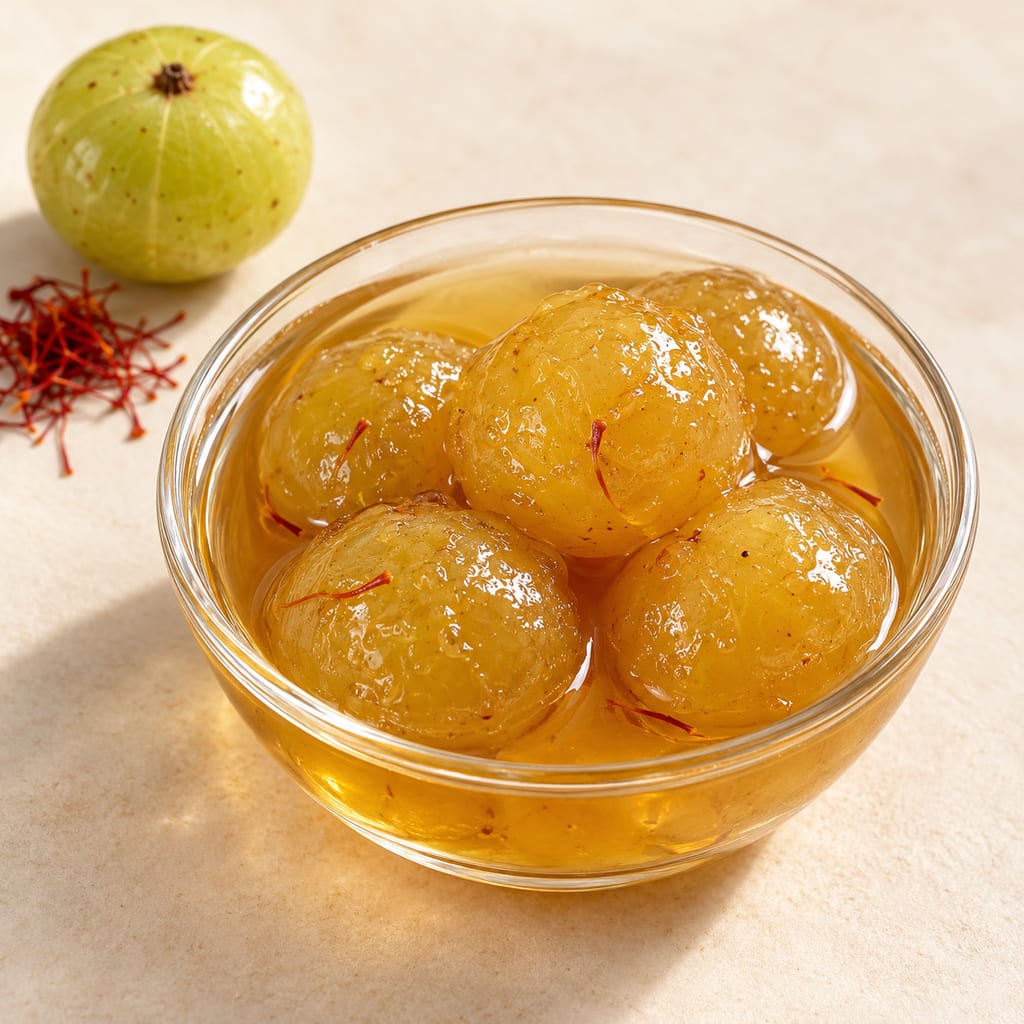
Amla murabba with saffron
Whole amla simmer in sugar syrup with saffron, black cardamom and pepper in this chef's version of the Indian fruit preserve. The fruit is soaked overnight before cooking.
 FermenteaWhere food goes to change
Salt
Rock salt is sodium chloride mined from ancient salt beds, sold from coarse grey chunks to pink Himalayan crystals and the fired black salt, kala namak, used in Indian cooking.
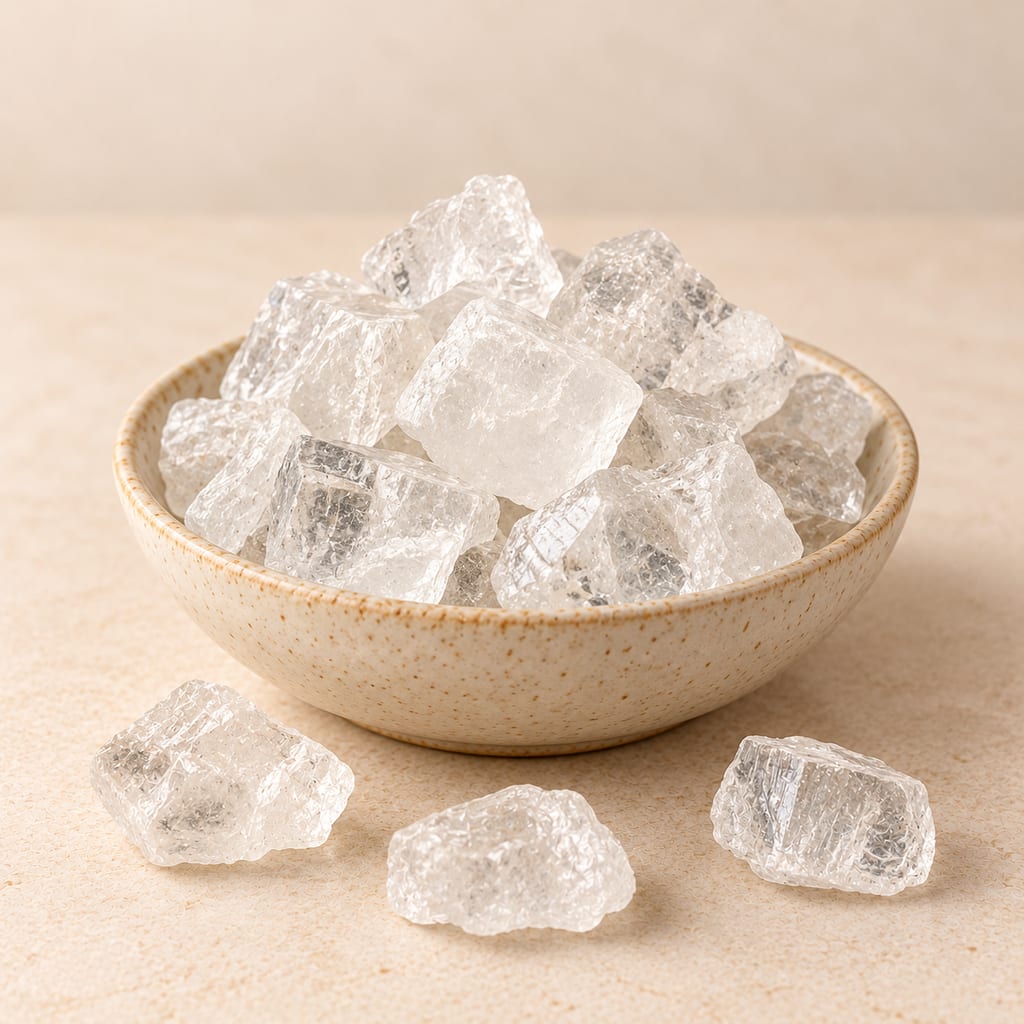
Rock salt is salt that was mined, not evaporated from water at the surface. The mineral is halite, sodium chloride, NaCl, which forms cubic crystals and occurs in crystalline, granular and massive forms. A seam of rock salt can be colourless, white, pink or red, depending on the impurities locked in as it formed. The same chemical compound is sold as table salt, sea salt and flaked finishing salt, and what separates them is how they were obtained, how clean and how finely divided they are, and what has been added.
Because "rock salt" describes an origin and not a specification, the name tells you less than it appears to. A coarse grey block sold for road de-icing and a pink crystal sold in a spice jar can both be rock salt. The Kansas deposit mined near Hutchinson is a good example: the salt it yields is used mostly for de-icing, while its highest-purity output, over 99.8 percent sodium chloride, is used for table salt, food processing and animal feed. The international standard for food-grade salt requires at least 97 percent sodium chloride on a dry matter basis, excluding additives, and sets limits for other substances, so what matters in the kitchen is whether the packet is sold for human food and what it contains.
Rock salt is a mineral, not an organism, so it has no species, variety or microflora of its own. What it brings to a preparation is sodium chloride and, depending on the deposit, small amounts of other minerals.
Every rock-salt deposit begins as a body of salty water that dries faster than it is refilled. In Kansas, the Hutchinson Salt Member was laid down in the Permian period about 275 million years ago in a restricted sea under a hot, dry climate, where evaporation exceeded the inflow of water and salt built up on the sea floor. Producing one foot of salt took about 80 feet of seawater, so the bed took thousands of years to accumulate. Younger rock then buried it. Today the deposit covers about 37,000 square miles under central and south-central Kansas, reaches more than 500 feet in thickness and is about 80 percent salt.
Other deposits are older still, and no two are the same. The Salt Range of Punjab, in Pakistan, holds the Khewra deposit, which its operator dates to the Precambrian, as far back as 600 million years. The geology matters to the cook for a simple reason: how pure a salt is, and what colour, depends on what else was in the ancient water and mud. The age of a bed does not tell you how clean a particular packet of its salt is.
Rock salt is taken from the earth in two ways. In room-and-pillar mining, a shaft reaches the bed and the salt is cut away in a checkerboard pattern, leaving pillars to hold up the roof. In Kansas about 75 percent of the salt is removed and 25 percent is left as support, in mines 600 to 1,000 feet deep. The Khewra mine is also worked room-and-pillar, on 17 levels, with seven thick salt seams adding up to about 150 metres of salt.
The second way is solution mining. Water is pumped down a well into the deposit, the salt dissolves, and the brine is brought to the surface, where it is evaporated to recover the salt. The salt that results is then crystallised, as it would be from seawater, and no longer looks like the rock that was underground. A packet that begins in a buried bed can therefore be a evaporated crystal, and a rough chunk that looks natural can be a quarried piece. Whether a product is food grade depends on how it was handled after extraction.
The best-known rock salt in the kitchens of South Asia comes from the Salt Range of Punjab. The Khewra mine, about 160 kilometres south of Islamabad in the foothills of the range, produced 314,397 tons in 2022 to 2023. Its operator, the Pakistan Mineral Development Corporation, gives its average purity as 98 percent and describes salt ranging from transparent white through pink to red. The corporation sells edible salt in white, pink and dark-pink grades, in granular and powder form, alongside material for de-icing, decoration, animal licks and industry.
India has its own rock salt. Hindustan Salts Limited operates mines at Mandi in Himachal Pradesh, which it took over on a long-term lease in 1963. The Indian Bureau of Mines yearbook for 2012 records that the rock salt from the Mandi mines contained 67.81 percent sodium chloride, and that it was not suitable for human consumption, since edible salt must contain at least 96 percent; it was generally used to feed cattle. A portion of rock salt produced in India is iodised to supply regions where goitre is endemic. The figures are a useful reminder that the same word can cover a food ingredient and a feed supplement, and that the percentage of sodium chloride is the test.
In Indian cooking the term covers two salts with different jobs. The national dietary guidelines describe rock salt as of two types: pink salt, called sendha namak, and black salt, called kala namak, which can be told apart by colour, texture and smell. Pink salt is described as one of the purest forms of salt.
Kala namak is not simply dark rock salt. It is made by firing raw salt, traditionally from Himalayan-region mines or salt lakes, in a sealed ceramic jar with charcoal and small amounts of ingredients such as harad, amla, bahera and babul bark. The heat converts part of the salt's sodium sulphate into sulphur compounds, which give it the egg-like smell that is the point of the ingredient in chaat masala and in vegan egg dishes. The national guidelines add that black salt darkens in storage and that its spices, charcoal, seeds and bark are part of its preparation. Its sodium content is, however, much like that of other salts.
Rock salt differs from solar salt, which is crystallised from seawater in shallow pans and keeps small amounts of magnesium, calcium, sulphur, potassium, iron and zinc, and from purified salt, which is nearly pure sodium chloride with no additives. The mineral content of a rock salt depends on its bed. Colour is a poor guide: a pink crystal can be as pure as a white one, and neither colour reveals iodine, trace-mineral content or origin.
Salt preserves by taking water away from microbes. Water activity measures how much of the water in a food is free for microorganisms to use, on a scale from 0 for no available water to 1 for pure water. Salt and sugar bind water, so adding them lowers it. Fresh meat and fish sit at 0.99 and raw vegetables at 0.99. Most spoilage bacteria need a water activity of about 0.90 or above, Staphylococcus aureus can grow down to 0.91 without air and 0.86 with air, Clostridium botulinum needs about 0.93, and moulds and yeasts can grow as low as 0.61. A high-salt food such as soy sauce is at about 0.8. This is why a salted food can hold off most bacteria while moulds and yeasts, which tolerate the lowest water activity, are the hardest to stop.
Salt does a second, finer job in a ferment: it chooses the winners. A study of kimchi describes this as inhibiting harmful microorganisms by osmotic shock while regulating the selective growth of salt-resistant lactic acid bacteria, with optimal growth and acid production at a salt concentration of about 2 to 3 percent or less. In sauerkraut, a final concentration of 2.25 to 2.5 percent salt draws juice from the cabbage, helps keep undesirable bacteria from growing and favours Leuconostoc, the lactic acid bacteria that begin the fermentation, which tolerate less acid and give way to the more acid-tolerant lactobacilli. The amount of salt in a tested recipe is therefore chosen for the food and the organisms it is meant to favour, not raised for extra safety.
The kind of salt changes the result more than its colour suggests. Kimchi made with solar salt aged for one year, solar salt aged for three years, dehydrated solar salt and purified salt developed different microbial communities. Leuconostoc and Weissella dominated the kimchi made with solar salt, while Latilactobacillus sakei dominated the batches made with purified and dehydrated salt, and the sugars, organic acids and amino acids differed as well. The study did not test mined rock salt, so it shows that salt type matters and not what rock salt in particular would do. Home-preservation guidance asks for pickling salt, notes that iodized or non-iodized table salt can be used, that anti-caking additives can cloud the brine, that reduced-sodium salt is not recommended for fermented pickles, and that flake salt varies in density, which is why recipes should be followed by weight where they give it.
Rock salt turns up in cooking more often as a seasoning than as a preservative. In an amla murabba recipe attributed to the chef Reetu Uday Kugaji, a pinch of rock salt is added late in the cooking of the gooseberries in sugar syrup. The recipe gives no measure, does not present the pinch as a preservative, and leaves colour, grain size and mine unspecified. Another method for the same preserve calls for kala namak, a reminder that a recipe's "rock salt" and "black salt" are different choices.
Beyond the preserve, sendha namak and kala namak season fruit, chutneys, raitas and chaats, and plain rock salt serves in the same ways as other salts in curing, brining and cooking. A large crystal can be crushed in a mortar or bought ground. Ground and chunked salt weigh differently by volume, so a "pinch" or a spoonful can mean quite different masses.
When a recipe says only "rock salt", the practical questions are which of the three it means: plain pink or white sendha namak, the sulphurous kala namak, or a coarse salt meant for a brine. The answer changes the flavour, since kala namak carries sulphur notes that plain salt does not, and it changes the quantity, since a recipe written for fine table salt by weight will be undersalted if the same volume of coarse crystals is used, since they pack less salt into a spoon. Where a recipe gives grams, use grams, and where it does not, add salt by taste in a cooked dish and not by the spoonful in a preserve or ferment.
Buy rock salt that is sold for food. The label should say it is edible, and for fermentation, where the salt amount matters, it should say whether it is iodised or contains anti-caking agents. A decorative block or a mine sample is not a food ingredient because it looks like the crystals in the spice aisle. Keep salt dry, in a sealed container, away from rain and humidity; the international standard advises that iodised salt not be exposed to rain, excess humidity or direct sunlight, since iodine is lost under those conditions.
Salt is a source of sodium whatever its colour. The World Health Organization identifies sodium and chloride as the main components of regular salt, recommends reducing sodium intake, and recommends iodised salt for consumption. A pink colour or a claim about trace minerals does not take away the sodium in a serving. Salt is not among the major food allergens named by the US Food and Drug Administration; anyone with an allergy should still read the label of a purchased blend, since spiced or fired salts such as kala namak contain other ingredients.
The recipe names no mine, producer or sourcing country. Kansas, Punjab and Mandi are explanatory examples, not the provenance of its salt.
Whole amla simmer in sugar syrup with saffron, black cardamom and pepper in this chef's version of the Indian fruit preserve. The fruit is soaked overnight before cooking.
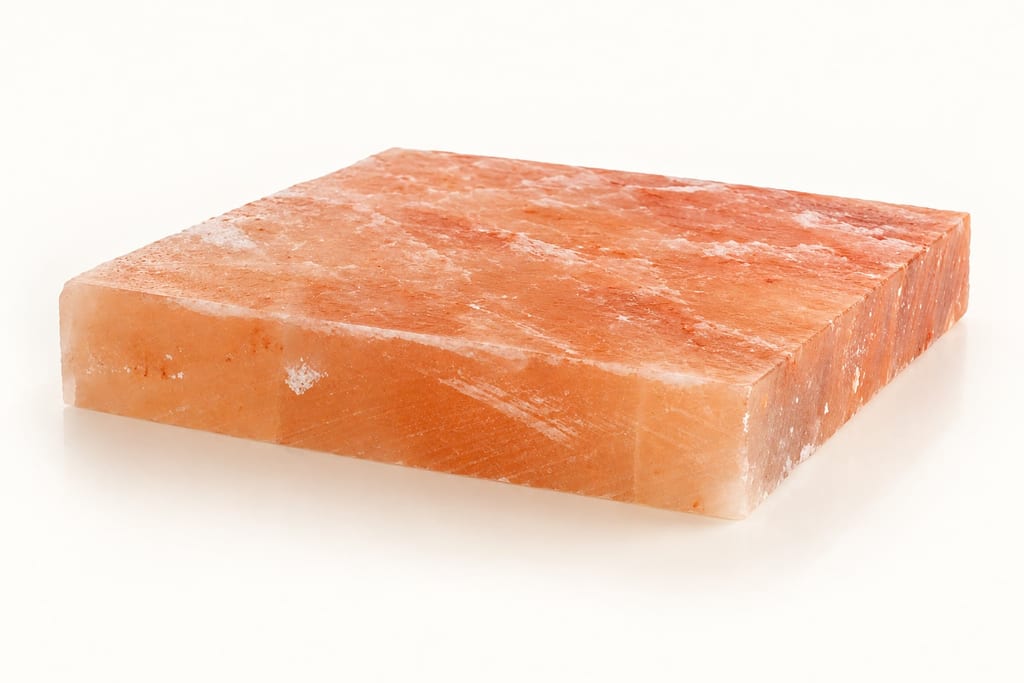
A salt cooking slab is a cut block of food-grade salt used as a heated cooking surface or a chilled serving plate. Its material is edible salt, but a decorative salt block is not automatically suitable for food.
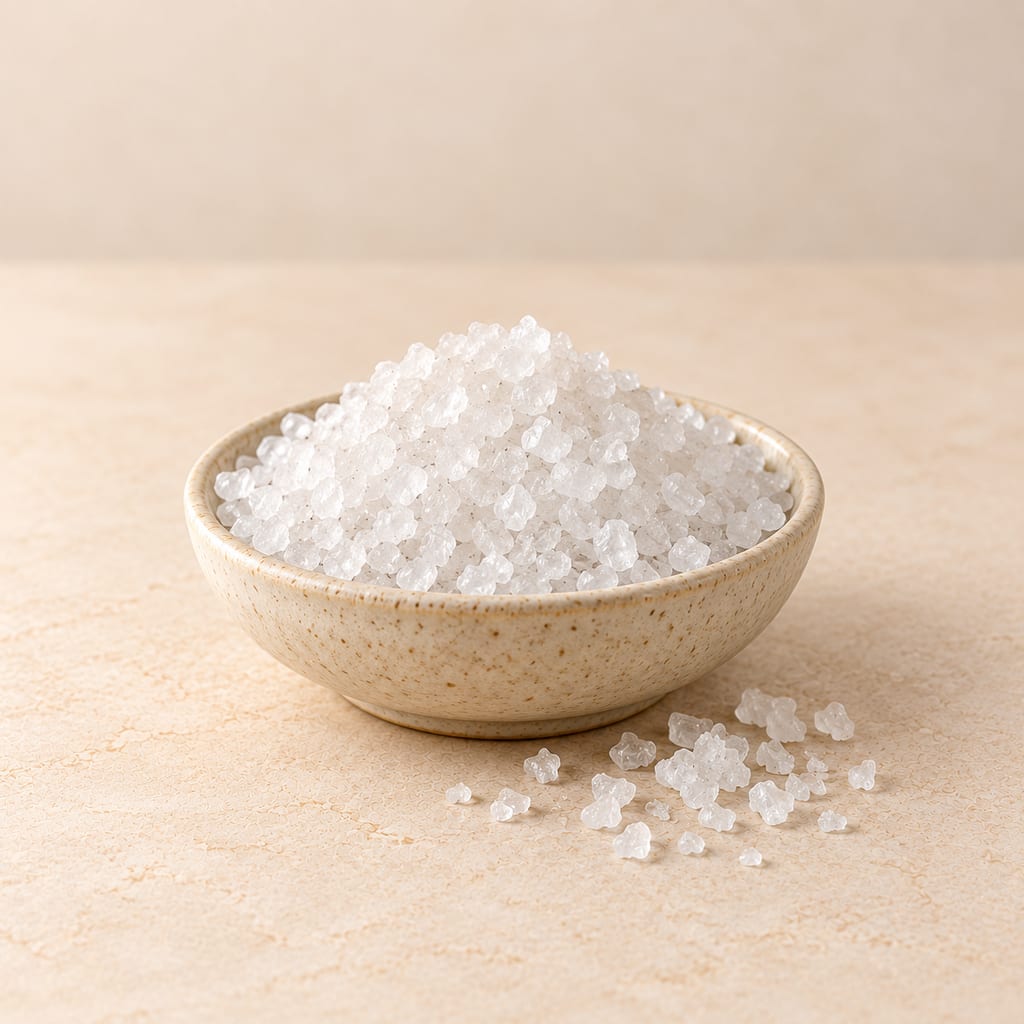
Coarse salt is food-grade salt in large grains, from sea, rock deposits or brine, used for curing, brining, pickling and packing fish.
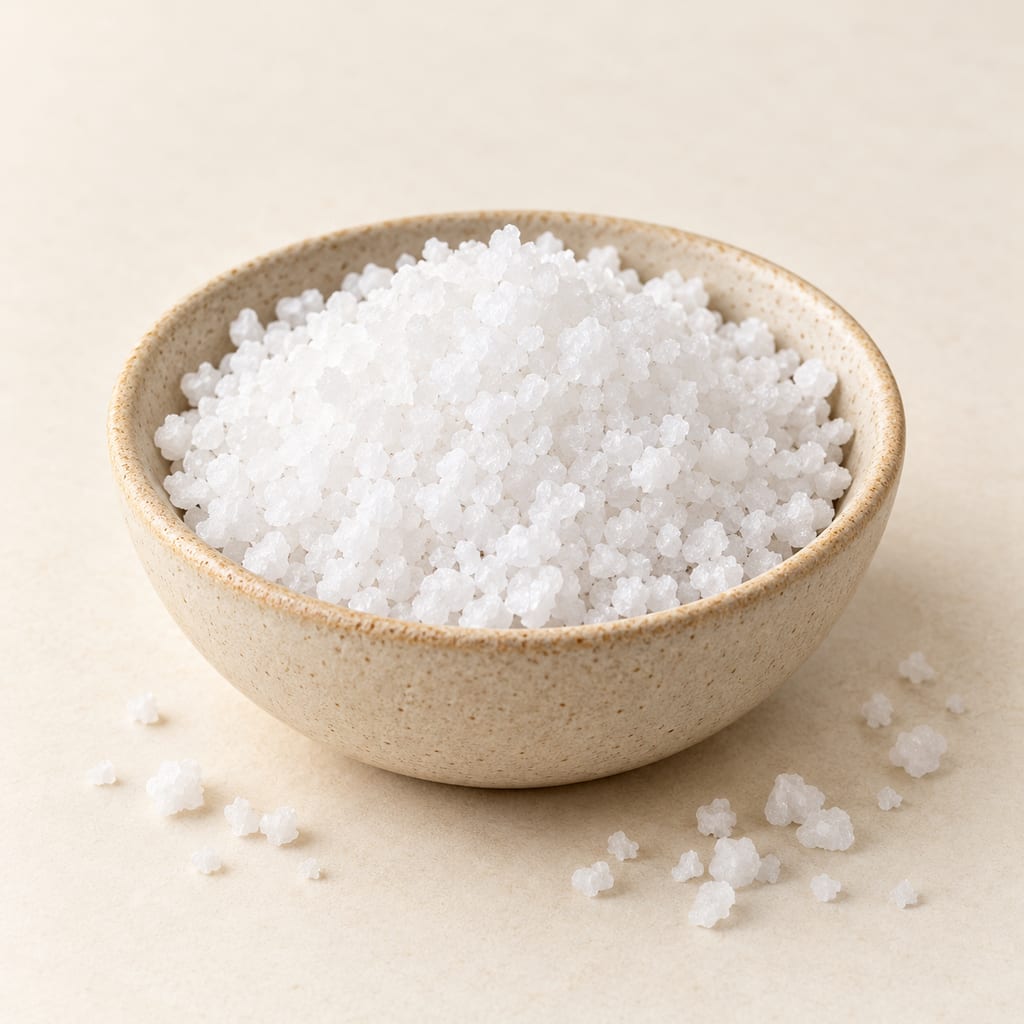
Food-grade sodium chloride seasons food and changes water movement in brines and cures; crystal size and the recipe's measurement method matter.
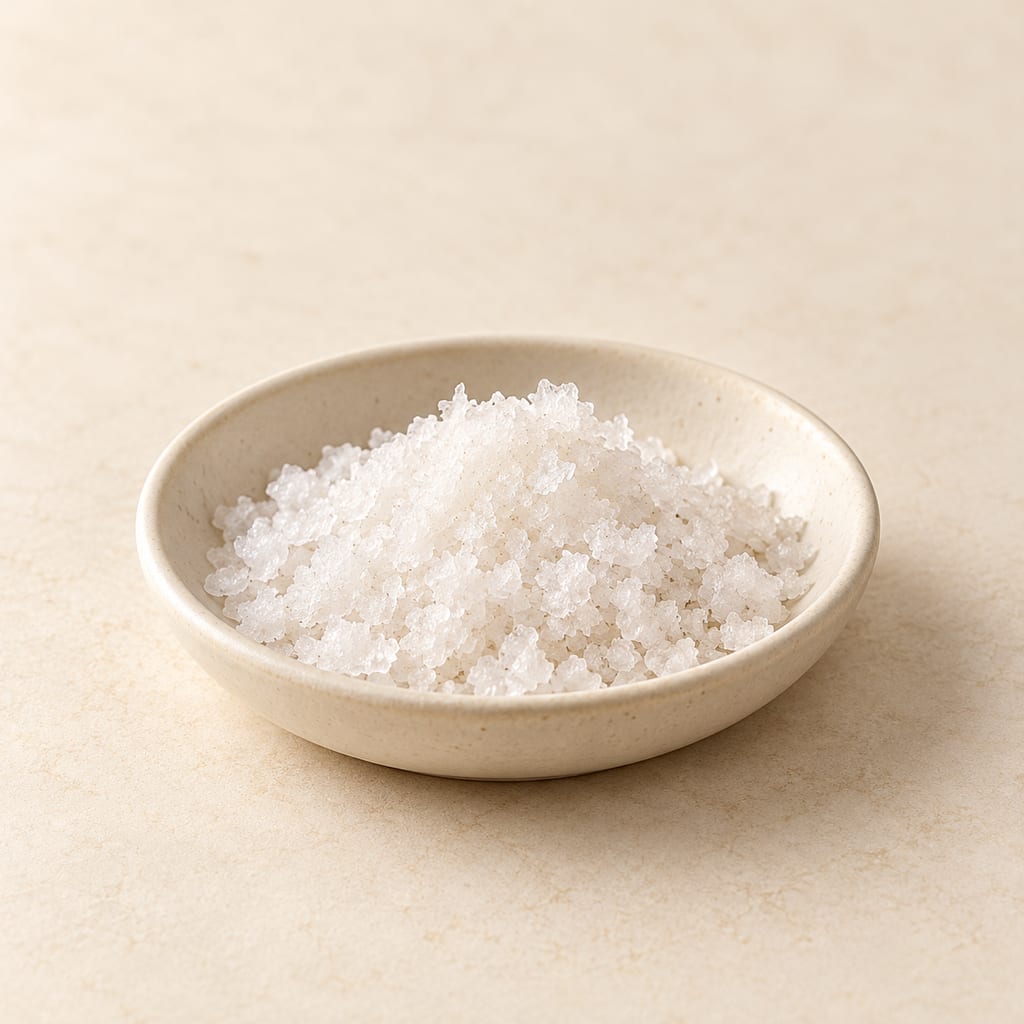
Salt recovered from seawater comes as fine grains, coarse crystals and delicate flakes. Its production, crystal form and measured use connect coastal saltworking with cooking and preservation.
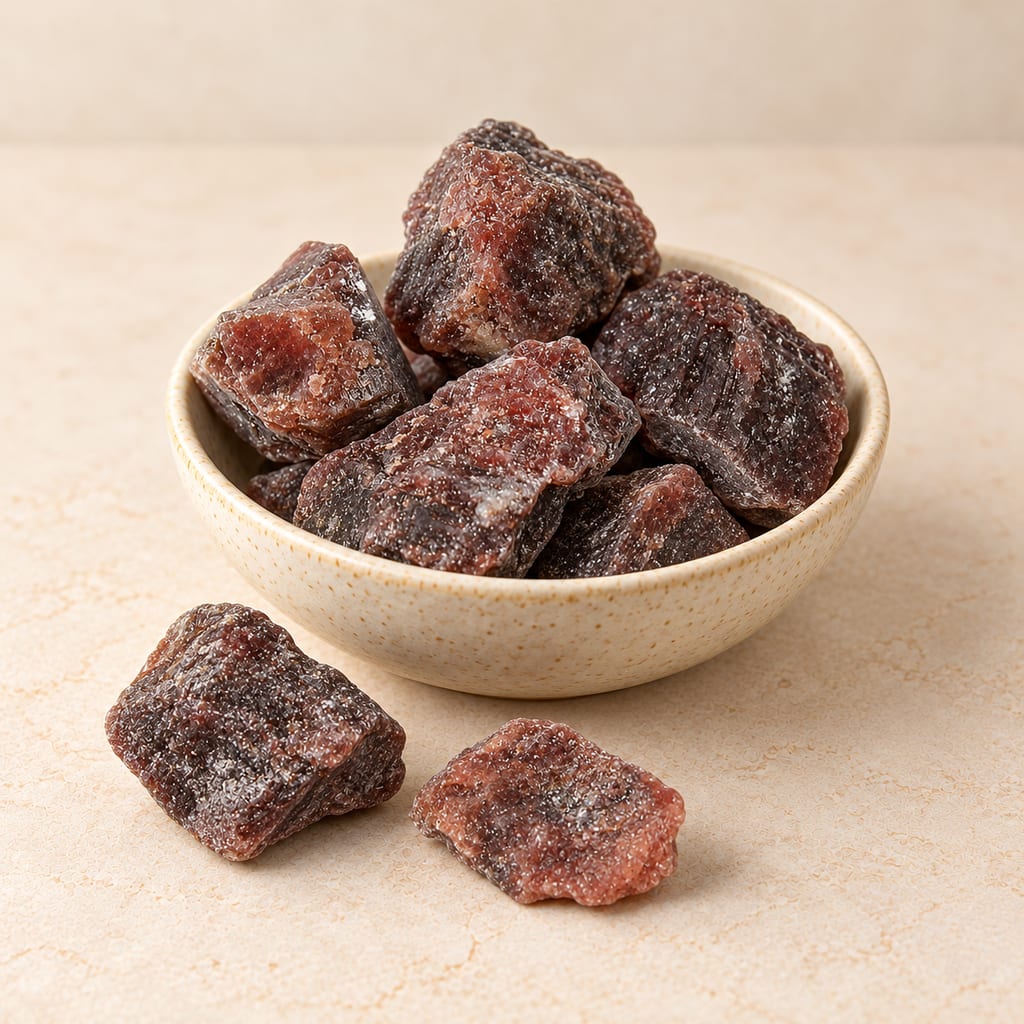
Black salt, or kala namak, is a South Asian rock salt fired with plant material until it holds sulphur compounds and smells of boiled eggs. It seasons chaats, chutneys and fruit, and it gives vegan egg dishes their eggy note.
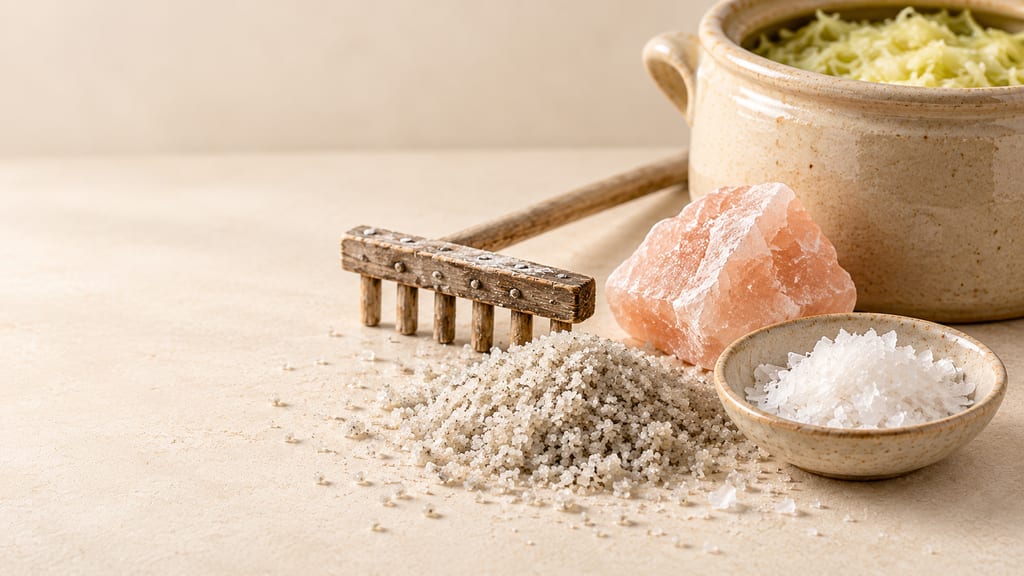
Salt seasons a meal, shapes fermentation and preserves food. Its history follows the people who mine, harvest, trade and transform it, and the choices hidden inside an ordinary packet.
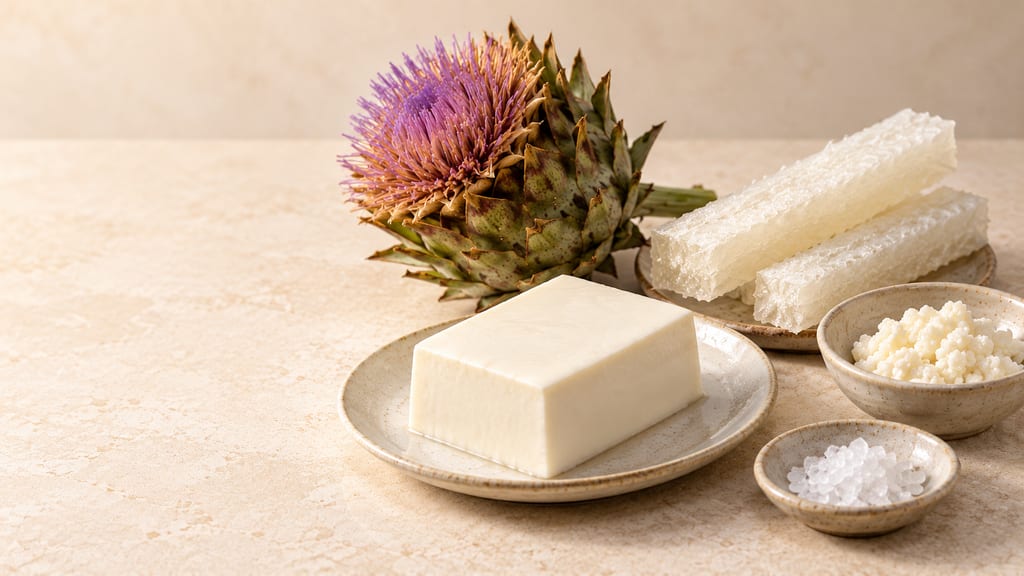
Cheese, tofu, agar, nixtamal and cured ham all begin with a liquid or soft food made to set, sour or keep. Rennet is one branch of that history, beside plant enzymes, acids, minerals, alkalis, gels, finings and curing salts.
No community contributions have been published for this entry yet.
Sign in to contribute. Published comments and photos are free to read.
British Geological Survey
HaliteHalite is sodium chloride, NaCl, occurring in crystalline, granular and massive forms with cubic crystals.
Cited in: Salt from the ground
Kansas Geological Survey; Robert S. Sawin and Rex C. Buchanan
Salt in KansasHutchinson Salt Member: Permian, about 275 million years old, 37,000 square miles, over 500 feet thick, 80 percent salt, 80 feet of seawater per foot of salt; room-and-pillar mining removes about 75 percent in mines 600 to 1,000 feet deep; solution mining; uses include de-icing and over 99.8 percent sodium chloride for table salt.
Cited in: Salt from the ground; How a salt bed forms; Getting it out of the ground
US Environmental Protection Agency
Class III Injection Wells for Solution MiningSolution mining: water injected into a salt deposit dissolves it and the brine is brought to the surface.
Cited in: Getting it out of the ground
Pakistan Mineral Development Corporation
MinesKhewra salt mine in the Punjab Salt Range: 160 km south of Islamabad; geological horizon Precambrian, back to 600 million years; room-and-pillar; 17 levels; seven thick seams totalling 150 m; average purity 98 percent; colours white to pink and red; 314,397 tons produced in 2022-23.
Cited in: Getting it out of the ground; Khewra, Mandi and South Asian rock salt
Government of India, Ministry of Heavy Industries
Hindustan Salts Limited (HSL) And Sambhar Salts Limited (SSL)Mandi rock-salt mines in Himachal Pradesh transferred to Hindustan Salts Limited on a long-term lease in 1963.
Cited in: Khewra, Mandi and South Asian rock salt
FAO/WHO Codex Alimentarius
Standard for Food Grade Salt, CXS 150-1985Food-grade salt contains at least 97 percent NaCl on a dry matter basis excluding additives; iodised salt should be protected from rain, humidity and sunlight in storage.
Cited in: Salt from the ground; Choosing, storing and health
Government of India, Indian Bureau of Mines
Indian Minerals Yearbook 2012: Salt (Rock)Mandi rock salt contained 67.81 percent NaCl, unsuitable for human consumption since edible salt must contain at least 96 percent NaCl; generally used to feed cattle; part of rock-salt output is iodised.
Cited in: Khewra, Mandi and South Asian rock salt; Choosing, storing and health
Pakistan Mineral Development Corporation
Khewra Pink Rock SaltKhewra salt product list: edible white, pink and dark-pink salts in granular and powder forms, and de-icing, decorative, animal-lick and industrial products.
Cited in: Khewra, Mandi and South Asian rock salt; Pink, black and white: the kinds of rock salt
NDTV Food; Sarika Rana, recipe attributed to Reetu Uday Kugaji
How To Make Amle Ka Murabba At HomeAmla murabba recipe attributed to Reetu Uday Kugaji adds a pinch of rock salt late in cooking the amla in sugar syrup.
Cited in: Rock salt in the kitchen: amla murabba and other uses
ICMR-National Institute of Nutrition
Dietary Guidelines for IndiansIndian dietary guidelines: rock salts are pink salt (sendha namak) and black salt (kala namak), distinguishable by colour, texture and smell; pink salt among the purest salts; black salt darkens in storage; made with spices, charcoal, seeds and bark; sodium content almost similar.
Cited in: Pink, black and white: the kinds of rock salt; Rock salt in the kitchen: amla murabba and other uses
Nisha Madhulika
Amla Murabba RecipeAn amla murabba method that calls for kala namak.
Cited in: Rock salt in the kitchen: amla murabba and other uses
Heliyon; Lee and colleagues
Effects of salt type on the metabolites and microbial community in kimchi fermentationKimchi with solar salt aged 1 and 3 years, dehydrated solar salt and purified salt: salt inhibits harmful microbes by osmotic shock and selects salt-resistant lactic acid bacteria, optimal at about 2-3 percent or less; Leuconostoc and Weissella with solar salt, L. sakei with purified and dehydrated salt; sugars, organic acids and amino acids differed.
Cited in: Pink, black and white: the kinds of rock salt; What salt does in preserving and fermenting
National Center for Home Food Preservation
Salts Used in PicklingPickling salt recommended; iodized or non-iodized table salt acceptable; anti-caking agents may cloud brine; reduced-sodium salt not recommended for fermented pickles; flake salt varies in density.
World Health Organization
Sodium reductionSodium and chloride are the main components of regular salt; recommends reducing sodium intake and iodized salt.
Cited in: Choosing, storing and health
US Food and Drug Administration
What is a major food allergen?The list of major food allergens does not include salt.
Cited in: Choosing, storing and health
Kansas State University Research and ExtensionPreservation
Water Activity of Foods (MF3674)Water activity scale; salt and sugar bind water; most spoilage bacteria need about 0.90; S. aureus 0.91 anaerobic and 0.86 aerobic; molds and yeasts about 0.61; C. botulinum around 0.93; fresh meat, fish and raw vegetables 0.99; soy sauce 0.8.
Cited in: What salt does in preserving and fermenting
Clemson Cooperative Extension, Home and Garden Information CenterFermentation
Making SauerkrautSauerkraut at 2.25 to 2.5 percent salt: salt draws juices, keeps undesirable bacteria from growing and favours Leuconostoc, which start the fermentation and are followed by acid-tolerant lactobacilli.
Cited in: What salt does in preserving and fermenting
Wikipedia (tertiary overview)Variety
Kala namakKala namak is kiln-fired in a sealed jar with charcoal and herbs or bark; sodium sulphate converts partly to sulphur compounds that give the smell. Cited as a tertiary summary.
Cited in: Pink, black and white: the kinds of rock salt