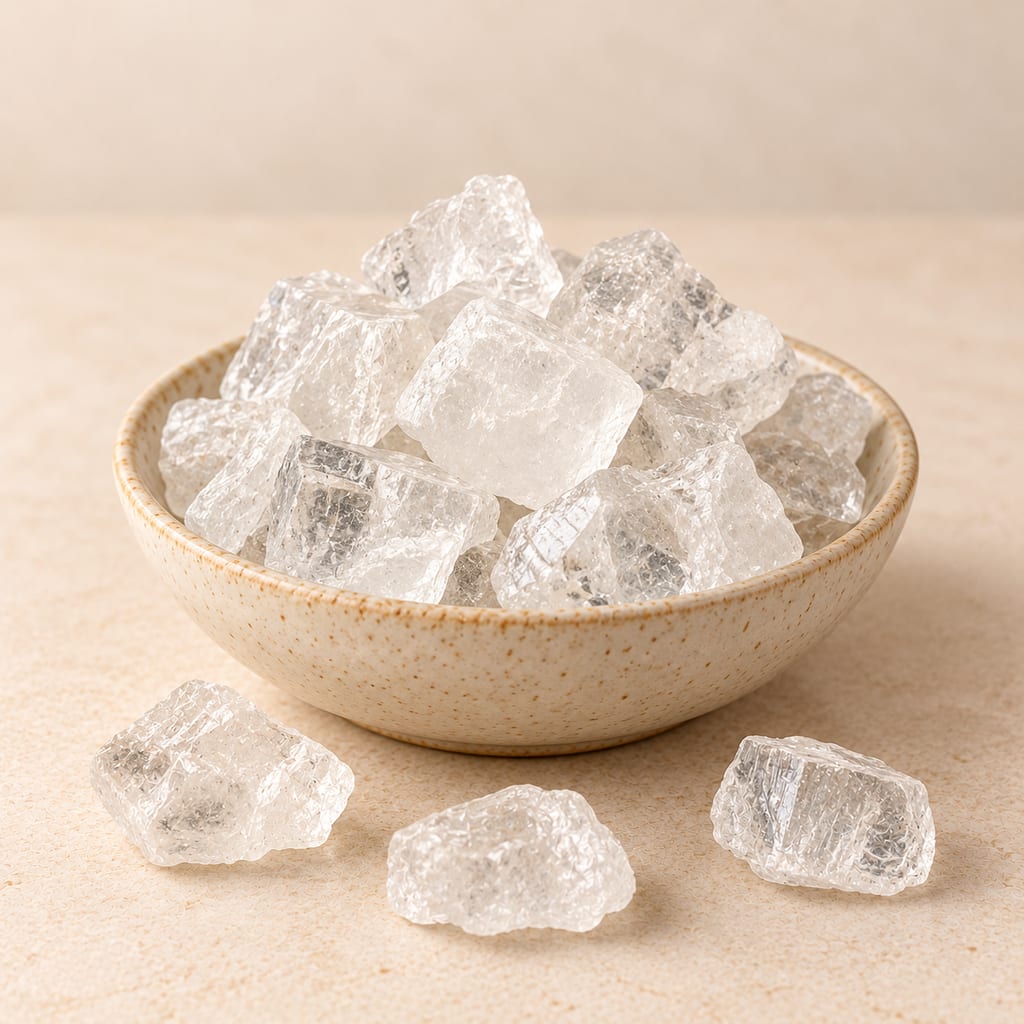
Rock salt
Rock salt is sodium chloride mined from ancient salt beds, sold from coarse grey chunks to pink Himalayan crystals and the fired black salt, kala namak, used in Indian cooking.
 FermenteaWhere food goes to change
Equipment · Cooking surfaces
Salt block · Salt plate · Salt plank · Salt slab
A salt cooking slab is a cut block of food-grade salt used as a heated cooking surface or a chilled serving plate. Its material is edible salt, but a decorative salt block is not automatically suitable for food.
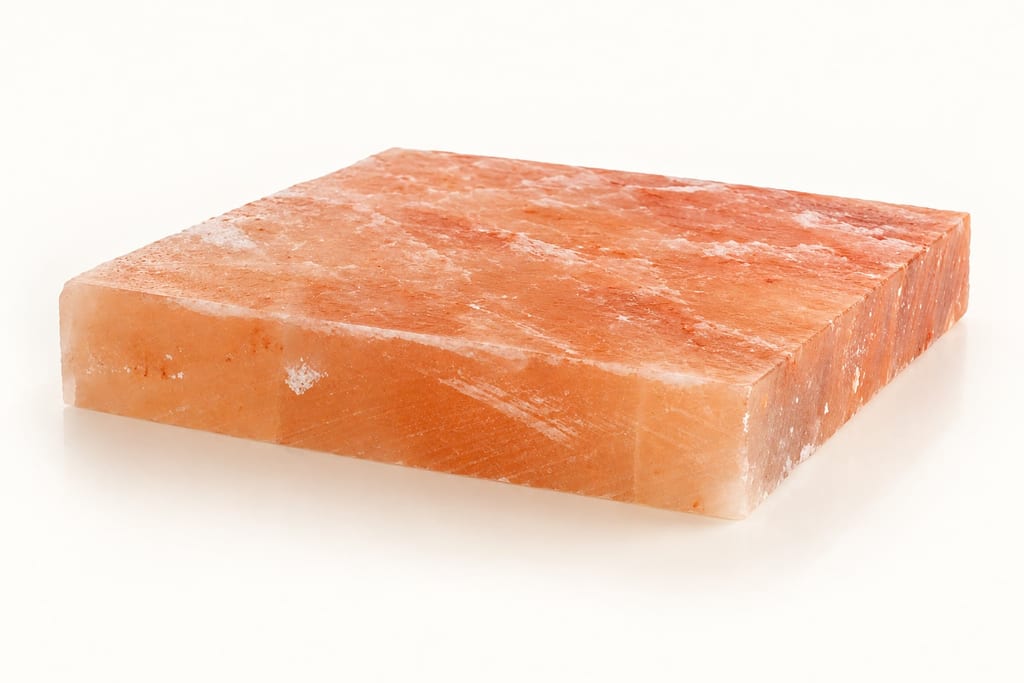
A salt cooking slab is a solid, movable surface cut from a block of salt. It is cookware when heated for contact cooking, and a serving plate when used cool or chilled. Unlike a pan with a separate coating, its working surface is the salt itself: food may pick up salt where it touches the slab, especially when moist. The object and the ingredient overlap materially, but they are different records—the slab is the equipment, and the salt is the edible material. The term also covers a range of forms: vendors use “block,” “plate,” “plank” and “slab” for flat pieces of different sizes and thicknesses.
SaltWorks describes Himalayan salt boulders being cut into slabs, blocks, bricks and plates. The same product may be heated and used as a contact surface, then later chilled for serving. The company describes salt as dense and slow to conduct heat, so the slab holds heat after removal from its source; its guide also notes that moist foods take on more salt than dry foods. Those descriptions concern that supplier’s Himalayan product, not a performance guarantee for every block. A slab is not an appliance: heat comes from an external oven, grill or burner, and the slab itself has no powered parts.
One widely marketed example uses pink rock salt from Pakistan’s Salt Range. SaltWorks says its slabs are made by slicing mined salt boulders and labels its own salt products “Gourmet Food Grade.” Pakistan Mineral Development Corporation describes Khewra salt products in edible and decorative categories, including a rock-and-piece grade for edible or decorative manufacturing. The rock’s origin, colour or shape alone therefore does not establish that a particular block is meant for food. The Codex standard is a reference for food-grade salt; it does not certify a finished slab or any individual retailer’s stock. Check the exact product designation and supplier information.
Natural salt slabs vary in colour, visible inclusions, shape and thickness. Supplier guidance warns that trapped moisture and abrupt heating or cooling may cause cracking, and advises following the particular maker’s instructions. Those cautions cannot be reduced to a single heating or cleaning rule for all products. Do not treat decorative salt blocks or unlabelled mineral pieces as cooking slabs, and do not infer a standard size, food-grade status or performance from a photograph. As the surface wears or breaks, a product may no longer be suitable for its advertised cooking or serving role.
SaltWorks published a dated Himalayan salt-block guide in 2016 and currently describes salt slabs, blocks and plates cut from mined boulders for hot cooking and chilled service. This documents a modern product form, not the invention date or an ancient tradition.
A decorative mineral block is not established as suitable for cooking or food service; the product's actual food-use grade must be checked.
Source →Salt slabs vary in thickness and physical properties, and supplier instructions warn of cracking with trapped moisture or rapid temperature changes; no single size or heat limit applies to every slab.
Source →The listed food-grade claim applies to the supplier's own Himalayan products and does not independently verify every salt cooking slab.
Source →The sources describe current Himalayan-salt-block use, salt from Pakistan, and food-grade salt standards, but do not establish where the cooking-slab equipment class originated or where it is exclusively used.
Rock salt is sodium chloride mined from ancient salt beds, sold from coarse grey chunks to pink Himalayan crystals and the fired black salt, kala namak, used in Indian cooking.

Soft, spreadable Calabrian pork sausage made with a great deal of red chilli and fatty pork, stuffed into natural casings, sometimes smoked and matured while staying soft.

A way to add independent temperature logging to an existing food dehydrator without changing its built-in controls or protections. It is a monitoring method, not a rewiring plan.

Pleurotus cystidiosus is the abalone mushroom, a cultivated oyster-type fungus with dark brown caps that grows more slowly and is more demanding than other Pleurotus species.

A dark, balanced vinegar from Emilia-Romagna made by combining cooked or concentrated grape must with wine vinegar, then acetifying and refining it in wood under a protected specification.

A living dairy inoculum that starts controlled cream fermentation, developing acidity and aroma before sour cream or cultured butter is finished.

A small electric incubator holds jars at a selected temperature for yogurt and other documented warm food preparations. Controls, capacity and vessel arrangement vary by model.

Adygean salt is a seasoned table salt associated with Adygea and the wider North Caucasian culinary tradition. Salt is blended with garlic and a variable selection of herbs and spices; the exact mix depends on the named style and maker.

The African Caesar-group mushroom, Amanita masasiensis, is a wild ectomycorrhizal species of central and southern African woodlands, eaten locally. The genus contains deadly poisonous species, so identification needs care.
No community contributions have been published for this entry yet.
Sign in to contribute. Published comments and photos are free to read.
SaltWorksEquipment form · Equipment use · Material source · Manufacturer food grade claim · Care
Using Himalayan Salt BlocksSaltWorks describes mined Himalayan salt boulders sliced into slabs, blocks, bricks and plates.
The page describes hot cooking and chilled serving uses, and states its products are Gourmet Food Grade; this is the supplier's claim for its own range.
The source describes product variation and warns about cracking from trapped moisture and abrupt temperature change.
Cited in: A slab that is also salt; A hot cooking surface and a cold platter; The source salt and the food-use grade are separate questions; Natural variation sets limits
Himalayan Salt CompanyEquipment variation · Care · Thermal limits
Himalayan Salt Block (Plank) Owner’s GuideThe dated guide describes salt blocks for cooking or serving and discusses varied thickness, appearance and use.
The supplier warns that moisture and uneven heating can stress or crack blocks and gives product-specific care guidance.
Cited in: A slab that is also salt; Natural variation sets limits
Pakistan Mineral Development CorporationGeology · Salt product grades
Khewra Pink Rock SaltPMDC places Khewra rock salt in the Punjab Salt Range and describes several product grades.
Its list distinguishes edible salts from decorative and other salt products; it also lists rock/piece salt for edible and decorative manufacturing.
Cited in: The source salt and the food-use grade are separate questions; Natural variation sets limits
FAO/WHO Codex AlimentariusFood grade standard
Standard for Food Grade Salt, CXS 150-1985The Codex standard defines requirements for food-grade salt; it is a standard reference, not a certificate for a finished salt slab or a specific supplier's item.
Cited in: The source salt and the food-use grade are separate questions