Cantharellus magnus
Cantharellus magnus is a large Chinese chanterelle recorded in five provinces. A national scientific catalogue lists it as edible, but evidence here does not establish preparation or local food traditions.
 FermenteaWhere food goes to change
Mushrooms
Boletus botryoides, the grape-coloured bolete, is a porcini-like wild bolete of central and south-western China. It is listed as edible in Chinese catalogues, but no dish or preparation is documented for it.
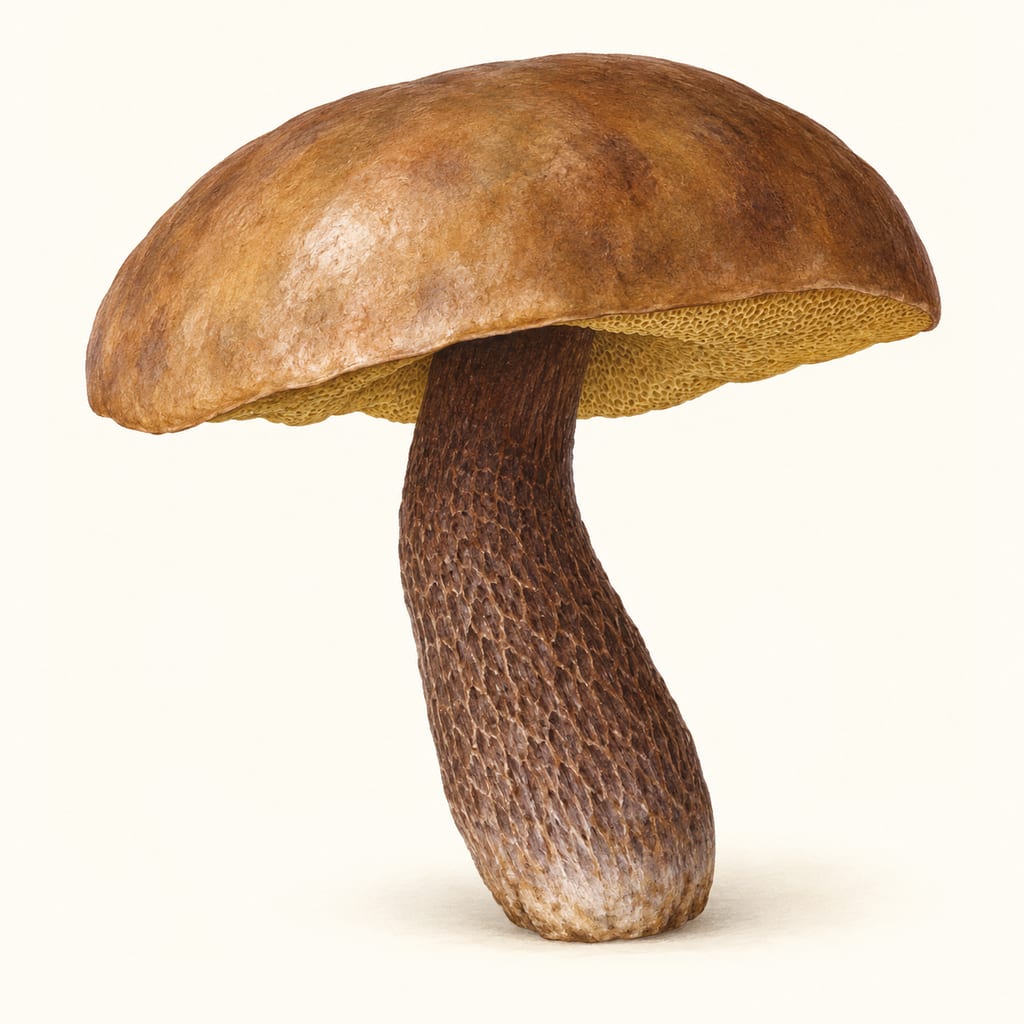
Boletus botryoides belongs to the porcini group, Boletus section Boletus, which contains the bolete most people know as cep or porcino. Its Chinese name, 葡萄色牛肝菌, means grape-coloured bolete. The published description gives a dark brown to olive-brown cap, yellow-brown pores, and a dark stem with a reticulate pattern. It grows in Fagaceae forests, the oak and beech family that forms ectomycorrhizal partnerships with the fungus.
The species was described by Chinese mycologists in 2016 as part of a revision of Chinese porcini. Porcini in this group are hard to separate by appearance, and the description relies on microscopic and molecular characters. The traits listed here summarize the description and are not a field key.
The primary description records the species from Hunan and Yunnan in China, under Fagaceae forest. The vouchers available to the reviewers were collected in August and September. A small set of specimens cannot give the full fruiting season, so those months describe collections and not a general pattern.
The 2026 Chinese catalogue of edible and medicinal fungi lists the species as edible, and a Chinese catalogue of ectomycorrhizal edible fungi also includes it. Those are published food-status records for China. They are not an independent toxicology assessment, and the 2026 catalogue's own index marks the entry as not independently assessed.
The sources reviewed give no dish, preparation method or cooking time specific to this bolete. Porcini recipes from other species should not be applied to it without a source that names it. The species has no documented fermentation role.
Porcini-like boletes from China were revised in 2016 and again in later catalogues, and some names have moved since. A 2025 paper created a separate genus for a related species, which shows that the group's classification is still changing. A market or catalogue name alone does not tell which bolete is on the table.
Species identification relies on microscopy and phylogenetic analysis. Nothing on this page is a foraging instruction, and no wild specimen should be eaten on the strength of a photograph or a description.
Use only correctly identified, food-grade material from a supplier who can say which species it is. The published status is a checklist entry, not a safety guarantee, and the sources reviewed contain no species-specific toxicity assessment.
Collection record; no food use is recorded for this province in the description.
Collection record and catalogue edible listing; no dish documented.
No community contributions have been published for this entry yet.
Sign in to contribute. Published comments and photos are free to read.
Fungal DiversityTaxonomy · Description · Distribution
Porcini mushrooms (Boletus sect. Boletus) from ChinaCap, pore and stem description; Hunan and Yunnan records; Fagaceae forests; August and September vouchers
Cited in: Overview; Where it grows
MycosystemaFood status
Species cataloging of edible and medicinal fungi in ChinaLists the species as edible in the 2026 catalogue; not independently assessed in the supplied index
Cited in: Food status; Safety
MycosystemaFood status
Chinese list of ectomycorrhizal edible fungiIncludes the species among ectomycorrhizal edible fungi
Cited in: Food status
MycoKeysTaxonomy
Pseudobaorangia (Boletaceae, Boletales), a new genus for Boletus lakhanpaliiShows that boletes of this group are still being reclassified
Cited in: Related porcini and identification