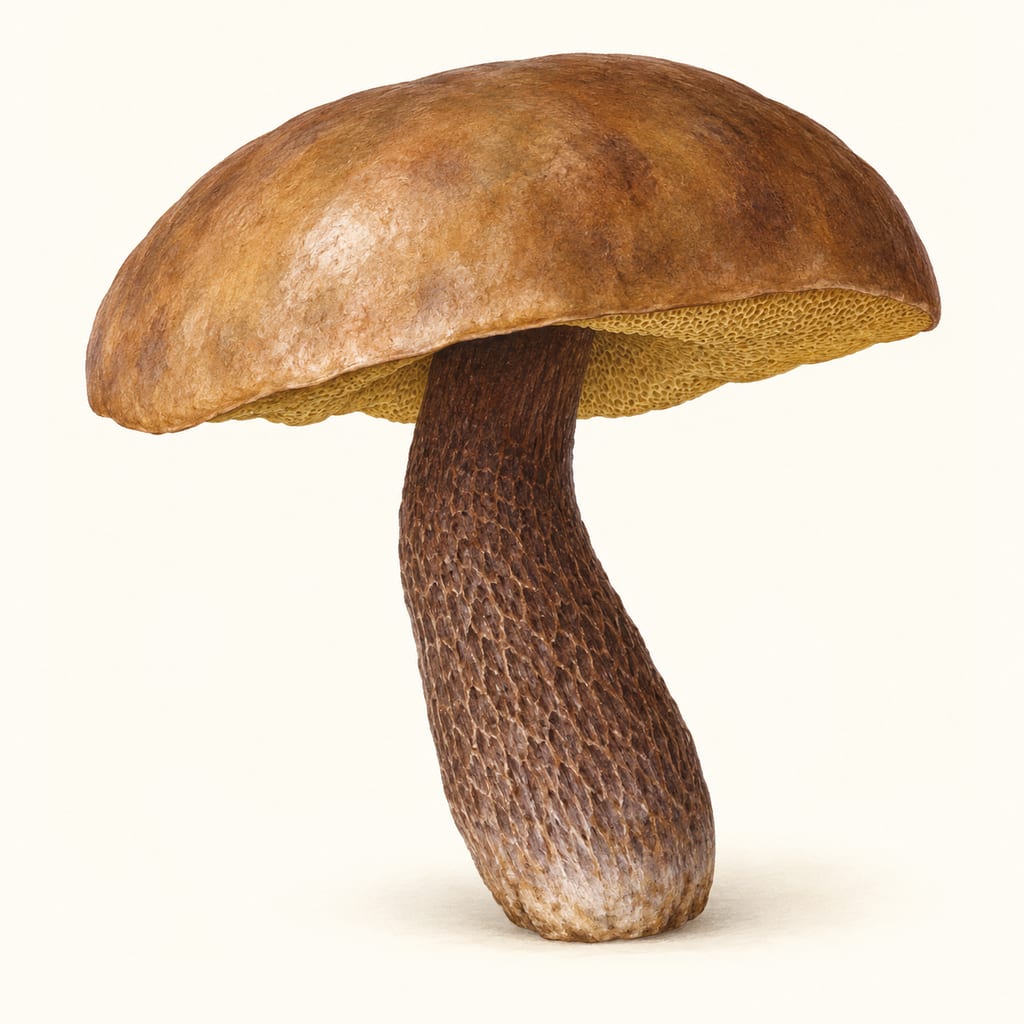
Boletus botryoides
Boletus botryoides, the grape-coloured bolete, is a porcini-like wild bolete of central and south-western China. It is listed as edible in Chinese catalogues, but no dish or preparation is documented for it.
 FermenteaWhere food goes to change
Mushrooms
Cantharellus magnus is a large Chinese chanterelle recorded in five provinces. A national scientific catalogue lists it as edible, but evidence here does not establish preparation or local food traditions.
Cantharellus magnus is a Chinese chanterelle formally described in 2021 from central China. Its mature cap can reach about 20 centimetres across. The cap is deep yellow to orange, broad and funnel-shaped at maturity, with an incised edge that can fold and wave irregularly. The fruit body is fleshy but fragile while fresh and becomes soft, corky and light as it dries. The underside is distinctive in the description: its fertile surface runs down the stem and is almost smooth, rather than formed into the conspicuous blunt ridges typical of many familiar chanterelles.
These characters describe collected material; none alone confirms a field specimen. Colour changes with moisture and age, the cap edge varies, and smooth hymenophores occur elsewhere in the genus. The large size that inspired the name is an observation about the species, not a reliable identification test. The published type record and subsequent collections give the reader a more dependable account than a common-name resemblance.
The original description used molecular sequence comparisons alongside cap, hymenium and microscopic characters to place C. magnus in the chanterelle genus and establish a large-bodied subgenus. A 2023 study then described C. laevigatus as a separate, smaller member of that group. The 2025 multi-gene revision re-examined the relationship and treated C. laevigatus as a synonym of C. magnus: the compared collections did not show a meaningful genetic gap, while the smaller size difference was judged insufficient to keep the two names separate as more material became available.
That later treatment is the current basis for this account. Older papers and photographs can therefore label some specimens C. laevigatus even though the 2025 revision places them under C. magnus. A 2023 sequence table also assigns two Wei collection numbers to Liaoning, while the 2021 type account locates Wei 10244 at Hunan’s Badagong Nature Reserve. The 2025 revision expands the known range with further vouchers, but the earlier conflicting locality metadata should not be silently harmonized. These are source-specific collection records, not evidence of a single smooth and complete distribution history.
The type collection was made on soil in an angiosperm forest at Badagong Nature Reserve in Hunan. The later revision describes the species as solitary or scattered under broad-leaved forests in subtropical China. This establishes a forest-floor setting for the recorded fruit bodies. The cited species accounts do not identify a single tree partner or show that every broad-leaved stand is suitable; the surrounding habitat should not be turned into a picking rule.
The 2025 revision reports known records from Anhui, Guangdong, Hunan, Jiangxi and Zhejiang. The specimen list includes collections from Huangshan in Anhui, Nanling in Guangdong, Wugong Mountain in Jiangxi and Badagong in Hunan, while the Zhejiang record is associated with the taxonomic history of C. laevigatus. The national edible catalogue supports China as the country-level food-list context. It does not establish province-by-province culinary traditions.
The available vouchers were gathered in summer and early autumn. The original Hunan type is dated 23 September 2020. Later material assigned to C. magnus includes July collections from Guangdong and Hunan, August collections from Jiangxi and Anhui, an August 2023 Guangdong specimen, and an Anhui specimen from 3 September. The earlier C. laevigatus account adds July collections from Hunan and Zhejiang; under the 2025 synonymy, these are now part of the C. magnus record.
Taken together, the studied collections document fruit bodies from late July through September in several subtropical Chinese sites. This is not a complete fruiting calendar. The publications are taxonomic surveys with particular collection dates, not repeated weekly monitoring across all five provinces. Weather, elevation, forest and year could change when visible mushrooms are encountered; the sources do not support a fixed annual schedule.
The 2026 Chinese catalogue of edible and medicinal fungi includes C. magnus among edible fungi. That is a useful, species-specific catalogue classification and is the food-use evidence available here. The catalogue is national in scope, but its entry does not describe household practice, market volume, a named region of consumption or the age and condition of specimens that people eat.
The taxonomic papers are about identification and classification, not cookery. They provide no recipe, cooking time, preservation method or fermentation practice for this species. No species-specific medicinal use is established by the sources used for this page. A checklist label must not be expanded into a preparation recommendation or a claim that the mushroom is harmless in every form.
The broad cap, yellow-orange colour and nearly smooth decurrent underside help explain why C. magnus was separated from other chanterelles, but field recognition involves a combination of characters and taxonomic context. Related Cantharellus species can overlap in colour, size or hymenophore shape. The 2023 description of C. laevigatus is a practical example of how close collections can initially receive separate names before a later phylogenetic comparison changes the species boundary.
A photograph, map point, common name or edible-list entry cannot identify an individual mushroom. The research sources do not provide a species-specific safety assessment or a validated cooking instruction. Anyone considering wild fungi for food needs competent local identification and the relevant local food-safety guidance; this account is not a field key. It does not recommend eating an unknown specimen.
The species is listed as edible in a Chinese scientific catalogue and has documented occurrence and collection records across several Chinese provinces. No regional recipe, traditional-preparation label, fermentation use or season beyond the collection dates is established.
The 2026 scientific catalogue lists Cantharellus magnus as edible; the entry does not establish provincial consumption or preparation.
Collection and type localities are documented here; this row indicates occurrence only and makes no claim of local food tradition.
The 2025 revision reports a voucher from Anhui; occurrence only, not a local food-use record.
The 2025 revision reports vouchers from Guangdong; occurrence only, not a local food-use record.
The 2025 revision reports a voucher from Jiangxi; occurrence only, not a local food-use record.
The 2025 revision includes the former Cantharellus laevigatus record from Zhejiang under its synonym treatment; occurrence only, not a local food-use record.
Boletus botryoides, the grape-coloured bolete, is a porcini-like wild bolete of central and south-western China. It is listed as edible in Chinese catalogues, but no dish or preparation is documented for it.
Clavulina ruchengensis is a gray, branching coral fungus described from Hunan, China, where a 2024 study documents local collection and cooking.
No community contributions have been published for this entry yet.
Sign in to contribute. Published comments and photos are free to read.
MycosystemaUse · Geography
Species cataloging of edible and medicinal fungi in ChinaThe catalogue is scoped to China and lists Cantharellus magnus as edible (entry 921). This is checklist-level edible status; it gives no species-specific preparation method, safety protocol or evidence of local prevalence.
Cited in: On soil in subtropical broad-leaved forests; What the Chinese edible catalogue records; Identification and food-safety limits
Studies in MycologyIdentity · Morphology · Ecology · Season
A phylogenetic overview of the Hydnaceae (Cantharellales, Basidiomycota) with new taxa from ChinaDescribes Cantharellus magnus as a new species and establishes subgenus Magnus, later styled Magni. Type material is from Hunan Province, Sangzhi County, Badagong Nature Reserve, collected 23 September 2020 in angiosperm woodland. Describes large yellow-to-orange caps up to 20 cm, deeply decurrent smooth hymenophore, and fragile fresh fruit bodies.
Cited in: A species defined by a large, nearly smooth chanterelle; A name refined as more collections were compared; On soil in subtropical broad-leaved forests; The documented season is a collection window; What the Chinese edible catalogue records; Identification and food-safety limits
Frontiers in MicrobiologyIdentity · Morphology · Season · Geography
Updated taxonomy of Chinese Cantharellus subgenera Afrocantharellus and Magni (Hydnaceae, Cantharellales): Three new taxa and amended descriptions of one previous speciesDescribes Cantharellus laevigatus as a distinct small-to-medium Magni species from Hunan and Zhejiang with July collection records; its Figure 2 panels G and H are field photos. The 2025 revision later treats C. laevigatus as a synonym of C. magnus, so those historical names must be reconciled.
Cited in: A name refined as more collections were compared; On soil in subtropical broad-leaved forests; The documented season is a collection window; Identification and food-safety limits
MycosphereIdentity · Morphology · Ecology · Season · Geography
Species diversity, taxonomy, distribution and multi-gene phylogeny of chanterelles in ChinaTreats Cantharellus laevigatus as a synonym of C. magnus and gives the current known range as Anhui, Guangdong, Hunan, Jiangxi and Zhejiang. Its examined specimens include dates from late July through early September, and Figure 26 shows two basidiomata photographs.
Cited in: A species defined by a large, nearly smooth chanterelle; A name refined as more collections were compared; On soil in subtropical broad-leaved forests; The documented season is a collection window; What the Chinese edible catalogue records; Identification and food-safety limits