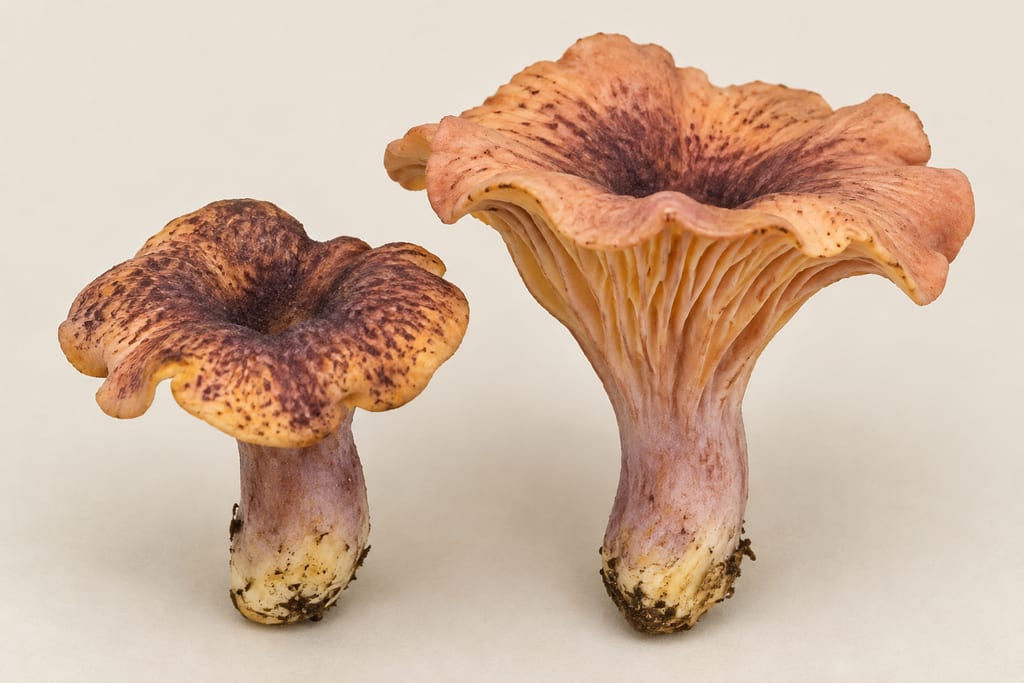
Cantharellus longisporus
Wild Central African chanterelle recorded as locally eaten in voucher-backed Tshopo interviews. Historical country claims exceed the current revised range; preparation, fermentation and toxicology remain undocumented.
 FermenteaWhere food goes to change
Mushrooms
This page records a Tshopo food-use report under the epitypified name Cantharellus densifolius; it is not an identification or safety assessment of a wild specimen.
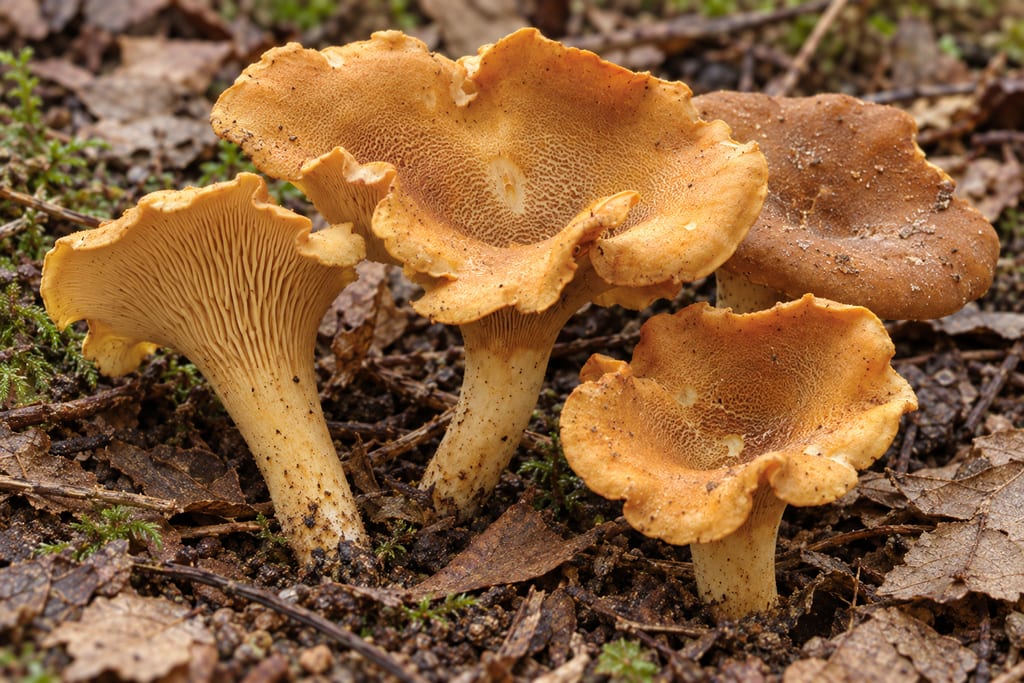
Cantharellus densifolius is a chanterelle, a wild mushroom of the genus Cantharellus that lives in partnership with forest-tree roots. Species Fungorum lists this as the current name. A 2019 taxonomic study epitypified the name with a recently collected specimen and sequence evidence, distinguishing it as a species in its own right. The authors also explain that earlier African woodland finds assigned to this name included other species, and that the separate rainforest species C. tomentosoides can be confused with it.
Cantharellus is the most important edible ectomycorrhizal genus in the forests of the Congo Basin, according to the 2020 Tshopo survey that records this species. The food-use statement on this page preserves that ethnomycological report; it is not an independent identification of any wild mushroom.
The record comes from the rainforests of Tshopo Province in the Democratic Republic of the Congo. The 2020 survey worked with 160 informants from six ethnic communities around the Yangambi and Yoko reserves.
The catalogue records the species as wild. It does not record any cultivation, market supply or quantity.
The 2020 survey lists Cantharellus densifolius among the edible ectomycorrhizal fungi eaten by all six ethnic groups it sampled, among them the Kumu, Lokele, Ngando, Ngelema, Topoke and Turumbu. That is the food-use record on which the catalogue relies.
The sources reviewed do not describe how the mushroom is prepared, which parts are eaten, or in what season it is gathered. The catalogue states that species-specific preparation was not established, so this page does not give one.
Earlier ethnomycology work from Tshopo lists wild fungi in local use. The same literature gives this species a role beyond food, as one of the mushrooms believed to bring luck. The 2020 survey describes local interest in edible ectomycorrhizal fungi as low overall, with most attention going to saprotrophic fungi.
The local interest in this species is therefore a regional observation. It does not show how widely the fungus is eaten outside the sampled communities.
The Tshopo survey reports food use under this name and lists a voucher, MKH017. The 2019 taxonomic treatment establishes how the name is applied to its epitype, but that does not independently re-identify the survey's voucher. Neither this page nor the cited food-use report is a toxicological assessment of a specimen.
The 2019 taxonomic paper describes distinct chanterelles that can resemble C. densifolius. This page is not an identification guide and gives no verdict on whether a specimen is safe to eat. Do not pick or eat a wild chanterelle-like mushroom on the basis of this page.
Voucher-backed interviews in the rainforests around the Yangambi and Yoko reserves; no locality is given beyond the reserves.
Wild Central African chanterelle recorded as locally eaten in voucher-backed Tshopo interviews. Historical country claims exceed the current revised range; preparation, fermentation and toxicology remain undocumented.
No community contributions have been published for this entry yet.
Sign in to contribute. Published comments and photos are free to read.
PubMed CentralFood use · Ecology · Geography
Wild edible ectomycorrhizal fungi: an underutilized food resource from the rainforests of Tshopo province (Democratic Republic of the Congo)Cantharellus densifolius eaten by all six ethnic groups sampled (Kumu, Lokele, Ngando, Ngelema, Topoke, Turumbu); 160 informants around Yangambi and Yoko reserves; Cantharellus as the most important edible ectomycorrhizal genus in the Congo Basin; low local interest in edible ectomycorrhizal fungi (search summary and supplied catalogue record; article text not reopened, PMC returned a browser check).
Cited in: What it is; Where it is recorded; Food use; Local knowledge; Identification and safety
Journal of Ethnobiology and Ethnomedicine (BioMed Central)Food use · History
Uses and importance of wild fungi: traditional knowledge from the Tshopo province in the Democratic Republic of the CongoLocal use of wild fungi in Tshopo, including mushrooms treated as bringing luck (title and search summary only; primary text not opened).
Cited in: Where it is recorded; Local knowledge
MycoKeysTaxonomy · Identity · Morphology · Habitat
Epitypification of the Central African Cantharellus densifolius and C. luteopunctatus allows for the recognition of two additional species2019 epitypification and sequence data support C. densifolius as a distinct species; the taxonomic paper documents its typification, field morphology, and epitype habitat.
Prior use of the name for African woodland chanterelles included separate taxa, including C. densilamellatus; C. tomentosoides is a distinct rainforest species described as easily confused with C. densifolius.
The epitype plate shows field habit and hymenophore structure; its pictured taxonomic material is not evidence that any other wild specimen is this species or safe to eat.
Cited in: What it is; Identification and safety
Species FungorumTaxonomy · Identity
Cantharellus densifolius Heinem., Bull. Jard. bot. État Brux. 28: 410 (1958)Current name is Cantharellus densifolius Heinem.; the record lists holotype Goossens-Fontana 879 and epitype PC 0142486.
Cited in: What it is