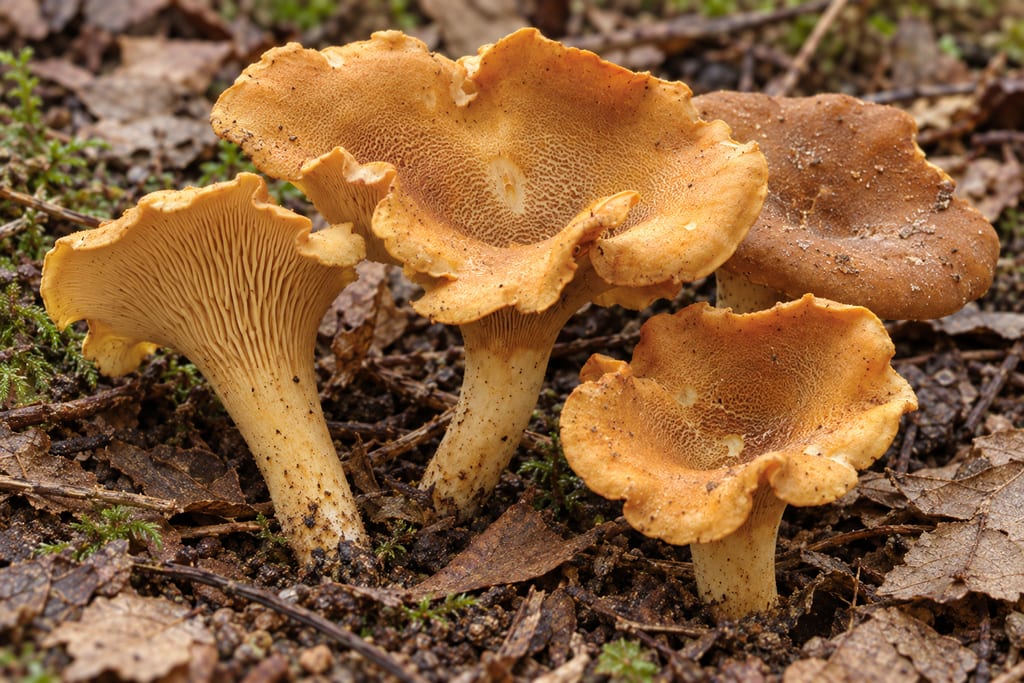
Cantharellus densifolius
This page records a Tshopo food-use report under the epitypified name Cantharellus densifolius; it is not an identification or safety assessment of a wild specimen.
 FermenteaWhere food goes to change
Mushrooms
Wild Central African chanterelle recorded as locally eaten in voucher-backed Tshopo interviews. Historical country claims exceed the current revised range; preparation, fermentation and toxicology remain undocumented.
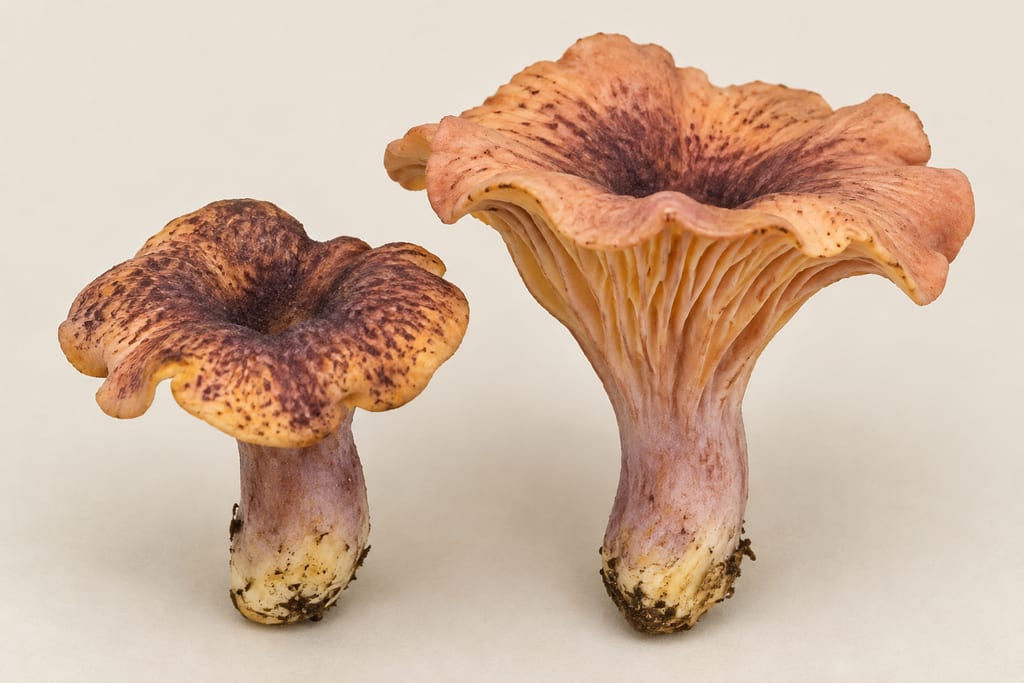
Cantharellus longisporus Heinem. is an accepted chanterelle in Hydnaceae (Cantharellales). The name was published in 1958 from material collected near Binga in what is now the Democratic Republic of the Congo. The holotype was gathered in April 1928, growing in groups on the ground in forest dominated by Gilbertiodendron dewevrei.
The modern description is of a large, firm, fleshy chanterelle. Mature caps can expand broadly and become funnel-shaped with a lobed, wavy edge. Young caps carry dark violet to purple-brown scales over an orange-yellow ground; the scales become more spaced and fade toward the margin as the cap matures. The folds beneath the cap run down the stem, are pale yellowish, and become more veined with age. Stems are thick and solid, lilac to reddish lilac above and yellowish near the base. The flesh is firm and pale, with yellow near the stem base and pink or orange tones in the cap. The description records a pale spore print and long, narrow spores, but these microscopic details are not a field identification key.
There is an important taxonomic correction behind the map. In 2020, a multi-locus reassessment found the two Malagasy subspecies previously placed under C. longisporus to be distinct species, recombining them as C. littoralis and C. isaloensis. The same treatment described the central African C. longisporus from new collections. Later and older lists that combine these names may therefore show a wider range than the current species concept supports.
The confirmed habitat is dense Central African rainforest. The fungus is ectomycorrhizal, living in association with tree roots rather than feeding on dead wood. The 2020 treatment links it with Gilbertiodendron dewevrei, either in near-monodominant forest or mixed with Julbernardia seretii and Paramacrolobium coeruleum. A 2012 voucher from Yangambi came from rainforest dominated by G. dewevrei.
Voucher localities in the taxonomic treatment include the type site near Binga in the Democratic Republic of the Congo; Yangambi Man-and-Biosphere Reserve in Tshopo, DRC; and Goualougo in Nouabalé-Ndoki National Park, Republic of the Congo. These records establish occurrence at those sites, not food use at each one. The Tshopo food study sampled forest plots around Yangambi and Yoko reserves and deposited vouchers at Meise Botanic Garden; its named vouchers for C. longisporus are ADK5684 and MKH141.
Historical summaries and the supplied annotated checklist also associate the name with Malawi, Mozambique and Zambia. The FAO overview is a useful record of those older food or edibility claims, but it uses country-level historical labels, and the 2020 taxonomic revision narrowed the Malagasy component of the name. I could not independently trace these three country records to modern, sequence-supported vouchers matching the revised species concept. They are preserved as historical attributions, not represented as verified current range.
The confirmed dated collections are sparse: the holotype near Binga was collected in April 1928; a collection at Goualougo, Republic of the Congo, was made on 12 January 2012; and the Yangambi reserve voucher in Tshopo was collected on 26 October 2012. These dates show that fruit bodies were collected in different months at different Central African sites. They do not establish a fixed season or show that the species fruits year-round.
The Tshopo study collected ectomycorrhizal fruit bodies in 2013–2016 across monitored plots, but its general study period cannot be assigned as the fruiting season of this one species. Rainfall and local forest conditions may matter for wild mushrooms, yet no species-specific climatic response or quantitative phenology series was found. A harvest calendar cannot be inferred from three dated herbarium events.
In Tshopo, C. longisporus was classed as “Food” in a study that paired herbarium vouchers with interviews of 160 residents from six ethnic communities near the Yangambi and Yoko reserves. Respondents were asked whether they ate the pictured or fresh mushroom. The table reports 132 affirmative mentions and a cultural-significance score of 0.8 out of 1; all six communities were recorded as consuming it. The table gives two local names: Baolo-bandei, attributed to Turumbu speakers, and Abamongo, attributed to Kumu speakers.
This supports a precise claim: people in the studied Tshopo communities locally consumed mushrooms identified in the study as C. longisporus. It does not identify a specific dish, cooking method, preservation process, serving amount or species-specific preparation. The FAO country tables and later African edible-mushroom summaries preserve additional historical claims for other countries, but those are not equivalent to observed contemporary use under the revised taxonomy.
No fermentation use was found. The fungus itself is a raw wild food, not a fermented product, and no source reviewed documents it as a starter, substrate, or ingredient in a fermented preparation. Its ecological mycorrhiza is a relationship with living trees, not a food fermentation.
A food-use record is not toxicological testing. The Tshopo study documents reported consumption and vouchers; it does not establish a dose, preparation that makes the mushroom safe, contaminant profile, or toxicological limit. The species-level revision describes the taste as acrid or distinctly peppery. Taste is not a safety assay and should not be used to decide whether an unknown mushroom is edible.
The main identification caution is that Cantharellus species can be confused and that historic names have been revised. The current literature separates the old Malagasy subspecies from C. longisporus, and the broader species boundaries in related chanterelles are under active taxonomic study. The evidence reviewed did not establish a species-specific lethal look-alike or prove that none exists. A photograph, common name, colour, or resemblance to a general chanterelle shape cannot authenticate a wild specimen.
For that reason, this page reports documented local food use without turning it into a general foraging endorsement. It also leaves preparation, storage, shelf life and home-fermentation instructions blank: the sources reviewed do not give those details for this species.
Voucher De Kesel 5210 from rainforest dominated by Gilbertiodendron dewevrei; this occurrence record does not itself document food use.
Holotype Goossens-Fontana 692, collected on the ground in Gilbertiodendron dewevrei forest; coordinates were not given in the consulted source.
Voucher-supported interviews recorded local consumption; species-specific preparation was not established.
Voucher collections 737 and 744; this is an occurrence record, not a food-use claim.
Retained as a historical attribution in the supplied index; not independently matched to modern voucher evidence under the revised taxonomic concept.
Retained as a historical attribution in the supplied index; not independently matched to modern voucher evidence under the revised taxonomic concept.
Retained as a historical attribution in the supplied index; not independently matched to modern voucher evidence under the revised taxonomic concept.
This page records a Tshopo food-use report under the epitypified name Cantharellus densifolius; it is not an identification or safety assessment of a wild specimen.
No community contributions have been published for this entry yet.
Sign in to contribute. Published comments and photos are free to read.
Publications scientifiques du Muséum national d’Histoire naturelle, Paris; Cryptogamie, Mycologie 41(10):161–177Taxonomy · Description · Habitat · Season · Geography · Image provenance
Tropical African Cantharellus Adans.: Fr. (Hydnaceae, Cantharellales) with lilac-purplish tinges revisitedCurrent Hydnaceae placement and 1958 name citation.
DRC holotype at Binga in April 1928 and additional Yangambi DRC and Goualougo Republic of the Congo vouchers with dates.
Morphology, ecology, tree associations, taste and spore characteristics.
The former Malagasy subspecies were recombined as distinct species.
Fig. 2 contains five subject-photo panels A–E credited to S. T. Ndolo Ebika and P. Ballings; BioOne terms limit use to personal, educational and non-commercial use.
Cited in: A Central African chanterelle with a revised boundary; Rainforest habitat and the known collection record; Dates are specimen snapshots, not a fruiting calendar; Safety, identification and evidence limits
Journal of Ethnobiology and Ethnomedicine 16:8Food use · Ethnomycology · Geography · Vouchers
Wild edible ectomycorrhizal fungi: an underutilized food resource from the rainforests of Tshopo province (Democratic Republic of the Congo)Voucher-supported food-use record for C. longisporus, vouchers ADK5684 and MKH141, frequency of mention 132, EMCS 0.8.
160 interviews across six named ethnic communities; study sample localities around Yangambi and Yoko reserves, with positive reports across all six groups.
Local names Baolo-bandei (Turumbu) and Abamongo (Kumu), and the limits of interview evidence.
Cited in: Rainforest habitat and the known collection record; Dates are specimen snapshots, not a fruiting calendar; A documented local food, with no recipe yet established; Safety, identification and evidence limits
Meise Botanic Garden, Edible Fungi of Tropical AfricaTaxonomy · Description · Ecology · Geography · Images
Cantharellus longisporus — Edible Fungi of Tropical Africa species pageSpecies description, ecology and current known distribution limited to DRC and Republic of the Congo.
Names its taxonomic illustrations, including Buyck et al. 2020 Fig. 2 and Heinemann 1959.
Provides a map link and image gallery; linked thumbnail nodes inspected in this session proved to be sponsor logos, not mushroom photographs.
Cited in: Rainforest habitat and the known collection record; Dates are specimen snapshots, not a fruiting calendar; A documented local food, with no recipe yet established; Safety, identification and evidence limits
Food and Agriculture Organization of the United NationsHistorical food use · Geography
Wild edible fungi: a global overview of their use and importance to people — Annex 2 country recordsFAO's historical country tables list C. longisporus as edible in Malawi, and as food in Mozambique and Zambia; these source-level country headings are historical labels, not modern voucher or taxonomic confirmation.
Cited in: A documented local food, with no recipe yet established; Safety, identification and evidence limits
The IUCN Red List of Threatened SpeciesConservation · Distribution · Food use
Cantharellus longisporus — IUCN Red List assessmentSummarizes historic broad sub-Saharan range and edible status; explicitly notes that some miombo records may result from misidentifications and that Madagascar subspecies were described. Used with caution because it predates the 2020 redefinition.
CABI Agriculture and Bioscience 4, article 3 (2023)Historical food use · Geography
Underutilized wild edible fungi and their undervalued ecosystem services in AfricaThe review emphasizes taxonomic and inventory uncertainty in African edible fungi and its supplemental species lists combine information from varied studies; it does not provide modern sequence-confirmed specimens for the historical Malawi, Mozambique and Zambia claims used here.