Cantharellus magnus
Cantharellus magnus is a large Chinese chanterelle recorded in five provinces. A national scientific catalogue lists it as edible, but evidence here does not establish preparation or local food traditions.
 FermenteaWhere food goes to change
Mushrooms
Cantharellus luteovirens is a small yellow chanterelle described from Guangdong in 2021. It grows in subtropical forest with acacias, and China's 2026 catalogue lists it as edible. Its species boundary depends on microscopy and DNA.
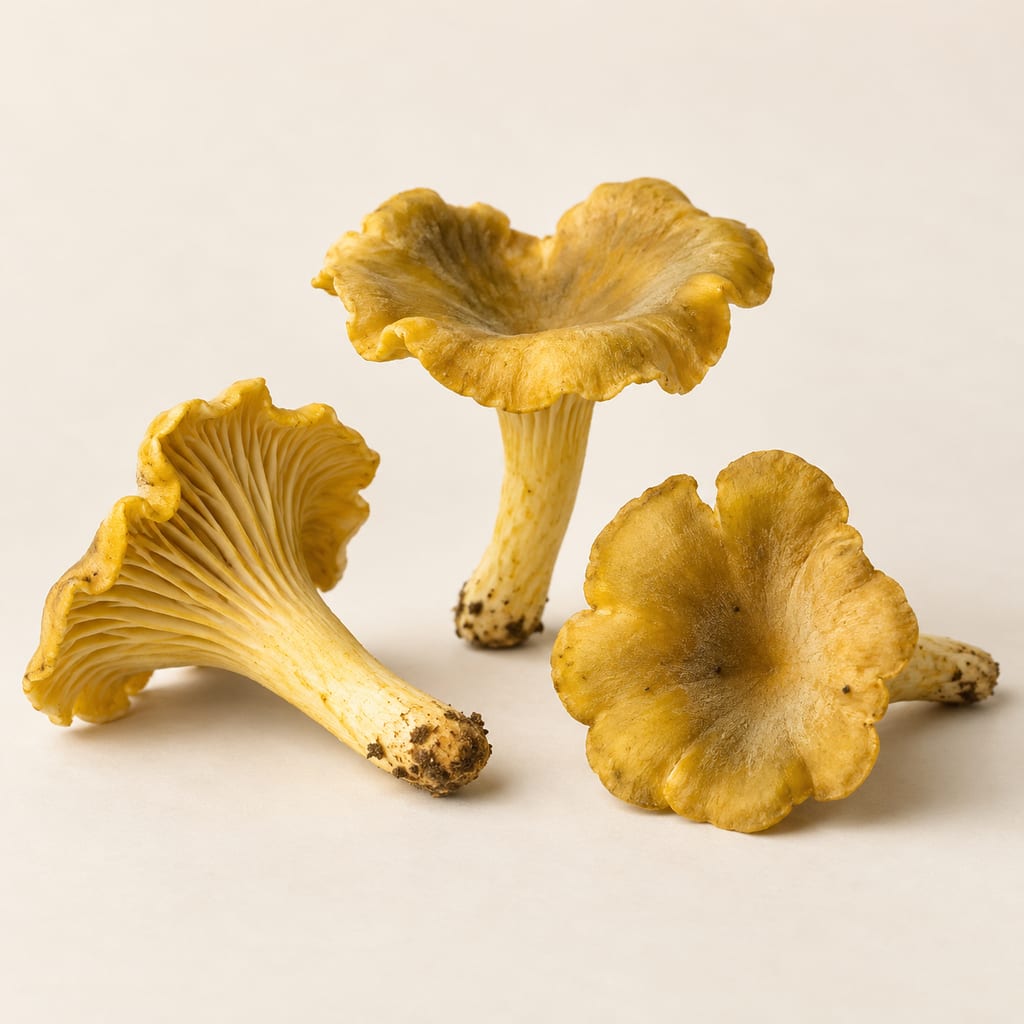
Cantharellus luteovirens is a small chanterelle. Its caps are about 15 to 42 millimetres across, yellow to orange-yellow, sometimes greyish-yellow at the centre, and shallowly depressed when mature. The underside bears low, weakly developed folds that fork and join, pale yellow to yellow-white. The hollow stem is only about 20 to 30 millimetres long and 2 to 3 millimetres thick. Spores are broadly ellipsoid to nearly spherical, about 6 to 7.5 by 4.5 to 6 micrometres.
Several similar Chinese chanterelles occur, including C. austrosinensis, C. galbanus and C. luteolus. The describers separated the species using microscopic characters and DNA evidence. A yellow cap photograph does not settle the identity.
The best-supported range is Guangdong Province in southern China. A 2025 taxonomic treatment reports the species only from Guangdong, where it fruits in groups in subtropical broadleaf forest, especially stands dominated by Acacia auriculiformis and A. confusa. The authors suggest it may be an obligate ectomycorrhizal partner of acacias. That relationship is a proposal from the authors, not a demonstrated cultivation method.
Voucher-backed records come from Baiyun Mountain in Guangzhou, Maluanshan Forest Park and Xianhu Botanical Garden in Shenzhen, and Luofushan in Huizhou. The type was collected on Baiyun Mountain on 16 June 2020 at 130 metres. Other vouchers are dated from May to September across several years. These dates describe the records, and they do not guarantee a fruiting window at any site.
The Chinese national catalogue of edible and medicinal fungi lists the species as edible. That is a checklist entry, not a verified consumption record. The sources consulted give no dish, preparation method, market chain, storage practice or fermentation role, and no toxicological assessment for this exact species.
The species was described recently, and similar yellow chanterelles occur in the same region. This entry does not encourage collecting or identifying wild specimens from photographs, and it makes no claim about an unverified field specimen.
Holotype locality; no coordinates supplied.
Voucher-backed locality records; no coordinates supplied.
Voucher-backed locality record; no coordinates supplied.
No community contributions have been published for this entry yet.
Sign in to contribute. Published comments and photos are free to read.
Journal of FungiTaxonomy · Description
Multigene Phylogeny and Morphology Reveal Unexpectedly High Number of New Species of Cantharellus Subgenus Parvocantharellus in ChinaDescription of C. luteovirens in 2021; morphology and spore size; MycoBank MB840653; similar Chinese taxa
Cited in: Overview; Habitat and range
MycosphereDistribution · Habitat
Cantharellus monograph, species account and Fig. 35Guangdong only; Acacia forest; voucher localities and dates
Cited in: Overview; Habitat and range
MycosystemaFood status
Species cataloging of edible and medicinal fungi in ChinaLists C. luteovirens as edible in the 2026 catalogue
Cited in: Food status
MycosystemaTaxonomy
Species diversity and distribution of Cantharellus in ChinaCurrent treatment of Chinese Cantharellus diversity
Cited in: Food status