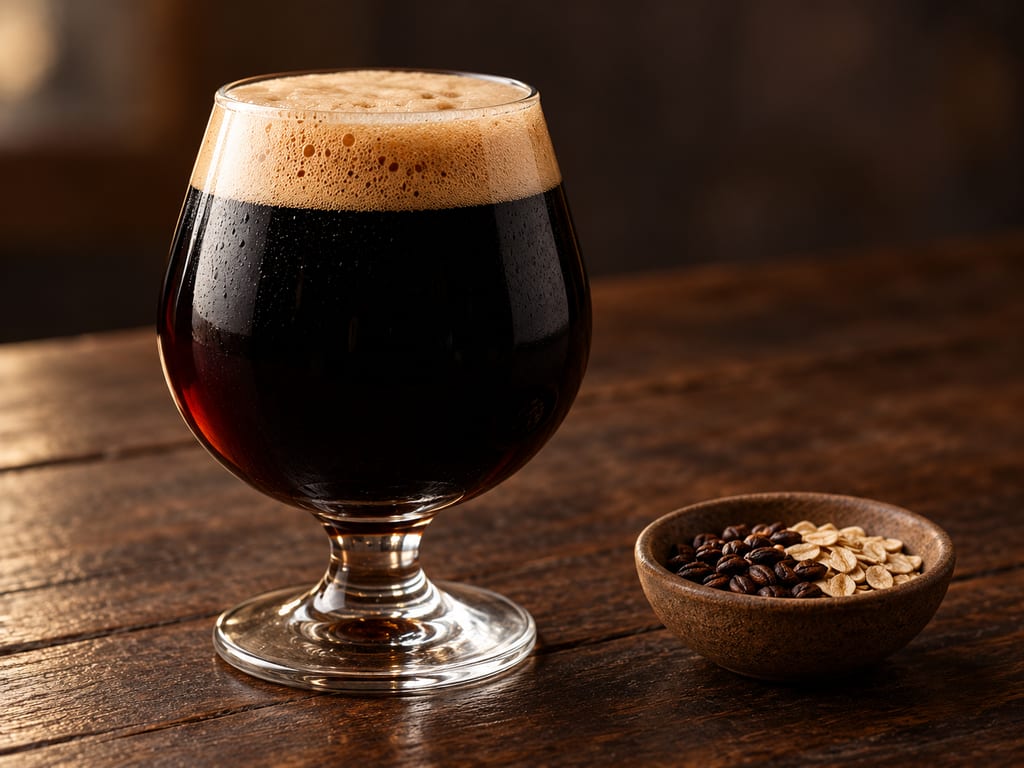
Dark Cellar imperial stout
An all-grain imperial stout with pale malt, roasted barley, dark malts and oats, fermented with an American ale-yeast starter.
 FermenteaWhere food goes to change
Substrates
A dark roasted barley malt grade used for strong colour and coffee-to-chocolate roast character; standard Type3 differs from the husk-reduced Special line.
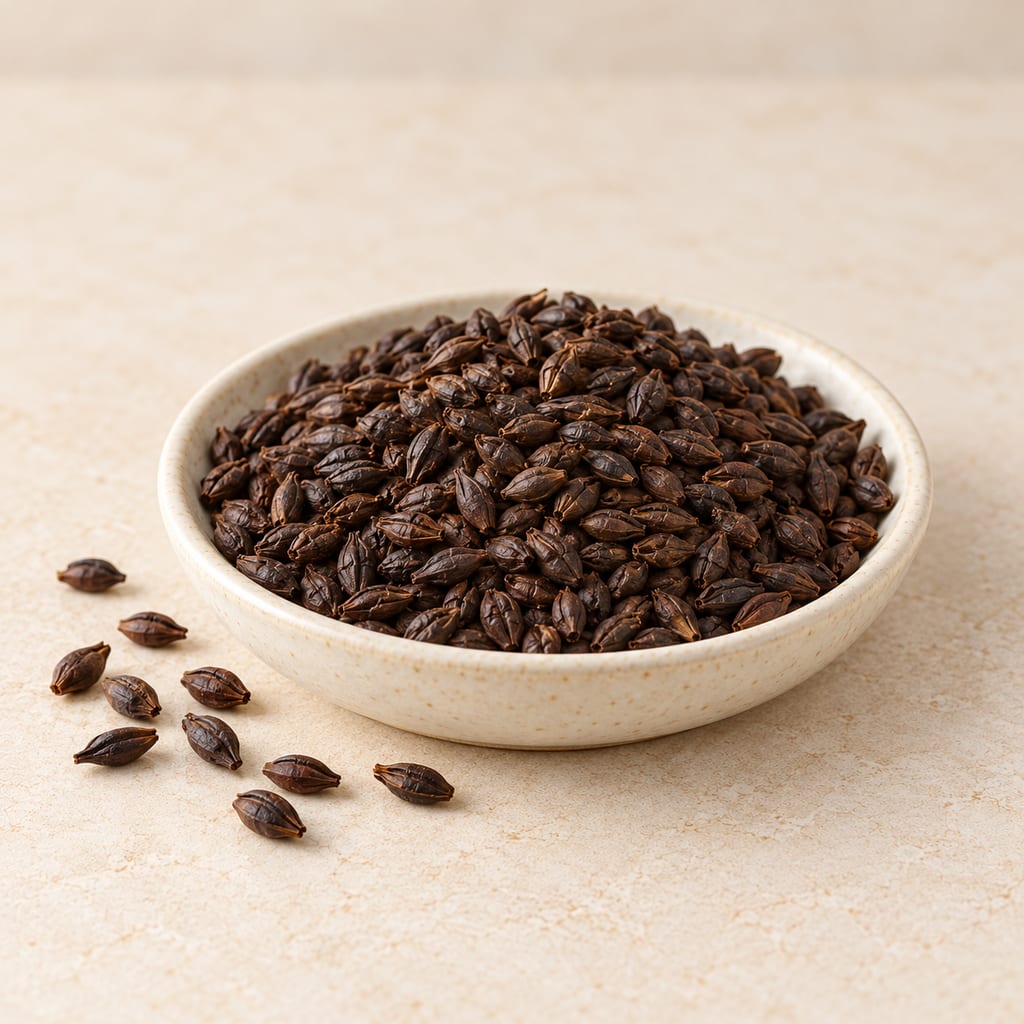
Carafa III is a highly roasted barley malt used to give beer a deep colour and an emphatic roast aroma. The name belongs to a particular commercial malt tradition rather than a barley variety. Weyermann markets CARAFA Type 3 as the darkest numbered grade in its standard CARAFA range, with coffee, cocoa and dark-chocolate notes. A small portion of such a malt can perform a different job from the much larger quantity of pale malt beside it in a brewing recipe.
The maker's roots connect those aromas with a history outside the beer glass. In 1879 Johann Baptist Weyermann established a malt-coffee factory in Bamberg. Its first roasting equipment was a small drum beneath a tarpaulin. Expansion into a specialty-malt factory followed in 1888. Roasted grain, colour and aroma were therefore central to the business before its present catalogue existed. That company history gives context to the modern ingredient without establishing a launch date for Carafa III itself.
CARAFA is a registered Weyermann name, with Type 3 occupying a particular place in the present-day range. Numbered grades give the brewer a way to select within that range, while the separate Special name signals another processing choice. A longstanding maltster's catalogue brings together several ways of treating barley: some retain useful mash enzymes, while intensely roasted products concentrate on colour and flavour. Carafa III is one of those distinct choices within a mixed grain bill.
The full product name is useful when buying the ingredient. Weyermann's standard CARAFA Type 3 and CARAFA Special Type 3 are separate products. For the Special line, the maker explicitly describes removing a large portion of the grain husk and adapting the roast programme to reduce roasted bitterness. The standard Type 3 description does not make that husk-removal claim. Abbreviating both to Carafa III can erase a real processing difference.
Their published colour ranges overlap. A colour match therefore cannot identify which version is in the bag or establish that they will taste the same. The Special line is intended to combine strong colour with a finer roasted character and less roast bitterness. Standard Type 3 is described as intensely roasted. These are distinctions in the maltster's own product range, not a universal promise that one ingredient will taste smooth in every beer and the other harsh.
The Roman numeral III in a recipe and Type 3 on a product page identify the same numbered position in the commercial naming convention. They do not identify a barley cultivar, an enzyme preparation or a stage a brewer must carry out. The purchased ingredient is already malted and roasted. Making wort from it is a later process, undertaken with the rest of the recipe's grain bill.
Barley, Hordeum vulgare, is the cereal behind this malt. Its kernel contains a starch-rich endosperm, an embryo and surrounding tissues. A maltster begins with grain suitable for controlled germination and modification. Grain quality influences how consistently water is taken up and how processing proceeds. Weyermann describes its Type 3 product as made from German quality brewing barley. The maltster then gives that selected grain the preparation and roast that distinguish it from the crop's many other food and brewing uses.
Malting uses the seed's biological machinery. Cleaning and grading prepare a more consistent grain supply; steeping raises moisture so germination can proceed. Enzymes developed during germination begin breaking down endosperm structures, including cell walls and portions of protein and starch. The maltster then stops further growth by drying. This produces malt with a different internal condition from raw barley, even though both retain a recognizable kernel shape.
The later roast gives Type 3 its specialist role. Pale base malt is prepared to retain useful enzyme capacity, while a dark specialty malt is chosen for a stronger colour and aroma contribution. Those aims are different. The route from seed to malt and then to intense roast explains why Carafa III belongs beside pale malt in a formulation rather than being treated as a dark-coloured replacement for every function of the base grain.
Heating changes the constituents prepared during malting. The general chemistry of specialty-malt roasting includes Maillard reactions between sugars and amino compounds, caramelization and further thermal breakdown. Temperature, heating time, moisture and the composition of the starting material influence which pathways develop. The result is a mixture of coloured substances and volatile aroma compounds, rather than one pigment accompanied by one flavour.
Research on roasted malts describes a progression from lighter malt impressions toward caramel, bread-like, chocolate, coffee and burnt notes as processing changes. That is a useful account of the range made possible by heat. It does not mean every dark malt contains an identical mixture, or that all of those notes must be obvious in the finished beer. A brewer's formulation also contains other grains, hops and fermentation-derived aromas.
Coffee, cocoa and chocolate on the CARAFA product description are sensory comparisons. They are not a list of added coffee beans or chocolate ingredients. The grain's roasting history produces those associations. This is why a malt can help give a stout a coffee-like impression even when no brewed coffee enters the kettle. Read added flavour ingredients separately from the vocabulary used to describe the malt itself.
Weyermann declares no enzyme activity for CARAFA Type 3. It should therefore be selected for its colour and roasted character rather than relied upon as the grist's source of starch-converting enzymes. Active base malt can supply enzymes for the mixed mash. A dark specialty addition still contributes material to the wort, but it does not replace the biological preparation and retained enzyme system of a self-converting base malt.
Mashing mixes ground grain with water under conditions that allow extraction and enzymatic reactions. Soluble material passes into the liquid, while available enzymes break down accessible starch into smaller carbohydrates. Yeast later uses the fermentable portion of that wort. Malt roasting, mash conversion and fermentation are three different stages; the fact that a grain has been malted does not mean the grain is itself a fermenting culture.
The finished beer's attenuation and body depend on the whole wort and fermentation, not simply on the darkness of one ingredient. Studies of roasted malt in distilling show that intensified roasting can change fermentability and process efficiency, but those experiments are not a measurement of Carafa III in this stout. The practical rule is narrower and stronger: keep the maltster's no-enzyme declaration attached to this product, and design conversion around the active ingredients in the complete grist.
Weyermann lists standard Type 3 at 1300–1500 EBC. That range is a specification for the malt product's colour assessment, not a forecast that a beer made with it will have the same number. A brewer uses a chosen quantity within a larger grain mixture and extracts it through a particular process. Wort volume and the other grains also affect the resulting colour. A handful of nearly black kernels is therefore informative about appearance but cannot replace a formulation calculation or an analysis of the beer.
The standard CARAFA range has lighter numbered members. Type 1 is listed at 800–1000 EBC and Type 2 at 1100–1200 EBC, before the darker Type 3 range. These figures describe a manufacturer's graded products. Their differing sensory descriptions and suggested uses accompany the analytical ranges. The number identifies a choice within that range; it is not an instruction to multiply the quantity of a lighter malt until its name becomes equivalent to Type 3.
A substitution should consider roasted flavour and husk treatment as well as colour. A different black or chocolate malt may overlap in one property while differing in another. The Special Type 3 example makes that point particularly clearly because its colour range matches the standard product while its processing description differs. Keep the product identity visible when comparing formulations, especially when roast character is an important part of the beer.
Dark Cellar imperial stout lists 1.62 pounds, or 735 grams, of Carafa III. It is one entry in a grain bill that also includes chocolate malt, roasted barley, caramel 60, coffee malt, oats, black patent malt and a much larger pale-malt base. This layered formulation is more informative than treating every dark grain as a generic colouring ingredient. The brewer chose several distinct names, and those distinctions belong in the ingredient links.
The American Homebrewers Association published the recipe for its 2026 Big Brew event after Joel McGormley's beer won a gold medal in the 2024 National Homebrew Competition final round. Its notes describe a mash, boil and American-ale-yeast fermentation. These are the steps that turn the mixed grist into stout; the ingredient has already received its own malting and roasting treatment before the brewing begins.
The supplied extract alternative replaces the pale malt with pale malt extract and retains the remaining grains for milling and steeping. This gives the specialty grains a different brewing arrangement while preserving their place in the formulation. The extract supplies the main wort base, and the dark grains supply their selected contributions to the mixture. In both approaches, the stout's finished roast character emerges from the combined grain bill and the brewing and fermentation that follow.
The manufacturer names porter, several stout styles and Altbier among standard Type 3's applications. In these uses, dark colour and roast aroma are intended parts of the beer's character. The malt's concentrated role allows it to be considered alongside base-malt richness, hop bitterness and the flavours developed during fermentation. Its coffee-like character can be prominent or integrated according to the formulation rather than being a compulsory dominant flavour.
The maker's suggested addition rates belong to its product guidance. They are useful when developing a recipe, but they are not a dietary safety boundary or a universal maximum for all dark malts. Likewise, a product being suitable for an imperial stout does not make every imperial stout require it. The linked beer demonstrates one actual use, while the catalogue describes a wider set of brewing possibilities.
Read the complete label, including standard or Special, the numbered type, whole or milled form, and the producer's analysis. These details connect the purchase to the colour range and sensory character the brewer intends. Standard Type 3 and Special Type 3 can share a declared colour range while differing in husk treatment. Whole kernels and milled malt also reach the brewhouse in different physical forms, ready for the milling and extraction arrangement of the chosen recipe.
Protect the dry grain from moisture and contamination and follow its package instructions for storage and freshness. Whole grain and pre-milled malt have different handling forms; mill the grain as the brewing method requires, keeping fine dust controlled during transfer. The manufacturer may provide a lot analysis or specific storage directions with the product. Those details are more relevant to the purchased bag than a shelf life borrowed from another maltster's dark grain.
Barley malt contains gluten. Roasting and the absence of enzyme activity leave it a barley-derived ingredient. Check the full product and finished-recipe ingredients when considering dietary suitability, including other cereals and any supplier cross-contact declarations. The exact first release of Carafa III remains uncertain, and the company's retrospective accounts differ on CARAFA's trademark-registration year. Dark Cellar names no supplier; its wording does not distinguish a particular malt lot.
barley (gluten)
Dark Cellar does not name its Carafa supplier or lot provenance. Weyermann’s product and brand history in Bamberg provides context, rather than proof of the recipe grain’s origin.
An all-grain imperial stout with pale malt, roasted barley, dark malts and oats, fermented with an American ale-yeast starter.
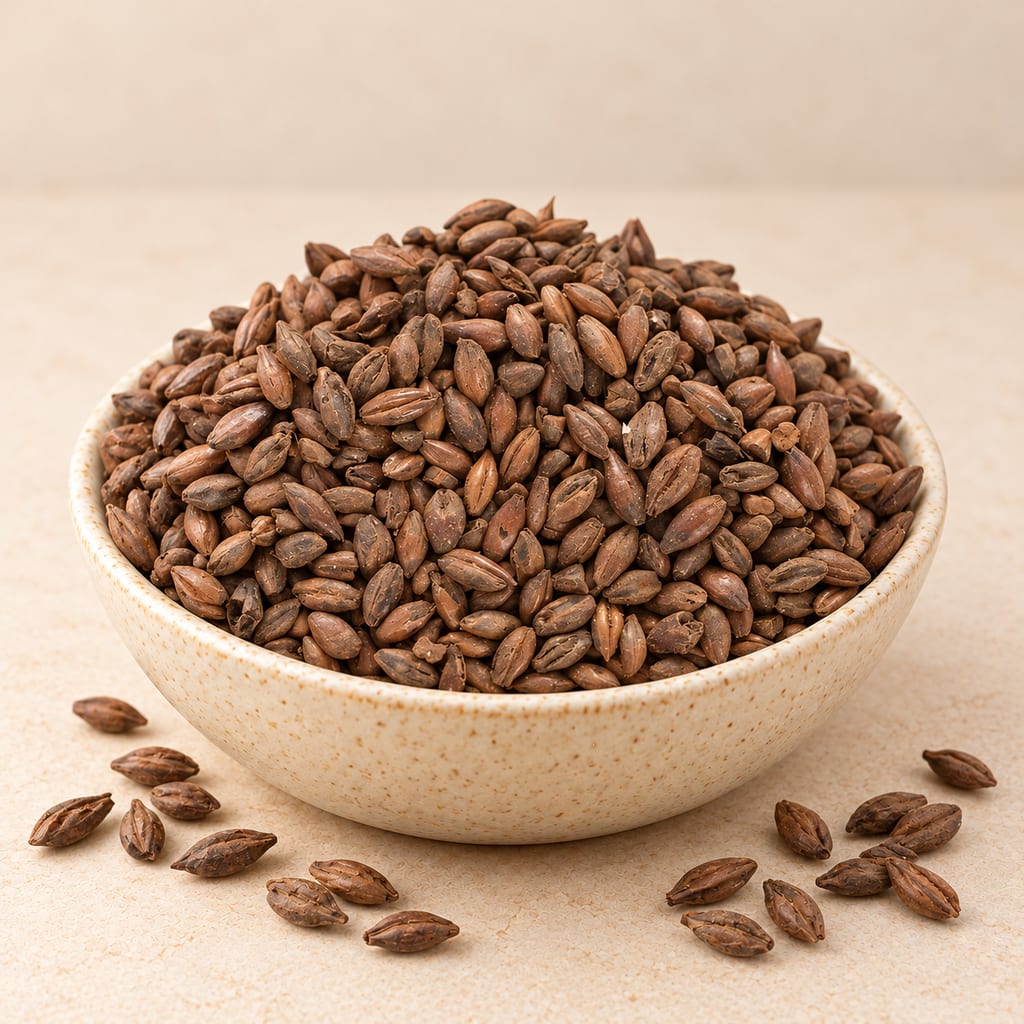
Chocolate malt is barley that has been malted and then roasted to a dark brown, used in porters, stouts and brown ales for colour and a bitter-cocoa, roasted-coffee flavour. It contains no cocoa.
No community contributions have been published for this entry yet.
Sign in to contribute. Published comments and photos are free to read.
Weyermann Specialty MaltsIngredient context
Weyermann CARAFA Type 3Weyermann standard CARAFA Type 3: German brewing barley, intense roasted aroma,1300–1500 EBC, no enzyme activity and named beer applications.
Cited in: A dark malt with a named identity; Standard Type 3 and the Special line; The barley underneath the colour; Roasting creates a new aroma mixture; What Type 3 does not do for the mash; Reading the colour grade; Uses in dark ales and lagers; Choosing and keeping the malt
Weyermann Specialty MaltsIngredient context
Weyermann CARAFA Special Type 3CARAFA Special Type 3: reduced husk material and an adapted roasting programme for a softer roast character, with a colour range overlapping standard Type 3.
Cited in: Standard Type 3 and the Special line; Reading the colour grade; Choosing and keeping the malt
Weyermann Specialty MaltsIngredient context
Weyermann CARAFA Type 1CARAFA Type 1:800–1000 EBC, the producer’s sensory description and brewing applications within its numbered range.
Cited in: Reading the colour grade
Weyermann Specialty MaltsIngredient context
Weyermann CARAFA Type 2CARAFA Type 2:1100–1200 EBC, the producer’s sensory description and brewing applications within its numbered range.
Cited in: Reading the colour grade
Weyermann Specialty MaltsIngredient context
HistoryJohann Baptist Weyermann’s 1879 malt-coffee factory, its early roasting drum and the 1888 specialty factory. The company accounts leave Type 3’s launch unestablished and differ on the CARAFA registration year.
Cited in: A dark malt with a named identity; Choosing and keeping the malt
Lukinac and Jukić; Plants2022Ingredient context
Barley in the Production of Cereal-Based ProductsBarley identity, Hordeum vulgare, kernel anatomy, row and hull classifications, and changes during malting. The article synthesizes cereal research rather than identifying the cultivar in Dark Cellar.
Cited in: The barley underneath the colour
University of Minnesota ExtensionIngredient context
Understanding grain qualityBarley quality and malting: cleaning, steeping, germination, modification, drying and the role of enzymes in mash starch conversion.
Cited in: The barley underneath the colour; What Type 3 does not do for the mash
Marčiulionytė etal.; JASBC2022Ingredient context
Roasted Malt for Distilling: Impact on Malt Whisky New Make Spirit Production and Aroma Volatile DevelopmentGeneral roasted-malt chemistry: Maillard reactions, caramelization, thermal breakdown, colour and aroma development. The original study concerns distilling malt; it does not measure the named recipe ingredient.
Cited in: Roasting creates a new aroma mixture; What Type 3 does not do for the mash
American Homebrewers Association; JoelMcGormleyIngredient context
2026 Official Big Brew Recipes: Dark Cellar Imperial Stout,p3Dark Cellar’s 1.62 lb(735 g) Carafa III addition, separate grain inputs,2024 competition gold and 2026 Big Brew publication, with all-grain and extract approaches. The recipe names no supplier.
Cited in: A dark malt with a named identity; A place among several roast grains; Uses in dark ales and lagers; Choosing and keeping the malt
American Homebrewers AssociationIngredient context
How To Store Homebrew IngredientsMalt storage, moisture protection, whole and crushed forms, and the loss of flavour and aroma under poor conditions.
Cited in: Choosing and keeping the malt
U.S.Food and Drug AdministrationIngredient context
Gluten and Food LabelingBarley is a gluten-containing cereal; the guidance explains gluten-related food labeling.
Cited in: Choosing and keeping the malt