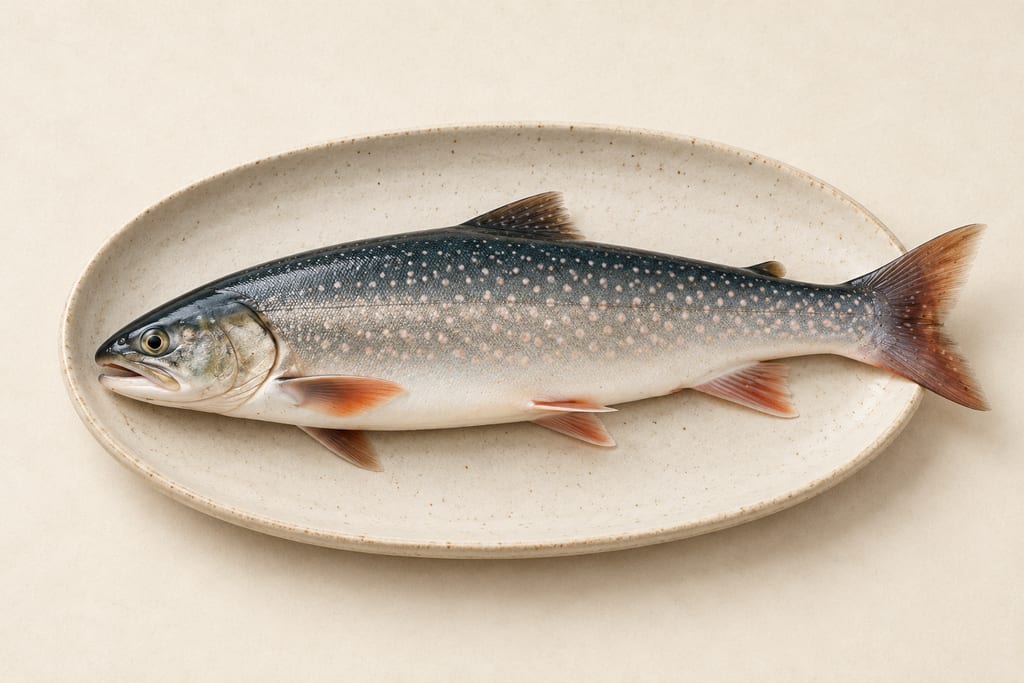
Arctic char
Arctic char (Salvelinus alpinus) is a circumpolar salmonid eaten fresh and preserved in northern communities. Its local forms and food traditions vary; dried or smoked fish and fermented char are distinct from the raw ingredient.
 FermenteaWhere food goes to change
Substrates
Cloudberry has distinct Gwich’in, Nunatsiavut, NunatuKavut-area and Québec records. A 2009 cutover-peatland trial reports site-specific rhizome establishment results, not a household pot or fruit-yield method.
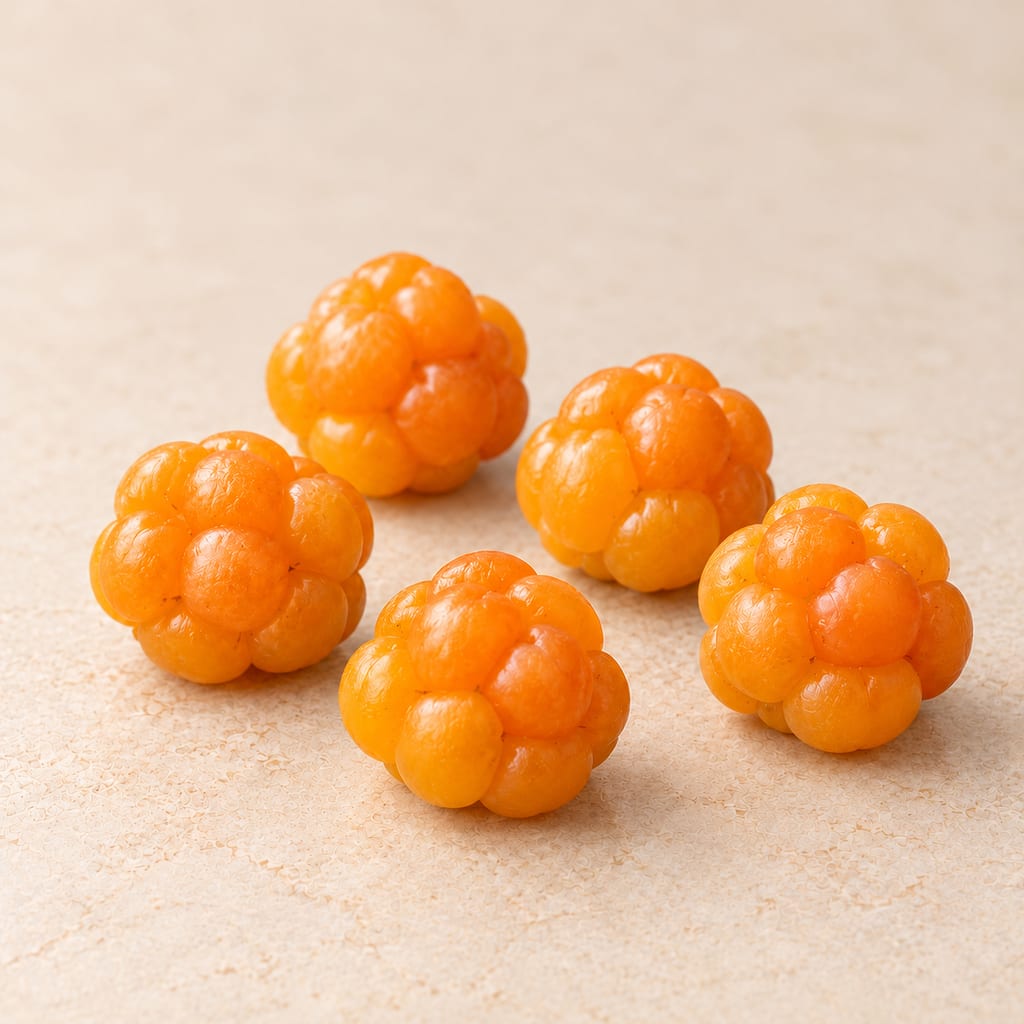
Kew accepts Rubus chamaemorus L., a rhizomatous perennial with a broad subarctic and subalpine Northern Hemisphere range. The Gwich’in Social & Cultural Institute page identifies yellowberry/cloudberry as R. chamaemorus and records Gwichya Gwich’in nakàl and Teetł’it Gwich’in nakal. Other names below come from distinct regional records; they should not be treated as interchangeable community names.
A Nunatsiavut ethnobotany study based on interviews in Hopedale, Postville and Rigolet lists bakeapple/cloudberry as edible R. chamaemorus. A separate Nunatsiavut Government page names bakeapples among berries gathered in the region but does not give a botanical identification. The article’s broader discussion of berry foods is not a bakeapple-specific recipe.
A southeastern Labrador case study reports on picking in Cartwright, where the authors describe the people as NunatuKavut. Its 18 interviews, field surveys and satellite imagery examine changes to local patches and harvesting. Participants describe picking mainly around August, with timing and abundance varying by place and year; these findings belong to that case study, not all Labrador communities.
A Québec IREPI memory account identifies chicoutai, plaquebière and ronce petit-mûrier as R. chamaemorus in Natashquan/Minganie. One informant recalls a second-week-of-July start, with islands earlier and plains collection lasting about three weeks. This is a single retrospective account, not a Québec-wide calendar.
The Gwich’in page describes June flowers and late-July berries, immediate eating, and saving or gifting fruit. It also recounts a historical practice of storing yellowberries in birch-bark baskets under moss; the page provides no transferable storage duration or modern preservation method.
The Cartwright study reports bakeapple pies, cheesecakes and muffins as local foods, without recipe batches. The Québec account mentions alcoholic drinks, jam and coulis but gives no process details and does not establish fermentation or distillation. The Nunatsiavut table identifies bakeapple as edible; its separate general statements about berries eaten raw or used in baked goods apply to berries collectively, not specifically to bakeapple.
A 2009 study tested cloudberry establishment and productivity in four experiments on abandoned cutover peatlands at Lamèque Island, New Brunswick, and Pointe-Lebel, Québec. Cloudberry grows on undamaged bogs; the trials measured site reclamation and fruit production. The New Brunswick site had a maritime climate and extraction ditches that left the summer and autumn water table more than 80 cm below ground. At the Québec site, ditches were blocked and the first-year water table was near 50 cm below ground in spring and autumn, with a wider summer range. The residual peat was classified H4 on the von Post humification scale; the article reports no pH.
In the Québec length-and-depth trial, 20- and 25-cm rhizomes survived better than 15-cm rhizomes, and 5-cm planting depth performed better than 10 cm; these effects persisted through the third season. Autumn planting improved survival over spring planting at both sites. At New Brunswick, the rhizome-length experiment had n=2 and found no significant length effect. Survival fell in later years. The results do not establish a universal planting rule, home yield, pot production or greenhouse method.
A 2004 Newfoundland and Labrador industry overview described bakeapple as wild-harvested and said domestication was then unknown. That is a dated statement and should not be repeated as current absence evidence: the 2009 field experiments followed it. An AAFC country report describes a six-year Makkovik food-systems project arising from 2019–2020 consultations; the listed work concerns identifying production constraints and exploring management adaptations, and the report gives project aims rather than outcomes.
Local food accounts are descriptive and do not provide a complete measured recipe, storage duration or preservation endpoint. The 2009 experiments concern cutover peatlands; they do not establish container or greenhouse production or household fruit yield.
No local collection-permission review or current community-specific harvesting guidance is included. The AAFC Makkovik report lists project aims, not findings; the 2004 provincial statement about domestication is historical.
An interview-based ethnobotany study in Hopedale, Postville and Rigolet lists bakeapple/cloudberry as an edible plant; this is a documented use, not an origin claim.
A case study of bakeapple picking and local foods in Cartwright; it does not describe all Labrador communities.
One retrospective account of picking chicoutai; it is not a Québec-wide record.
Arctic char (Salvelinus alpinus) is a circumpolar salmonid eaten fresh and preserved in northern communities. Its local forms and food traditions vary; dried or smoked fish and fermented char are distinct from the raw ingredient.
No community contributions have been published for this entry yet.
Sign in to contribute. Published comments and photos are free to read.
Royal Botanic Gardens, Kew, Plants of the World OnlineIngredient research
Rubus chamaemorus L.Cited in: Accepted name and regional names; Research gaps
Gwich’in Social & Cultural InstituteIngredient research
YellowberryCited in: Accepted name and regional names; Reported foods and incomplete preparation records; Research gaps
Nunatsiavut GovernmentIngredient research
Food ServicesCited in: Different Labrador and Québec contexts; Research gaps
Economic Botany, Springer NatureIngredient research
People and Plants in Nunatsiavut (Labrador, Canada): Examining Plants as a Foundational Aspect of Culture in the SubarcticCited in: Different Labrador and Québec contexts; Reported foods and incomplete preparation records; Research gaps
Human Ecology, Springer NatureIngredient research
The Impacts of Climate and Social Changes on Cloudberry (Bakeapple) Picking: a Case Study from Southeastern LabradorCited in: Different Labrador and Québec contexts; Reported foods and incomplete preparation records; Research gaps
Inventaire des ressources ethnologiques du patrimoine immatériel (IREPI), Université LavalIngredient research
Arnold Collard: cueillette de petits fruits sauvagesCited in: Different Labrador and Québec contexts; Reported foods and incomplete preparation records; Research gaps
Mires and Peat, International Mire Conservation Group and International Peat SocietyIngredient research
Conditions favouring survival of cloudberry (Rubus chamaemorus) rhizomes planted in cutover peatlandCited in: What the peatland trials show; Dated crop-development references and open questions; Research gaps
Agriculture and Agri-Food CanadaIngredient research
Canada’s Country Report for the Third Report on the State of the World’s Plant Genetic Resources for Food and AgricultureCited in: Dated crop-development references and open questions; Research gaps
Government of Newfoundland and LabradorIngredient research
An Overview of the Newfoundland and Labrador Agrifoods Industry (2004)Cited in: Dated crop-development references and open questions; Research gaps