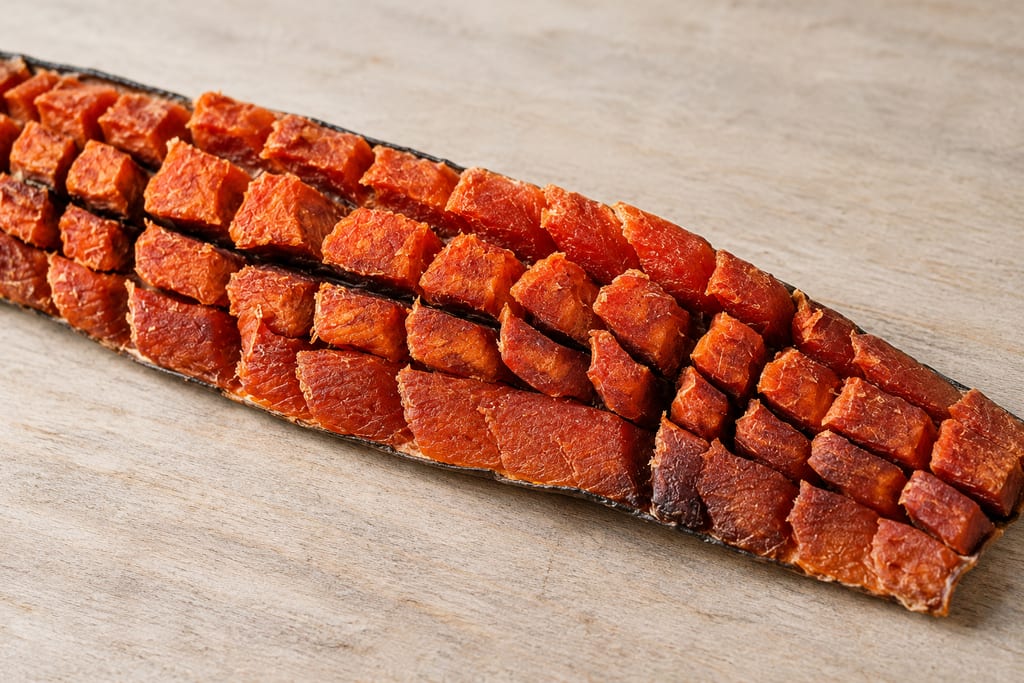
Pipsi
Arctic char opened, scored and air-dried in the Canadian Arctic: concentrated, chewy country food recorded as pipsi in Nunavut and pitsik in Nunavik.
 FermenteaWhere food goes to change
Arctic char (Salvelinus alpinus) is a circumpolar salmonid eaten fresh and preserved in northern communities. Its local forms and food traditions vary; dried or smoked fish and fermented char are distinct from the raw ingredient.
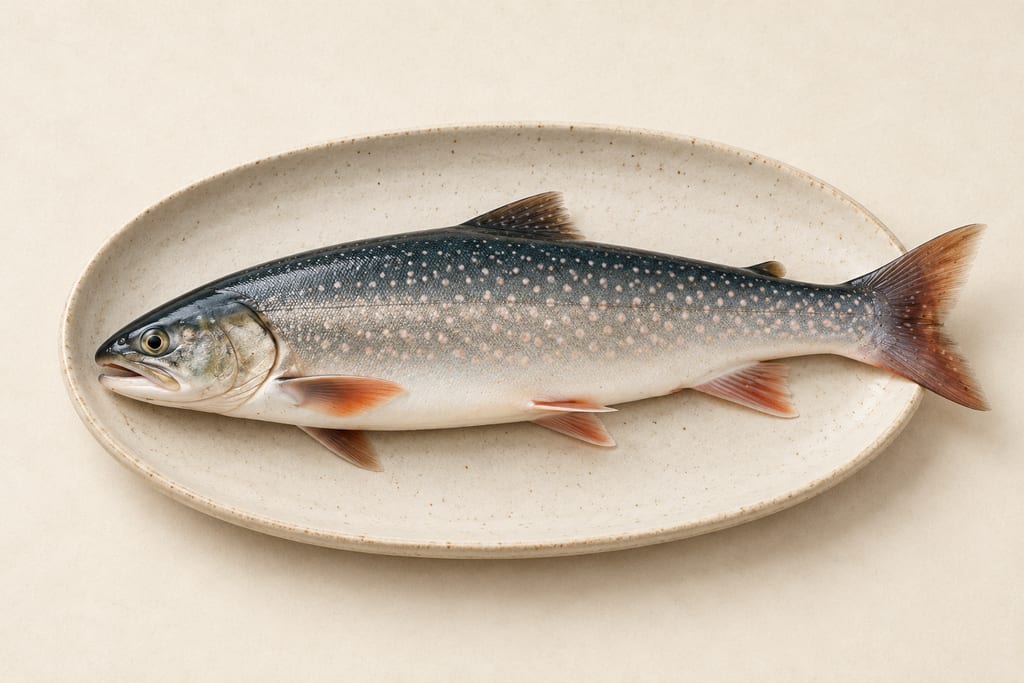
Arctic char, *Salvelinus alpinus*, is a salmonid whose range circles the far north. It is closely related to trout and salmon, but it is a distinct species. Fisheries and Oceans Canada describes a fish with a dark blue, brown, or green back, silvery sides and a pale belly; purple, pink, or red spotting may appear, and spawning fish often become vividly red or orange. Colour varies with season, place, and life stage, so a single colour is not a dependable identification on its own.
The species includes populations with different life histories. Some char remain in freshwater for their entire lives; others migrate between freshwater rivers and lakes and the sea, returning to freshwater to spawn and overwinter. The sea-run and landlocked forms can differ in size and appearance. These are ecological forms within one species, not different raw ingredients, although a particular fishery or community may have its own names and preferences.
Char is valued as food across much of its northern range. It can be eaten fresh, dried, smoked, or preserved in other ways. This page follows the raw ingredient. It does not use 'Arctic char' as a synonym for dried fish, smoked fish, or fermented char. Those are different stages or preparations, each requiring its own evidence and, where documented, its own page.
Arctic char occur in northern Canada, Greenland, Iceland, northern Europe, Asia and Alaska. Fisheries and Oceans Canada records char throughout the Canadian Arctic, northern Labrador and northern Québec; resident populations also occur farther south. Their range does not identify one origin for the species or for any food tradition. Each river, lake and coastal fishery has its own population context.
Some char migrate to the sea in summer to feed, then return to freshwater. Other populations live in lakes and connected rivers without a marine phase. A management document for Cambridge Bay treats the char present in a given waterbody as a management unit even though stocks may mix at a fishing location. The fish caught in one bay or river therefore cannot automatically be treated as representative of another population.
Habitat and movement matter to people as well as to fish biology. In small Arctic communities, nearby rivers, lakes and coastal waters can connect food gathering with seasonal travel, family knowledge and local management. Fisheries and Oceans Canada's Cambridge Bay plan documents the role of local fishers and the co-management institutions involved in that fishery. It is a place-specific account, not a single model for all Inuit fisheries.
Arctic char is important to Inuit foodways, community connection and food access. Fisheries and Oceans Canada's Cambridge Bay plan describes a commercial fishery alongside subsistence harvest and Indigenous knowledge. Inuit Tapiriit Kanatami's 2025 profile of culinary instructor Tasha Tologanak gives a grounded example: she catches char near Starvation Cove, cleans it, and often dries fish as *piffi*. That account shows one person's practice in Cambridge Bay; it should not be made to stand for every household or Inuit community.
Other regional words describe other stages. The Inuvialuit Regional Corporation explains *pipsi* as fish that is deboned and hung to dry or smoke. Pipsi is a dried or smoked fish product, not proof of fermentation. Communities may have their own terms and methods, and English-language sources do not always record them consistently. Where the source documents a named preparation, use that name for that preparation rather than stretching it across the entire species.
Avataq Cultural Institute records a Nunavimmiut traditional medicine account in which char is eaten raw or boiled in a specific remedy. This is evidence of a particular medicinal use and source context, not a general clinical recommendation, a safety assessment, or evidence that raw char should be used by everyone. Such accounts belong to the people and knowledge holders who provided them; they should not be detached from the local context.
Freshly caught char is the raw ingredient. Gutting and cleaning prepare it for eating or preservation, but do not turn it into a fermented food. Drying removes moisture; smoking exposes fish to smoke and may also dry it. The Inuvialuit description of pipsi specifically covers dried or smoked fish, while the Cambridge Bay profile uses piffi for char often dried. Those terms should remain attached to their own regional sources and described stages.
A separate 2022 collaborative study on Inuit fermented foods reports preliminary microbial characterization from fermented Arctic char and trout samples. It found microbial communities that differed from those in fermented mammal foods. That finding documents a scientific study of particular samples; it does not define one universal Inuit method, show that every dried or aged char is fermented, or validate a process for home use. The study's purpose and evidence are characterization, not recipe testing or safety validation.
These distinctions also matter when reading images. A fish in a stream is live; a juvenile in a measuring tray is a research capture; an angler holding a fish shows a catch; a dried fish is a later ingredient form; a sealed container of aged fish may show a ripening stage only if the image source establishes its contents. None of the five references attached to this item depicts fermented char. Image captions should say exactly what is visible and not assign a preparation stage the photograph cannot prove.
Cambridge Bay, also called Ekaluktutiak, lies in the Kitikmeot Region of Nunavut. Fisheries and Oceans Canada's integrated fisheries management plan focuses on this community's commercial Arctic char fishery. It records a long relationship between local Inuit families and nearby fish, as well as present-day subsistence and commercial harvest. The plan describes local fishers, a Hunters and Trappers Organization, traditional knowledge, and co-management under the Nunavut Agreement.
The species profile describes char harvested near river mouths during migrations between freshwater and marine feeding grounds, with spring and fall fisheries in the Cambridge Bay area. Harvest timing, gear and access are specific to these fish stocks and management arrangements. The sources do not support turning those dates into a universal Arctic-char season or a harvesting recommendation for an unrelated place.
Co-management matters because harvest is not just a biological extraction question. DFO's plan describes consultation and shared stewardship with rights-holders and local organizations. The plan is not a binding legal instrument and may change. The 2021 document is useful evidence for the managed fishery and its local structure at publication; current access, regulations, and fishery conditions should be checked with the responsible community and authorities rather than inferred from this article.
Like other fish, char provides muscle protein, fats and water, with its composition affected by the fish, season, diet and processing stage. It is eaten as a substantial food in northern communities, not merely as a fermentation substrate. Drying changes the balance between water and solids; smoking adds another exposure and flavour stage. A prepared fish and a fresh fish are therefore not interchangeable ingredients by weight or texture.
Fermentation changes the fish through microbial and enzymatic activity, but the exact changes depend on the fish and process. The 2022 study's comparison of microbial communities in char/trout and mammal ferments is a result for its samples. It does not demonstrate that one species of microbe defines Inuit fermentation, nor that all organisms found are harmless or desirable. The study does not give a recipe that can be safely generalized from one community to another.
Nunavut's traditional-food nutrition fact sheets document food knowledge and nutrient information for regional foods. Nutrient data are not a complete measure of dietary value, and a result for one serving, preparation or community should not be applied to every fish. The sources reviewed do not establish one standard fat content, size grade, freshness specification or nutritional profile for all char caught across the circumpolar range.
Fish can carry parasites. A Canadian Arctic-char overview describes several parasites and a pathway by which people can be exposed to tapeworm larvae by eating uncooked flesh. The risk depends on the parasite, fish, harvest area and handling. A fish's clean appearance does not establish that it is free of parasites.
Health Canada recommends keeping raw food cold, separating it from ready-to-eat food and cleaning hands, utensils and work surfaces. It also warns that smell and taste cannot reliably establish safety. Québec's public guidance on raw fish describes parasite-control freezing for fish intended to be eaten raw. That is regional public guidance for raw dishes; it is not a validated Arctic-char fermentation process.
The U.S. FDA seafood hazards guide explains that parasite hazards vary across species and sources, and that processing steps may not eliminate them. It notes that some fish not specifically listed may still carry unidentified or localized hazards. None of these general documents validates a home fermentation of char. No universally applicable salt, acidity, temperature, time, water-activity, freezer, or storage limits are established here. Do not use sensory changes as a safety test or assume drying, smoking, ageing or fermentation alone makes raw fish safe.
English sources use Arctic char or Arctic charr and the scientific name *Salvelinus alpinus*. Fisheries and Oceans Canada also gives the French name omble chevalier. Inuit and Inuvialuit languages have their own names for the fish and its forms, but this set of sources does not establish one spelling for all Inuit dialects or communities. It is better to name a specific language and community when a source provides the term than to offer a pan-Inuit translation without evidence.
Likewise, a record of char in Cambridge Bay, Nunavik, the Inuvialuit region or another Arctic community is a place-specific account. The Cambridge Bay fishery plan, ITK's profile, IRC's food page and Avataq's medicine archive document different communities, contexts and purposes. None should be made to stand for all Indigenous northern food practice.
The atlas names fermented Arctic char and trout among fermented-meat entries and points to Inuit communities in Nunavut. The related `fermented-arctic-char-and-trout` item is a preparation; `arctic-char` is the raw fish. Pipsi and piffi describe dried or smoked states in their cited contexts, and are also distinct. Keeping those names and stages separate lets each page explain what its evidence actually supports.
The federal fisheries plan and Inuit Tapiriit Kanatami profile document place-specific char fishery and food practice around Cambridge Bay; this is not a species origin claim.
Avataq documents char in a specific Nunavimmiut traditional-medicine account; it does not represent all Inuit communities or give a species origin.
Arctic char opened, scored and air-dried in the Canadian Arctic: concentrated, chewy country food recorded as pipsi in Nunavut and pitsik in Nunavik.
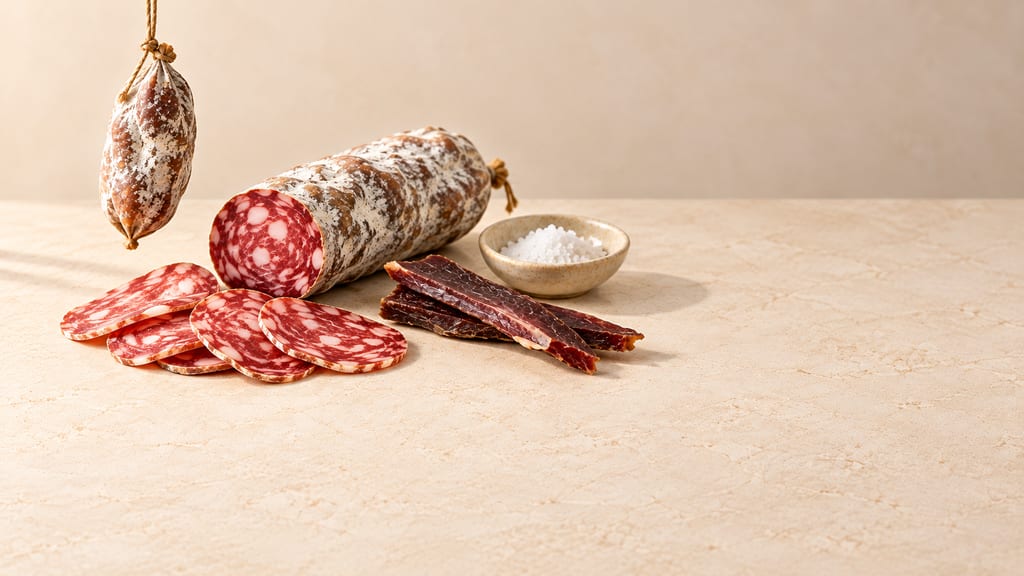
Dry salami, sour pork with rice, matured sheep and aged blubber follow different paths from animal to food. Their stories connect microbes with climate, slaughter, migration and the meals people share.
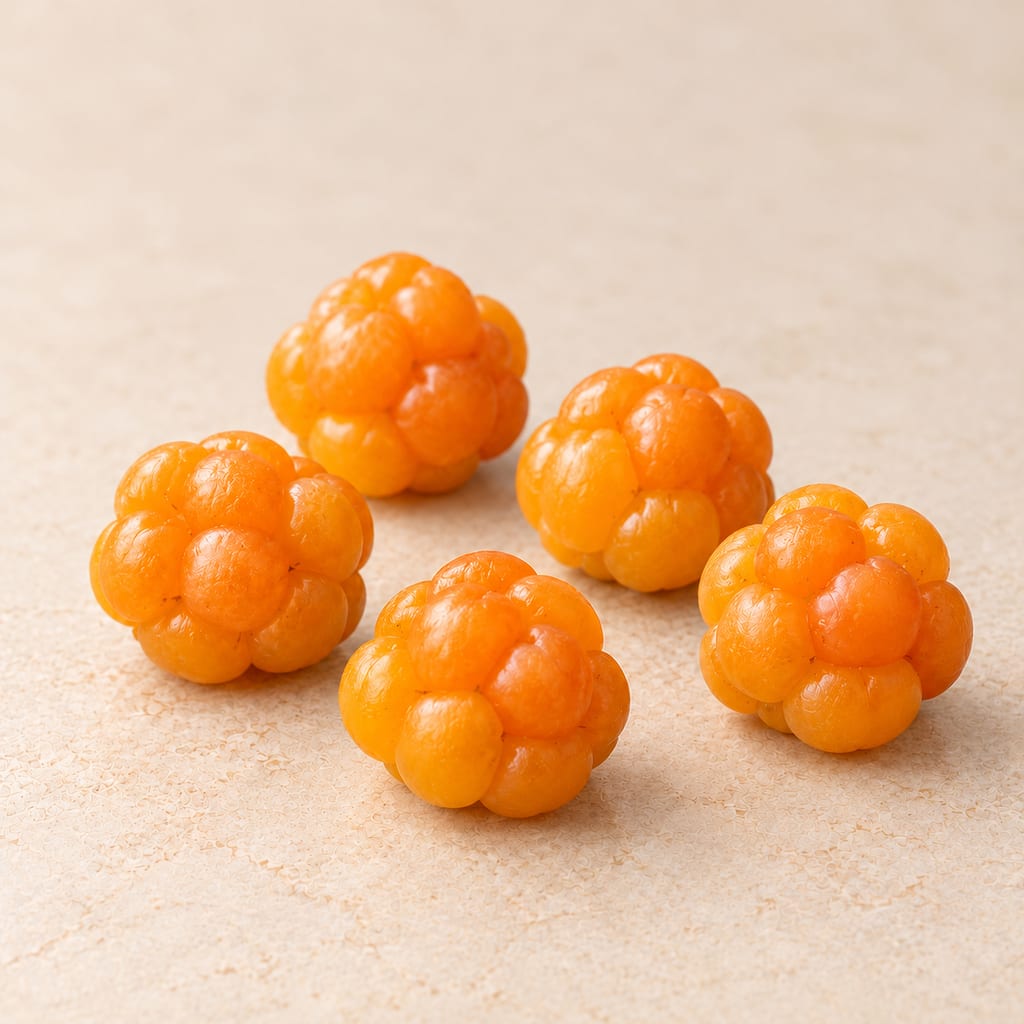
Cloudberry has distinct Gwich’in, Nunatsiavut, NunatuKavut-area and Québec records. A 2009 cutover-peatland trial reports site-specific rhizome establishment results, not a household pot or fruit-yield method.
No community contributions have been published for this entry yet.
Sign in to contribute. Published comments and photos are free to read.
Microbiome Research ReportsUse · Biology · Safety
Better understanding of food and human microbiomes through collaborative research on Inuit fermented foodsReports preliminary microbial characterization of fermented Arctic char and trout samples in a collaborative Inuit-food study; it is not a validated process or safety assessment.
Cited in: Fresh fish, dried fish, smoked fish and fermented fish; What char contributes as food and raw material; Names and evidence boundaries
Fisheries and Oceans CanadaGeography · History · Use
Cambridge Bay Arctic Char, Salvelinus alpinus, Commercial Fishery, NunavutThe 2021 Cambridge Bay plan documents local commercial and subsistence fishery context, Inuit knowledge, local fishers and co-management.
It describes the Cambridge Bay area fishery and its seasonal harvest context; those details are specific to this management area.
Cited in: An Arctic salmonid, with many ways of living; Circumpolar distribution and local stocks; Food knowledge is local and continuing; Harvest, season and stewardship around Cambridge Bay; Names and evidence boundaries
Fisheries and Oceans CanadaIdentity · Biology · Geography
Arctic Char (Salvelinus alpinus)Describes physical appearance, circumpolar distribution, landlocked and anadromous forms, spawning and fishery regions.
Documents Cambridge Bay in the Kitikmeot Region and regional seasonal harvest context.
Cited in: An Arctic salmonid, with many ways of living; Circumpolar distribution and local stocks; Harvest, season and stewardship around Cambridge Bay; What char contributes as food and raw material; Names and evidence boundaries
Inuktitut Magazine, Inuit Tapiriit KanatamiUse · History · Geography
Cooking the CatchA 2025 profile of Cambridge Bay culinary instructor Tasha Tologanak describes local char catch, cleaning and drying fish as piffi; it is one person's documented practice.
Cited in: Food knowledge is local and continuing; Fresh fish, dried fish, smoked fish and fermented fish
Inuvialuit Regional CorporationUse · History
FoodDescribes pipsi as deboned fish hung to dry or smoke, distinguishing it from fermented fish.
Cited in: Food knowledge is local and continuing; Fresh fish, dried fish, smoked fish and fermented fish
Avataq Cultural InstituteUse · History
Fish: Traditional Medicine among NunavimmiutRecords a specific Nunavimmiut medicinal context using raw or boiled char; it is not a clinical or food-safety recommendation.
Cited in: Food knowledge is local and continuing; Names and evidence boundaries
Polar Knowledge CanadaBiology · Safety · Geography
Arctic char in a rapidly changing NorthDescribes Arctic-char parasites and a human exposure pathway through uncooked flesh; also discusses habitat and northern food context.
Cited in: Circumpolar distribution and local stocks; Fresh fish, dried fish, smoked fish and fermented fish; Raw-fish handling and hazards
Health CanadaSafety
Food safety and youSupports general guidance on chilling, separating raw fish from ready-to-eat food, cleaning and limits of smell/taste as safety indicators.
Cited in: Raw-fish handling and hazards
Gouvernement du QuébecSafety
Tartare, sushi and other raw dishesProvides Québec public guidance on parasite control for fish intended for raw consumption; it does not validate char fermentation.
Cited in: Raw-fish handling and hazards
Government of NunavutBiology · Use
Inuit Traditional Foods Nutrition Fact Sheet SeriesRegional educational materials document traditional foods and nutrition; data should not be generalized to every char population or preparation.
Cited in: What char contributes as food and raw material
U.S. Food and Drug AdministrationSafety
Fish and Fishery Products Hazards and Controls Guidance, June 2022 EditionExplains species- and source-dependent parasite risk, and cautions that fish not listed may still have unidentified or localized hazards.
Cited in: Raw-fish handling and hazards
U.S. Food and Drug AdministrationSafety
What is a “major food allergen”?Identifies fish as a major food-allergen group under U.S. law.