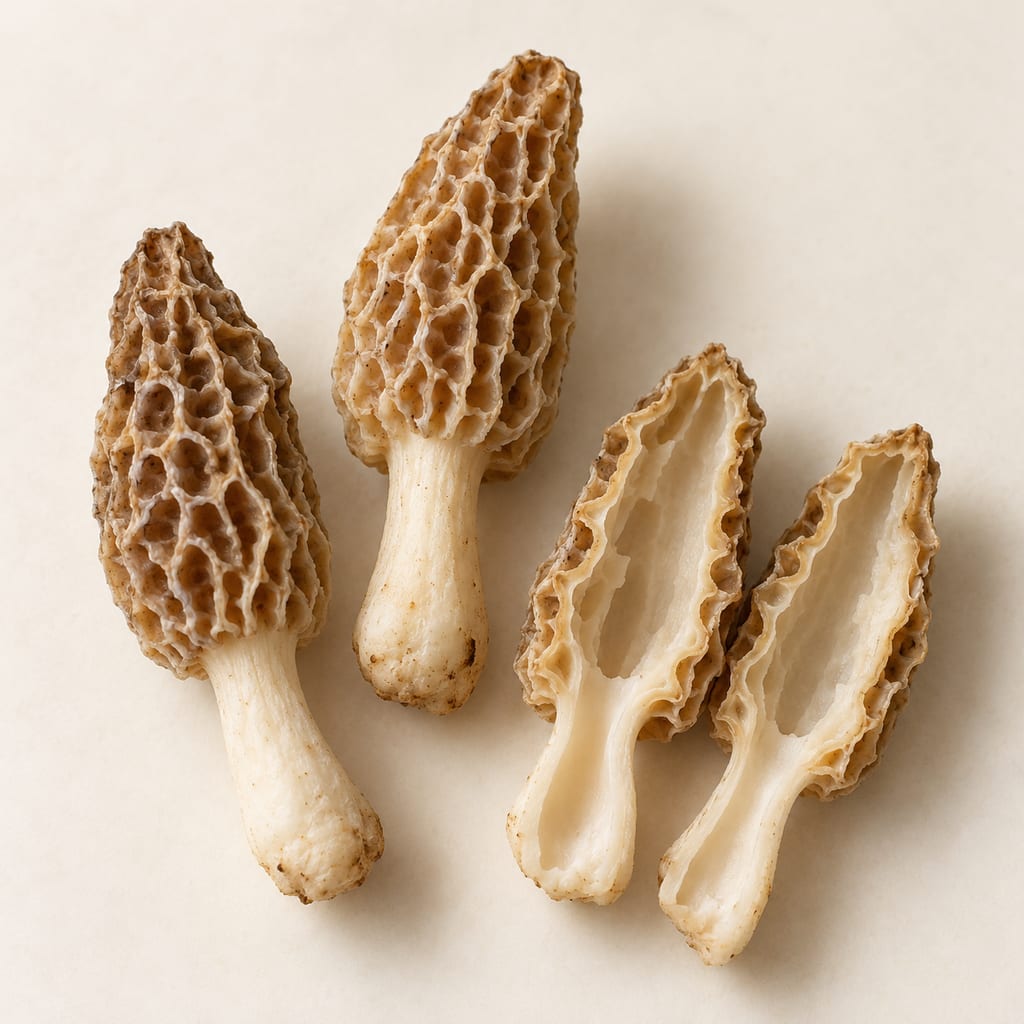
Diminutive morel
Morchella diminutiva is a yellow true morel described in 2012 from eastern North America. Sources report it as a culinary morel that must be cooked; this page is not an identification guide.
 FermenteaWhere food goes to change
Mushrooms
Tuber cumberlandense, an aromatic truffle described as a new species in 2024, native to eastern North America and sold from truffle orchards and woodlands dominated by broadleaf trees.
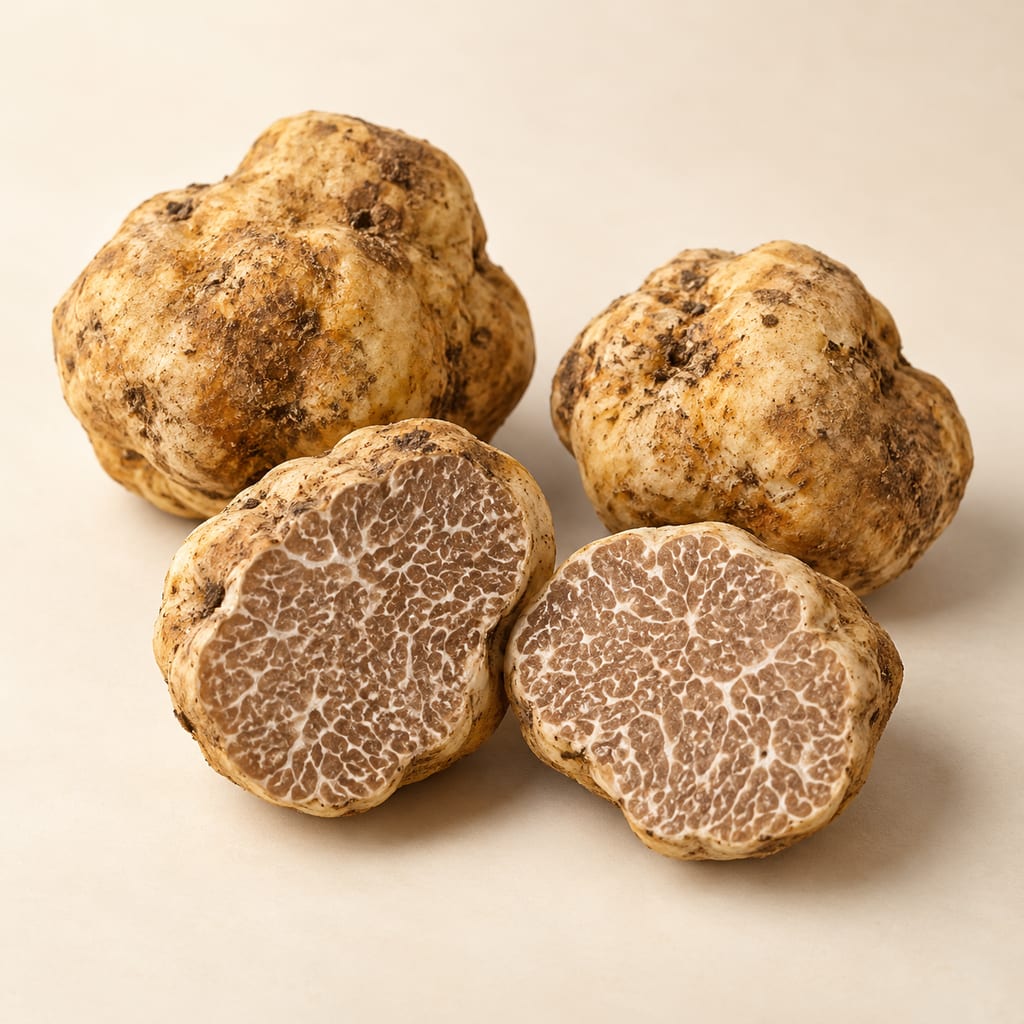
The Cumberland truffle is the common name of Tuber cumberlandense, a truffle, the fruiting body of an underground ectomycorrhizal fungus that grows in association with tree roots. It was formally described in 2024, in a paper in the journal Mycologia by Sow and colleagues, alongside a second new species from the same region, Tuber canirevelatum. Before the description it circulated under the informal name Tuber sp. 66, which the catalogue keeps as an alias.
The name refers to the Cumberland Plateau, the area of Kentucky and Tennessee where the species was collected. The description rests on multilocus phylogenetic analysis and on morphology. The samples were located with truffle-hunting dogs, which is how many of the eastern North American truffles were found.
The species is recorded as endemic to eastern North America. It has been found in truffle orchards and in woodlands dominated by broadleaf trees. The catalogue records its ecology as ectomycorrhizal, which means the truffle lives in partnership with the roots of its host trees and cannot be grown without them.
Researchers and growers describe the species as having been opportunistically harvested for sale from orchards across the region. The catalogue, however, is careful on this point: finding the truffle in orchards does not by itself show that it is being cultivated in a controlled way, and the catalogue lists the cultivation context as experimental.
The truffle is described as aromatic and edible, and it is sold as food. Its smell has been compared by one culinary guide to cabbage and onion. The volatile analysis reported with the species description found dimethyl sulfide, a compound also present in the Périgord black truffle and the Piedmont white truffle, together with 2,4-dithiapentane, a compound used in the making of synthetic truffle products. The two aroma descriptions come from different kinds of source, a culinary guide and a laboratory analysis, so they are not directly comparable.
Because the species was only described recently, recipes and culinary records for it are few. The sources read for this entry do not give a preparation, a shelf life or a method of storage.
Truffles of the genus Tuber are hard to tell apart by appearance alone, and the description of this species rests on DNA and microscopic characters rather than on the fruiting body alone. Several North American Tuber species remain undescribed, and some of them are said to have favourable culinary qualities. The Cumberland truffle should not be treated as the same food as the European truffles, whose culinary record is much longer.
This entry is not an identification guide. Truffles are sold by appearance and smell, and a truffle that looks and smells right may still be a different species, so a specimen of this truffle should be identified from its DNA or by an expert. The catalogue states that the species is newly delimited and that appearance in orchards does not by itself demonstrate controlled cultivation.
No food-safety assessment of this species was found in the sources read. The catalogue states that identity and current safety require separate validation, and this entry gives no verdict on whether the species is safe to eat.
The chief open questions are how widely the species is harvested and sold, whether it can be cultivated on a controlled basis, and what the culinary record looks like once it has been used for several seasons.
Endemic range recorded in the 2024 species description; the food use is recorded at regional level and is not described country by country.
Morchella diminutiva is a yellow true morel described in 2012 from eastern North America. Sources report it as a culinary morel that must be cooked; this page is not an identification guide.
No community contributions have been published for this entry yet.
Sign in to contribute. Published comments and photos are free to read.
Mycologia (Taylor and Francis)Identity · Food · Aroma
Tuber cumberlandense and T. canirevelatum, two new edible Tuber species from eastern North America discovered by truffle-hunting dogsFormal description in 2024 with T. canirevelatum; phylogenetic and morphological basis; samples found by truffle dogs
Endemic to eastern North America; name from the Cumberland Plateau
Volatile compounds dimethyl sulfide and 2,4-dithiapentane reported
PubMed (Mycologia)Identity
Tuber cumberlandense and Tuber canirevelatum, new edible truffle species from eastern North AmericaSupplied catalogue source for the 2024 description; the abstract was not read during this recovery, so no fact is taken from it directly
Phys.orgBackground
Dog-found truffle: researchers and canines discover two new truffle speciesCoverage of the discovery of the two new species by truffle-hunting dogs